History of the Internet (HSC SSCE Legal Studies): Revision Notes
📚Revision Notes
History of the Internet
The development of computers
The story of the internet begins with the evolution of computing technology. Understanding how computers developed helps explain why the internet emerged in the way it did.
Early computing machines (1880-1940s)
While computers can be traced back to early calculators, the real breakthrough came at the start of the century with punch card technology powered by electricity.
In 1880, an -year-old engineer named Henry Hollerich revolutionised data processing. He invented a machine using punch cards and spring-mounted needles that created electrical loops to tabulate information. This innovation was first used in the 1890 Census and reduced processing time from seven years to just two and a half years.
Note
Hollerich's punch card system represented a fundamental shift in data processing. By automating census tabulation, it demonstrated how mechanical systems could dramatically improve efficiency in handling large-scale information—a concept that would become central to computing.
Hollerich's success led him to found the Tabulating Machine Company, which expanded into payroll, inventory and billing services for large companies. In 1924, this company became International Business Machines (IBM).
World War II and the electronic revolution
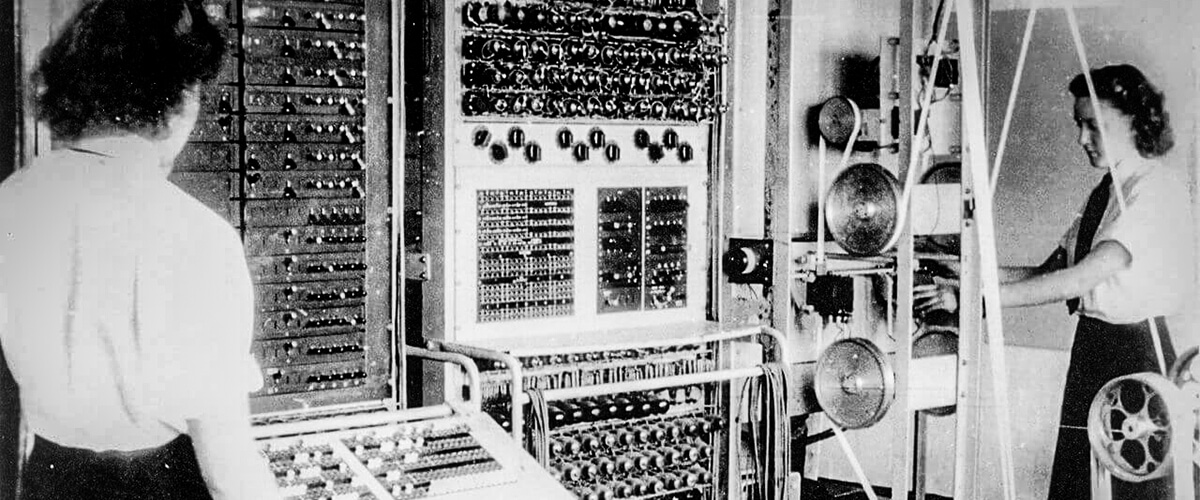
Before and during World War II, scientists in England, Germany and the United States began replacing mechanical calculating parts with electronic circuits. Early computers like the Z3, Atanasoff-Berry Computer, Colossus computers and ENIAC used valve-based circuits.
These early machines were vastly different from today's personal computers:
- The ENIAC (Electronic Numerical Integrator And Calculator) used vacuum tubes
- It occupied over square metres
- It weighed over tonnes
Important
Despite their enormous size, these early computers demonstrated unprecedented computational power. The ENIAC could perform calculations in seconds that would have taken humans weeks or months to complete manually. This marked the beginning of the electronic computing age.
In 1948, IBM's Selective Sequence Electronic Calculator made calculations about the moon's position that were later used in the 1969 Apollo moon landing.
By the end of the 1940s, several large government-owned mainframe computers existed. The first commercial computers appeared in 1951:
- The Lyons Electronic Office in England solved clerical problems
- The UNIVAC 1 in the United States, made for the US Census Bureau, occupied cubic feet and cost $1 million (46 units were sold)
IBM and the computer boom (1950s-1960s)
IBM entered the computer market in 1953 with the 701 EDPM Computer. The company's growth was remarkable:
- 1954: IBM 650 magnetic drum calculator became the first mass-produced computer ( sold)
- 1959: 7000 series mainframes (first fully transistorised computers)
- 1961: IBM held over market share; demand for the 1400 series reached units
- 1964: IBM sold over computers per month
Note
IBM's dominance in the 1960s was so complete that competitors were collectively known as "the BUNCH" (Burroughs, UNIVAC, NCR, Control Data Corporation, and Honeywell). This market concentration would later have significant implications for the relationship between hardware and software development.
Other competitors, including Commodore Business Machines (CBM) and AT&T, entered the market by the end of the 1960s.
The personal computer era (1970s-1990s)
In 1970, the Palo Alto Research Center in California attracted talented scientists who developed transformative technologies:
- PC graphical user interface
- Ethernet
- Laser printer
The personal computer (PC) revolution began in 1976 when Steve Wozniak designed the Apple I. The Apple II followed in 1977, achieving instant success with its brilliant colour graphics when connected to a television monitor.
1981 marked IBM's entry into the PC market with a machine using Microsoft's MS-DOS operating system.
In 1982, Commodore introduced the Commodore 64, which remained in production until 1993. With over million units sold, the Guinness Book of Records recognised it in 2006 as the greatest selling computer of all time.
Important
The Revolution of User Interface
1984 brought another revolution with Apple's Macintosh, the first affordable computer with:
- A mouse
- A graphic user interface
This transformation made computers accessible to non-technical users for the first time. The graphical interface meant people could interact with computers through visual metaphors (windows, icons, folders) rather than memorising text commands.
IBM introduced the mouse with its PS/2 machines in 1987, which included Intel's 80386 chip—a microprocessor used in PCs for many years.
By the mid-1990s, computers were becoming common in homes across Australia, the United States, other Western countries, and advanced Asian nations like Japan. In 1995, of American adults reported regularly using a computer at home or work.
The separation of hardware and software
One often overlooked but crucial development was the unbundling of hardware from software.
Important
The Unbundling Revolution
Until 1969, IBM computers came packaged only with the company's own software. However, pressure from competitors who sued IBM under US anti-monopoly laws (antitrust laws) forced IBM to announce that it would unbundle its computers from its software.
This meant customers could now buy IBM computers without IBM software, opening the door for anyone to develop software for any computer. This transformation made PCs generative platforms rather than mere appliances.
Generative platform: a platform that invites innovation by others. This means users are free to use software created by anyone or even create their own software, tailoring their computers to their own requirements.
The arrival of the internet
The internet emerged from efforts to connect computers across networks, enabling communication and information sharing.
ARPANET: the foundation (1972-1982)
In 1972, the Advanced Research Projects Agency Network (ARPANET) established the first true network linking computers in different locations. A new program was trialled that enabled sending individual messages across the network—what we now call email.
Note
The invention of email on ARPANET was almost accidental. Ray Tomlinson, a programmer working on the network, developed the first email program as a side project. He chose the @ symbol to separate the user name from the computer name, a convention we still use today.
In 1974, scientists who developed ARPANET, working with researchers from Stanford University, created a common language: Transmission Control Protocol/Internet Protocol (TCP/IP). This protocol enabled computers from different networks to communicate with each other.
TCP/IP: a universal language that allows different computer networks to communicate with each other; became the foundation of the modern internet.
Computer networks developed in various places with different and competing systems, but ARPANET remained the backbone holding these systems together.
In 1981, the term internet was coined to refer to this collection of interconnected networks.
By 1982, when ARPANET adopted the TCP/IP system, the internet was positioned for massive expansion.
Non-scientific developments drive expansion (1983-1990)
From 1983 onwards, non-scientific developments led to further internet expansion:
1983: The Domain Name System (DNS) was invented, making the internet easier to navigate by translating user-friendly host names into IP addresses. The system introduced organisational structure:
.edufor education sites.govfor government sites.comfor commercial sites.orgfor international organisations- Country codes like
.au(Australia),.ca(Canada),.uk(United Kingdom)
The DNS made host computer names easier to remember and navigate.
Note
The Impact of Government Support
Both the UK and US governments began encouraging universities and educational institutions to use the internet. These two developments triggered explosive growth:
- 1986: Host computers increased from to
- The commercial sector began showing interest, though workshops only explored potential
- 1989-1990: Number of hosts tripled from to
For several years, governmental and educational institutions drove expansion, not commercial entities.
The birth of the World Wide Web
In 1990, Tim Berners-Lee at CERN (the European Organization of Nuclear Research) in Geneva, Switzerland, developed the first internet browser/editor. This program could find and retrieve computer files using two new systems:
Hypertext Markup Language (HTML): a language for web pages that allows links hidden behind text to be denoted as lists, links, headings, paragraphs, embedded images and other content.
Hypertext Transfer Protocol (HTTP): a language used by web browsers to transmit HTML along with images, sound and other content.
Important
The World Wide Web: A Transformative Innovation
Berners-Lee coined the term World Wide Web for his program. The World Wide Web combined HTML (for creating web pages) with HTTP (for transmitting them through web browsers). HTML became popular because it was easy to copy and use.
What made the World Wide Web revolutionary was its simplicity and openness. Unlike previous information systems that required proprietary software or special training, the Web could be used by anyone with basic computer skills.
Timeline of the World Wide Web:
- 1991: The World Wide Web became a reality
- 1992: One million hosts on the internet; the term "surfing the net" was coined
- 1994: Commercial websites began proliferating across the internet
- 1995-1997: Host computers increased from million to million
- Late 1990s: Commercialisation continued at an exponential rate
The new millennium and beyond
The internet and World Wide Web continued expanding into the new millennium:
- 2002: Two million host computers; million users
- Currently: Approximately billion internet users worldwide
The internet and World Wide Web have become integral to millions of people's lives in developed countries. Developing countries recognise they must increase internet access or risk falling further behind—a problem known as the digital divide.
Note
Digital divide: the gap between those with reasonable access to digital technology and the internet and those without. This divide can exist between rich and poor nations and between groups within nations, such as different socioeconomic groups, races, cultural groups, and between males and females.
As people currently excluded from the globalised economy and World Wide Web gain access, the number of connected individuals will likely continue growing dramatically.
Visions and visionaries of the World Wide Web
Early in the World Wide Web's development, an optimistic vision emerged declaring this new realm of human activity was somehow unique. As Jack Goldsmith and Tim Wu wrote in Who Controls the Internet?, the idea of this new space tapped into a deep human desire for liberation from the world around us, offering hope that it could "somehow liberate us from the human condition."
The dream of a law-free internet
The idea developed that the internet and World Wide Web could and should remain free of government interference and, indeed, free of law. This proposition seemed credible because all key technological innovations creating the internet and World Wide Web came from private individuals' initiative—people passionate about spreading ideas and knowledge and creating mechanisms for easier digital communication between like-minded people.
Note
Techno-utopianism became widespread. This philosophy held that "connecting every human on earth might make the world a better place. Humanity united might do better than our lousy systems of government, throw away the construct of the nation-state, and live in some different but better way."
Techno-utopianism: a belief that society is revolutionised by technological change and that digital technology will increase personal freedom for the individual, particularly in the area of government control.
This hope was shared by:
- Libertarians: who believed things would be better with no government interference
- Internationalists: who believed international laws replacing state laws in cyberspace could improve human affairs
However, within a short time of these visions being articulated, they were tested in the courts.
Architecture of the internet
The internet's rambling, haphazard structure resulted from its creation by private citizens acting on their own initiative.
The founding engineers
The internet's founding engineers were mostly US academics and computer scientists, including:
- Vinton Cerf
- Jon Postel
- Dave Clark
- Larry Roberts
- Robert Kahn
This group created the TCP/IP protocol, a successful universal language that became the foundation of today's internet.
Open architecture principles
The TCP/IP protocol was revolutionary because it was an open architecture:
- Open to anyone: Any type of computer or network could join
- Required very little in return: Minimal requirements from computer users who joined
- Neutral regarding applications: New and better software applications could be designed by anyone and used on the internet, replacing old and outdated applications
Important
The Philosophy Behind Open Architecture
The designers deliberately created this openness because they distrusted centralised governmental control.
The TCP/IP protocol now dominates data networking so completely that there are no serious competitors. It has spread like a universal language.
The Internet Engineering Task Force (IETF)
In 1986, a group of internet engineers led by Vinton Cerf established the Internet Engineering Task Force (IETF) as the central standards body for the internet.
These engineers believed in a "bottom-up" approach to internet governance. As Dave Clark stated in 1992:
We reject: kings, presidents, and voting. We believe in: rough consensus and running code.
Note
The IETF demonstrated that many difficult internet problems could be solved without government involvement. This led many people to believe that a cyberspace free of government-imposed law was possible.
This philosophy of self-governance through technical consensus rather than legal regulation became a defining characteristic of early internet culture.
Remember!
Summary
Key dates and milestones:
- 1880-1890: Hollerich's punch card system revolutionises census processing
- 1924: IBM founded
- 1972: ARPANET creates first network with email
- 1974: TCP/IP protocol invented
- 1981: Term "internet" coined; IBM PC released
- 1982: TCP/IP adopted; Commodore 64 launched
- 1983: Domain Name System (DNS) invented
- 1990: Tim Berners-Lee invents World Wide Web
- Current: billion internet users worldwide
Key concepts:
- Generative platform: A system that invites innovation by others, allowing users to create and use any software they choose
- TCP/IP: The universal language enabling different computer networks to communicate
- HTML and HTTP: The languages that power the World Wide Web
- Digital divide: The gap between those with and without internet access
- Techno-utopianism: The belief that technology will increase personal freedom and revolutionise society
- Open architecture: Design principle allowing anyone to join and innovate on the internet
Critical developments:
- The separation of hardware from software (1969) allowed anyone to develop software for any computer
- The Domain Name System (1983) made the internet easier to navigate
- Government encouragement of universities to use the internet drove exponential growth in the 1980s
- The World Wide Web (1990) transformed the internet from a specialist tool into a mass-communication platform
Exam tip: When analysing the history of the internet, consider how technological innovation, government policy, and commercial interests interacted to shape its development. Understanding this context helps explain contemporary legal issues around internet regulation and governance.