Angles of Elevation and Depression (HSC SSCE Mathematics Standard): Revision Notes
📚Revision Notes
Angles of Elevation and Depression
What are angles of elevation and depression?
When solving problems involving right-angled triangles in real-world situations, you'll often need to work with angles measured from a horizontal line. These angles have special names depending on whether you're looking up or down.
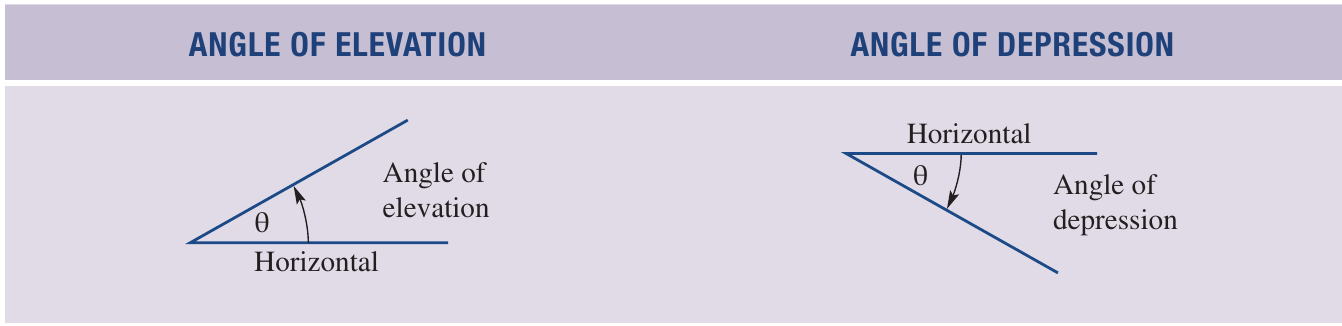
Angle of elevation: This is the angle you measure when looking upward from a horizontal line. Think of it like looking up at the top of a building or a mountain peak.
Angle of depression: This is the angle you measure when looking downward from a horizontal line. Imagine standing on a cliff and looking down at a boat on the water below.
Note
Both angles are always measured from the horizontal reference line, never from the vertical. This horizontal line serves as your starting point for measuring the angle.
Important relationship between these angles
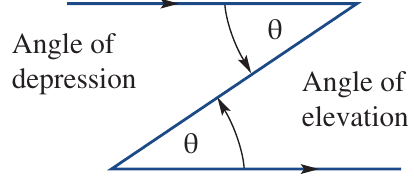
Here's a useful fact that will help you solve many problems: the angle of elevation and the angle of depression in the same situation are actually equal to each other.
Why? Because they form alternate angles between two parallel horizontal lines.
Important
This relationship is particularly helpful when you're given one angle but need to work with the other in your calculations. Remember: the angle of elevation from one point equals the angle of depression from another point when working with parallel horizontal lines.
Using angle of elevation to find heights
When you know the angle of elevation and the horizontal distance, you can calculate vertical heights using trigonometry. The tangent ratio is particularly useful for these problems.
Example
Worked Example: Volcanic Ash Plume
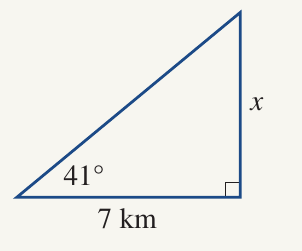
Problem: A park ranger measured the angle of elevation to the top of a volcanic ash plume as . Her map showed the volcano was km away. What was the height of the plume? (Answer to two decimal places.)
Solution approach:
Step 1: Draw a diagram and label what you need to find
Let represent the height of the volcanic plume we want to calculate.
Step 2: Choose the appropriate trigonometric ratio
We have:
- The angle:
- The adjacent side: km
- The opposite side: (unknown)
This means we need the tangent ratio:
Step 3: Set up the equation
Step 4: Solve for
Multiply both sides by :
Step 5: Calculate the answer
Answer: The height of the volcanic plume was 6.09 km.
Using angle of depression to find distances
Angles of depression are commonly used to find horizontal distances or straight-line distances from an elevated position.
Example
Worked Example: Ship from a Cliff
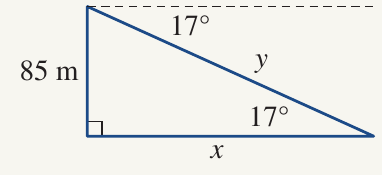
Problem: The top of a cliff is m above sea level. Minh observed a tall ship from the top of the cliff and estimated the angle of depression as .
a) How far was the ship from the base of the cliff? (Answer to the nearest metre.)
b) How far was the ship in a straight line from the top of the cliff? (Answer to the nearest metre.)
Step 1: Draw a diagram
Let = horizontal distance from the cliff base to the ship
Let = straight-line distance from the cliff top to the ship
Notice that the angle of depression from the top equals the angle of elevation from the ship (alternate angles), so we can use at the base of the triangle.
Part a) Finding the horizontal distance
Step 2: Choose the appropriate ratio
We have:
- The angle:
- The opposite side: m
- The adjacent side: (unknown)
Use the tangent ratio:
Step 3: Set up the equation
Step 4: Solve for
Multiply both sides by :
Divide both sides by :
Step 5: Calculate
Answer: The ship is 278 metres from the base of the cliff.
Part b) Finding the straight-line distance
Step 6: Choose the appropriate ratio
For the straight-line distance, we have:
- The angle:
- The opposite side: m
- The hypotenuse: (unknown)
Use the sine ratio:
Step 7: Set up the equation
Step 8: Solve for
Multiply both sides by :
Divide both sides by :
Step 9: Calculate
Answer: The ship is 291 metres from the top of the cliff in a straight line.
Exam tips
Note
Tips for Success:
- Always draw a clear diagram showing the horizontal line and the angle
- Label what you know and what you need to find
- Remember that angles of elevation and depression are equal (alternate angles)
- Choose the right trigonometric ratio based on which sides you know
- Check your calculator is in degree mode
- Round only at the final step to avoid errors
Summary
Key Points to Remember:
- Angle of elevation is measured upward from the horizontal line
- Angle of depression is measured downward from the horizontal line
- These angles are equal to each other because they form alternate angles between parallel horizontal lines
- Use tangent when you have or need the opposite and adjacent sides
- Use sine when you have or need the opposite side and hypotenuse
- Always draw a diagram to visualise the problem before solving