Finding an Unknown Side or Angle (HSC SSCE Mathematics Standard): Revision Notes
📚Revision Notes
Finding an Unknown Side or Angle
Introduction
Trigonometric ratios allow us to calculate unknown sides and angles in right-angled triangles. When you know at least one angle and one side, you can find an unknown side. When you know at least two sides, you can find an unknown angle. The key to solving these problems is using the SOH CAH TOA mnemonic and carefully labelling the triangle's sides.
Note
When to use which method:
- If you know one angle and one side → find an unknown side
- If you know two sides → find an unknown angle
Finding an unknown side
When you need to calculate the length of an unknown side in a right-angled triangle, trigonometric ratios are your tool of choice. This method works when you already know one angle (besides the right angle) and at least one side length.
Step-by-step procedure
Follow these steps systematically to find an unknown side:
Step 1: Label the sides of your triangle relative to the angle you're working with:
- for hypotenuse (the longest side, opposite the right angle)
- for opposite (the side across from your angle)
- for adjacent (the side next to your angle, excluding the hypotenuse)
Step 2: Identify which trigonometric ratio to use by examining which sides you know and which you need to find. Use SOH CAH TOA to help:
- SOH: (Sine = Opposite / Hypotenuse)
- CAH: (Cosine = Adjacent / Hypotenuse)
- TOA: (Tangent = Opposite / Adjacent)
Step 3: Rearrange the equation algebraically to make the unknown side the subject.
Step 4: Use your calculator to evaluate the expression. Always check your calculator is in degree mode, not radian mode.
Step 5: Round your answer to the required level of accuracy (usually decimal places).
Important
Critical: The labels "opposite" and "adjacent" change depending on which angle you're considering. Always label your triangle relative to the specific angle you're working with.
Worked example: Using tangent
Example
Worked Example: Using Tangent
Question: Find the length of the unknown side in the triangle shown. Answer correct to three decimal places.
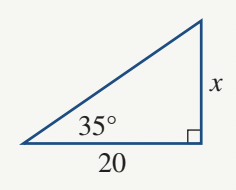
Solution:
- Name the sides: , , (not given)
- Determine the ratio: We have the adjacent and need the opposite, so use TOA
- Substitute the known values:
- Multiply both sides by :
- Calculate using your calculator: Press
- Round to three decimal places:
Worked example: Using sine
Example
Worked Example: Using Sine
Question: Find the length of the unknown side in a triangle where the hypotenuse is and the angle is . Answer correct to two decimal places.
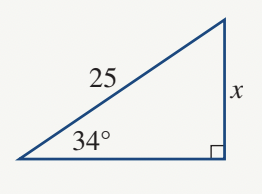
Solution:
- Name the sides: (not given), ,
- Determine the ratio: We have the hypotenuse and need the opposite, so use SOH
- Substitute the known values:
- Multiply both sides by :
- Calculate: Press
- Round to two decimal places:
Finding an unknown side in the denominator
Sometimes the unknown side appears in the denominator of your trigonometric ratio. This happens when you're looking for the hypotenuse or the adjacent side in certain configurations. This requires an additional algebraic step to solve.
The extra algebraic step
When your unknown appears in the denominator, you'll get an equation like:
Important
Critical Algebraic Steps:
To solve when the unknown is in the denominator:
- First, multiply both sides by to eliminate it from the denominator:
- Then, divide both sides by the trigonometric expression to isolate :
Common mistake: Don't try to take the reciprocal directly - it's more error-prone. Always follow these two steps in order.
Worked example: Finding the hypotenuse
Example
Worked Example: Finding the Hypotenuse
Question: Find the length of the unknown side in the triangle shown. Answer correct to two decimal places.
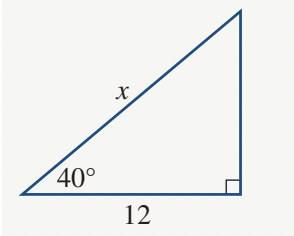
Solution:
- Name the sides: , (not given),
- Determine the ratio: We have the adjacent and need the hypotenuse, so use CAH
- Substitute the known values:
- Multiply both sides by :
- Divide both sides by :
- Calculate: Press
- Round to two decimal places:
Note
Exam tip: When the unknown is in the denominator, always multiply by the unknown first, then divide by the trig expression. This systematic approach reduces calculation errors.
Finding an unknown angle
When you know two sides of a right-angled triangle but need to find an angle, you use inverse trigonometric functions. These are written as , , and (also called arcsin, arccos, and arctan).
Note
Understanding Inverse Functions:
The inverse trigonometric functions "undo" the regular trig functions. If , then . On your calculator, you typically access these by pressing SHIFT or 2nd before the trig button.
Step-by-step procedure
Step 1: Label the sides of your triangle: for hypotenuse, for opposite, for adjacent.
Step 2: Identify which trigonometric ratio to use based on the two sides you know. The SOH CAH TOA mnemonic still applies.
Step 3: Rearrange the equation to make the angle the subject using the inverse trigonometric function.
Step 4: Use your calculator to find . Ensure your calculator is in degree mode.
Step 5: Express your answer to the required accuracy (degrees, minutes, or decimal places).
Worked example: Finding an angle to the nearest degree
Example
Worked Example: Finding an Angle to the Nearest Degree
Question: Find the angle in a triangle where the hypotenuse is and the opposite side is . Give your answer to the nearest degree.
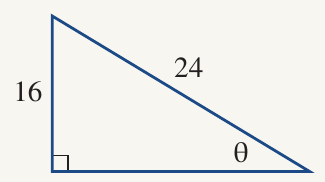
Solution:
- Name the sides: , , (not given)
- Determine the ratio: We have the opposite and hypotenuse, so use SOH
- Substitute the known values:
- Make the subject using the inverse sine function:
- Calculate: Press SHIFT
or Press SHIFT
- Round to the nearest degree:
Worked example: Finding an angle to the nearest minute
Example
Worked Example: Finding an Angle to the Nearest Minute
Question: Find the angle in a triangle where the hypotenuse is and the adjacent side is . Give your answer to the nearest minute.
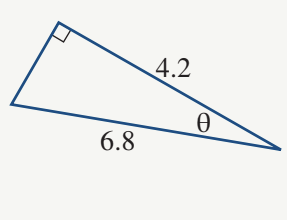
Solution:
- Name the sides: , (not given),
- Determine the ratio: We have the adjacent and hypotenuse, so use CAH
- Substitute the known values:
- Make the subject:
- Calculate: Press SHIFT
- Convert to degrees and minutes and round to the nearest minute:
Note
Understanding minutes: There are 60 minutes in one degree. To convert the decimal part to minutes, multiply by . For example, minutes.
Summary
Summary
Key Points to Remember:
-
SOH CAH TOA is your essential tool: Sine = Opposite/Hypotenuse, Cosine = Adjacent/Hypotenuse, Tangent = Opposite/Adjacent.
-
When finding an unknown side: Use the standard trig ratio, rearrange to make the subject, then calculate.
-
When the unknown is in the denominator: Multiply both sides by first, then divide by the trig expression.
-
When finding an unknown angle: Use inverse trig functions (, , ) to make the subject.
-
Always check your calculator is in degree mode before calculating.
-
Label your triangle sides carefully relative to the angle you're working with - the opposite and adjacent change depending on which angle you're considering.