Similarity and Scale Factors (HSC SSCE Mathematics Standard): Revision Notes
📚Revision Notes
Similarity and Scale Factors
What are similar figures?
Similar figures are shapes that look exactly the same but are different sizes. Think of it like taking a photograph and printing it at different sizes - the shape stays the same, but the dimensions change proportionally.

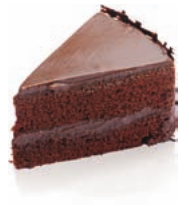
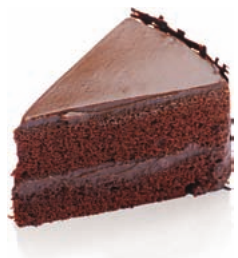
These three cake slices demonstrate similarity. Each slice has the same shape and angles, but they're different sizes.
Properties of similar figures
When two shapes are similar, they share these important characteristics:
Equal corresponding angles
All matching angles in similar figures have exactly the same measurement. For example, if one angle in the first shape measures , the corresponding angle in the similar shape will also measure .
Proportional corresponding sides
While the sides have different lengths, they maintain the same ratio or proportion. This means if you divide corresponding sides, you'll get the same number each time.
Note
Let's look at an example with two rectangles:
- Rectangle A: width mm, length mm
- Rectangle B: width mm, length mm
All angles in both rectangles are (equal corresponding angles).
To check if the sides are proportional, we calculate the ratios:
Both ratios equal 2, confirming the sides are proportional. Rectangle B's measurements are twice those of Rectangle A.
Understanding scale factors
A scale factor tells us how much a shape has been enlarged or reduced. It's the number we multiply the original dimensions by to get the new dimensions.

In the rectangle example above, Rectangle B was created by multiplying all of Rectangle A's dimensions by . Therefore, the scale factor is (or we can write this as ).
Note
Key points about scale factors:
- A scale factor greater than 1 means the shape has been enlarged
- A scale factor less than 1 means the shape has been reduced
- A scale factor of exactly means the shapes are identical
Scale factors and area
Here's something important to remember: when you apply a scale factor to length, the area changes differently.
Important
If all linear dimensions are multiplied by a scale factor of , then the area is multiplied by .
This relationship always works: Area scale factor = (linear scale factor)²
Let's see why this happens using our rectangles:
- Area of Rectangle A mm²
- Area of Rectangle B mm²
Ratio of areas:
Notice that while the length scale factor was , the area scale factor is . Rectangle B's area is four times larger than Rectangle A's area.
Worked examples
Example
Example 1: Calculating the scale factor
Question: What is the scale factor for these two similar rectangles?
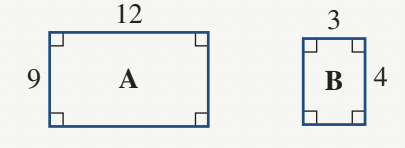
Rectangle A has dimensions: width , length
Rectangle B has dimensions: width , length
Solution:
Step 1: Identify which rectangle is larger. Rectangle A is larger than Rectangle B.
Step 2: Match the corresponding sides:
- Width: matches with
- Length: matches with
Step 3: Write the matching sides as a fraction (smaller rectangle divided by larger rectangle):
Scale factor or
Step 4: Simplify the fraction:
Answer: The scale factor is (or ). This means Rectangle B is one-third the size of Rectangle A.
Example
Example 2: Using a scale factor for length
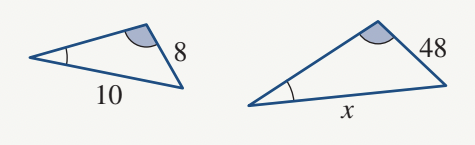
Question: What is the length of the unknown side in this pair of similar triangles?
Solution:
Step 1: Match the corresponding sides. We can see that the side of length in the first triangle corresponds to the side of length in the second triangle.
Step 2: Write the matching sides as a fraction (second triangle to first triangle):
Scale factor
Step 3: Simplify:
Scale factor (or )
Step 4: Now find the corresponding side for the unknown . The side of length in the first triangle corresponds to side in the second triangle.
Step 5: Calculate by multiplying by the scale factor:
Answer: The unknown side has length 60 units.
Example
Example 3: Using a scale factor for area
Question: Two similar triangles are given. The area of the small triangle is cm². One side of the small triangle measures cm, and the corresponding side of the larger triangle measures cm. What is the area of the larger triangle?
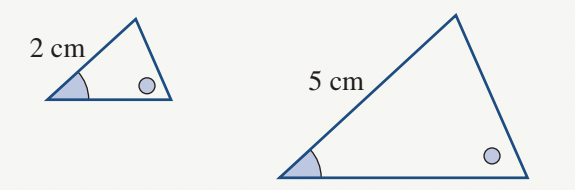
Solution:
Step 1: Match the corresponding sides to find the linear scale factor:
cm matches with cm
Step 2: Write the scale factor as a fraction (larger triangle to smaller triangle):
Scale factor
Step 3: Remember that area is multiplied by the square of the linear scale factor.
Step 4: Calculate the area:
Answer: The larger triangle has an area of 18.75 cm².
Summary
Key Points to Remember:
-
Similar figures have the same shape but different sizes - all corresponding angles are equal and all corresponding sides are in the same ratio.
-
Scale factor for length is found by dividing a measurement in the new shape by the corresponding measurement in the original shape.
-
Scale factor for area equals the square of the linear scale factor. If dimensions are multiplied by , area is multiplied by .
-
To find an unknown side in similar figures, multiply the corresponding known side by the scale factor.
-
Always match corresponding sides carefully before calculating - similar figures might be rotated or flipped!