The Position of Black Americans at the Start of the Civil Rights Period (HSC SSCE Modern History): Revision Notes
📚Revision Notes
The Position of Black Americans at the Start of the Civil Rights Period
Understanding civil rights
Before examining the position of Black Americans in the 1940s and 1950s, it is important to understand what civil rights actually mean.
Note
Definition of Civil Rights
Civil rights are the fundamental freedoms that enable people to participate freely and without retribution or fear in everyday life within their nation and community. These rights include economic, employment and education rights, the right to associate, speak and vote and share in the collective benefits of a society.
In a democratic society, civil rights should be guaranteed to all citizens equally, regardless of their race, religion, or background. However, for Black Americans at the start of the civil rights period, these rights existed only on paper. Despite constitutional protections, the reality of daily life was marked by systematic discrimination, segregation, and oppression.
The constitutional framework: Promises unfulfilled
Following the American Civil War, the United States government passed three constitutional amendments designed to free enslaved people and grant them full citizenship rights.
The Thirteenth Amendment (1865) officially abolished slavery throughout the United States. This was a monumental legal change, but it did not automatically grant Black Americans equal status in society. Southern states, in particular, resisted accepting formerly enslaved people as equal citizens.
The Fourteenth Amendment (1868) was intended to guarantee citizenship rights to Black Americans. It promised "due process" and "equal protection under the law" to all citizens. This meant that states should not be able to discriminate against people based on their race.
Note
Federal vs State Rights
Because of America's federal system of government, individual states claimed they had the right to make their own laws. This tension between federal constitutional protections and state authority became a central issue in the struggle for civil rights.
Many Southern states simply ignored the Fourteenth Amendment and continued to deny basic rights to Black Americans.
The Fifteenth Amendment (1870) granted Black Americans, including formerly enslaved people, the right to vote. This was a crucial democratic right, known as the franchise.
Important
The Gap Between Constitutional Rights and Reality
Gaining a constitutional right and actually being able to exercise it were two very different things. For the next 100 years, Black Americans faced enormous barriers when trying to register to vote. Southern states used literacy tests, poll taxes, and intimidation to prevent Black citizens from voting.
The doctrine of "separate but equal"
In 1896, a Supreme Court case called Plessy v Ferguson fundamentally shaped the legal position of Black Americans for the next six decades. The court ruled that racial segregation was constitutional as long as the separate facilities provided for Black and white Americans were "equal" in quality.
This doctrine of "separate but equal" gave legal approval to segregation laws throughout the United States, particularly in the South. States could now claim they were following the Constitution whilst maintaining completely separate facilities for Black and white citizens.
Important
"Separate but Equal" = Separate and Unequal
In practice, the facilities provided for Black Americans were almost always inferior to those for white Americans. Schools for Black children received less funding, had fewer resources, and were often in poor condition. Public facilities such as waiting rooms, restaurants, and toilets designated for Black Americans were typically of lower quality.
The Plessy v Ferguson decision meant that inequality and segregation became embedded in American law and society. This legal framework remained in place until 1954, when another Supreme Court case began to challenge it.
Discrimination across America in 1948
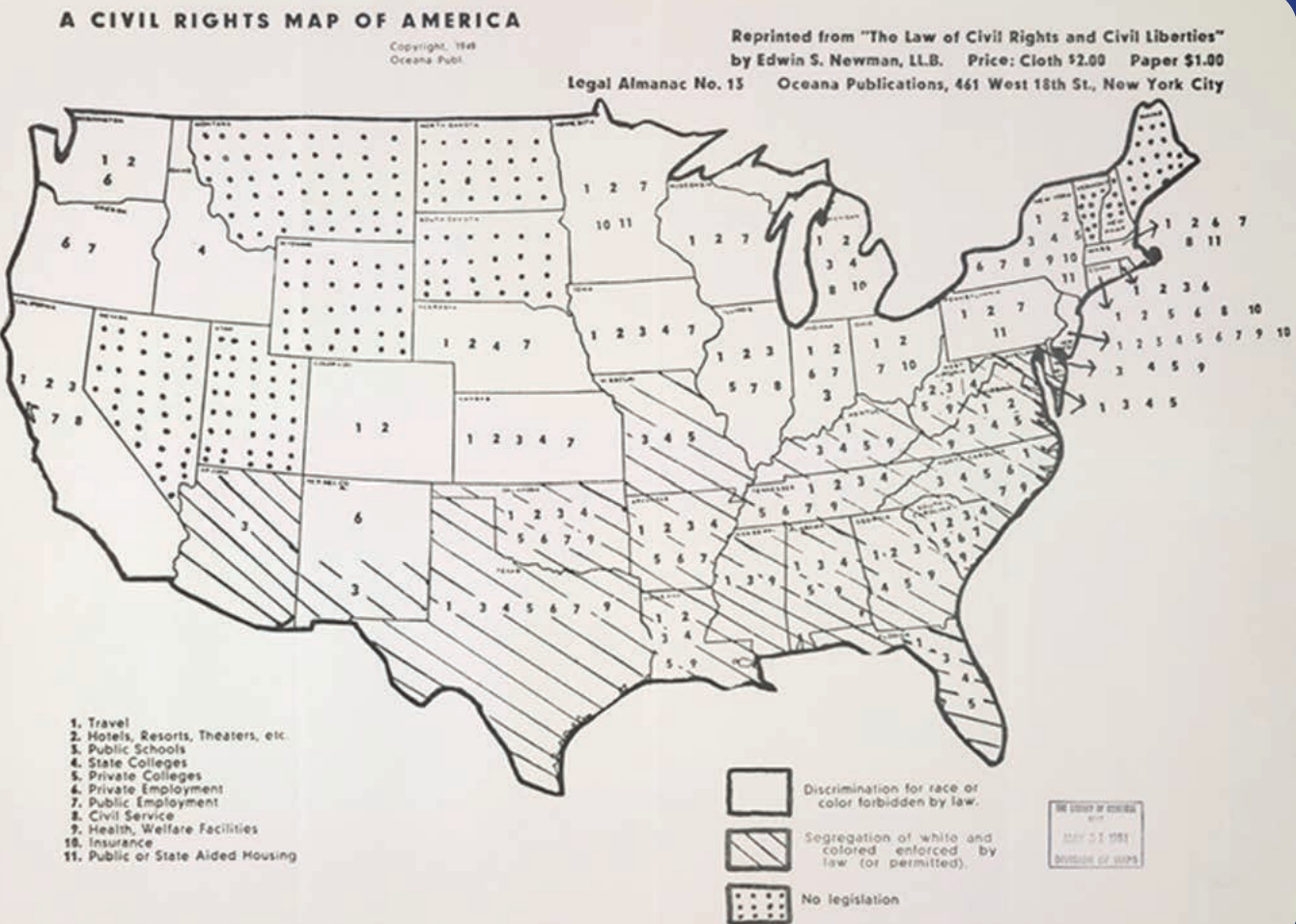
By 1948, discrimination against Black Americans was not just a Southern problem—it existed throughout the entire country. A map from that year reveals the extent of legal discrimination in different areas of American life.
Note
Geographic Variations in Discrimination
The map shows that states took different approaches to civil rights legislation:
- Some states had laws specifically forbidding discrimination in areas such as travel, hotels, public schools, employment, and housing
- Other states had laws that either enforced or permitted segregation
- Many states had no legislation at all, leaving discrimination unchecked
The Southern states, shown with diagonal lines on the map, had laws that actively enforced or permitted racial segregation. This meant that segregation was not simply a social custom in these states—it was legally required. Northern and Western states showed more variation, with some forbidding discrimination whilst others had no relevant laws.
This map demonstrates a crucial point: the position of Black Americans varied significantly depending on where they lived, but discrimination existed everywhere in some form.
Daily life under segregation
For Black Americans living in the 1940s and 1950s, segregation affected every aspect of daily life. This was particularly true in the Southern states, where segregation was enforced by law, but discrimination also existed in the North and West.
Education was strictly segregated in most areas. Black children attended separate schools from white children. These schools for Black students typically received far less funding, had older textbooks, fewer teachers, and buildings in poor repair. Many Black children had to travel long distances to reach their segregated schools, even when a school for white children existed in their own neighbourhood.
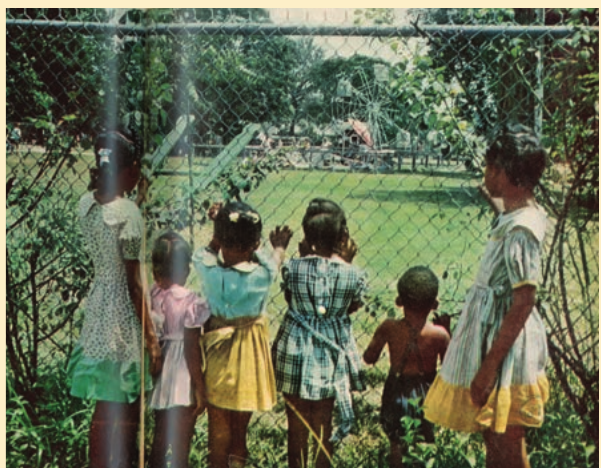
Public facilities were divided by race. Playgrounds, parks, swimming pools, libraries, and cinemas all had areas designated "Whites Only" or "Colored". Black Americans were excluded from many public spaces entirely or restricted to inferior sections. Water fountains, toilets, and waiting rooms were segregated, with facilities for Black Americans often poorly maintained or entirely absent.
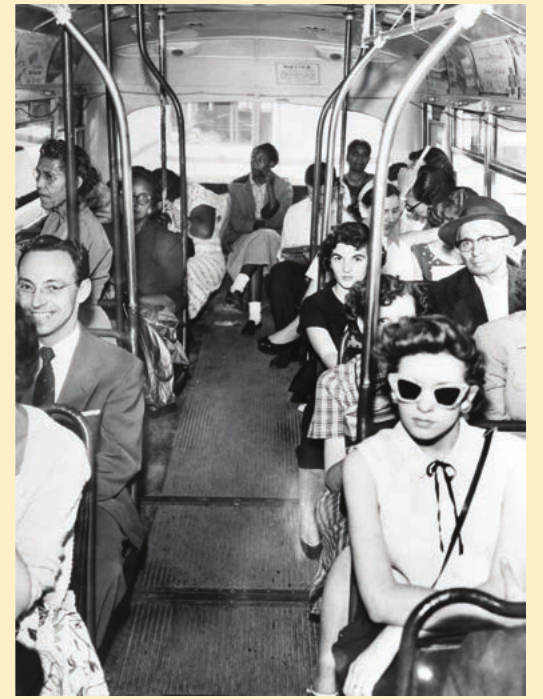
Transportation was another area where segregation was rigidly enforced. On buses, Black passengers were required to sit at the back and give up their seats to white passengers if the bus became crowded. On trains, separate carriages were designated for Black and white passengers. Even after court rulings began to challenge these practices, segregation often continued in practice.
Note
The Persistence of Segregation
This photograph from Texas in 1956 shows that despite a court ruling ordering the desegregation of buses, Black and white passengers continued to sit separately "by their own choice." This reveals how deeply ingrained segregation had become in American society—even when laws began to change, social attitudes changed much more slowly.
Employment and housing discrimination meant that Black Americans were largely excluded from professional jobs and better-paid work. They were denied mortgages to buy homes in certain areas, creating segregated neighbourhoods. This economic discrimination kept Black Americans trapped in poverty and prevented them from improving their social position.
Violence and intimidation
The segregated system was maintained not just through laws, but through violence and the threat of violence. Black Americans who challenged segregation or attempted to claim their constitutional rights faced serious risks.
Police brutality was common, particularly in the South. Law enforcement officers often used violence against Black Americans with impunity, knowing they would face no consequences. The courts offered little protection, as judges and juries in segregated areas were all white and often sympathetic to maintaining the racial hierarchy.
Important
The Climate of Fear
Beyond official violence, Black Americans faced threats from white supremacist groups and from ordinary white citizens who were determined to maintain segregation. Lynchings, beatings, and property destruction were used to intimidate Black Americans and prevent them from asserting their rights.
This climate of fear and violence meant that many Black Americans felt they had no choice but to accept segregation, even though it violated their constitutional rights.
The gap between rights and reality
Understanding the position of Black Americans at the start of the civil rights period requires recognising the enormous gap between their constitutional rights and their lived reality.
On paper, Black Americans had been granted citizenship, equal protection under the law, and the right to vote. These were fundamental rights enshrined in the Constitution.
Important
Constitutional Promises vs Daily Reality
In reality, Black Americans faced:
- Systematic exclusion from voting through intimidation, literacy tests, and poll taxes
- Segregated and inferior schools that provided an inadequate education
- Exclusion from most professional employment opportunities
- Restrictions on where they could live, eat, shop, and travel
- Constant threat of violence if they challenged the system
- Courts and police forces that offered no protection
This contradiction between America's constitutional promises and the actual treatment of Black Americans created growing frustration and anger. The United States claimed to be "the land of the free" and promoted democracy around the world, yet denied basic rights to millions of its own citizens based solely on the colour of their skin.
By the mid-1940s, this situation was becoming increasingly untenable. Black Americans who had served in World War II returned home having fought for freedom abroad, only to face discrimination at home. International criticism mounted as America's racial problems became more visible on the world stage during the Cold War. The position of Black Americans at the start of the civil rights period was one of profound inequality, legally sanctioned discrimination, and frustrated hopes for the equality that the Constitution promised but society denied.
Remember!
Summary
Key Points to Remember:
-
Despite constitutional amendments granting freedom, citizenship, and voting rights after the Civil War, Black Americans faced systematic discrimination and segregation by the 1940s.
-
The 1896 Plessy v Ferguson Supreme Court decision established the "separate but equal" doctrine, which gave legal approval to segregation throughout America.
-
Segregation affected every aspect of daily life for Black Americans, including education, public facilities, transportation, employment, and housing.
-
A 1948 map shows that discrimination existed nationwide, not just in the South, with different states taking varying approaches to civil rights legislation.
-
The gap between constitutional rights on paper and the lived reality of Black Americans created the conditions for the civil rights movement that would follow.