Background and Major Figures (HSC SSCE Modern History): Revision Notes
📚Revision Notes
Background and Major Figures
Introduction to the period
Between 1949 and 1989, China underwent dramatic transformations under Communist Party rule. After defeating the Guomindang government in the civil war, Mao Zedong's Chinese Communist Party (CCP) had the opportunity to implement its revolutionary vision. The Party enjoyed several advantages: a unified nation, a defeated Japan, and minimal foreign interference. However, significant challenges remained, including entrenched traditions, involvement in the Korean War, and the powerful personality of Chairman Mao himself.
Note
This forty-year period marked one of the most turbulent and transformative eras in modern Chinese history, witnessing radical social experiments that would reshape every aspect of Chinese society and politics.
This period witnessed ambitious social experiments like the Great Leap Forward and the Cultural Revolution, which would profoundly shape modern China. Understanding the key figures who drove these changes is essential for grasping how China evolved from Mao's radical socialism to Deng Xiaoping's market reforms.
Understanding Chinese names and romanization
Chinese characters are only partially phonetic, which created challenges for foreigners attempting to pronounce Chinese names and places. Early Western visitors to China, restricted mainly to the southern regions, developed romanization systems heavily influenced by local dialects. The first comprehensive system became known as Wade-Giles, named after its creators. In the late 1950s, China developed its own phonetic guide called Pinyin, which is now the internationally accepted standard.
Important
In Chinese naming conventions, the family name comes first, followed by the given name. This differs from Western naming conventions and is essential to understand when studying Chinese historical figures.
The table below shows how major names and places appear in different romanization systems:
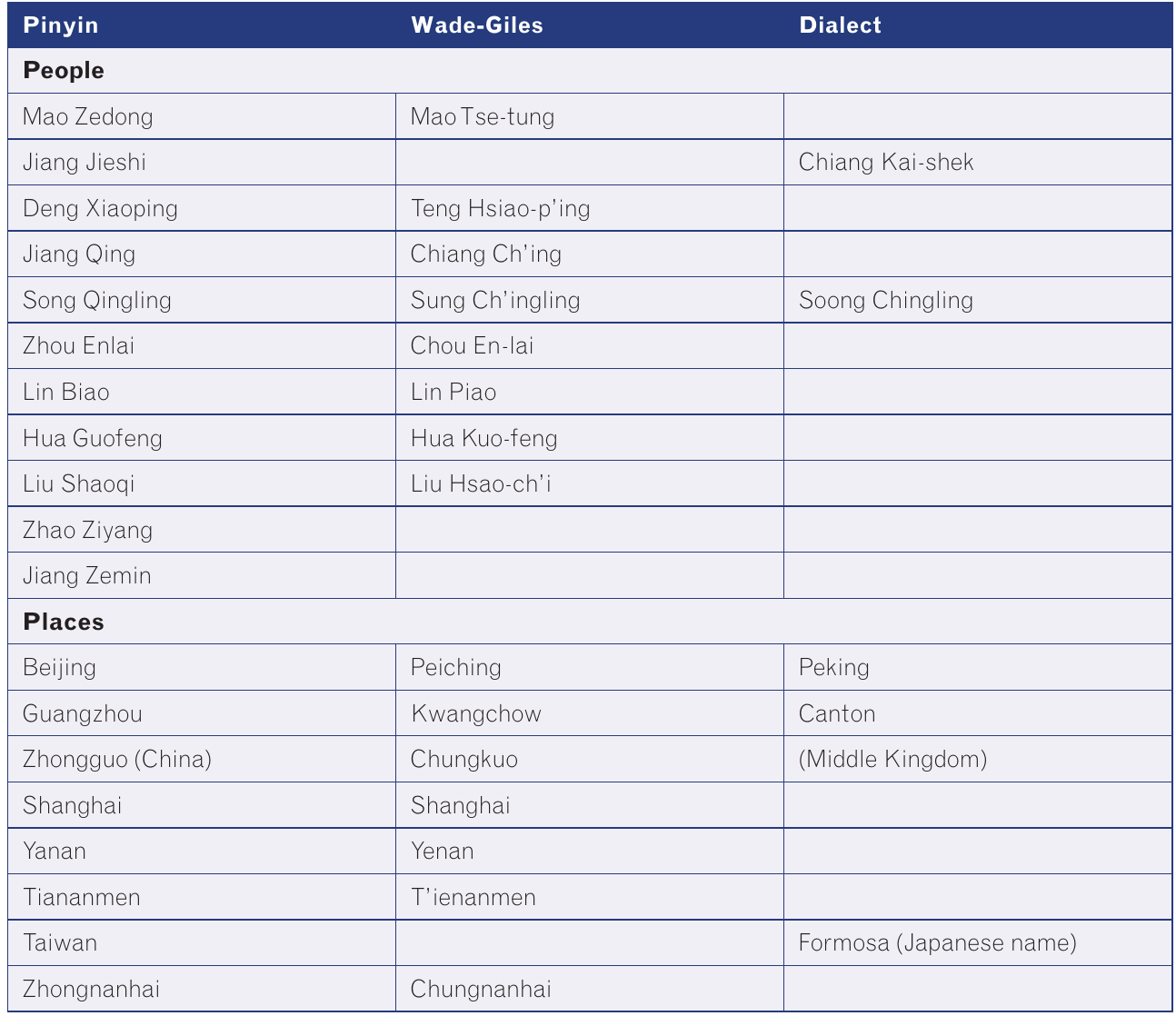
Major political figures
Mao Zedong (1893-1976)
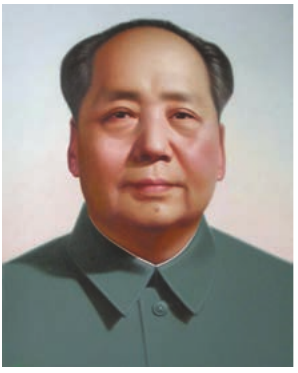
Born in Hunan Province, Mao began his political career as an assistant to Li Dazhao, one of China's early Marxist intellectuals. He married Yang Kaihui, who bore him two sons. Unlike many other Communist leaders, Mao recognised the revolutionary potential of China's peasants rather than focusing solely on urban workers.
Mao established the Jiangxi Soviet, an early Communist-controlled territory, and survived the gruelling Long March of 1934-1935, during which he emerged as Chairman of the CCP. From his base in Yan'an, he led the Communists to victory in the civil war and became Chairman of the People's Republic of China (PRC) in 1949.
As leader, Mao's record was mixed. His First Five Year Plan achieved considerable success in industrialisation, but his second major initiative, the Great Leap Forward (1958-1962), proved catastrophic. Millions starved as a result of failed agricultural policies. Following criticism at the Lushan Plenum in 1959, Mao lost his position as head of state, though he retained his party chairmanship.
Note
Mao's ability to maintain his party chairmanship while losing the state presidency illustrates the complex dual structure of Chinese governance, where party positions often held more real power than government titles.
Mao regained power in 1966 by launching the Cultural Revolution, using student Red Guards to attack his political rivals. This campaign created widespread chaos and persecution. In 1972, he surprised the world by welcoming American President Richard Nixon to China, beginning the normalisation of US-China relations. When Mao died in 1976, he designated Hua Guofeng as his successor, passing over more established party leaders.
Deng Xiaoping (1904-1997)
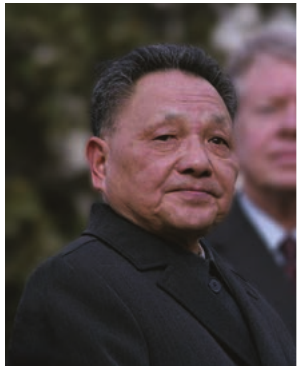
Born in Sichuan Province, Deng worked and studied in France before joining the CCP in 1924. Though he held a modest rank as a private during the Long March, he supported Mao at the crucial Zunyi Conference, which confirmed Mao's leadership. During the civil war, Deng served as a political commissar, earning respect from military commanders for his organisational skills.
By 1952, Deng had become Vice-Premier, and in 1956 he joined the elite Politburo Standing Committee. Between 1959 and 1966, he worked alongside Liu Shaoqi to revive China's economy after the Great Leap Forward's failures. However, at the beginning of the Cultural Revolution, Mao labelled him "Number Two Capitalist Roader" and purged him from power.
Example
Deng's Political Resilience: The Three Rises and Falls
Deng Xiaoping's career demonstrates extraordinary political survival:
- First purge (1966): Denounced as "Capitalist Roader" during Cultural Revolution
- First comeback (1973): Rehabilitated with Zhou Enlai's support
- Second purge (1976): Removed after Tiananmen Incident mourning Zhou
- Final rise (1977-1981): Gradually regained control to become paramount leader
This pattern of "three ups and three downs" became legendary in Chinese politics, showing both the volatility of Mao-era politics and Deng's remarkable ability to rebuild his political base.
Deng demonstrated remarkable political resilience. In 1976, he faced a second purge after crowds defied the Gang of Four to mourn Premier Zhou Enlai. With support from Marshal Ye Jianying, Deng gradually regained control between 1977 and 1981, eventually becoming China's paramount leader. He introduced market-oriented economic reforms that transformed China, though he maintained firm political control, ultimately ordering the military crackdown on protesters at Tiananmen Square in 1989.
Zhou Enlai (1898-1976)
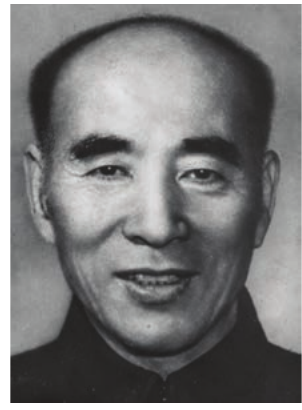
Born in Jiangsu Province, Zhou received a mission school education before studying in Japan. He participated in the May Fourth Movement of 1919, a significant anti-imperialist student protest. In 1920, Zhou travelled to France, where he established a CCP branch in 1922.
Zhou narrowly escaped the 1927 Shanghai Massacre, in which Chiang Kai-shek's forces killed thousands of Communists. Initially part of the "28 Bolsheviks" who removed Mao from leadership in Jiangxi, Zhou switched his support to Mao at the Zunyi Conference during the Long March.
Throughout his career, Zhou acted as a moderating influence, attempting to limit the damage caused by Mao's more extreme policies. He advocated for Deng Xiaoping's rehabilitation in 1973 and worked to improve relations with the United States. The Gang of Four continued attacking him until his death from cancer in 1976. His passing sparked spontaneous public mourning, with people defying government orders to honour him.
Note
Zhou Enlai's death in January 1976 triggered an unprecedented outpouring of public grief. When authorities tried to suppress memorial activities, crowds gathered at Tiananmen Square in April 1976 to honour him, marking one of the first major public protests against the Cultural Revolution's excesses.
Liu Shaoqi (1896-1969)
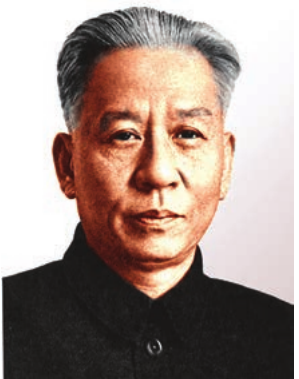
Born in Hunan, Liu assisted Mao in organising mine workers early in his career. After studying in Moscow and joining the CCP there, he returned to China and joined the Jiangxi Soviet in 1932. Tuberculosis prevented him from participating in the Long March, but he reached Yan'an in 1937, where he became an influential political commissar and party theoretician.
In 1958, Liu replaced Mao as Chairman of the PRC (head of state), while Mao retained his position as party chairman. This arrangement gave Liu considerable governmental authority. However, in 1966, Mao attacked Liu for "taking the capitalist road" as part of the Cultural Revolution's purge of moderate leaders. Liu died in 1969 in Kaifeng prison, suffering from medical neglect and general mistreatment. His persecution became one of the Cultural Revolution's most notorious injustices.
Important
Liu Shaoqi's tragic fate exemplifies the dangers faced by those who questioned Mao's policies. Despite being designated as Mao's successor and serving as head of state, Liu was stripped of all positions, publicly humiliated, denied medical treatment, and died alone in prison. His rehabilitation after Mao's death acknowledged the injustice of his persecution.
Lin Biao (1907-1971)
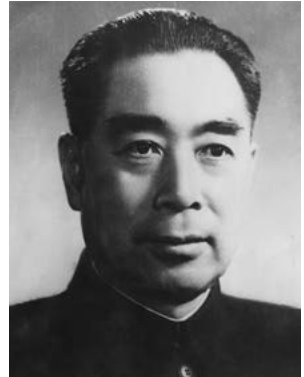
Born in Hubei Province, Lin graduated from the prestigious Huangpu Military Academy. During the Long March, he commanded breakthrough forces and supported Mao at Zunyi. Lin distinguished himself fighting against both the Japanese invaders and GMD forces in Manchuria during the civil war.
In 1959, Mao appointed Lin as Minister of Defence, replacing the disgraced Peng Dehuai. Lin compiled the famous "Quotations of Chairman Mao" (the Little Red Book) for the People's Liberation Army, which became a central text of the Cultural Revolution. Mao designated Lin as his successor, but their relationship deteriorated. Lin allegedly plotted to assassinate Mao but died in a mysterious plane crash in 1971 while apparently fleeing to the Soviet Union.
Note
The circumstances surrounding Lin Biao's death remain one of the most intriguing mysteries of the Cultural Revolution. Official accounts claim he was fleeing to the Soviet Union after a failed coup attempt, but the lack of clear evidence has led to numerous alternative theories about what actually happened on that fateful night in September 1971.
Peng Dehuai (1898-1974)
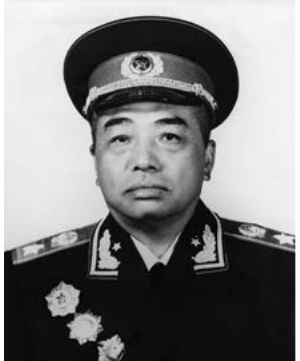
Born in Hunan, Peng began his military career serving a warlord before joining the CCP and the Jiangxi Soviet. He performed admirably during the Long March and served as a deputy commander in northwest China during the civil war. Peng led Chinese "volunteers" during the Korean War (1950-1953).
At the Lushan Conference in 1959, Peng courageously criticised Mao's Great Leap Forward policies, pointing out the devastating famine they had caused. Mao responded by dismissing Peng as Minister of Defence and purging him from the party. During the Cultural Revolution in 1966, authorities imprisoned Peng and subjected him to prolonged beatings. Despite the torture, Peng remained unrepentant about his criticism of Mao. He died in 1974, still in custody.
Important
Peng Dehuai's willingness to speak truth to power at the Lushan Conference demonstrated exceptional courage. Knowing the risks, he directly challenged Mao's disastrous policies, writing: "The Great Leap Forward has caused great losses to the people." His principled stand cost him everything, but his moral courage was later recognised when he was posthumously rehabilitated.
Hua Guofeng (1921-2008)
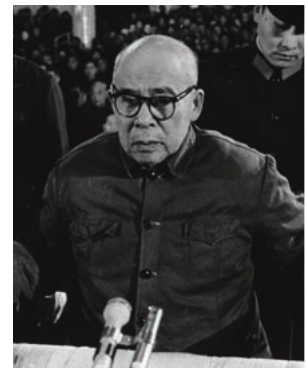
Hua served in various party positions before Mao surprisingly designated him as successor. After Mao's death in 1976, Hua briefly held the top positions in government, party, and military. However, he lacked the political base and experience of veteran leaders like Deng Xiaoping. More established party figures, particularly Deng, gradually pushed Hua aside, and by 1978 he had lost effective power. His rapid rise and fall illustrated the importance of political networks and experience in Chinese Communist politics.
Jiang Zemin (1926-)
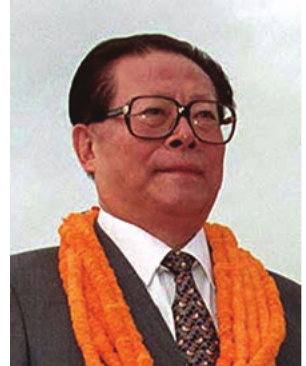
A trained engineer, Jiang became Minister for Electronics in 1983. Two years later, he became mayor of Shanghai and First Secretary of the Shanghai Communist Party. As a protégé of Deng Xiaoping, Jiang attracted attention during the Tiananmen Square protests of 1989. While Zhao Ziyang advocated a conciliatory approach toward the protesters, Jiang supported forceful suppression. This willingness to use violence against demonstrators led to his promotion to General Secretary of the CCP in 1989 and President of the PRC in 1993, positions he used to continue Deng's economic reforms while maintaining tight political control.
Zhao Ziyang (1918-2005)
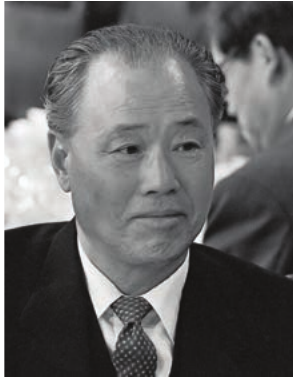
Zhao worked as a CCP official in Guangdong Province during the 1960s. Like many officials, he suffered purging during the Cultural Revolution but was later "rehabilitated" and became First Secretary of Sichuan Province. Under Deng Xiaoping's guidance, Zhao implemented successful economic reforms in Sichuan. These successes led to his appointment as Premier of China and then General Secretary of the CCP from 1987 to 1989.
Zhao became the first Chinese leader to wear Western business suits overseas instead of the traditional Mao jacket, symbolising China's opening to the world. However, his career ended abruptly when he sympathised with the Tiananmen Square protesters in 1989 and advocated dialogue rather than military force. Authorities removed him from all positions and placed him under house arrest for the remainder of his life.
Note
Zhao Ziyang's fall from grace marked the end of a brief period of political liberalisation in China. His emotional visit to Tiananmen Square protesters, where he tearfully told students "We have come too late," became one of the most poignant moments of the 1989 democracy movement. He spent the last 15 years of his life confined to his Beijing home.
Jiang Jieshi (1887-1975)
Born in Zhejiang Province, Jiang received military training in Japan and Russia. After establishing connections with Shanghai criminal gangs, he became a follower of Sun Yat-sen and later commanded the Huangpu Military Academy. He divorced his first wife to marry Song Meiling, which connected him to one of China's most influential families.
After Sun's death in 1925, Jiang gained control of the Guomindang (GMD) and led the Northern Expedition to unify China. In 1927, he shocked his Communist allies by ordering the Shanghai Massacre, killing thousands of CCP members. He established Nanjing as his capital and fought simultaneously against the Japanese invaders (after 1937, from Chongqing) and the CCP, while also managing difficult warlords.
Example
The Xi'an Incident (1936): A Turning Point
In December 1936, one of Jiang's own generals, Zhang Xueliang, took the dramatic step of kidnapping his commander-in-chief. Zhang's motivation was to force Jiang to stop fighting the Communists and instead form a united front against Japanese invaders. After tense negotiations involving Zhou Enlai, Jiang agreed to cooperate with the CCP against Japan. This incident fundamentally altered the course of Chinese history, giving the CCP time to rebuild and eventually win the civil war.
In the 1936 Xi'an Incident, one of his own generals, Zhang Xueliang, kidnapped Jiang to force cooperation with the Communists against Japan. After losing the civil war to the CCP in 1949, Jiang established the Republic of China government on Taiwan, where he ruled until his death in 1975.
Nikita Khrushchev (1894-1973)
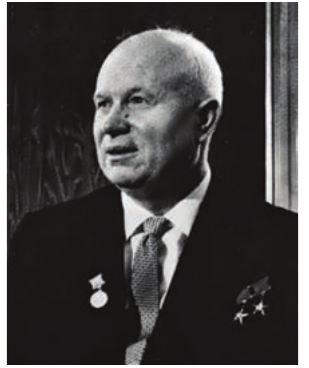
Khrushchev joined the Russian Communist Party in 1918 and gradually rose through its ranks. During the Second World War, he served as Premier of Ukraine and a lieutenant-general fighting German occupation. In 1939, he joined the Politburo and initially supported Stalin's purges.
Ironically, after Stalin died in 1953, Khrushchev launched a famous denunciation of Stalin's "capricious and despotic rule." This de-Stalinisation campaign disturbed Mao, who saw parallels to his own leadership style. Khrushchev became Premier of the USSR in 1958. Growing tensions between Chinese and Soviet communism led Khrushchev to withdraw Russian technical experts from China in 1960, seriously damaging Chinese industrial development.
Important
The Sino-Soviet Split had profound implications for China's development. When Khrushchev withdrew Soviet technical experts and advisers in 1960, China lost crucial industrial and scientific support at a critical moment. This rupture pushed China toward greater self-reliance but also contributed to the failures of the Great Leap Forward, as Chinese engineers struggled to operate complex Soviet-designed facilities without expert guidance.
Jiang Qing (1914-1991)
Born in Shandong Province, Jiang became a moderately successful actor in Shanghai under the stage name Lan Ping. She travelled to Yan'an in 1938, where she soon replaced He Zizhen as Mao's wife. The CCP leadership initially banned her from politics, but in 1966 she gained influence by supporting Mao during the Cultural Revolution.
Through the Cultural Revolution Group, which evolved into the notorious Gang of Four, Jiang wielded considerable power to persecute Mao's perceived enemies. After Mao's death in 1976, authorities arrested her and the other Gang of Four members. She committed suicide in prison in 1991.
Note
The Gang of Four consisted of Jiang Qing, Zhang Chunqiao, Yao Wenyuan, and Wang Hongwen. They became symbols of the Cultural Revolution's excesses, blamed for much of the chaos and persecution of that period. Their dramatic arrest in October 1976, just weeks after Mao's death, marked the beginning of the end for the Cultural Revolution era.
Chen Boda (1904-1989)
Chen arrived in Yan'an in 1937 and became Mao's political secretary in 1942. During the Cultural Revolution, he rose to prominence by editing Red Flag (the CCP newspaper) and possibly helping compile the Quotations of Chairman Mao. He became a member of the Central Committee and Politburo and played a key role in promoting the Big Character posters used to denounce alleged enemies.
Chen gained a reputation as one of the Cultural Revolution's cruelest figures, orchestrating vicious attacks on party members and intellectuals. He fell from power in 1970, possibly after advocating positions that conflicted with Mao's plans.
Kang Sheng (1898-1975)
Born in Shandong Province, Kang met Jiang Qing in 1918, years before either joined the Communist movement. He joined the CCP in 1924 and eventually became Mao's chief of secret police. Kang led the brutal 1945 Rectification Campaign in Yan'an, which established patterns of ideological persecution later used in the Cultural Revolution.
He played an active role in both the Great Leap Forward and the Cultural Revolution, directing attacks on senior party members. His secret police apparatus made him one of the most feared figures in the Communist hierarchy. He died of bladder cancer in 1975.
Summary
Key Points to Remember:
-
Three romanization systems exist for Chinese names: Pinyin (modern standard), Wade-Giles (older Western system), and local dialects. Chinese family names come first.
-
Mao Zedong led the CCP to victory in 1949 but caused millions of deaths through the Great Leap Forward and Cultural Revolution. His designated successor Hua Guofeng lasted only two years before Deng Xiaoping took control.
-
The three parallel structures of government, party, and army all answered to CCP control. Whoever controlled the party controlled China.
-
Key moderating figures like Zhou Enlai and Deng Xiaoping attempted to limit Mao's radical policies and eventually reformed China's economy after Mao's death.
-
Political survival required careful navigation of factional politics, as demonstrated by Deng Xiaoping's ability to recover from two purges, while figures like Liu Shaoqi and Peng Dehuai paid the ultimate price for challenging Mao.