The Dawn of the Nuclear Age (HSC SSCE Modern History): Revision Notes
📚Revision Notes
The Dawn of the Nuclear Age
Introduction
The Nuclear Age began at 5:30 am on Monday, 16 July 1945, when scientists in the United States successfully tested the world's first nuclear weapon. This moment marked a profound shift in human history, opening what one historian called "a wide, unobstructed pathway to the end of the world." The development of nuclear weapons would reshape international relations, military strategy, and the very survival of humanity.
The story of how we arrived at this moment involves scientific breakthroughs, wartime urgency, and critical political decisions that would echo through the decades to come.
Nuclear fission: the key discovery
Early atomic research
The Nuclear Age had its origins in scientific laboratories rather than military planning rooms. Throughout the early 1800s, scientists began investigating the fundamental structure of matter. By 1911, Ernest Rutherford had developed a groundbreaking model of the atom, earning him recognition as the 'father of nuclear physics'.
Note
The discovery of the atom's structure was crucial groundwork. Rutherford's model revealed that atoms had a dense nucleus at their center, surrounded by orbiting electrons. This understanding was essential for later discoveries about nuclear fission.
The pace of discovery accelerated in the 1930s. In 1932, scientists discovered the neutron within the atom. Two years later, in 1934, researchers found that bombarding atoms with neutrons could create entirely new elements. These discoveries set the stage for the breakthrough that would change everything.
The splitting of the atom
In December 1938, two Austrian scientists, Lise Meitner and Otto Frisch, working with German scientists Otto Hahn and Fritz Strassman, made a revolutionary discovery. They successfully split a uranium atom in two. Frisch named this new process 'nuclear fission' because it reminded him of binary fission, a term biologists used to describe cell division.
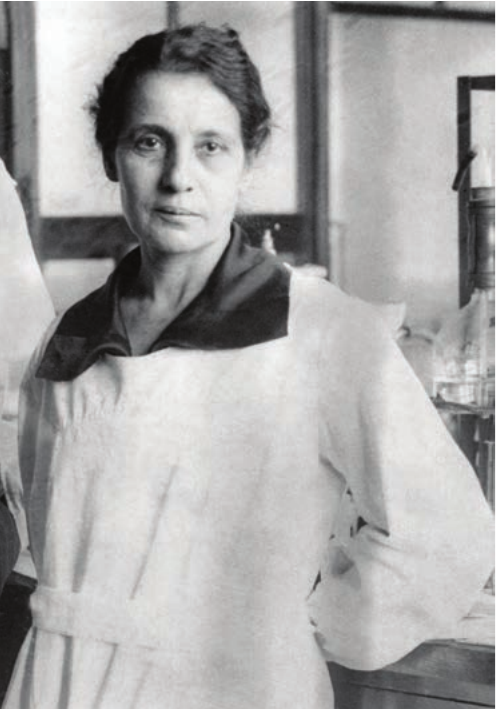
Nuclear fission is a type of nuclear reaction that releases enormous amounts of energy when the nucleus of an atom splits after being struck by another particle.
Important
This discovery was revolutionary because it demonstrated that splitting atoms could release far more energy than any chemical reaction. The energy released from splitting a single atom was millions of times greater than that from burning a molecule of coal or oil. Scientists quickly realized this could be harnessed for both peaceful energy production and devastating weapons.
The discovery spread quickly through the scientific community. Danish physicist Niels Bohr learned about the findings and brought the news to the United States, where it attracted significant attention from American scientists.
Einstein and the letter to Roosevelt
Growing concerns about Nazi Germany
Leo Szilard, a Hungarian-born American scientist who had worked on uranium research with Enrico Fermi in 1934, became deeply concerned. He feared that Nazi Germany might be the first to develop an atomic weapon. This was not an unreasonable fear, as much of the pioneering work in atomic research had been conducted in Germany before the war.
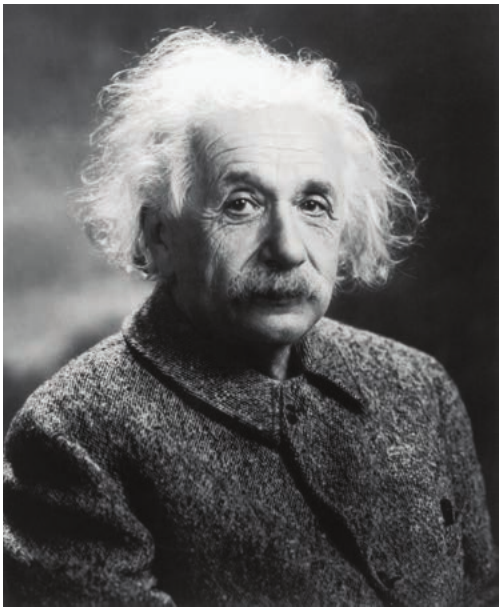
Szilard realised he needed someone with enough prestige and influence to get President Roosevelt's attention. He approached Albert Einstein, the famous German-born physicist who had developed the Theory of Relativity. Einstein had fled Germany in 1933 when Hitler came to power and was now living in Princeton, New Jersey.
The fateful letter
On 2 August 1939, Einstein signed a letter to President Roosevelt. The letter warned of the danger that Germany might develop atomic weapons and recommended that the United States begin its own program to build an atomic bomb.
The letter was hand-delivered to the Oval Office in the White House. Roosevelt read it carefully and ordered that a committee be established to investigate the matter. In October 1939, the Uranium Committee was formed and began recruiting scientists to work on various aspects of atomic theory.
British contributions
The Americans received a crucial push forward in late 1941 when they learned about the MAUD Committee's report from British scientists. This report demonstrated that an atomic bomb based on uranium fission was actually feasible. The report drew on a memorandum written by Otto Frisch and Rudolf Peierls, both German-born scientists now working in Britain, which outlined how an atomic bomb could work.
Note
The MAUD Committee's report was a turning point. It provided detailed calculations showing that a uranium bomb was not just theoretically possible, but practically achievable. The report estimated that a bomb containing about 25 pounds of uranium-235 could produce an explosion equivalent to thousands of tons of dynamite.
This convinced American leaders that they needed a more powerful and focused effort. On 18 December 1941, a more authoritative committee was established: the S-1 Executive Committee. Just over a month later, on 19 January 1942, President Roosevelt gave formal approval for the development of an atomic bomb.
The Manhattan Project
A massive secret program
What became known by its secret code name, the 'Manhattan Project', developed into a sprawling organisation with different sections spread across the United States. The project was so secret that not even Vice-President Truman knew of its existence.
Important
The scale of secrecy was unprecedented. Workers at different facilities often had no idea what they were building or how their work connected to the larger project. Security measures included coded language, restricted travel, and mail censorship for all project employees.
The scale of the Manhattan Project was staggering. Between 1942 and 1946, it employed over 130,000 people and cost the equivalent of about US$30 billion in today's currency. Only 10 per cent of this cost went to personnel. The rest funded the construction of massive buildings and facilities and the production of fissile material (material capable of sustaining a nuclear fission chain reaction).
Key locations
The Manhattan Project established massive facilities in three main locations:
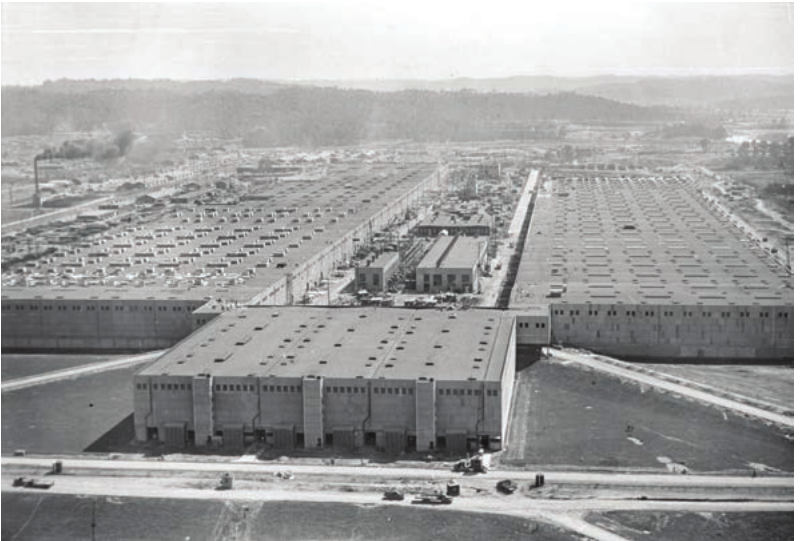
Oak Ridge, Tennessee: An entire city was built in 1942 to house the employees and their families who worked at the uranium-enrichment facility. The K-25 gaseous uranium enrichment plant at Oak Ridge was enormous.
Hanford, Washington State: This facility produced plutonium, another fissile material that could be used in atomic bombs.
Los Alamos, New Mexico: This laboratory became the site for assembling the bombs. Under the direction of Robert Oppenheimer, scientists at Los Alamos produced four nuclear bombs by 1945, before the Manhattan Project officially ended in 1946.
Two of these bombs, nicknamed 'Little Boy' and 'Fat Man', would be dropped on Japan in August 1945.
The Trinity Test
The first atomic explosion
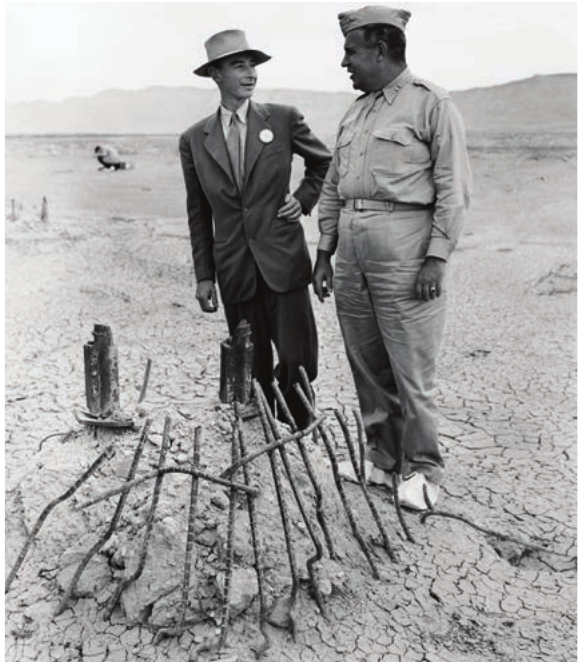
Just before 5:30 am on Monday, 16 July 1945, scientists in the United States successfully tested the world's first nuclear weapon in the New Mexico desert. The test was conducted at the Alamogordo bombing range and was code-named the Trinity Test.
The explosion was equivalent to 5,000 truckloads of dynamite being detonated simultaneously. The scientists who witnessed this first atomic explosion felt a mixture of elation that their hard work had succeeded and profound awe at what they had created.
Oppenheimer's reflection
Robert Oppenheimer, the lead scientist at Los Alamos, later recalled that the explosion brought to mind a line from the Hindu scripture, the Bhagavad Gita:
Important
Now I am become Death, the destroyer of souls.
This quote captures the terrible reality that scientists had unleashed: a weapon with the power to destroy entire cities and potentially threaten all life on Earth. Many scientists who witnessed the test experienced profound moral conflict about what they had created.
The Potsdam Conference
Truman takes charge
President Roosevelt died on 12 April 1945, and Vice-President Harry Truman was sworn in as president. Truman knew that something called the Manhattan Project was consuming a large portion of the war budget, but he did not know it was developing an atomic bomb.
Note
Truman's sudden elevation to the presidency placed him in an extraordinary position. Within months of taking office, he would have to make one of history's most momentous decisions: whether to use the atomic bomb against Japan. He had to quickly educate himself about a weapon so secret that even as Vice-President, he had been kept completely in the dark.
The war against Germany ended on 8 May 1945. The atomic bomb was successfully tested on 16 July 1945. Many scientists who had worked on the Manhattan Project became concerned that the US Government intended to use the weapon against Japan, even though the original justification (preventing Germany from getting the bomb first) no longer applied.
The Big Three meet
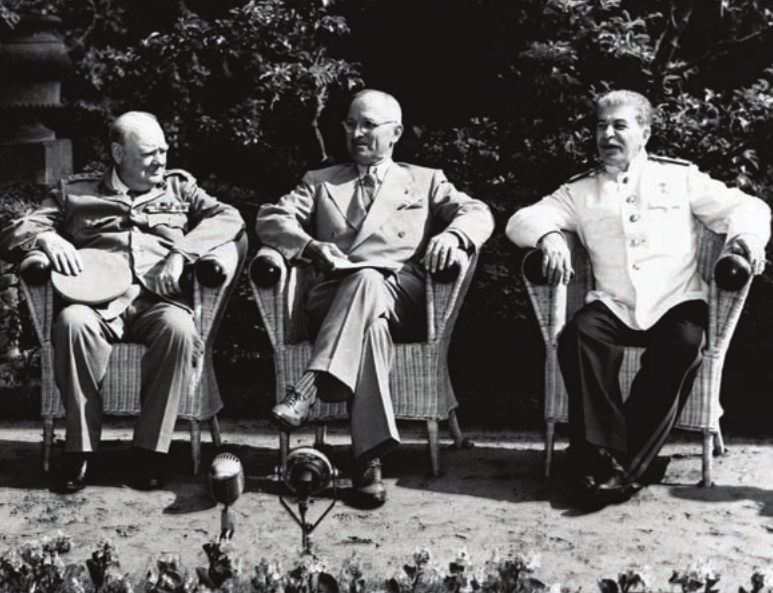
The Big Three Allied leaders were scheduled to meet in Potsdam, a city in defeated Germany near Berlin, from 17 July to 2 August 1945. President Truman faced a delicate diplomatic problem. The Americans and British had kept each other fully informed about their atomic research, but they had not briefed Soviet leader Joseph Stalin about their progress. This could potentially damage the wartime alliance.
Informing Stalin
During the Potsdam Conference, President Truman received confirmation that the atomic bomb test had been a complete success. According to Truman's account, on 24 July, he sought out Stalin in a quiet moment and spoke to him alone. Truman told the Soviet dictator that the United States now possessed a new weapon of immense destructive force.
Stalin appeared to show little interest. He simply said he hoped they would make 'good use of it against the Japanese'. Truman's concern that this revelation might cause problems with his Soviet ally proved unfounded. However, we now know that Stalin was already well aware of US progress on the atomic bomb through Soviet spies.
The ultimatum to Japan
On 27 July 1945, the Allied leaders issued the 'Potsdam Declaration' to Japan via radio. They called on Tokyo to:
proclaim now the unconditional surrender of all Japanese armed forces and to provide adequate assurances of their good faith in such action. The alternative for Japan is utter destruction.
Important
The declaration made no mention of the atomic bomb or the means that would be used to bring about that destruction. Japan's leaders had no way of knowing that "utter destruction" meant a single bomb that could obliterate an entire city in seconds. Meanwhile, the US military command had ordered that the atomic bombs be made ready for use.
First use of atomic weapons: Hiroshima
The city of Hiroshima
In August 1945, Hiroshima had a population of approximately 290,000 civilians, with an additional 43,000 soldiers stationed there. For months, the inhabitants had watched formations of American B-29 bombers fly overhead, using a dam west of the city as a navigation point before turning north towards major cities like Tokyo.
The US Air Force had been conducting devastating firebombing raids on Japanese cities. In the first raid on Tokyo, 300 B-29 bombers had dropped 2,000 tonnes of napalm, creating a massive firestorm that destroyed 16 square miles of the city, killed 100,000 people, and left 1 million homeless.
Note
The conventional bombing campaigns had already caused immense destruction across Japan. The firebombing raids were designed to destroy Japan's largely wooden cities and break civilian morale. These raids killed hundreds of thousands of civilians and left millions homeless, yet Japan had not surrendered.
Expecting that their turn would eventually come, the people of Hiroshima had organised tens of thousands of people, including many schoolchildren, to demolish buildings in the city centre. These demolitions created firebreaks designed to contain any firestorm within a limited area. On the morning of 6 August, thousands of children were at work in the centre of Hiroshima when the atomic bomb fell.
The bombing
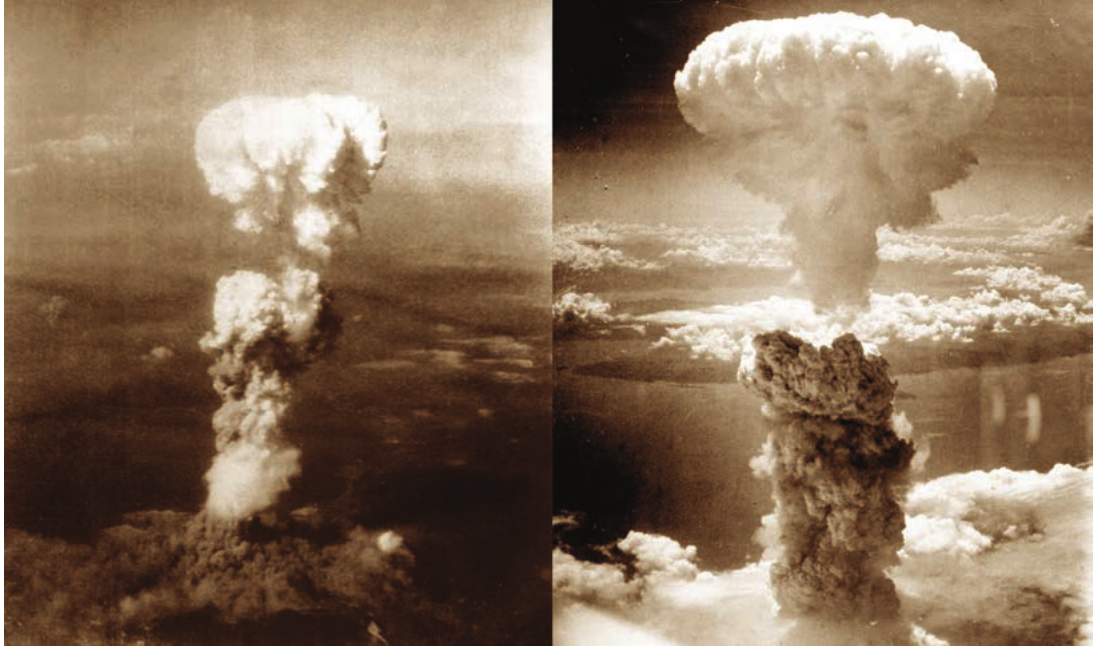
On 6 August 1945, the United States dropped an atomic bomb on Hiroshima. Unlike the conventional raids involving hundreds of bombers, a single B-29 bomber carried the weapon nicknamed 'Little Boy'. The bomb exploded with devastating effect, instantly killing tens of thousands of people and condemning many more to death from radiation sickness in the days, weeks, and months that followed.
Important
The bombing of Hiroshima marked the first use of nuclear weapons in warfare. The scale of destruction was unprecedented: a single bomb delivered by a single aircraft had destroyed an entire city. The heat from the explosion was so intense that it left permanent shadows of vaporized people burned into walls and pavement. The long-term effects of radiation exposure would continue to kill and sicken survivors for decades.
Three days later, on 9 August 1945, a second atomic bomb was dropped on Nagasaki. These two bombings remain the only times nuclear weapons have been used in war.
Summary
Key Points to Remember:
-
The Nuclear Age began with the discovery of nuclear fission in December 1938 by Lise Meitner, Otto Frisch, and their German colleagues.
-
Einstein's letter to President Roosevelt in August 1939 warned of the danger that Nazi Germany might develop atomic weapons first and led to the establishment of the Manhattan Project.
-
The Manhattan Project was a massive secret program that employed over 130,000 people and cost the equivalent of US$30 billion in today's currency to develop the atomic bomb.
-
The Trinity Test on 16 July 1945 was the first successful test of a nuclear weapon, demonstrating its enormous destructive power.
-
At the Potsdam Conference in July 1945, President Truman informed Stalin about the atomic bomb and the Allies issued an ultimatum to Japan demanding unconditional surrender or facing 'utter destruction'.
-
The atomic bombing of Hiroshima on 6 August 1945 marked the first use of nuclear weapons in warfare, followed by the bombing of Nagasaki three days later.