1914: The Descent into War (HSC SSCE Modern History): Revision Notes
📚Revision Notes
1914: The Descent into War
The year 1914 marked a critical turning point in world history, as Europe descended into the conflict that would become known as World War I. Understanding the events of this first year helps explain why the war developed into the prolonged and devastating struggle it became.
Germany's decision for war
Germany's choice to go to war in August 1914 was not driven by ambitions of world domination, as is sometimes believed. Instead, German leaders acted out of fear and strategic concern. They worried deeply about Russia's growing military strength and the threat posed by having hostile powers on both their eastern and western borders. To the west, France sought revenge for its defeat in the Franco-Prussian War of 1871, whilst to the east, Russia was becoming increasingly powerful and was allied with France.
Note
Pre-emptive strike: A military action based on the assumption that an enemy is planning an imminent attack; striking first to gain the advantage.
This strategic dilemma led Germany to develop what it hoped would be an insurance policy: the Schlieffen Plan. Created in 1905, this plan represented Germany's answer to the nightmare scenario of fighting a war on two fronts simultaneously. The strategy relied on the element of surprise – Germany would strike first to gain the advantage in mobilising its forces. In modern terms, it was a pre-emptive strike.
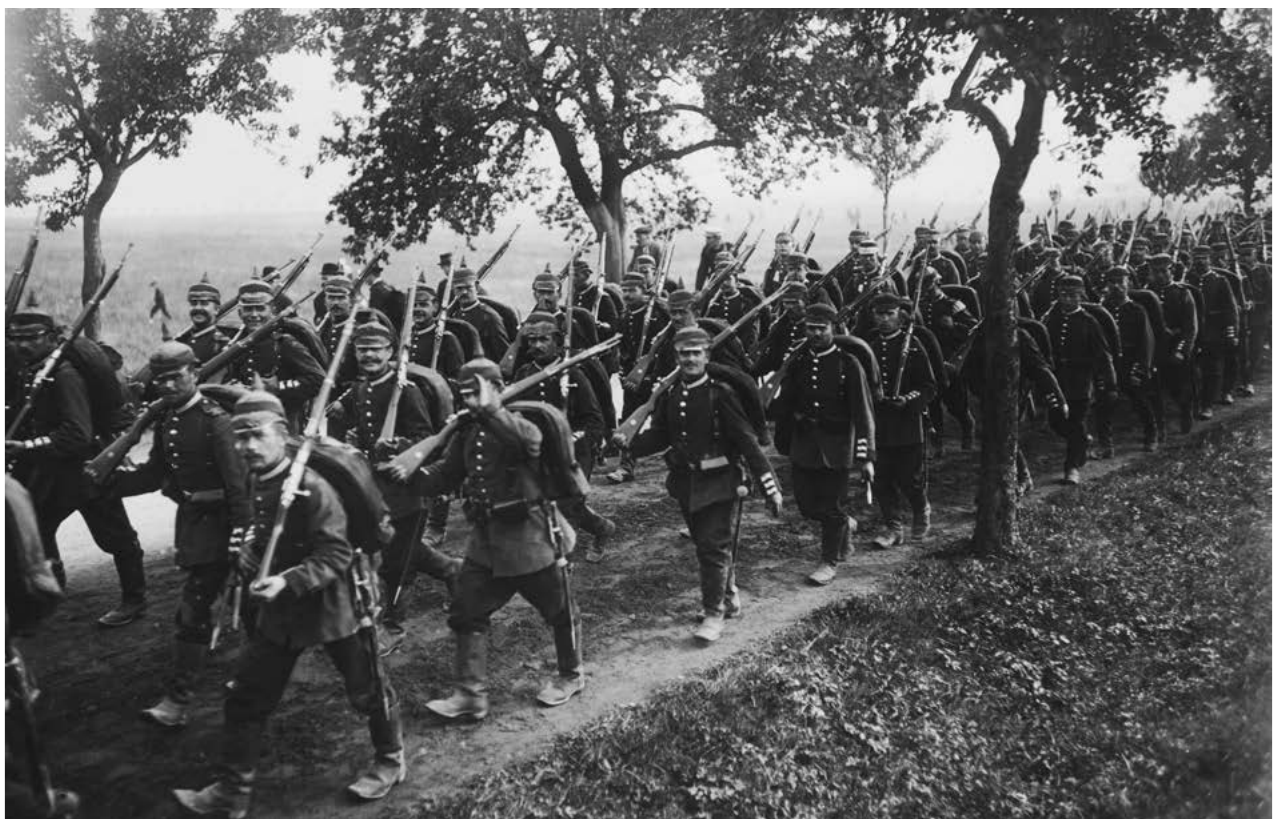
When the July Crisis of 1914 reached its critical point, Germany faced a difficult choice: support its ally Austria-Hungary in its confrontation with Serbia, or force Austria-Hungary into a humiliating retreat. Germany chose to stand by Austria-Hungary. When Russia mobilised its forces in response, German leaders believed war with Russia and France had become inevitable. They therefore activated the Schlieffen Plan, declared war on Russia and France, and within 24 hours began marching into neutral Belgium.
To secure public support and gain approval from the Reichstag (Germany's parliament), German leaders portrayed the war as defensive. This was particularly important for winning support from the Social Democratic Party (SPD), the largest political party in the Reichstag, whose approval was essential for passing war credits to finance the conflict. German leaders promoted the concept of Burgfrieden (meaning 'fortress peace') – a political truce between left and right-wing parties to unite the nation against external threats, particularly the perceived danger from Russia.
The Schlieffen Plan and French Plan 17
With war declared, both sides put their detailed military plans into action.
The Schlieffen Plan
The Schlieffen Plan was an elaborate military strategy devised by General Alfred Schlieffen (1833-1913), who served as Chief of the Imperial General Staff from 1891 to 1905. The plan called for most of the German army to attack France through neutral Belgium, sweep around towards the English Channel, and then encircle Paris from the west. Meanwhile, other German forces would surround the French capital from the north and east.
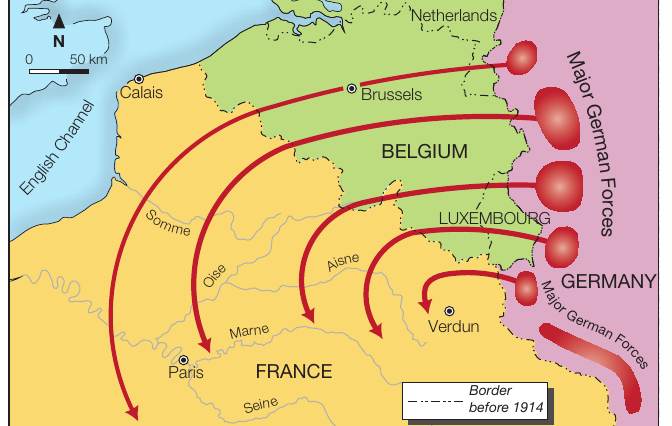
The plan's objective was ambitious: defeat France completely within six weeks, then redirect German forces eastward to fight Russia in what was expected to be a longer campaign. This strategy aimed to avoid the disastrous scenario of fighting a war on two fronts simultaneously.
French Plan 17
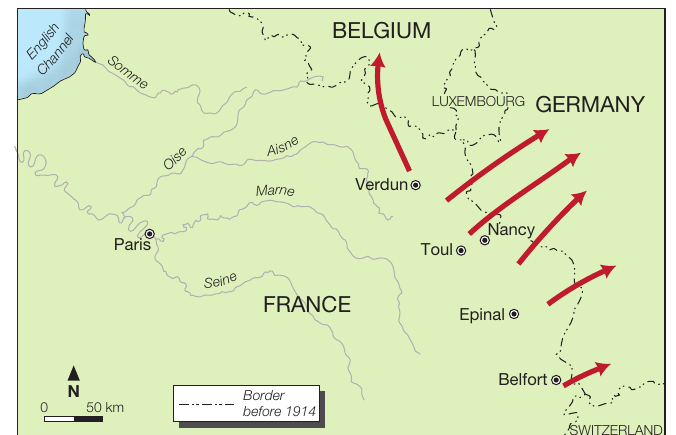
France implemented its own strategy, known as Plan 17, which involved a direct thrust into the German province of Lorraine. This aggressive approach aimed to reclaim territory lost to Germany in the Franco-Prussian War and strike at the heart of German industrial power.
Major battles of 1914
The first months of the war saw intense fighting that would determine the course of the entire conflict.
Battle of the Frontiers (August-September 1914)
France's Plan 17 proved disastrous. The month-long Battle of the Frontiers, which began on 7 August and continued until 13 September, resulted in catastrophic French losses of 329,000 casualties. This defeat demonstrated that pre-war tactics of aggressive offensive action could not overcome modern defensive firepower.
Important
The staggering casualty figures from the Battle of the Frontiers revealed a crucial lesson that would define the entire war: traditional offensive tactics were no match for modern defensive weaponry such as machine guns and artillery. This realisation would shape military thinking for the remainder of the conflict.
Battle of Mons (23 August 1914)
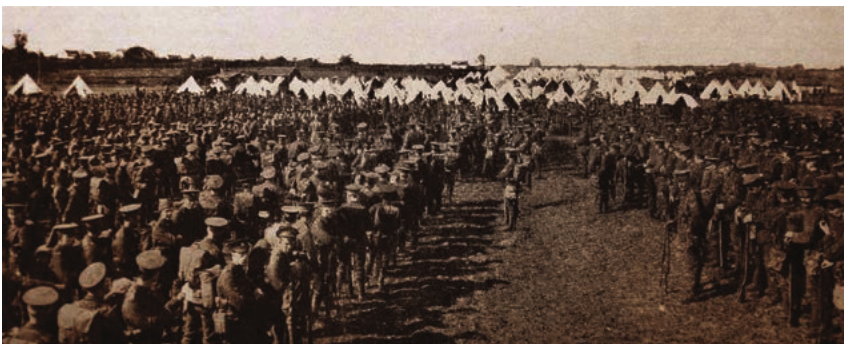
Meanwhile, the German Schlieffen Plan initially showed more promise. Although Belgian forces put up stiff resistance and Brussels fell on 20 August, German forces continued their advance. The British Expeditionary Force (BEF) had landed on the French coast and confronted the Germans at Mons on 23 August, holding up the German advance for two crucial days.
Battle of the Marne (12-28 August 1914)
The Battle of the Marne became the crucial engagement that saved France from defeat. French forces rushed every available soldier to the River Marne to mount a desperate defence against the German advance. The battle succeeded in stopping the Germans but at an enormous cost – 250,000 French casualties. German forces were pushed back to the Aisne River, marking the failure of the Schlieffen Plan's tight timetable.
Race to the Sea and First Battle of Ypres (September-November 1914)
As German forces retreated from the Marne, British commanders attempted to secure the Belgian coast and outflank the Germans. This led to what became known as the 'Race to the Sea' (25 September to 22 November), which culminated in the First Battle of Ypres (19 October to 22 November 1914).
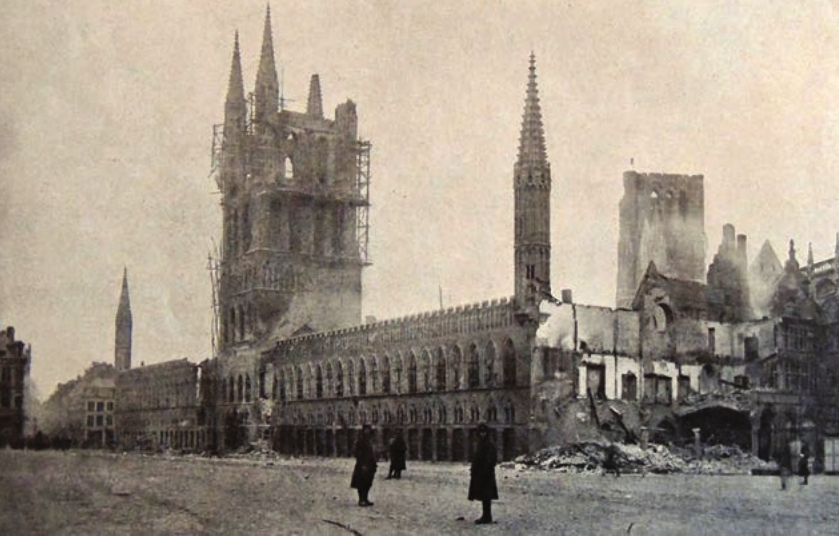
This battle effectively ended the war of movement on the Western Front. The opposing armies established trench lines that stretched from Dixmude on the English Channel all the way to the Swiss border. Unable to advance, both sides dug in, beginning the war of attrition that would last for three and a half years. The failure to break through at Ypres also meant Germany's strategic plan to defeat France quickly had completely collapsed. Germany now faced exactly what it had hoped to avoid: a war on two fronts.
Note
War of movement: Mobile warfare characterised by rapid advances and retreats, in contrast to the static trench warfare that followed.
War of attrition: A prolonged conflict in which each side tries to wear down the other through continuous losses in personnel and material.
Battles of Tannenberg and Masurian Lakes (August-September 1914)
Whilst the Schlieffen Plan unravelled in the west, Russia launched an offensive in the east, invading German territory in East Prussia. German Generals Hindenburg and Ludendorff commanded the German Eighth Army against the Russian First Army led by General Samsonov.
At the Battle of Tannenberg (26-30 August 1914), the Germans achieved the war's most spectacular military victory. The Russian First Army was completely destroyed: 30,000 soldiers were killed, 100,000 captured, and only 10,000 escaped. The defeat was so crushing that General Samsonov committed suicide.
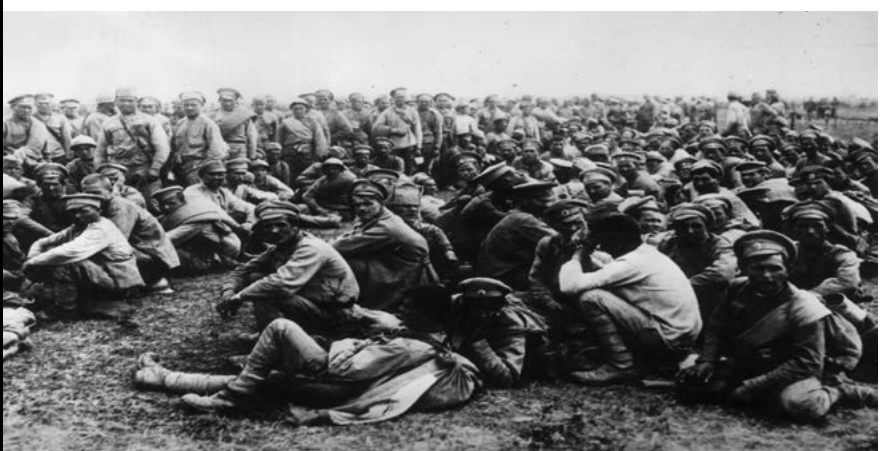
The German army then faced the Russian Second Army, led by General Rennenkampf, at the Battle of Masurian Lakes (9-14 September 1914). After strengthening their positions and receiving reinforcements from the Western Front, German forces pursued and defeated the Russians, who suffered 125,000 casualties.
These victories made Hindenburg and Ludendorff national heroes and established them as increasingly influential figures in German military and political affairs.
Other theatres of war in 1914
The war extended far beyond the Western and Eastern Fronts:
- Austro-Hungarian and Russian forces fought bitter battles with heavy casualties on both sides but achieved inconclusive results
- Austria-Hungary failed to capture Serbia by year's end
- Turkey engaged Russian forces near Kars, with Russia achieving some success
- Britain captured Cyprus
- British and Indian forces invaded Mesopotamia (modern-day Iraq)
- Japanese and British troops seized the German outpost of Tsingtao in China
- Australian forces captured German New Guinea and Nauru
- New Zealand forces captured the German colony of Samoa
The Christmas Day Truce
In December 1914, Pope Benedict XV appealed for a Christmas Day truce, hoping it might lead to peace negotiations. Although the warring governments rejected the appeal, an estimated 100,000 men in the trenches along the Western Front held their own unofficial Christmas truce. This remarkable event demonstrated the humanity that still existed despite the war's brutality. However, there would be no repeat of such truces for the remainder of the war.
Note
The Christmas Day Truce of 1914 remains one of the war's most poignant moments. Soldiers from opposing sides exchanged gifts, sang carols, and even played football in no-man's land. This spontaneous act of brotherhood contrasted sharply with the industrialised killing that would characterise the years ahead.
The situation at the end of 1914
Failed military objectives
By the end of 1914, both sides had failed to achieve their strategic goals. France's Plan 17 had been a complete disaster, resulting in massive casualties for minimal gain. Germany's Schlieffen Plan had left its army occupying positions in Belgium and France but failed to deliver the quick victory needed. The Russian offensive into Germany had been stopped decisively at Tannenberg and Masurian Lakes. None of the belligerents had achieved the breakthrough they expected.
Expanded war aims
Despite the lack of military success, both sides remained determined to continue fighting and actually expanded their objectives beyond the initial reasons for going to war.
Germany's September Program
When it initially appeared Germany might succeed in defeating France, Chancellor Theobald von Bethmann-Hollweg began defining expanded political objectives. On 9 September 1914, he announced the September Program, which went far beyond a defensive war. Germany now sought:
- Annexation of Belgium and northern France
- Control of the Baltic region
- Creation of a common European economic zone under German control
- Establishment of a German colonial empire in Central Africa
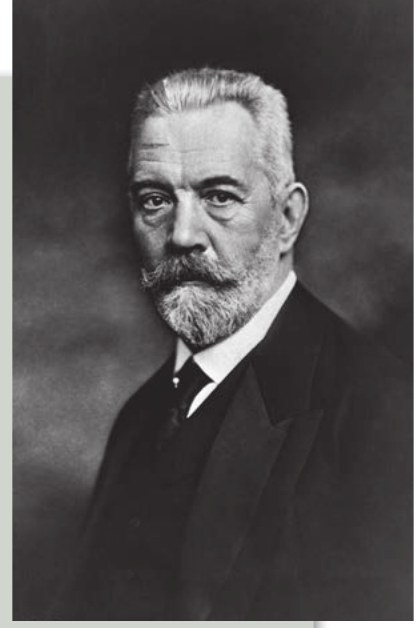
Bethmann-Hollweg remained German Chancellor until July 1917. Although he bore some responsibility for the poor decision-making in July 1914 that led to war, he was considered a political moderate. He later attempted to negotiate peace and opposed unrestricted submarine warfare, but his influence declined as military leaders gained more power.
The Pact of London
The Entente Powers (Britain, France, and Russia) recognised that maintaining their alliance was crucial to eventual success. On 4 September 1914, their foreign ministers signed a secret agreement known as the Pact of London. This committed all three nations to:
- Fight the war until a successful conclusion
- Not make a separate peace with the enemy
- Consult with each other regarding any communications from Germany about peace
This secret treaty was the first of many that would shape the war's conduct and eventual peace settlement. It demonstrated the critical role that alliances would play in the war's grand strategy and politics.
Important
Exam tip: When discussing the causes and nature of the war, remember that Germany's decision for war was motivated primarily by fear and strategic concerns rather than aggressive expansionism. The failure of both sides' war plans by the end of 1914 transformed the conflict into a prolonged war of attrition.
Summary
Key Points to Remember:
- Germany's decision for war in 1914 was driven by fear of being caught between hostile France and an increasingly powerful Russia, not by ambitions of conquest
- The Schlieffen Plan aimed to defeat France quickly within six weeks before turning to fight Russia, thus avoiding a two-front war
- Major battles of 1914 included the Battle of the Frontiers (French disaster with 329,000 casualties), the Battle of the Marne (250,000 French casualties but stopped German advance), and Tannenberg (devastating German victory with 30,000 Russians killed and 100,000 captured)
- By the end of 1914, both sides had failed to achieve their military objectives, leading to the establishment of trench warfare from the English Channel to Switzerland
- War aims expanded significantly beyond initial defensive goals, with Germany announcing the September Program seeking territorial annexations, whilst the Entente Powers signed the Pact of London committing to fight until victory