Overview of Projectile Motion (HSC SSCE Physics): Revision Notes
📚Revision Notes
Overview of Projectile Motion
What is a projectile?
A projectile is any object that has been launched, thrown, or fired into the air. Once in motion, a projectile doesn't power itself - unlike a bird or aeroplane that uses energy to maintain flight. Common examples include:
- A kicked football
- A bullet fired from a gun
- A thrown basketball
- Water droplets shot by an archer fish

After launch, a projectile's motion depends only on two factors: its initial velocity (the speed and direction at launch) and the gravitational force pulling it downward.
Understanding trajectory
The trajectory is the path that a projectile follows through the air. Two key elements determine this path:
- The initial velocity - how fast and in what direction the projectile starts moving
- The forces acting on it - in our simplified model, only gravity
Simplifying assumptions
To make calculations manageable, we assume that air resistance has no significant effect. This means gravity is the only force we need to consider after launch.
Important
In reality, air resistance can be quite significant, especially for fast-moving objects, but this simplified model still provides useful results for many situations.
The gravitational force near Earth's surface is constant and always points vertically downward, with magnitude:
where is the projectile's mass and is the acceleration due to gravity.
Acceleration of a projectile
Using Newton's second law, we can find the acceleration of any projectile:
This shows that every projectile accelerates downward at the same rate, regardless of its mass. We use the value:
The negative sign indicates downward direction.
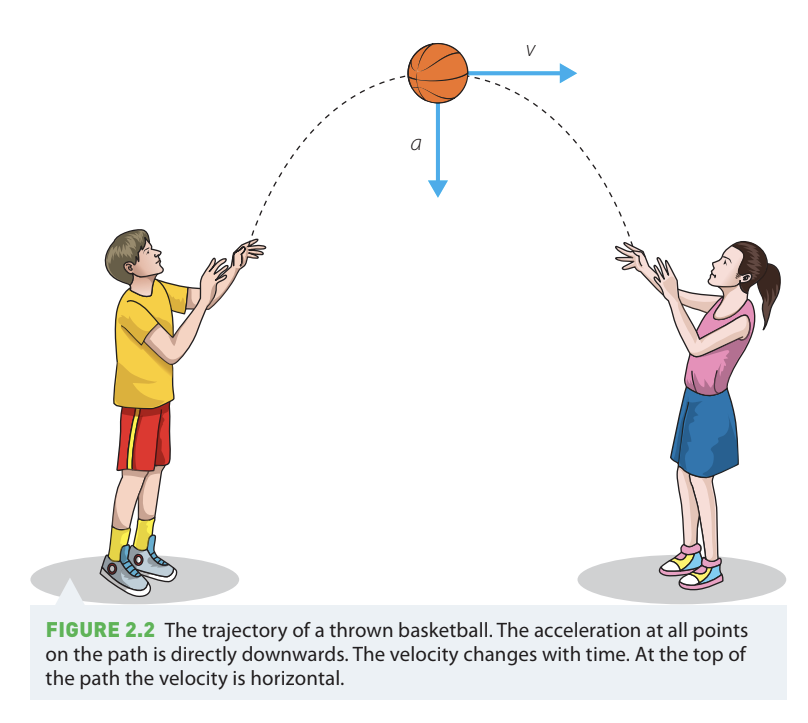
Breaking acceleration into components
Since acceleration is a vector, we can separate it into perpendicular components:
Note
Acceleration components:
- Horizontal component: (no horizontal force acts on the projectile)
- Vertical component: (gravity pulls downward)
This is crucial: the projectile experiences zero horizontal acceleration but constant downward vertical acceleration. The acceleration always points straight down, even when the projectile is moving upward or sideways.
Important
Important distinction: Acceleration pointing downward doesn't mean velocity points downward. Acceleration describes how velocity changes over time - the velocity and acceleration vectors don't need to point in the same direction.
Breaking down initial velocity
When a projectile launches at an angle, we need to split its initial velocity into horizontal and vertical parts. The angle above the horizontal is called the launch angle, represented by .
Using trigonometry, the initial velocity components are:
- Horizontal component:
- Vertical component:
where is the magnitude (size) of the initial velocity.
Example
Worked Example 2.1: Finding initial velocity components
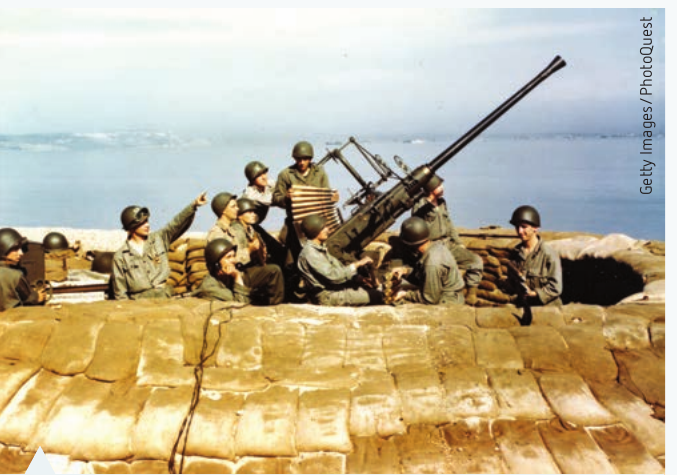
Question: A Bofors gun fires a shell with a muzzle velocity of at an elevation of above the horizontal. What are the vertical and horizontal components of the initial velocity?
Solution:
| Answer | Logic |
|---|---|
| , | Identify the relevant data |
| Write the expression for the horizontal component of | |
| Substitute values with correct units | |
| Calculate final value | |
| Write the expression for the vertical component of | |
| Substitute values with correct units | |
| Calculate the final value | |
| , | State final answer with correct units and appropriate significant figures |
Velocity during flight
The general equation for velocity under constant acceleration is:
We can separate this into horizontal and vertical components.
Horizontal velocity
For the horizontal direction:
Since (no horizontal acceleration):
Note
Key point: The horizontal velocity stays constant throughout the projectile's flight, equalling the initial horizontal velocity.
Vertical velocity
For the vertical direction:
Note
Key point: The vertical velocity changes continuously due to gravitational acceleration. It decreases on the way up, becomes zero at the maximum height, then increases downward on the way down.
Example
Worked Example 2.2: Finding velocity at a specific time
Question: For the shell from Worked Example 2.1, find the vertical and horizontal velocity components after . What is the magnitude and angle of the velocity at this time?
Solution:
| Answer | Logic |
|---|---|
| Identify the relevant data | |
| , | Refer to the previous worked example |
| Write the expression for the horizontal component of | |
| Substitute values with correct units to obtain the final value | |
| Write the expression for the vertical component of | |
| Substitute values with correct units | |
| Calculate the final value | |
| Write the expression for the magnitude of using Pythagoras' theorem | |
| Substitute values with correct units | |
| Calculate the final value | |
| Relate the angle to the velocity components | |
| Rearrange for angle | |
| Substitute values with correct units | |
| Calculate the final value | |
| , , | State the final answer with correct units and appropriate significant figures |
Position of a projectile
The position equation for constant acceleration is:
Position has both horizontal () and vertical () components.
Horizontal position
Since :
If we set the launch point as the origin ():
Vertical position
Substituting :
If the launch point is the origin ():
Example
Worked Example 2.3: Finding maximum height
Question: For the shell from the previous examples, at what time and height does it reach zero vertical velocity?
Solution:
| Answer | Logic |
|---|---|
| , | Identify the relevant data; refer to previous worked example |
| State the velocity at the time we need to calculate | |
| Write the expression for the vertical component of | |
| Rearrange for time | |
| Substitute values with correct units | |
| Calculate the final value | |
| Write the expression for the vertical position at this time | |
| Substitute values with correct units | |
| Calculate the final value | |
| , | State the final answer with correct units and appropriate significant figures |
Understanding maximum height
When the vertical velocity reaches zero, the projectile stops rising and begins to fall. This point represents the maximum height of the trajectory.
Notice that at maximum height:
- The vertical velocity is zero
- The horizontal velocity remains unchanged
- The projectile continues moving horizontally
The trajectory is symmetric - the path after reaching maximum height mirrors the path before it.
Important
Exam tip: In real situations with fast projectiles like bullets or shells, air resistance significantly affects the motion, and our calculated heights would overestimate the actual values.
Summary of projectile motion equations
The table below summarises all the key equations for analysing projectile motion:
| Component | Horizontal | Vertical |
|---|---|---|
| Position | ||
| Velocity | ||
| Acceleration |
Summary
Key Points to Remember:
- A projectile is an object that has been launched and doesn't propel itself during flight
- We model projectile motion by ignoring air resistance and treating gravity as the only force
- The trajectory (path) depends only on the initial velocity and gravitational force
- Initial velocity breaks into components: (horizontal) and (vertical)
- Horizontal velocity stays constant during flight because there's no horizontal acceleration
- Vertical velocity changes continuously due to gravitational acceleration ()
- At maximum height, the vertical velocity is zero, but the projectile still has horizontal velocity
- The trajectory is symmetric - the second half mirrors the first half