Forces (HSC SSCE Physics): Revision Notes
📚Revision Notes
Investigating the Motion of Objects on Inclined Planes
Introduction
Understanding how objects behave on sloped surfaces is fundamental to mechanics. When we analyze inclined planes, we're examining a common real-world scenario where gravity, friction, and support forces interact in interesting ways. This topic builds on our knowledge of forces and Newton's laws, applying them to situations where the surface isn't horizontal.
Note
Inclined plane problems appear everywhere in real life - from playground slides and wheelchair ramps to roads on hillsides and loading ramps. Understanding these systems helps us design safer structures and predict how objects will behave on slopes.
Forces acting on objects on inclined planes
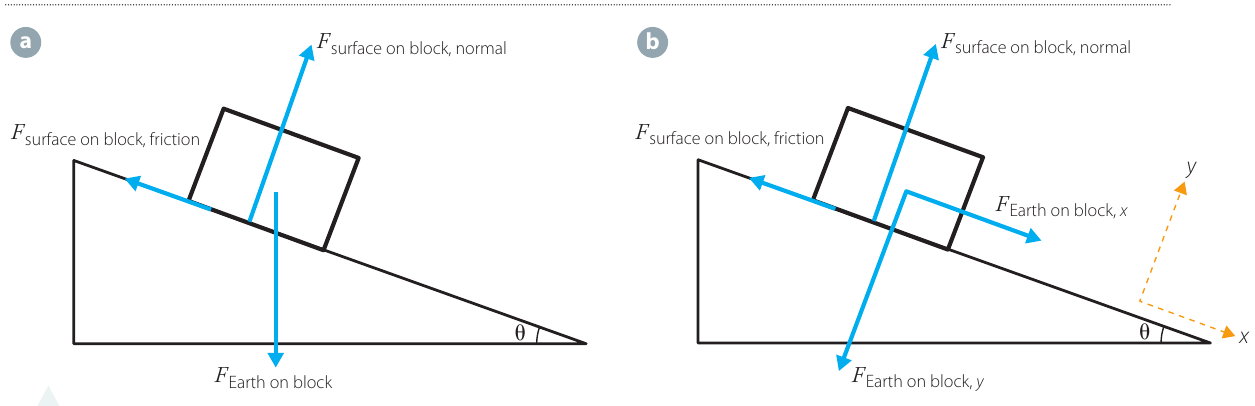
When an object rests on or moves along an inclined surface, three primary forces act upon it:
- Gravitational force (): This force always acts vertically downward toward the center of Earth, with magnitude , where is the object's mass and is the acceleration due to gravity.
- Normal force (): This force acts perpendicular to the surface of the slope, pushing the object away from the surface. The normal force prevents the object from sinking into the inclined plane.
- Friction force (): This force acts parallel to the slope's surface. When an object is stationary or moving up the slope, friction acts down the slope. When an object slides down, kinetic friction opposes the motion by acting up the slope.
These three forces are illustrated in the diagram below, which shows an object on an inclined plane at angle to the horizontal:
Choosing an appropriate coordinate system
In most physics problems, we use horizontal and vertical coordinate axes. However, when dealing with inclined planes, selecting axes aligned with the slope makes our calculations much simpler. Here's why:
We align the x-axis parallel to the slope and the y-axis perpendicular to the slope. This choice is strategic because:
- The object can only accelerate along the slope (parallel direction), not into or away from it
- If the object cannot move perpendicular to the slope, the net force in that direction must be zero
- Two of our three forces (normal force and friction) already act along these axes
- Only the gravitational force needs to be decomposed into components
Important
This coordinate system simplifies our analysis significantly because it reduces the number of forces we need to decompose. Instead of breaking down all three forces, we only need to decompose the gravitational force into components.
Decomposing the gravitational force
While the normal force acts along the y-axis and friction acts along the x-axis, the gravitational force acts vertically downward. We must decompose it into components:
- Parallel component (along x-axis): This component acts down the slope, trying to make the object slide downward.
- Perpendicular component (along y-axis): This component acts into the slope, compressing the object against the surface.
Note
Memory aids for trigonometric functions:
- "Sine for Slide" - the parallel component that makes objects slide uses sine
- "Cosine for Compression" - the perpendicular component that compresses into the surface uses cosine
These mnemonics help you remember which trigonometric function to use for each component.
Newton's second law in component form
We can now apply Newton's second law separately in each direction.
Perpendicular direction (y-axis)
Since the object cannot accelerate perpendicular to the slope, the net force in this direction equals zero:
Expanding this:
Therefore:
This tells us the normal force equals the perpendicular component of the gravitational force.
Parallel direction (x-axis)
In the parallel direction, the object may or may not accelerate, depending on whether friction can balance the gravitational component:
Expanding this:
If , the object is in equilibrium. If , the object accelerates down the slope.
Note
The key difference between the two directions: perpendicular to the slope, acceleration is always zero (the object can't move through the surface). Parallel to the slope, acceleration depends on the balance between friction and the gravitational component.
Static equilibrium on inclined planes
When an object remains stationary on a slope, it is in static equilibrium. This means the net force in both directions equals zero. We've already seen that the net force perpendicular to the slope is zero. For the parallel direction:
Therefore:
This equation tells us that the static friction force must exactly balance the gravitational component pulling the object down the slope. This equilibrium can only exist if the maximum possible static friction force is greater than or equal to .
Important
Key insight: As the angle increases, increases, so a larger friction force is needed to keep the object in place. Eventually, the angle becomes too steep, and the object begins to slide. This is why steeper slopes are more difficult to stand on or climb.
Sliding motion on inclined planes
When an object slides down an inclined plane, the kinetic friction force is less than the gravitational component down the slope. In this case, there is a net force parallel to the slope:
Rearranging to find acceleration:
Or equivalently:
This acceleration is directed down the slope. By measuring this acceleration experimentally, we can calculate the kinetic friction force acting between the object and the surface.
Note
Important distinction: This analysis applies to objects that slide on the surface. Objects that roll (like balls or cylinders) involve rotational motion, which is more complex and requires different equations. Rolling motion involves both translational and rotational kinetic energy.
Critical angle
The critical angle () is the angle at which an object just begins to slide down the inclined plane. At this angle, the static friction force reaches its maximum possible value:
By adjusting the angle of an inclined plane until an object just starts to slide, we can measure the critical angle and calculate the maximum static friction force between the surfaces. This is a useful experimental technique for studying friction between different materials.
Note
The critical angle is directly related to the coefficient of static friction. Different material combinations (wood on wood, rubber on concrete, metal on ice) will have different critical angles, reflecting their different friction properties.
Worked example: Harriet on the slide
Example
Worked Example: Calculating Forces on an Inclined Plane
Problem: Harriet sits on a slide to prevent her brother from using it. She has her bare feet braced against the slide, and friction prevents her from moving. If Harriet has a mass of and the slide makes an angle of to the horizontal, calculate the magnitude of each force acting on her.
Given information:
- Mass:
- Angle:
- Harriet is stationary, so (equilibrium)
The three forces acting on Harriet are the gravitational force from Earth, the normal force from the slide surface, and the friction force from the slide surface.
Step 1: Calculate the gravitational force
Step 2: Calculate the friction force
Using the equilibrium condition in the parallel direction:
Rearranging:
Rounding to appropriate significant figures:
Step 3: Calculate the normal force
Using the equilibrium condition in the perpendicular direction:
Rearranging:
Rounding to appropriate significant figures:
Final answers:
- Gravitational force: (downward)
- Normal force: (perpendicular to slide)
- Friction force: (up the slide)
Exam tip: Always start by drawing a clear force diagram showing all forces and their directions. Label your chosen coordinate axes clearly. This helps avoid sign errors and ensures you include all relevant forces.
Investigation: Motion of objects on inclined planes
Measuring the acceleration of objects on inclined planes allows us to determine the frictional forces acting between different surfaces. This investigation can also help us find the maximum static friction force by identifying the critical angle at which objects begin to slide.
Aim
Design your own investigation using objects sliding on inclined planes. For example, you might investigate:
- How does the angle of the incline affect the acceleration of a sliding object?
- What is the relationship between surface materials and friction on an incline?
- How does mass affect the motion of objects on an inclined plane?
Write a clear aim statement and formulate an inquiry question or hypothesis to guide your investigation.
Materials
Essential equipment:
- An inclined plane (adjustable to different angles is ideal)
- One or more objects to slide down the inclined plane
- A protractor or angle-measuring device
Additional equipment (depending on your investigation):
- Timing equipment (stopwatch, light gates, or motion sensors)
- Different surface materials to test various friction coefficients
- Various masses or weights
- Measuring tape or ruler for distance measurements
- Video recording equipment for motion analysis
Note
Consult with your teacher about available equipment and ensure your materials list matches your investigation design. Some schools may have specialized equipment like force sensors or motion detectors that can improve measurement accuracy.
Risk assessment
Important
Safety First
Before beginning any practical work, identify potential hazards and plan how to manage them safely. Consider:
- Could objects fall and cause injury?
- Are there sharp edges or pinch points on equipment?
- Could objects roll or slide in unexpected directions?
- Is there adequate space to conduct the experiment safely?
Document your risk assessment and obtain teacher approval before proceeding.
Method
Develop a detailed, step-by-step method for your investigation. Your method should:
- Clearly state what you will measure and how
- Identify your independent, dependent, and controlled variables
- Explain how you will minimise uncertainties in measurements
- Include sufficient detail that another student could replicate your experiment
- Specify the number of trials or measurements you will take
Have your teacher check and approve your method before you begin collecting data.
Results
Record all measurements as you make them, including:
- Appropriate units for all quantities
- Estimated uncertainties in your measurements
- Multiple trials to assess repeatability
Organise your results in a clear table format. For example:
| Angle () | Trial 1 time (s) | Trial 2 time (s) | Trial 3 time (s) | Average time (s) | Acceleration (m s) |
|---|---|---|---|---|---|
| ... | ... | ... | ... | ... | ... |
Analysis of results
Analyze your data to answer your inquiry question or test your hypothesis. This might involve:
- Calculating accelerations from distance and time measurements
- Determining friction forces using
- Plotting graphs to identify relationships between variables
- Calculating percentage differences or uncertainties
- Comparing calculated values with theoretical predictions
Show all calculations clearly and explain your reasoning.
Discussion
Reflect on your investigation:
- Did you answer your inquiry question? Was your hypothesis supported by the data?
- If other groups conducted similar investigations, do their results agree with yours? If not, why might they differ?
- What were the main sources of uncertainty in your measurements?
- How could you improve the investigation if you were to repeat it?
- What assumptions did you make in your analysis? Are they valid?
Conclusion
Write a concise conclusion that:
- Summarizes the key findings of your investigation
- Directly addresses your aim and inquiry question
- States any quantitative results with appropriate units and uncertainties
- Identifies the most significant limitation of your investigation
Note
Extension opportunity: This investigation could be expanded into a depth study by examining friction in greater detail, comparing rolling versus sliding motion, or testing objects with different shapes and surface materials. You might also investigate how temperature or surface texture affects friction coefficients.
Remember!
Summary
Key Points to Remember:
-
Three forces act on an object on an inclined plane: gravitational force (downward), normal force (perpendicular to surface), and friction force (parallel to surface).
-
Choosing coordinate axes parallel and perpendicular to the slope simplifies calculations because most forces naturally align with these axes.
-
The gravitational force must be decomposed into components: (down the slope) and (into the slope).
-
For an object in equilibrium on a slope: the friction force equals and the normal force equals .
-
When an object slides down a slope, its acceleration is , which is typically negative (indicating acceleration down the slope).
-
The critical angle is the angle at which an object just begins to slide, allowing measurement of the maximum static friction force.