Newton’s Laws and Friction (HSC SSCE Physics): Revision Notes
📚Revision Notes
Newton's Laws and Friction
Introduction
When you study objects in motion, you need to understand the relationship between forces and acceleration. In everyday life, you observe cars speeding up, trains braking, and aeroplanes taking off. All these situations involve forces acting on objects that are not in equilibrium. Newton's laws provide the framework for analysing these motions.

Newton's first law and everyday observations
Newton's first law states that in the absence of external forces, an object at rest remains at rest and an object in motion continues in motion with constant velocity. However, this second part seems to contradict what you observe in daily life.
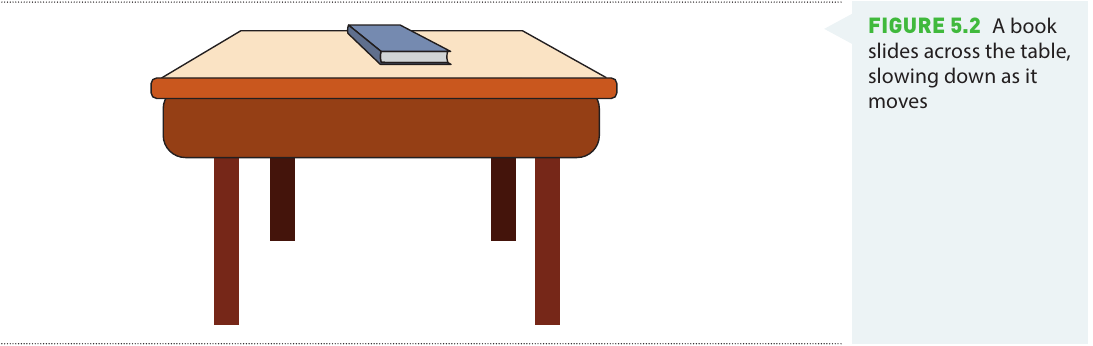
Consider a simple experiment: slide a book along a table surface. The book does not continue moving at constant velocity. Instead, it slows down and eventually stops.
Note
To understand this situation using Newton's first law, you must recognise that the book is accelerating. Even though the book moves forwards, it is slowing down. This means the book has an acceleration in the backwards direction (opposite to its motion). According to Newton's first law, this acceleration indicates that a force must be acting on the book.
Identifying forces on accelerating objects
To analyse the motion of any accelerating object, you need to identify all forces acting on it. Forces arise from interactions between objects. Use this systematic process:
Step 1: Consider field forces
Ask yourself which fields affect the object:
- Is the object in Earth's gravitational field? If so, it experiences a gravitational force downwards.
- Does the object have charge and exist in an electric field? If so, it experiences an electrostatic force.
- Is the object magnetic or moving with charge in a magnetic field? If so, it experiences a magnetic force.
For most everyday situations, you only need to consider gravitational forces.
Step 2: Consider contact forces
Identify everything the object touches:
- Surfaces exert a contact force with components both perpendicular (normal force) and parallel (friction) to the surface.
- Fluids like air and water exert drag forces (air resistance, water resistance) and buoyant forces.
Decide which contact forces are significant enough to include in your analysis. Sometimes friction or air resistance is negligible, but often these forces are important.
Step 3: Draw a force diagram
Once you have identified all forces, create a force diagram showing:
- The object (often represented as a point or simple shape)
- All forces as arrows pointing away from the object
- Arrow lengths indicating relative force magnitudes
- Clear labels for each force
Note
The object's acceleration tells you the direction of the net force, which helps you determine the directions and relative sizes of individual forces.
Example
Worked Example: Forces on a sliding book
Let's identify the forces acting on a book sliding across a table, slowing down as it moves to the right.
Forces acting:
- Gravitational force (): Acts downwards due to Earth's gravitational field
- Normal force (): Acts upwards, perpendicular to the table surface
- Friction force (): Acts horizontally, parallel to the table surface
Assumptions: The forces due to air are negligible compared to other forces, so we can ignore air resistance and buoyancy.
Analysis:
The net force must be horizontal and to the left because the book is slowing down (accelerating backwards). The only horizontal force is friction. Therefore, the friction force must be to the left.
Since there is no vertical acceleration, the vertical forces must balance. This means the normal force equals the gravitational force in magnitude.
Newton's second law and calculating forces
Once you have identified all forces, you can use Newton's second law to relate acceleration to the net force:
Important
This equation tells you that acceleration is proportional to the net force and inversely proportional to mass. The acceleration is always in the same direction as the net force.
Example
Worked Example: Calculating friction force
Ranji asks Phil if she can borrow his maths textbook. Phil slides the textbook along the table towards Ranji with an initial speed of . The book, with a mass of , slides along and comes to rest in . Calculate the frictional force acting on the book.
Given information:
- Mass:
- Initial velocity:
- Final velocity:
- Time:
Solution:
The net force equals the friction force (the only horizontal force):
To find acceleration, use the equation of motion:
Rearranging for acceleration:
Substituting this into Newton's second law:
The negative sign indicates the force acts opposite to the direction of motion (backwards).
Understanding friction
Friction is the component of the contact force that prevents one surface from sliding over another. It always acts parallel to the surface. The key characteristic of friction is that it opposes the relative motion of one surface against another.
Friction can act in different directions relative to an object's motion:
- With the motion: Friction enables you to walk forward. Your foot pushes backwards on the ground, and friction pushes you forwards.
- Against the motion: Friction causes a sliding book to slow down and stop.
The microscopic view of friction
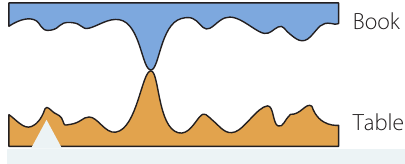
Friction arises from interactions between atoms at the surfaces of two materials. These interactions are electrostatic in nature. If you could examine any surface with extreme magnification, you would see that it is not perfectly smooth but has microscopic bumps and valleys.
Note
When two surfaces come into contact:
- Bumps on one surface can catch on bumps on the other surface
- Atoms on the surfaces can form temporary bonds where they touch
- The more one surface pushes into another (increasing the normal force), the more atoms interact, and the greater the friction force
Static friction
When you try to slide a book along a table, you must apply a force to get it moving. If you push very gently, the book does not move. This is because static friction acts to prevent motion.
How static friction behaves
Static friction has a special characteristic: it adjusts to match the applied force, up to a maximum value.
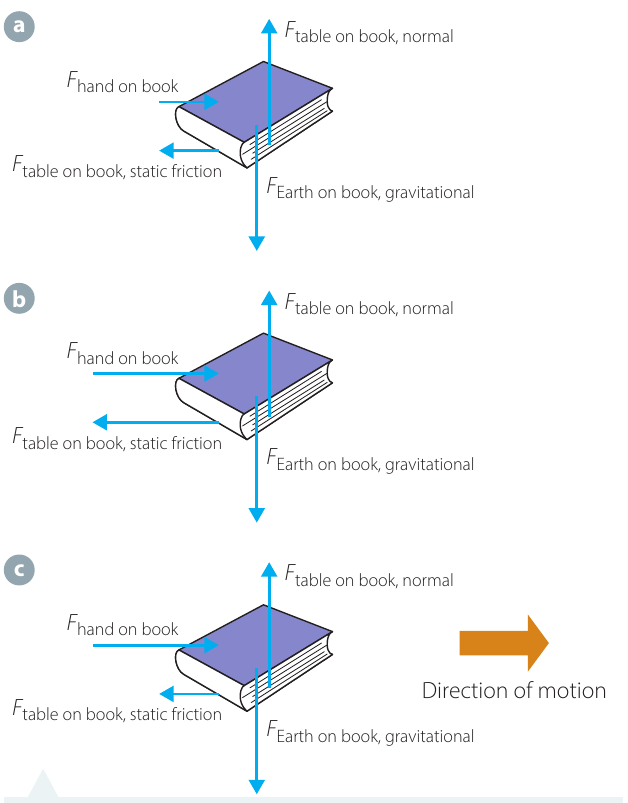
- Small applied force: The book remains stationary. The static friction force equals the applied force in magnitude but acts in the opposite direction. The net force is zero.
- Increasing applied force: As you push harder, the static friction force increases to match your applied force. The book still does not move.
- Maximum static friction: Eventually, you reach a point where the friction force cannot increase any further. This maximum value is called the maximum static friction force.
- Beyond the maximum: If you apply a force greater than the maximum static friction, the bonds between surfaces break and the bumps push past each other. The book begins to slide.
Mathematical model for static friction
Important
The static friction force can take any value from zero up to a maximum:
where:
- is the coefficient of static friction (a dimensionless constant)
- is the normal force between the surfaces
The maximum static friction force is:
Kinetic friction
Once an object starts sliding, the friction force acting on it decreases. The friction force during sliding is called kinetic friction. If you perform the sliding book experiment carefully, you will feel this sudden decrease when the book starts to move.
Characteristics of kinetic friction
Unlike static friction, kinetic friction:
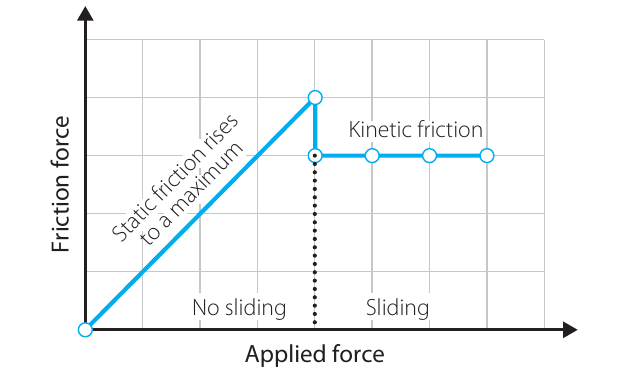
- Has a constant value (for a given pair of surfaces)
- Is less than the maximum static friction force
- Is independent of other forces applied parallel to the surfaces
- Is independent of the speed of sliding (to a good approximation)
Note
The graph shows how friction force changes with applied force. In the "no sliding" region, static friction increases linearly with applied force. Once sliding begins, kinetic friction remains constant at a lower value.
Mathematical model for kinetic friction
Important
The kinetic friction force is proportional to the normal force:
where:
- is the coefficient of kinetic friction (a dimensionless constant)
- is the normal force between the surfaces
The more one surface pushes into another (increasing the normal force), the greater the kinetic friction. This is because more atoms are interacting between the surfaces.
Coefficients of friction
The coefficients of friction ( and ) depend on the properties of the two surfaces in contact. These values are:
- Dimensionless (no units)
- Usually between 0 and 1, but can exceed 1
- Different for different material combinations
- Approximately constant for a given pair of surfaces
Important
Important relationship: For any pair of surfaces, . The coefficient of static friction is always greater than the coefficient of kinetic friction.
Typical values
| Surfaces | ||
|---|---|---|
| Rubber on concrete | 1.0 | 0.8 |
| Glass on glass | 0.94 | 0.4 |
| Wood on wood | 0.25–0.5 | 0.2 |
| Steel on steel, unlubricated | 0.74 | 0.57 |
| Steel on steel, lubricated | 0.15 | 0.06 |
| Ice on ice | 0.1 | 0.03 |
Observations from the table:
- Smoother surfaces (like lubricated steel or ice) have lower coefficients of friction
- Rougher surfaces (like rubber on concrete) have higher coefficients
- Lubrication significantly reduces friction
- Static friction coefficients are consistently higher than kinetic friction coefficients
Example
Worked Example: Calculating friction forces with different applied forces
A textbook sits on a table. The coefficient of static friction between the book and table is , and the coefficient of kinetic friction is . Calculate the friction force acting on the book when Ranji pushes it with a horizontal force of:
Given information:
- Mass:
- Coefficient of static friction:
- Coefficient of kinetic friction:
Solution:
First, calculate the maximum static friction force to determine whether the book will slide for each applied force.
The normal force equals the gravitational force (no other vertical forces act):
Maximum static friction force:
Part 1: Applied force = 2.5 N
The applied force () is less than the maximum static friction force (). Therefore, the book does not slide. The static friction force adjusts to equal the applied force:
Part 2: Applied force = 5.0 N
The applied force () is still less than the maximum static friction force (). The book does not slide. The static friction force equals the applied force:
Part 3: Applied force = 7.5 N
The applied force () exceeds the maximum static friction force (). The book slides. Now kinetic friction acts:
Notice that once the book starts sliding, the friction force drops from to .
Applications of friction
Car acceleration
When a car accelerates, the engine provides power to rotate the wheels. However, it is not the engine that directly accelerates the car forwards. Instead, friction between the tyres and the road provides the forward force.
Here is how it works:
- The engine causes the wheels to rotate
- The rotating tyres push backwards against the road
- By Newton's third law, the road pushes forwards against the tyres
- This forward force is the static friction force between the tyres and road
- This friction force accelerates the car
Note
If the friction is insufficient, the wheels spin without the car moving forward. This happens when:
- The road is icy (low coefficient of friction)
- The engine applies too much power (applied force exceeds maximum static friction)
- The car attempts to accelerate too quickly
Example
Worked Example: Maximum acceleration of a car
The coefficient of static friction between a racing car's tyres and the road surface is . The car has a mass of . Calculate the maximum acceleration possible for this car on a flat road.
Given information:
- Mass:
- Coefficient of static friction:
Solution:
Using Newton's second law:
The maximum net force equals the maximum static friction force (the only horizontal force):
The normal force equals the gravitational force (no other vertical forces):
Therefore:
Substituting into Newton's second law:
Important observation: The maximum acceleration is independent of the car's mass! The mass cancels out in the calculation. This means a heavier car has the same maximum acceleration as a lighter car (assuming the same coefficient of friction), because although the heavier car requires more force to accelerate, it also has a greater normal force, which provides proportionally more friction.
Investigation: Measuring friction coefficients
You can measure the coefficients of static and kinetic friction experimentally using an inclined plane (ramp).
Equipment needed
- Adjustable ramp
- Box
- Set of weights
- Protractor
- Stopwatch or data logger
- Weighing scales
Safety considerations
Important
Risk: The box with weights may slide off the end of the ramp and hit someone.
Management: Keep the area at the end of the ramp clear of people.
Method for static friction (Part 1)
- Measure the mass of the box with one weight inside
- Place the box on the horizontal ramp
- Slowly raise one end of the ramp until the box just begins to slide
- Record the angle at which sliding starts
- Make repeated measurements to improve accuracy
- Add another weight to the box and measure the total mass
- Repeat the process for at least six different masses
Method for kinetic friction (Part 2)
- Set the ramp at an angle large enough to overcome the maximum static friction
- Measure the mass of the box with one weight inside
- Place the box on the ramp and release it from rest
- Measure the time taken for the box to slide a known distance
- Make repeated measurements to improve accuracy
- Add another weight and repeat for at least six different masses
Data analysis
Part 1 - Static friction:
- Draw a force diagram for the box on the ramp
- Identify forces parallel to the ramp surface
- Use trigonometry to express the static friction force in terms of the angle and mass
- Calculate the maximum static friction force for each mass
- Plot maximum static friction force against mass
- Find the gradient of the line of best fit
- The gradient equals , allowing you to calculate
Part 2 - Kinetic friction:
- Use kinematics equations to calculate acceleration for each mass
- Apply Newton's second law to calculate the net force
- Plot net force against mass
- Find the gradient of the line of best fit
- Express the gradient in terms of the angle, , and
- Calculate from the gradient
Drag forces in fluids
Fluids (liquids and gases) also exert frictional forces on objects moving through them. These forces are called drag forces or resistive forces. Examples include:
- Air resistance (or air drag) on objects moving through air
- Water resistance on objects moving through water
Differences from solid surface friction
Drag forces differ from friction between solid surfaces in important ways:
- Speed dependence: Drag forces depend on the relative speed between the object and fluid
- Air resistance increases with the square of speed:
- Liquid drag is proportional to speed:
- Magnitude: Drag forces can be very large, especially at high speeds
- Mechanism: The physical mechanism is different (fluid flow and pressure differences rather than surface interactions)
Practical implications
Note
The relationship between air resistance and speed explains why driving at is more fuel efficient than driving at . At the higher speed, air resistance is:
times greater (approximately 50% more drag force), requiring significantly more fuel to maintain speed.
Summary
Key Points to Remember:
-
If an object is accelerating (including slowing down), a net force must be acting on it. Use Newton's first law to identify that forces are present.
-
To identify forces, consider both field forces (gravitational, electric, magnetic) and contact forces (normal, friction, drag). Draw force diagrams to visualise all forces.
-
Static friction prevents motion and can take any value up to a maximum: . This force enables walking, rolling wheels, and stationary objects on slopes.
-
Kinetic friction acts during sliding and has a constant value: . It is always less than the maximum static friction.
-
Friction forces oppose relative motion between surfaces but can act in the direction of an object's motion (like when walking forward) or opposite to it (like when a book slides to a stop).
-
The coefficient of static friction () is always greater than the coefficient of kinetic friction () for the same pair of surfaces.
-
In car acceleration, it is the static friction between tyres and road that provides the forward force, not the engine directly. Maximum acceleration is limited by friction: .