Potential Energy and Work in an Electric Field (HSC SSCE Physics): Revision Notes
📚Revision Notes
Potential Energy and Work in an Electric Field
Introduction to energy in electric fields
Energy exists in two main forms: potential energy and kinetic energy. Moving objects possess kinetic energy, while objects subject to a force have potential energy. An object in Earth's gravitational field, for example, has gravitational potential energy. This potential energy exists because of the interaction between the object and Earth - the energy belongs to the system as a whole.
Note
Energy is always conserved. When you drop a pencil, its gravitational potential energy transforms into kinetic energy. This transformation occurs because the gravitational field exerts a force on the pencil.
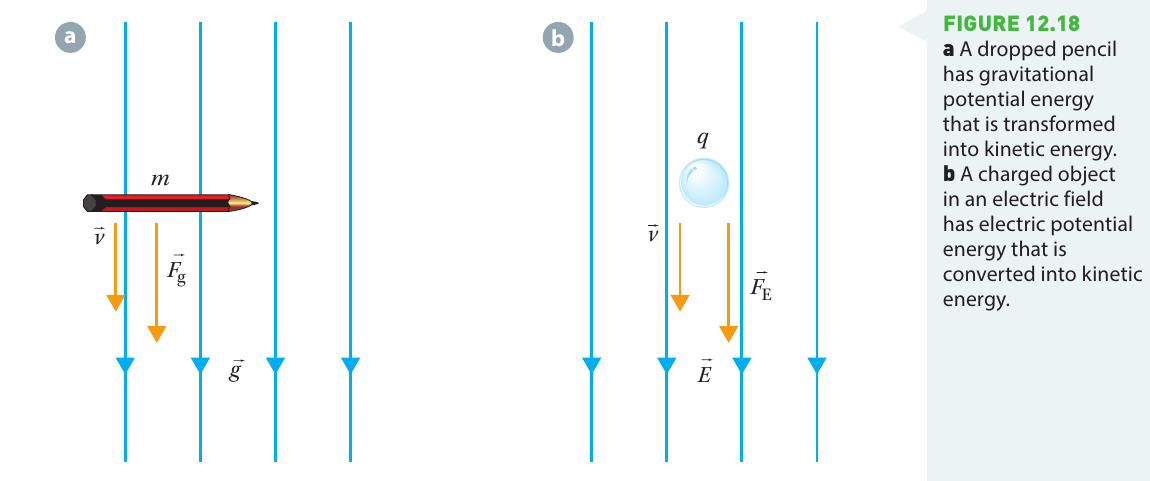
Charged objects in electric fields behave similarly to objects in gravitational fields. A charged object in an electric field has electric potential energy that can be converted into kinetic energy. If a charged object starts at rest in an electric field and is released, it will accelerate because the field exerts a force on it through some distance, doing work on the object.
Work done by electric fields
Review of work and gravitational fields
The gravitational force is given by . Work () done by a force () on an object displaced a distance () in the direction of the force is:
When a pencil falls through a height , the gravitational field does work on it:
Work in electric fields
A charged object in an electric field experiences a force given by:
When a charged object is displaced by distance in the direction of the field, the work done on the object is:
This work equals the change in potential energy of the object-field system:
Note
The negative sign indicates that when work is done by one part of the system on another, the potential energy of the system decreases.
Electric force is a conservative force, just like gravitational force. This means the change in potential energy appears as a change in kinetic energy:
Important
Fields store energy. The gravitational field stores gravitational potential energy, and the electric field stores electric potential energy. Fields are not only a way of exerting force at a distance - they also act as energy stores.
Worked example: Charged bead between plates
Example
Worked Example: Charged Bead Between Plates
A charged polystyrene bead is placed between two charged parallel plates. The bead has a mass of and a charge of . The field between the plates has a magnitude of . Ignoring friction and assuming the bead starts from rest, calculate its speed after moving .
Given data:
Solution:
Start with the work-energy relationship:
The kinetic energy change is:
Combining these equations:
Rearranging for speed:
Checking units:
Substituting values:
Does energy increase or decrease?
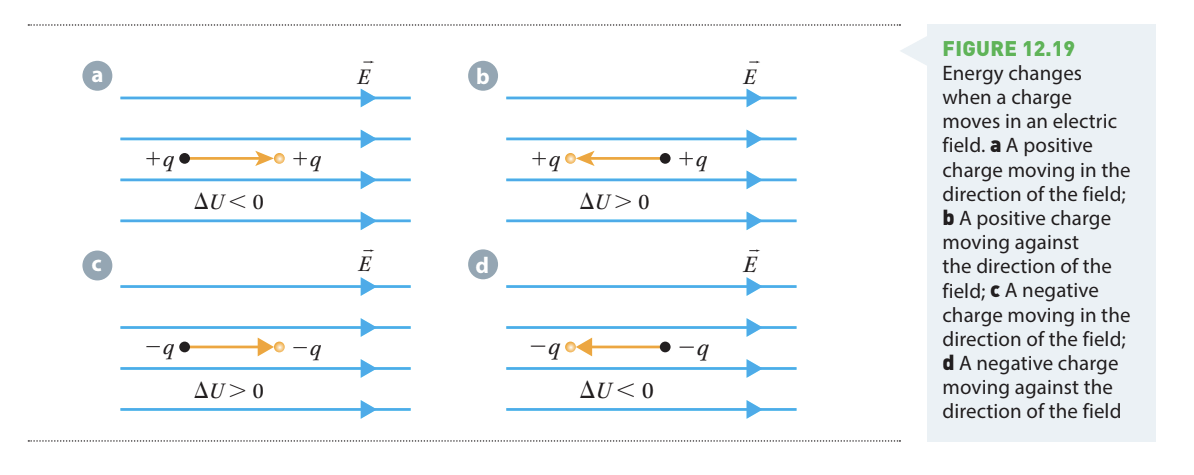
Understanding signs is crucial. A positive charge moving in the direction of an electric field (where and have the same sign) has positive work done on it and gains kinetic energy. For a negative charge to gain kinetic energy, it must move in the opposite direction to the field.
Important
This makes physical sense:
- Electric fields point away from positive charges
- Positive charges are repelled by other positive charges and accelerate away from them
- Negative charges are attracted to positive charges and accelerate towards them, against the field direction
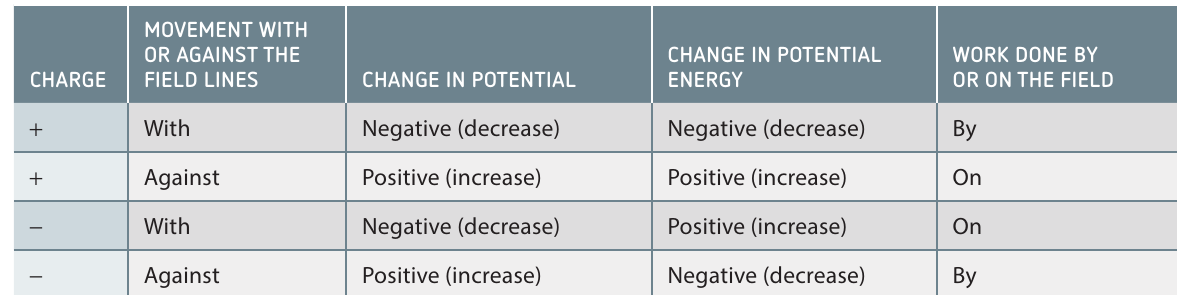
The table above summarises when work is done by or on the field:
- Work done by the field: Positive charge moving with the field, or negative charge moving against the field
- Work done on the system: Positive charge moving against the field, or negative charge moving with the field
The 'zero' of electric potential energy
In our equations, we refer to changes in potential energy () rather than absolute potential energy (). Potential energy is always measured relative to some zero reference point. For gravitational potential energy near Earth's surface, we typically choose ground level as zero. However, this choice isn't useful when considering astronomical objects like the Sun and planets.
For electric potential energy, there's no obvious zero point. The convention is to choose the configuration where the force is zero. When the field (and hence force) is zero, no work can be done. This occurs when the object creating the field and the object experiencing the force are infinitely far apart and no longer interact.
Important
Convention: The zero of electric potential energy is defined as infinite separation between charged objects.
Electric potential, energy and field
Defining electric potential
Electric potential is extremely useful when working with electric fields and circuits. It has the same relationship to potential energy that field has to force.
Electric field is defined as force per unit charge:
Similarly, electric potential () is defined as potential energy per unit charge at a point:
Note
Units: Electric potential is measured in joules per coulomb (), also known as volts (). Thus:
Just as force depends on both the object exerting it and experiencing it, but field depends only on the source, potential energy depends on all objects in a system, but potential depends only on the charged object creating the field.
Potential difference
We usually define zero potential as being infinitely far from any charged objects, consistent with our choice for potential energy. However, this is arbitrary and not always practical to measure.
Instead of absolute potentials, we typically work with potential differences - the difference in electric potential between two points:
Note
The unit for potential difference is the volt (), the same as for potential. Sometimes just is used for potential difference, but properly should be used to indicate it's a difference. Potential difference is sometimes called voltage, though "potential difference" is more precise.
When a charged particle moves through a potential difference , its potential energy changes by:
Assuming no other forces act, the kinetic energy must change by the same amount but with opposite sign, due to energy conservation.
Worked example: Alpha particle potential energy change
Example
Worked Example: Alpha Particle Potential Energy Change
An alpha particle with charge passes through a potential difference of . What is the change in potential energy?
Given:
Solution:
Using the formula:
Substituting values:
The positive change in potential energy means either kinetic energy was lost from the system, or the system was not isolated (external work was done on it).
Relationship between field and potential
We can derive a relationship between electric field and potential using the work-energy relationship:
For an electric field:
Dividing both sides by charge :
Rearranging:
Important
This equation reveals several important points:
-
Alternative units for electric field: Field can be expressed as as well as
-
Direction: The negative sign tells us the electric field direction is opposite to the direction of increasing potential
-
Physical meaning: A positively charged object released from rest in an electric field accelerates in the field direction. The field force increases the object's kinetic energy. By energy conservation, this must come from a decrease in potential energy. Therefore, must be negative - there's a drop in potential in the direction of a field line.
For a negatively charged object moving from higher to lower potential (where is negative), the change in potential energy is positive. This can only occur if the charge has initial kinetic energy or if an external force does work on the system. In circuits, batteries provide this additional potential energy.
Worked example: Electron in X-ray machine
Example
Worked Example: Electron in X-ray Machine
An electron in an X-ray machine is accelerated through a potential difference of before colliding with a target. What is the electron's energy just before impact? Give the answer in both electron volts and joules.
Given:
Solution:
By energy conservation:
The potential energy change is:
Therefore:
Substituting values:
In electron volts: An electron gains for each volt it passes through, so:
The electron volt
Subatomic particles moving through potential differences are so common that a special energy unit is used: the electron volt (eV).
When an electron moves through a potential difference of , its energy change is:
Important
Therefore:
The electron volt is appropriately sized for describing subatomic particle energies - the joule is very large by comparison. The eV is commonly used in nuclear physics, particle physics, and chemistry to describe reaction energies.
Important: The electron volt is a unit of energy, not potential difference.
Equipotentials
Understanding equipotentials
Sometimes the field-potential equation is written as:
However, this omits two crucial aspects:
Important
-
The negative sign is missing: This form gives only the field magnitude, not direction. Remember: potential decreases in the field direction.
-
The delta () is important: There must be a change in potential for an electric field to exist. It's not sufficient for potential to be non-zero - it must be changing.
If there's no change in potential between two points (), then the electric field is zero in that direction. However, since field is a vector, it may have non-zero components in other directions. The in this equation should really be a potential difference, not potential at a point.
Equipotential lines (in 2D) or equipotential surfaces (in 3D) are lines or surfaces along which the potential is constant. Therefore, between any two points on an equipotential line or surface.
Perpendicularity of field lines and equipotentials
We can decompose any vector into perpendicular components. If we break the electric field into components parallel and perpendicular to an equipotential:
- The parallel component must be zero (since along the equipotential)
- Only the perpendicular component(s) are non-zero
Important
Key principle: Electric field lines are always perpendicular to equipotential lines.
Worked example: Equipotentials for a point charge
Example
Worked Example: Equipotentials for a Point Charge
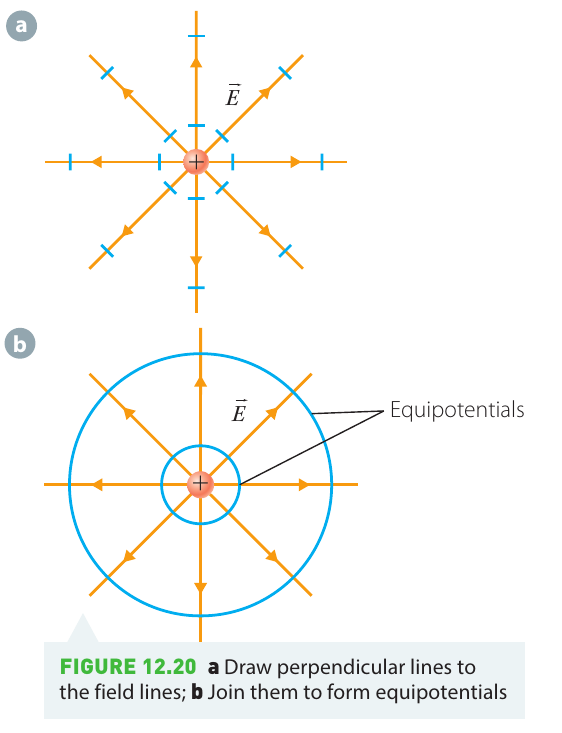
For the electric field of a single positive point charge, draw the equipotential lines.
Solution:
Since field lines must be perpendicular to equipotentials:
- Draw perpendicular lines to the radial field lines
- Join these perpendicular points to form continuous equipotential lines
- For a point charge, equipotentials form concentric circles (or spheres in 3D) centred on the charge
For a uniform field between parallel plates, equipotentials would be straight lines perpendicular to the field lines.
Investigation 12.3: Mapping equipotential lines
Aim
To map equipotential lines for a dipole and verify that they are perpendicular to electric field lines.
Materials
- DC power supply with leads
- Conductive paper
- Voltmeter
Risk assessment
Important
Safety note: Power supplies can be dangerous if not used correctly. Only connect the power supply as instructed.
Method
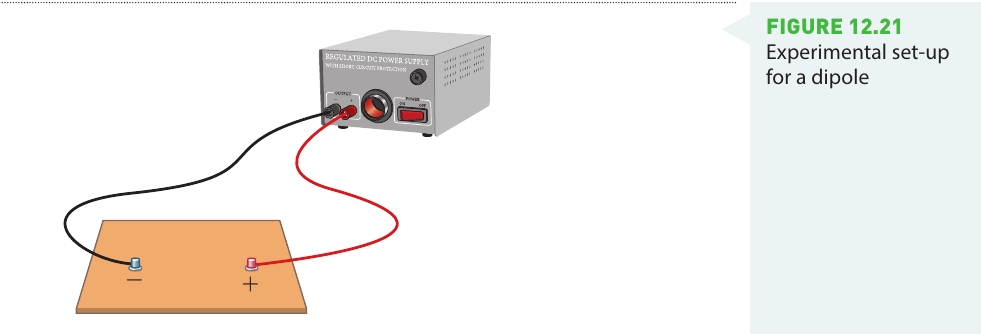
- Attach the positive terminal of the power supply to a point near one end of the conductive paper and the negative terminal near the other end. This creates a dipole with positive and negative electrodes on the paper.
- Record the electrode positions by tracing around them on the paper.
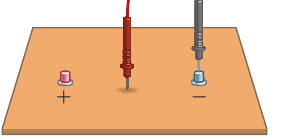
- With one voltmeter probe touching the negative electrode, move the other probe around on the paper until you get a reading of . Mark this point.
- Carefully move the probe around and mark other points of potential on the paper. Join the dots - this is your first equipotential line. Label it .
- Repeat steps 3 and 4 to map equipotential lines of , , and potential. Label each line.
Results
You should now have a piece of paper showing a set of equipotential lines.
Analysis of results
- Use the equipotential lines to draw electric field lines for your electrode arrangement. Remember: field lines must be perpendicular to equipotentials.
- Plot graphs of potential as a function of distance from one of your electrodes. Do this for:
- The line joining the two electrodes
- At least one other line
Discussion questions
- Are the equipotential lines equally spaced?
- Do the field lines look as expected from theory?
- Describe the relationship between potential and distance from the electrodes. Write an equation to describe this relationship.
Conclusion
With reference to the data obtained and its analysis, write a conclusion based on the aim. Was your hypothesis supported or disproved?
Remember!
Summary
Key Points to Remember:
-
Work by electric fields: Electric fields do work on charged objects by exerting a force on them, changing the system's potential energy and the object's kinetic energy:
-
Zero reference: The zero of electric potential energy is conventionally defined as when charged objects are infinitely far apart and exert no forces on each other
-
Electric potential: Potential energy per unit charge at a point: . Units are volts (), where
-
Potential difference: Usually we measure potential differences rather than absolute potentials:
-
Energy changes: When a charged particle moves through potential difference , its potential energy changes: . By energy conservation, kinetic energy changes equally and oppositely (if no friction acts)
-
Field-potential relationship: Electric field relates to potential difference by . The field can be expressed in units of or
-
Direction rule: The electric field direction is opposite to the direction of increasing potential - field lines point "downhill" in potential
-
Charge behaviour: Positive charges lose potential energy and gain kinetic energy when moving from higher to lower potential (with the field). Negative charges gain potential energy and lose kinetic energy when moving from higher to lower potential
-
Electron volt: A convenient energy unit for subatomic particles: . It represents the energy change when an electron moves through potential difference
-
Equipotentials: Lines or surfaces of constant potential where between any two points. Electric field lines are always perpendicular to equipotential lines