Magnetism and Magnetic Materials (HSC SSCE Physics): Revision Notes
📚Revision Notes
Magnetism and Magnetic Materials
Introduction to magnetic fields
Moving electric charges generate magnetic fields, which in turn exert forces on other moving charges. This is similar to how gravitational fields are produced by objects with mass and electric fields are created by charged objects. The key difference is that magnetic fields specifically arise from the motion of charged particles, such as electrons flowing in an electric current. Some materials also produce magnetic fields due to the behaviour of electrons within their atomic structure.
Note
Magnetic fields play an important role in our daily lives and in nature. Earth possesses a magnetic field that shields us from harmful cosmic radiation from the Sun. Magnetic materials are essential components in many modern devices, including transformers, computer hard drives, and USB storage devices.
Understanding magnetic fields
Symbol and units
In physics, we represent magnetic fields using the symbol . The standard unit for measuring magnetic field strength is the tesla, represented by the symbol . The tesla is quite a large unit, so everyday magnetic fields are typically measured in millitesla () or microtesla ().
Note
Magnetic Field Strength Examples:
To give you some perspective on magnetic field strengths:
- Earth's magnetic field varies between approximately and at the surface, depending on your location
- Strong permanent magnets made from neodymium alloys can produce fields around
- Specialised laboratory equipment using high-power technology can generate fields approaching
Origins of the term "magnet"
The words "magnet" and "magnetism" derive from magnetite, which is an iron ore with the chemical formula . Ancient Greeks discovered magnetite's ability to attract iron approximately 3000 years ago. According to legend, the material was named after a shepherd called Magnes, whose iron shoe nails reportedly became stuck to pieces of magnetite whilst he was tending his flocks.
Ferromagnetic materials
Materials capable of being magnetised are termed ferromagnetic, where the prefix ferro means iron. Most magnetic materials used today still contain iron as a key component. When a material becomes magnetised, it generates its own magnetic field. It's important to understand that most materials are not ferromagnetic and cannot be magnetised.
Once magnetised, ferromagnetic materials experience an attractive force when placed in a magnetic field. You've likely observed this phenomenon when using a magnet to pick up pins or paper clips. The presence of the external magnetic field is what magnetises the material initially. After becoming magnetised, the material then experiences a force due to the magnetic field.
Investigation 14.1: Identifying magnetic materials
Aim
To identify some ferromagnetic materials through experimental observation.
Materials
- Strong magnet
- Paper clips
- Coins
- Iron filings in a transparent container
- Other magnets including fridge magnets
- Samples of various materials including plastics, copper, and aluminium
Safety considerations
| What are the risks in doing this investigation? | How can you manage these risks to stay safe? |
|---|---|
| Magnets can become demagnetised by being dropped or banged together repeatedly | Avoid dropping the magnets or allowing them to bang together |
| A pair of strong magnets can pinch you | Handle magnets one at a time |
| Magnets can be toxic, and small magnets are choking hazards | Never put a magnet in your mouth and always wash your hands after any investigation |
Method
- Gather your sample materials and arrange them on your desk with adequate spacing
- Place the strong magnet close to the first sample
- Record the sample's response
- Move the strong magnet away, reverse it, and place it close to the sample again (this time the opposite end of the magnet will be close to the sample)
- Record the sample's response
- Repeat steps 2–5 for each of your samples
Results
Create a table to summarise your results. Include your predictions, written before you test each sample.
| Sample | Predicted Behaviour | Observed Behaviour |
|---|---|---|
Analysis of results
- Can you identify any patterns in your results?
- Were all the metal samples attracted to the magnet?
- Was it only metals that were attracted?
- Did it matter which end of the magnet you used?
Discussion
- State whether your results agree with what you expected
- List two ways you could improve this experiment
Conclusion
With reference to the data obtained and its analysis, write a conclusion based on the aim of this investigation.
Note
Key Finding: Not all metals are ferromagnetic! You should observe that only certain materials (primarily those containing iron, nickel, or cobalt) are attracted to the magnet, regardless of which end of the magnet is used.
The microscopic origin of magnetism
Electron shell structure
Most materials are not ferromagnetic. The properties and behaviour of electrons within a material determine whether it exhibits ferromagnetism. From chemistry, you know that electrons orbit the atomic nucleus in shells. Within these shells, electrons occupy specific orbitals (designated as 1s, 2s, 2p, and so on). The shell structure can change when atoms bond together to form molecules.
Electrons as tiny currents
Every electron in a material creates its own small magnetic field as it orbits the nucleus. This occurs because the orbiting electron acts as a tiny circular electric current. When an orbital contains two electrons (called paired electrons), they create magnetic fields in opposite directions, which cancel each other out completely. Materials that only have paired electrons are not ferromagnetic.
Important
Critical Concept:
Ferromagnetism arises from unpaired electrons in the shells.
Only materials with unpaired electrons can become ferromagnetic because paired electrons produce magnetic fields that cancel out.
Electron spin
Beyond their orbital motion, electrons possess a property known as spin. The electrons probably aren't literally spinning like a ball, but this term describes a quantum mechanical property. Electrons have their own inherent magnetic field in addition to the field produced by their orbital motion. If a charged sphere were actually rotating, it would indeed produce a magnetic field, which is why this property is called "spin."
Note
The spin of a particle represents a measure of the particle's intrinsic magnetic field. This is a fundamental quantum mechanical property that contributes to the overall magnetic behavior of materials.
Total magnetic field from electrons
Electrons in materials therefore have magnetic fields from two sources:
- Their orbital motion around the nucleus
- Their intrinsic spin
The total magnetic field from each electron is the sum of these two contributions.
In materials where all electrons are paired, the magnetic fields from each electron in a pair cancel out completely. Even in materials containing unpaired electrons, their magnetic fields may be randomly oriented and cancel each other out overall.
Magnetic domains
In ferromagnetic materials, the fields from unpaired electrons tend to align parallel to each other. However, this alignment usually occurs only in small localised regions called magnetic domains. Since each domain may have a different orientation, the overall magnetic field of an unmagnetised ferromagnetic material is still zero or very small. However, if the magnetic fields in different domains can be aligned in the same direction, the result is a material with a large overall magnetic field – a magnet.
Note
Protons and neutrons in the nucleus also have spin and their own magnetic fields, but the total magnetic field from the nucleus is extremely small compared to that from electrons. Therefore, nuclear magnetism doesn't contribute significantly to ferromagnetic behaviour, although it is important in technologies such as nuclear magnetic resonance (NMR) imaging or magnetic resonance imaging (MRI).
Magnetic poles
Forces between magnets
When two magnets are brought close together, they exert a force on each other. This force acts at a distance, demonstrating that the magnetic field must exist. The field model for forces, whether gravitational, electric, or magnetic, describes how forces can act between objects that are not in physical contact.
Two magnets will either attract or repel each other. This occurs because every magnet has two poles, which we call a north pole and a south pole.
Important
Fundamental Rules of Magnetic Poles:
-
Like poles repel each other, similar to how like electric charges repel. Therefore, a north pole will repel another north pole.
-
Unlike poles attract each other, so a north pole is attracted to a south pole and vice versa.
Earth's magnetic field
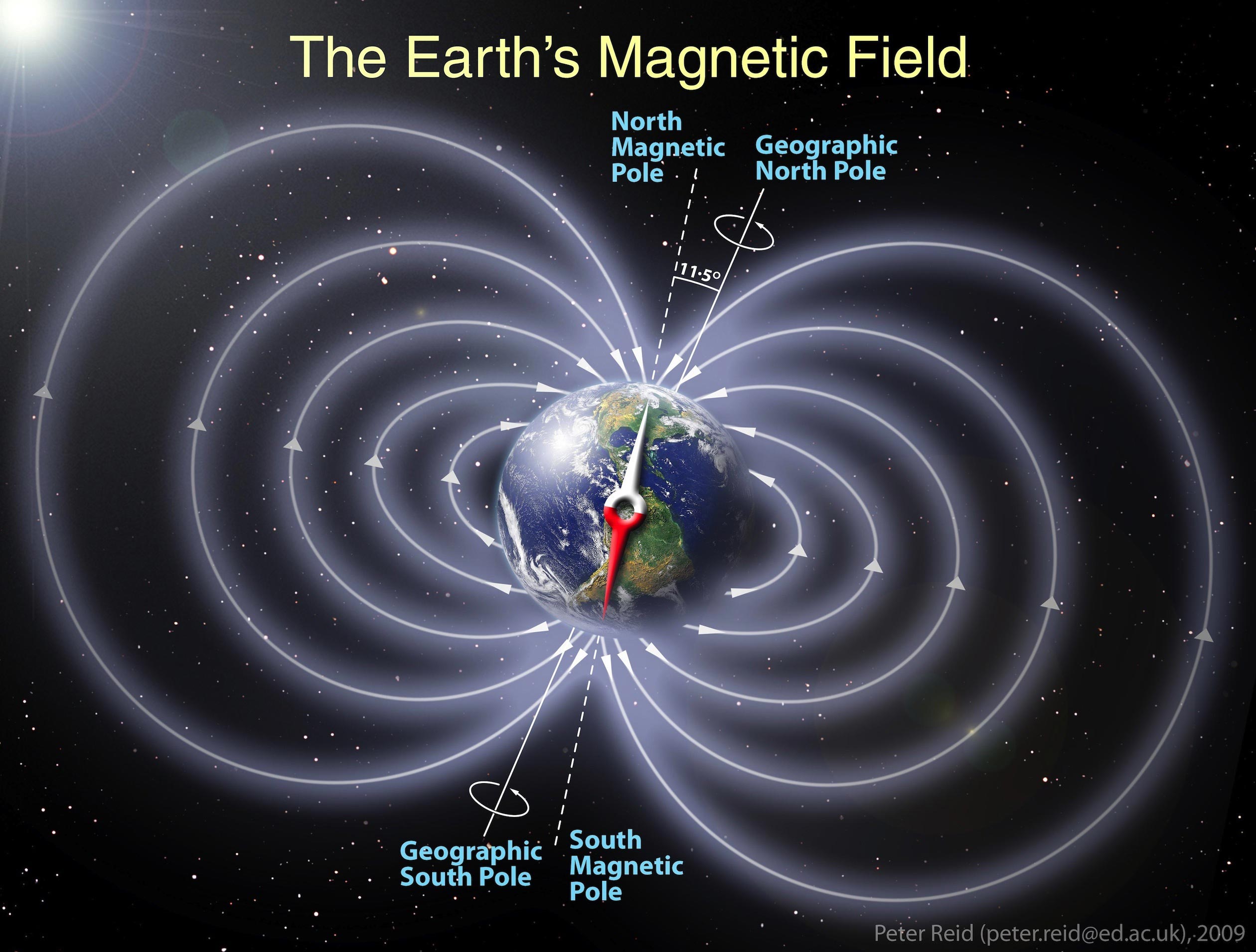
This naming convention originates from observations of Earth's magnetic field. Compass needles swing to point approximately towards Earth's geographic North Pole. Since it is the north pole of the compass needle that points towards the geographic North Pole, this tells us that the geographic North Pole is actually a magnetic south pole. As visible in the diagram of Earth's magnetosphere, the geographic and magnetic poles don't align precisely. Additionally, the magnetic poles move over time and occasionally reverse completely.
Investigation 14.2: The force exerted between magnetised materials
Aim
To investigate the force between two magnets.
Materials
- 2 strong magnets with at least two parallel flat sides (e.g. 'button' or rectangular shaped magnets)
- Tape
- Sensitive kitchen scales (1 g precision)
Safety considerations
| What are the risks in doing this investigation? | How can you manage these risks to stay safe? |
|---|---|
| Magnets can be toxic and small magnets are choking hazards | Never put a magnet in your mouth and always wash your hands after any investigation |
Method
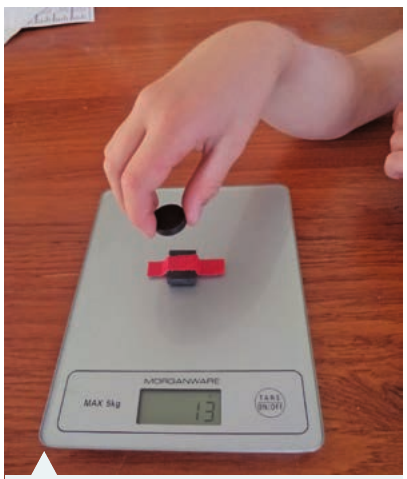
- Tape one of the magnets to the kitchen scale so that one pole is pointing upwards (you may need to observe the magnets first to determine which sides are the poles)
- Record the reading on the scale
- Hold the second magnet at least 10 cm above the first, with one pole pointing directly down towards it
- Very slowly move the second magnet down and note how the scale reading changes – does it increase or decrease?
- Note whether you can feel any force on the magnet in your hand. Does it appear to be pushing upwards or pulling downwards?
- Record your observations
- Move the second magnet back up again, and reverse its direction
- Repeat steps 4–7
Results
Record your observations. Draw a diagram showing the directions of the forces acting on each of the magnets.
Analysis of results
Draw a diagram showing the forces acting on the magnet taped to the scale when the second magnet was far away, and when the second magnet was close by. Make sure you include the normal force of the scale on the magnet.
Discussion
Note
Newton's Third Law Application:
By Newton's third law, the normal force exerted by the magnet on the scales is equal and opposite to the normal force the scales exert on the magnet. The normal force exerted on the scales is what converts to a displayed mass reading. Therefore, the apparent change in mass can be converted to a change in the normal force exerted on the magnet.
- Apply Newton's second law to your diagram showing the forces on the magnet. Write an equation relating the forces acting, noting that the magnet is in equilibrium
- Explain why the scale reading increased or decreased when the second magnet was moved close to it
- Identify the Newton's third-law force pair to the force exerted by the magnet in your hand on the magnet taped to the scale
Conclusion
With reference to the data obtained and its analysis, write a conclusion based on the aim of this investigation.
Diamagnetic and paramagnetic materials
Most materials are not ferromagnetic and cannot be magnetised to produce magnets. These materials can be classified as either diamagnetic or paramagnetic.
Paramagnetic materials are very weakly attracted into magnetic fields. The attraction is so weak that specialised and highly sensitive equipment is needed to observe it.
Diamagnetic materials are repelled by magnetic fields. Most diamagnets are only very weakly repelled, making this behaviour difficult to observe without specialised equipment.
Superconductors and the Meissner effect
An important exception to the weak diamagnetic behaviour is a superconductor below its critical temperature. The critical temperature is the temperature at which a material becomes superconducting. Below this critical temperature, a superconductor behaves as a strong diamagnet and is strongly repelled by a magnet.
Important
The Meissner Effect:
By Newton's third law, the magnet must also be repelled by the superconductor. This can be observed where a magnet levitates above a cooled superconductor. The downwards gravitational force on the magnet is balanced by the upwards magnetic force.
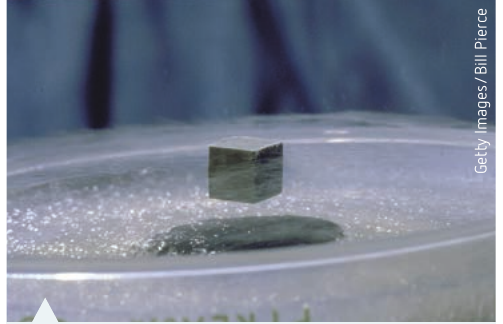
This phenomenon of magnetic levitation above a superconductor is called the Meissner effect. It demonstrates the strong diamagnetic properties of superconductors and has potential applications in magnetic levitation transport systems.
Summary
Key Points to Remember:
- Ferromagnetic materials can be magnetised to create their own magnetic fields due to the motion of electrons within the material
- Magnetic fields are represented by the symbol and measured in units of tesla ()
- Most (but not all) ferromagnetic materials contain iron
- Ferromagnetism arises from unpaired electrons whose magnetic fields align in small regions called magnetic domains
- Every magnet has a north pole and a south pole; like poles repel whilst unlike poles attract
- Most materials are either paramagnetic (very weakly attracted) or diamagnetic (very weakly repelled)
- Superconductors below their critical temperature are strong diamagnets and can levitate magnets through the Meissner effect