Charged Particles in Uniform Magnetic Fields (HSC SSCE Physics): Revision Notes
📚Revision Notes
Charged Particles in Uniform Magnetic Fields
Introduction
Magnetic fields are created by moving charged particles, which we call electric currents. Understanding how charged particles behave in magnetic fields is fundamental to electromagnetism and has important applications in particle physics and technology.
Magnetic field strength is measured in units called tesla (symbol: ), where:
Note
A key principle in electromagnetism is that stationary charged particles do not experience any force from a constant magnetic field. However, when a charged particle moves relative to a magnetic field, it experiences a magnetic force. This importance of relative motion was one of the observations that helped lead to Einstein's theory of relativity.
Force on a moving charged particle in a magnetic field
Magnitude of the force
The force experienced by a charged particle moving through a magnetic field depends on several factors:
- The charge on the particle ()
- The particle's velocity ()
- The magnetic field strength ()
- The angle between the velocity direction and the magnetic field direction ()
Important
The particle experiences:
- Maximum force when it moves perpendicular to the field ()
- Zero force when it moves parallel to the field ()
We can calculate this force using the formula:
where:
- is the magnetic force (in newtons, N)
- is the charge on the particle (in coulombs, C)
- is the velocity of the particle (in )
- is the magnetic field strength (in tesla, T)
- is the angle between the velocity vector and the magnetic field vector
Note
An alternative form of this equation is:
where represents the component of velocity perpendicular to the magnetic field.
Direction of the force
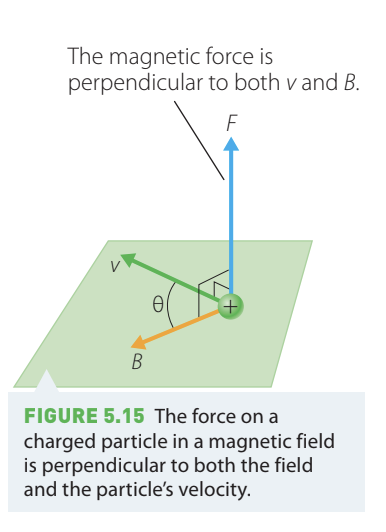
The magnetic force acts in a direction that is perpendicular to both the magnetic field and the velocity. This three-way perpendicular relationship is crucial to understanding particle motion in magnetic fields.
To find the direction of the force, we use the right-hand rule:
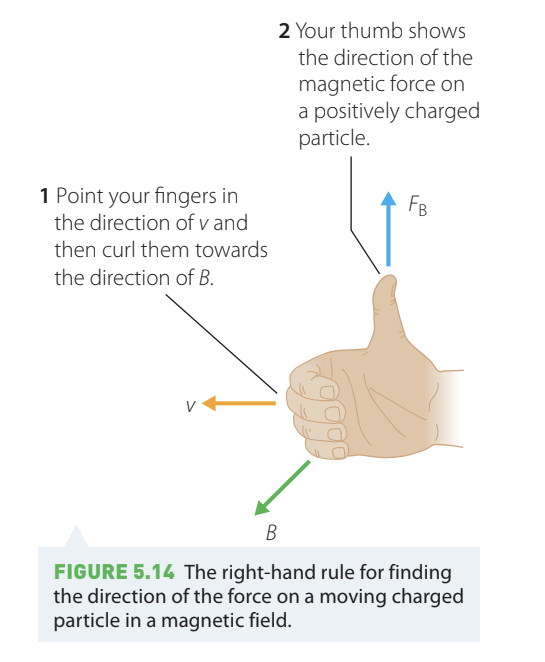
- Point the fingers of your right hand in the direction of the velocity ()
- Curl your fingers toward the direction of the magnetic field ()
- Your thumb points in the direction of the force () if the particle is positively charged
Important
If the particle is negatively charged, the force acts in the opposite direction to what the right-hand rule indicates for a positive charge.
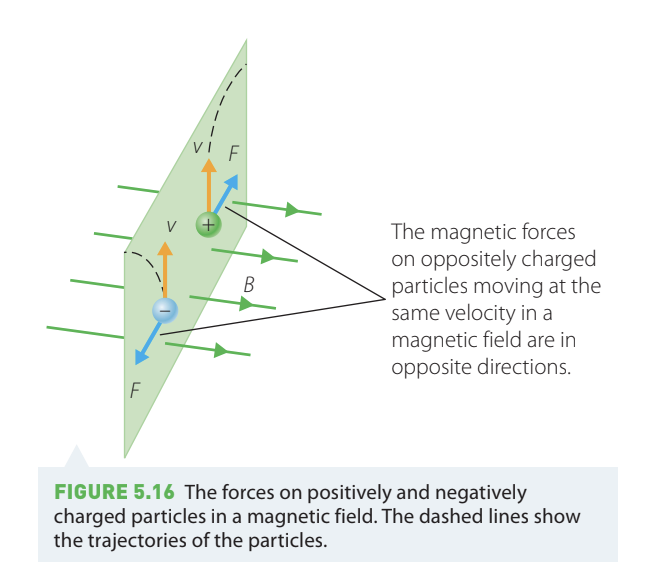
When a positively charged particle and a negatively charged particle have the same initial velocity in a uniform magnetic field, they experience forces in opposite directions. This causes them to follow curved trajectories that curve in opposite directions.
Worked example: Alpha particle in Earth's magnetic field
Example
Worked Example: Alpha particle in Earth's magnetic field
Problem: An alpha particle enters Earth's magnetic field at a velocity of . The local magnetic field strength is . What is the range of possible forces on the alpha particle?
Solution:
Given data:
- (charge of an alpha particle)
The force depends on the angle between the velocity and the magnetic field.
Maximum force (when ):
Rounding to appropriate significant figures:
Minimum force (when ):
Answer: The range of possible forces is from to , acting in a direction perpendicular to both the magnetic field and the velocity.
Path of a charged particle in a uniform magnetic field
Acceleration of charged particles
Once we know the force on a moving charged particle, we can use Newton's second law to find its acceleration:
The acceleration is in the same direction as the force, which is perpendicular to both the magnetic field and the instantaneous velocity.
Three types of trajectories
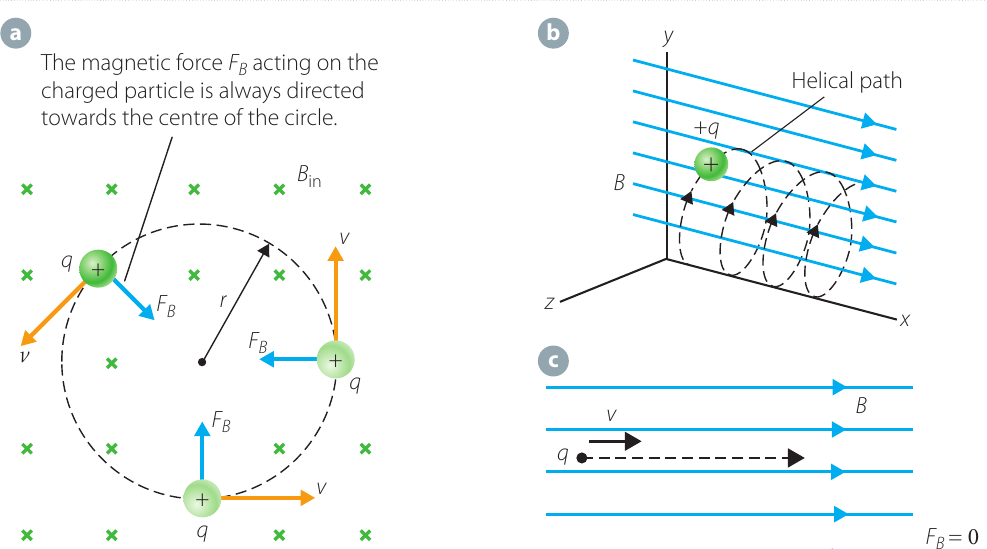
The force and acceleration depend on , the angle between the magnetic field lines and the velocity. Therefore, the path of a charged particle in a uniform magnetic field also depends on the angle between the initial velocity and the field. There are three possible trajectories:
Note
1. Straight line: The particle travels in a straight line only when its velocity is parallel to the field. In this case, and the force on the particle is zero.
2. Circular motion: If the particle moves in a plane perpendicular to the field, then the force is always perpendicular to the velocity, causing the particle to move in a circle. In this case, and the force and acceleration are at their maximum values.
3. Helical path: If the particle has a velocity component both parallel and perpendicular to the field, it follows a helical (corkscrew-shaped) path. The parallel component of velocity is not affected by the magnetic field, while the perpendicular component causes circular motion. The combination produces a helix with its axis aligned along the magnetic field direction.
Circular motion in a magnetic field
When a charged particle moves in a circle due to a magnetic field, we can apply the principles of uniform circular motion. For an object undergoing uniform circular motion with orbital radius , the centripetal acceleration is:
By Newton's second law, the net force acting on the object is:
For a charged particle in a circular orbit in a uniform magnetic field, the magnetic force provides the centripetal force. Since the particle moves perpendicular to the field (, so ), we can equate the two expressions for force:
From this equation, we can derive the radius of the orbit:
We can also derive the orbital period (the time for one complete orbit):
Important
Exam tip: Notice that the orbital period does not depend on the velocity of the particle. All particles with the same charge-to-mass ratio () have the same orbital period in a given magnetic field, regardless of their speed.
Note
The magnetic force can act as a centripetal force just like other forces. For example:
- Gravitational force provides the centripetal force for satellites orbiting Earth
- Tension in a string provides centripetal force for an object whirled in a circle
- Friction provides centripetal force for a car turning a corner
Remember that centripetal force is the net force causing circular motion, not a separate type of force. Any force, including magnetic force, can produce centripetal acceleration when it acts perpendicular to the velocity.
Worked example: Electron in a synchrotron
Example
Worked Example: Electron in a synchrotron
Problem: An electron is circulating inside the ring of a synchrotron with an orbital radius of . The electron has a velocity of . Calculate the magnetic field required to keep the electron in orbit.
Solution:
Given data:
- (charge of an electron)
- (mass of an electron)
Starting with the radius formula:
Rearranging to solve for the magnetic field:
Substituting the values:
Converting units (note that ):
Answer: A magnetic field of (microtesla) is required to keep the electron in orbit.
Note: The magnitude is quoted as positive even though the calculation gives a negative value due to the negative charge of the electron.
Remember!
Summary
Key Points to Remember:
-
Stationary charged particles experience no force from a magnetic field; only moving charged particles experience a magnetic force.
-
The magnetic force is given by , where the force is maximum when the particle moves perpendicular to the field () and zero when moving parallel to the field ().
-
Use the right-hand rule to find force direction: point fingers along velocity, curl toward magnetic field, thumb shows force direction for positive charges (reverse for negative charges).
-
Charged particles can follow three types of paths in uniform magnetic fields: straight lines (parallel to field), circles (perpendicular to field), or helices (combination of parallel and perpendicular components).
-
For circular motion, the magnetic force provides the centripetal force, giving us the radius formula and period formula .