Magnetic Flux (HSC SSCE Physics): Revision Notes
📚Revision Notes
Magnetic Flux
What is magnetic flux?
The magnetic flux represents how much magnetic field passes through a given area. When we talk about flux, we're essentially measuring the number of magnetic field lines that cross through a particular surface.
Field strength is indicated by how densely packed the field lines are in a region. Therefore, magnetic flux tells us both about the strength of the field and how much of it is passing through our chosen area.
Note
Think of magnetic flux like measuring water flow through a hoop. The amount of water passing through depends on:
- How strong the water flow is
- How big the hoop is
- How the hoop is oriented relative to the flow
The magnetic flux formula
For a uniform magnetic field passing through an area , we calculate the magnetic flux using the equation:
where:
- (the Greek letter phi) represents the magnetic flux
- is the magnitude of the magnetic field strength (in tesla, T)
- is the area (in square metres, m²)
- (the Greek letter theta) is the angle between the magnetic field vector and the normal to the area
Note
Understanding the normal vector:
The normal to an area is an imaginary line that points perpendicular to the surface. We can represent this as an area vector , which has:
- Magnitude equal to the area
- Direction perpendicular (normal) to the surface
The angle is measured between the magnetic field direction and this normal vector.
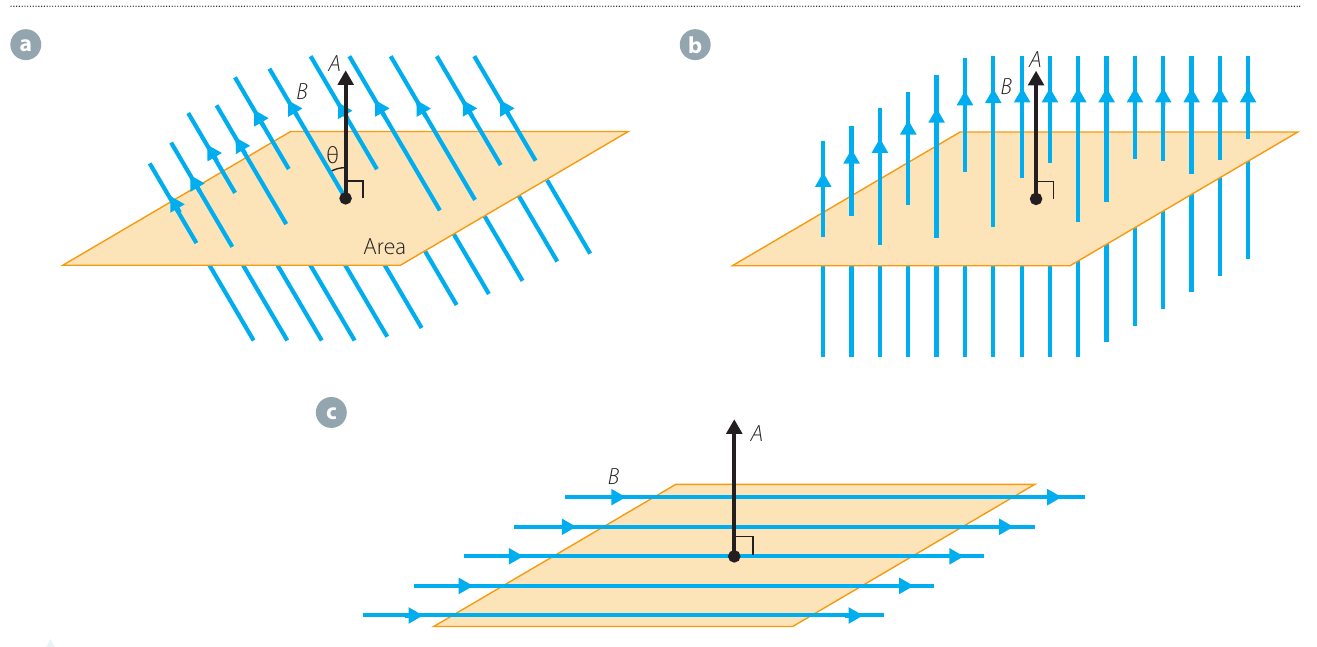
The diagram above shows how the angle affects the flux through a surface. Notice how the orientation of the surface relative to the field lines changes the amount of flux.
Units of magnetic flux
Magnetic flux is measured in units called weber (symbol: Wb), named after German physicist Wilhelm Weber who contributed significantly to telecommunications.
The weber is equivalent to tesla metres squared:
Maximum and minimum flux
The value of magnetic flux depends critically on the angle between the field and the normal to the area.
Maximum flux
Flux reaches its maximum value when the magnetic field is perpendicular to the area. This occurs when θ = 0° because the field vector is parallel to the normal vector.
When :
- Therefore:
In this orientation, the maximum number of field lines pass through the area.
Minimum flux (zero)
Flux equals zero when no field lines cross the area. This happens when the magnetic field is parallel to the surface, making θ = 90° because the field is perpendicular to the normal vector.
When :
- Therefore:
In this orientation, field lines run along the surface without crossing through it.
Important
Memory aid: "Perpendicular is Perfect" for maximum flux, "Parallel is Pointless" for zero flux.
Remember: The angle is between the field and the normal (perpendicular) to the area, not the area itself!
Worked example: flux through a loop
Example
Worked Example: Calculating Maximum and Minimum Flux
Let's calculate the maximum and minimum flux through a circular loop.
Given information:
- Loop cross-sectional area:
- Uniform magnetic field magnitude:
Part (a): Identifying maximum and minimum flux orientations
For minimum flux, the loop is parallel to the field so and flux is zero.
For maximum flux, the loop is perpendicular to the field so .
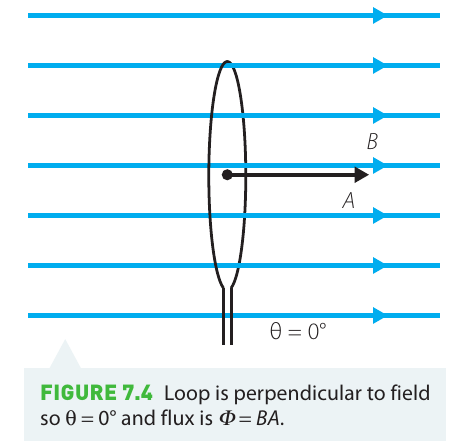
Part (b): Calculating the flux values
Using the formula :
Maximum flux (when ):
Minimum flux (when ):
Answer: The maximum flux through this loop is and the minimum is zero.
How magnetic flux can change
Magnetic flux can change in three different ways, since it depends on three variables:
Changing the magnetic field ()
If the strength of the magnetic field increases or decreases, the flux will change accordingly. For example, if you move a magnet closer to a loop, the field strength increases and so does the flux.
Changing the area ()
If the size or shape of the area changes, the flux changes. For instance, if you deform a circular loop into an ellipse, you've changed the effective area and therefore the flux.
Changing the angle ()
If you rotate the loop relative to the field direction, you change the angle and thus the flux. This is the principle behind how motors and generators work - they rotate coils in magnetic fields to continuously change the flux.
Note
Transformers work by changing the magnetic field strength rather than rotating coils.
Rate of change of flux
Understanding how quickly flux changes is crucial for electromagnetic induction. The rate of change of flux tells us how much the flux changes per unit time.
Constant rate of change
When flux changes at a constant rate, a graph of flux versus time forms a straight line. The rate of change equals the gradient of this line.
Variable rate of change
If the graph of flux versus time is curved (for example, exponential or sinusoidal), then the rate of change varies with time. This will be important when studying induced emf in electromagnetic induction.
Worked example: changing magnetic flux
Example
Worked Example: Rate of Change of Magnetic Flux
Let's calculate how quickly flux changes when a magnetic field decreases.
Given information:
- Initial magnetic field:
- Final magnetic field:
- Time interval:
- Loop area:
- Loop orientation: perpendicular to field ()
- Field decreases at a constant rate
Finding the change in flux per second:
Since , we have .
The change in flux per second relates to the change in field per second:
First, find the rate of change of the field:
The negative sign indicates the field is decreasing.
For each 1 second interval:
Now calculate the change in flux:
Answer: The flux decreases by in each second.
Important properties of magnetic flux
Flux is a scalar
Although magnetic flux depends on vectors (the field and area ), flux itself is a scalar quantity. This means it has magnitude but no direction.
However, flux can be positive or negative. For an open surface (like a loop), the choice of which direction is positive is arbitrary. Once we've chosen a convention, we can determine whether changes in flux are positive or negative:
- If positive flux increases, the change is positive
- If positive flux decreases, the change is negative
Note
For closed surfaces (like a sphere), we typically define inward flux as positive.
Summary
Key Points to Remember:
- Magnetic flux () measures the amount of magnetic field passing through an area:
- Flux is measured in webers (Wb), where
- Maximum flux occurs when the field is perpendicular to the area ():
- Zero flux occurs when the field is parallel to the area ():
- Flux can change by varying the field strength (), the area (), or the angle ()
- The rate of change of flux is constant when flux changes linearly with time, but varies when the relationship is curved