Equations for Straight-Line Motion with Constant Acceleration (HSC SSCE Physics): Revision Notes
📚Revision Notes
Equations for Straight-Line Motion with Constant Acceleration
Introduction to equations of motion
When studying motion with constant acceleration, we can represent the same physical situation in two equivalent ways: using graphs or using algebraic equations. Neither representation is more important than the other—they are simply different models of the same motion.
Note
Graphs and algebraic equations are equally valid ways to describe motion. Understanding both methods gives you flexibility in problem-solving and helps build a deeper understanding of the underlying physics.
For motion at constant acceleration, the velocity versus time graph is a straight line. From this graph, we can extract two key pieces of information:
- The gradient (slope) represents the acceleration
- The area under the graph represents the distance travelled
From these graphical relationships, we can derive simple algebraic equations that represent exactly the same motion as the graphs show.
The three equations of motion
There are three main equations used to describe motion with constant acceleration. Each equation involves four of the five key variables: , , , , and .
Understanding the variables
Before we look at the equations, let's define what each symbol represents:
- = initial velocity (the velocity at the start of the time interval)
- = final velocity (the velocity at the end of the time interval)
- = acceleration (the rate of change of velocity)
- = time (the time interval during which the motion occurs)
- = displacement (the distance travelled in a particular direction)
Important
These five variables (often remembered as SUVAT) are the foundation of all kinematics problems. You'll need to know three of them to find the fourth using the appropriate equation.
Equation 1: Relating velocity, acceleration and time
Starting with the basic definition of acceleration for uniformly accelerated motion:
This can be rearranged to give:
However, this assumes there is no initial velocity. To account for an initial velocity (which could still be zero), we add the term to represent the starting velocity. The final velocity will be the sum of the initial velocity plus the change in velocity due to acceleration:
Equation 1:
Note
This equation is useful when you know the initial velocity, acceleration, and time, and need to find the final velocity. It's the most straightforward of the three equations and is often your first choice when time is known.
Equation 2: Relating displacement, velocity, acceleration and time
To find the displacement (distance travelled), we need to calculate the area under the velocity-time graph.
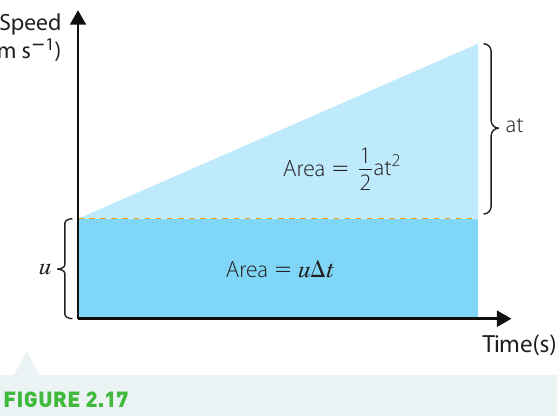
On a velocity-time graph:
- The height of the graph represents velocity ()
- The base represents time ()
- The area represents displacement ()
For constant velocity, displacement would simply be (the area of a rectangle). However, for uniformly accelerated motion starting with initial velocity , the graph shows two distinct regions:
- A rectangle with area = (representing the displacement due to the initial velocity)
- A triangle on top with area = (representing the additional displacement due to acceleration)
Since , which means , the area of the triangle becomes:
The total displacement is the sum of both areas:
Equation 2:
Note
This equation allows you to calculate displacement when you know the initial velocity, acceleration, and time. It's particularly powerful because it gives you position directly, without needing to calculate final velocity first.
Equation 3: Relating velocity, acceleration and displacement
Sometimes you need to relate velocities, acceleration, and displacement without knowing the time interval. By making the subject of Equation 1 and substituting this into Equation 2, we can derive a third equation that is independent of time:
Equation 3:
Important
Choose this equation when time is unknown and not required! This is the only equation that doesn't involve time, making it perfect for problems where you know velocities, acceleration, and displacement.
Using the equations to solve problems
Each of the three equations involves four of the five kinematic variables. When solving problems:
- Identify the known variables from the information given
- Identify which variable you need to find
- Choose the equation that contains the three known variables and the one unknown variable
- Substitute the values carefully, including units
- Calculate the answer and express it with appropriate significant figures and units
Once you have found the fourth variable, you can use another equation to find the fifth variable if needed.
Example
Worked Example: Car Acceleration (Part 1)
Problem: A car is travelling along a straight road at . It accelerates at a uniform for seconds. What is the car's final velocity?
Solution:
Given data:
- (initial velocity)
- (acceleration)
- (time)
We need to find: (final velocity)
Since we know , , and , we use Equation 1:
Substituting values:
The car's final velocity is 40 m s⁻¹
Example
Worked Example: Car Acceleration (Part 2)
Problem: Using the same scenario, what is the total distance travelled by the car during its acceleration phase?
Solution:
Given data:
We need to find: (displacement)
Since we know , , and , we use Equation 2:
Substituting values:
The car travels a total distance of 300 m during acceleration
Example
Worked Example: Using Graphs and Multiple Calculations
Problem: A car initially travelling at a speed of accelerates at for seconds.
- Sketch the acceleration versus time graph
- Find the velocity of the car after seconds
- Sketch the velocity versus time graph
- Find the distance moved by the car in the seconds
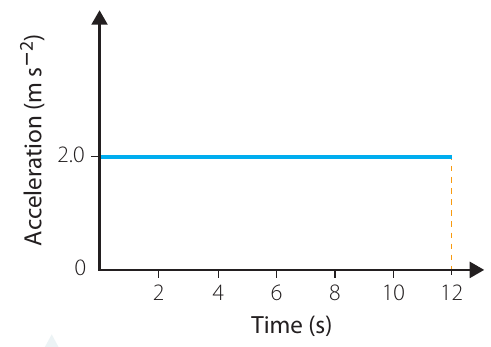
Solution:
Part 1: The acceleration is constant at 2.0 m s⁻², so the graph is a horizontal line.
Part 2: The change in velocity equals the area under the acceleration-time graph:
The final velocity is:
Part 3: The velocity increases linearly from to over seconds.
Part 4: The distance equals the area under the velocity-time graph. Using the trapezium formula:
The car moves 96 m in the 8.0 seconds
Graphical versus algebraic analysis
Both graphical and algebraic methods yield the same answers because they are both models of the same physical motion.
Graphical analysis is often simpler and more intuitive. Once you sketch a velocity versus time graph with the relevant data points:
- Acceleration can be found from the gradient (slope)
- Distance can be calculated from the area under the curve
Algebraic analysis using the equations is systematic and precise, particularly useful for complex calculations where graphical methods might be less accurate.
Note
Choose the method that best suits the problem and the information given. In exams, you may be required to demonstrate both methods, so practice with each approach.
Linear acceleration under gravity
What is gravitational acceleration?
Once an object is released or thrown, the only significant force acting on it (ignoring air resistance) is the gravitational force. Near Earth's surface, gravity causes all objects to accelerate vertically downwards with an acceleration of approximately:
This value is called gravitational acceleration and is given the symbol . Although varies slightly around the world, using gives sufficiently accurate answers for most purposes.
Important
All objects fall at the same rate in the absence of air resistance, regardless of their mass. This was famously demonstrated by Apollo 15 astronaut Commander David Scott, who dropped a hammer and a feather on the Moon. With no atmosphere to provide air resistance, both objects hit the ground simultaneously.
Understanding "metres per second per second"
The value is read as "9.8 metres per second per second." This means that for every second an object falls, its speed increases by 9.8 m s⁻¹.
For example:
- After second: velocity = (about )
- After seconds: velocity = (about )
- After seconds: velocity = (about )
Note
This rapid increase in speed explains why falling from even moderate heights can be dangerous. After just 3 seconds of free fall, an object is already moving at nearly 30 m s⁻¹ (about 108 km h⁻¹)!
Graphs for falling objects
When an object is dropped from rest, its motion can be represented by three graphs:
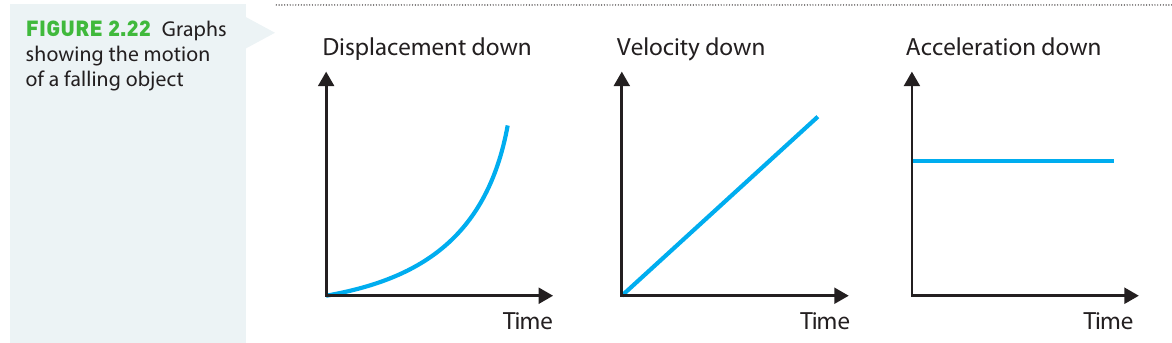
- Displacement-time graph: Shows a parabolic curve (displacement increases at an increasing rate)
- Velocity-time graph: Shows a straight line through the origin (velocity increases uniformly)
- Acceleration-time graph: Shows a horizontal line (acceleration is constant at )
Objects falling directly downwards
When analysing falling objects, we typically set the origin at the point where the object starts to move. If we define the downward direction as positive, then all variables (, , , , and ) will be positive, with:
The same three equations of motion apply, simply replacing with .
Important
Sign convention matters! Be consistent with your choice of positive direction. If you take downward as positive, then . If you take upward as positive, then .
Example
Worked Example: Watch Falling from a Bridge
Problem: A watch falls from a Sydney Harbour Bridge climber's wrist. The watch falls for seconds before hitting a car below.
- Sketch a velocity versus time graph of this motion
- With what velocity does the watch hit the car?
- How far did the watch fall?
Solution:
Part 1: The velocity-time graph starts at the origin (initial velocity = 0) and increases linearly with a positive gradient.
Part 2:
Given data:
- (starts from rest)
- (if taking downward as negative)
Using Equation 1:
The watch hits the car with a velocity of 24.5 m s⁻¹ vertically down.
Part 3:
Using Equation 2:
The watch fell a distance of 31 metres (to two significant figures).
Investigation 2.2: Measuring gravitational acceleration
This investigation allows you to experimentally determine the value of by collecting first-hand data.
Aim
- To find the value of gravitational acceleration, g
- To investigate average and instantaneous velocities
Materials
- Ruler
- Ball bearing
- Electronic timer or timing photogate
Risk assessment
| What are the risks? | How can you safely manage these risks? |
|---|---|
| The ball bearing may cause injury if thrown, dropped, or stepped on | - Never throw ball bearings - Manage the use of the ball bearing carefully - Never leave the ball bearing on the ground |
Method
- Set up the electronic timing apparatus
- Carefully measure the vertical distance, , that the ball bearing will fall
- Release the ball bearing from rest and measure the time, , taken to fall through the known height
- Repeat this measurement several times to get an average
- Change the height and repeat the procedure
- Record sufficient data to plot a graph
Note
Taking multiple measurements at each height and calculating an average helps reduce the effect of random errors. Aim for at least three measurements at each height.
Results
- Record all raw and derived data in a correctly constructed data table
- Plot the data as it is collected
- Estimate and record uncertainties in the data
Analysis of results
- Plot versus with uncertainty bars and draw a line of best fit
- Create a data table with columns for , , , and
- Plot versus
- Draw a straight line of best fit and calculate the gradient
- Use the equation to relate the gradient to
- Since for a dropped object:
- Therefore, gradient of s vs t² graph = ½g
- So:
- Calculate the best estimate of from your gradient
- Use the maximum and minimum possible gradients to estimate the uncertainty in
- Calculate average speed for each pair:
- Plot versus and describe the trend
Important
Exam tip: When calculating gradients for experimental data, always draw a line of best fit and use two points on that line—do not simply use two data points. This reduces the effect of random errors.
Summary
Key Points to Remember:
- There are three main equations for constant acceleration: , , and
- Choose the equation that contains the three known variables and the one unknown you need to find
- Graphical and algebraic methods are equivalent—both give the same answer for the same motion
- On a velocity-time graph: gradient = acceleration and area = displacement
- Gravitational acceleration causes all objects to fall at the same rate (in the absence of air resistance)
- Always include units in your calculations and express answers with appropriate significant figures