Distance and Displacement in a Plane (HSC SSCE Physics): Revision Notes
📚Revision Notes
Distance and Displacement in a Plane
Understanding displacement in two dimensions
In kinematics, it is essential to distinguish between two fundamental quantities: distance and displacement. While these terms might seem similar, they represent different physical concepts, especially when analysing motion in a plane (two dimensions).
Distance is a scalar quantity that measures the total length of the path travelled by an object. It only has magnitude (size) and is always positive.
Displacement is a vector quantity that describes the straight-line distance from an object's starting position to its final position, including the direction of that straight line. Because displacement is a vector, it has both magnitude and direction.
Important
Key Difference
The crucial distinction is that distance depends on the actual path taken, whereas displacement only depends on the starting and ending positions. The route travelled between these points is irrelevant to the displacement.
Note
Real-World Application: Multiple Routes, Same Displacement
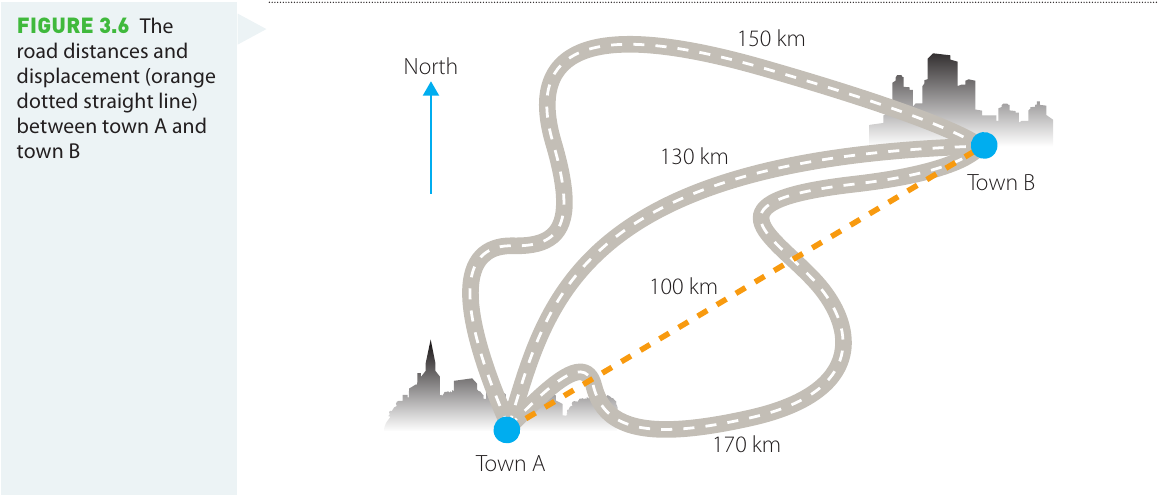
Consider the example shown above. Cars travelling from Town A to Town B could take different routes along the winding road. One car might travel 170 km, another 230 km (taking a different route), and a third might drive 400 km by going to Town B and back to Town A.
However, all cars at Town B have the same displacement from Town A: approximately 150 km in a north-easterly direction. The car that returned to Town A has zero displacement, even though it travelled 400 km, because it ended at its starting position.
Mathematical representation of displacement
Displacement is mathematically defined as the difference between the final position vector and the initial position vector:
where:
- is the displacement vector
- is the final position vector
- is the initial position vector
Note
Position vs. Displacement
It's important to note that a displacement can begin anywhere in space. However, a position vector is always measured relative to the origin of the coordinate system. This is a crucial distinction in problem-solving.
Displacement can also vary with time. The kinematic equation allows us to calculate the magnitude of displacement as a function of time (where is initial velocity, is acceleration, and is time). When working in two dimensions, we must account for both the vector nature of displacement and its time dependence.
Adding displacements using the graphical method
When an object undergoes multiple displacements in sequence, we need to find the total or resultant displacement. Since displacements are vectors, we cannot simply add their magnitudes; we must use vector addition techniques.
Head-to-tail method
The head-to-tail method is a graphical technique for adding vectors. To add two displacement vectors and :
- Draw the first vector to scale with the correct direction
- Place the tail of the second vector at the head (arrow tip) of vector
- Draw the resultant vector from the tail of to the head of
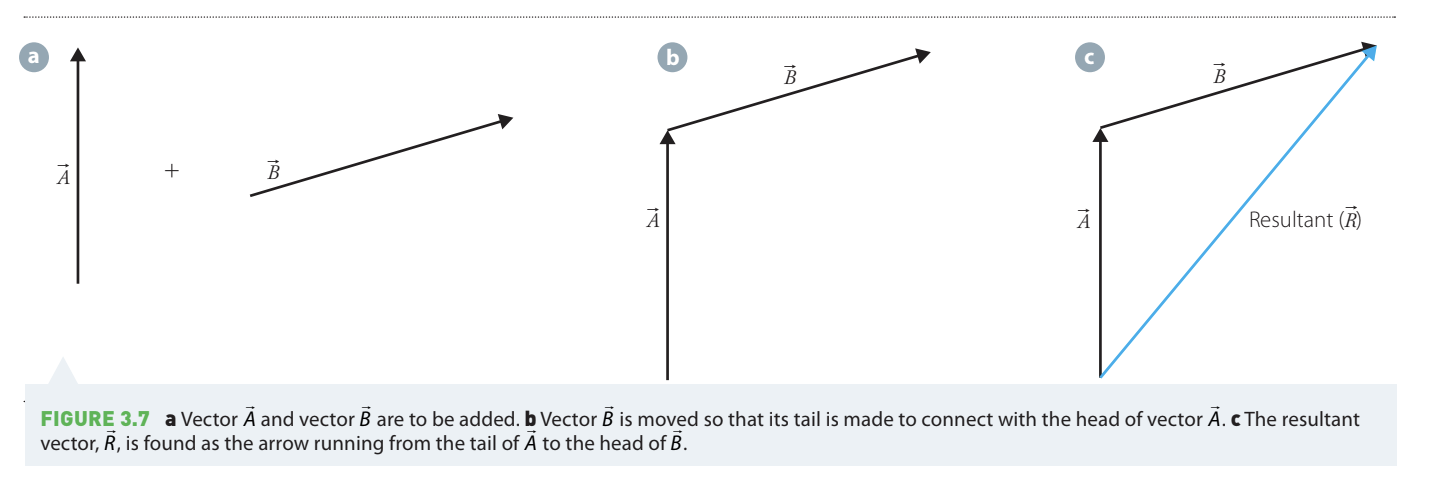
The resultant vector represents the total displacement. This method works for any number of vectors - simply continue placing each subsequent vector head-to-tail.
Important
Essential for Accurate Results
When using this graphical method, it is essential that all vectors are drawn to the same scale and with accurate angles. A ruler and protractor can be used to measure the magnitude and direction of the resultant.
Parallelogram rule
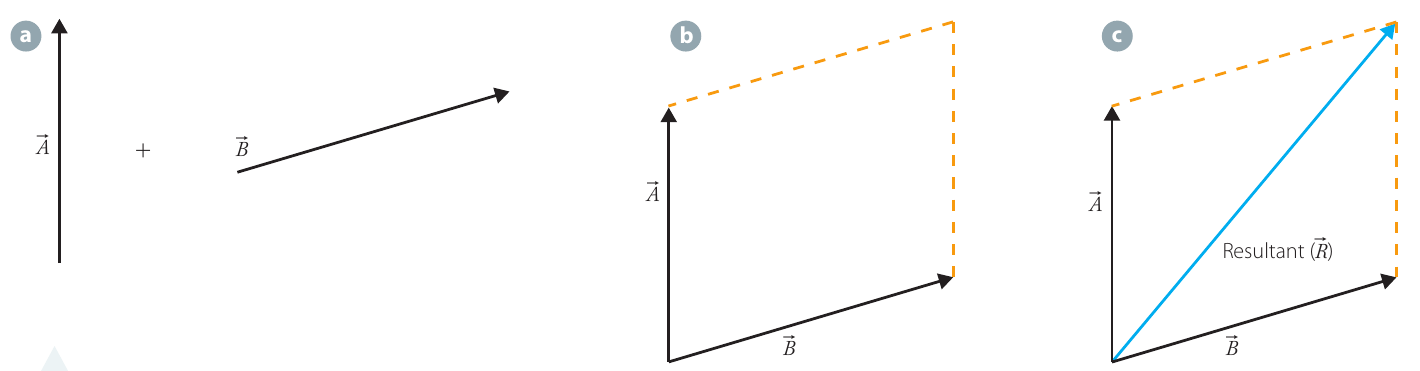
An alternative graphical method is the parallelogram rule. This method is particularly useful when you want to see both vectors starting from the same point:
- Draw both vectors and with their tails at the same point
- Complete a parallelogram using these vectors as two adjacent sides
- The resultant vector is the diagonal of the parallelogram, running from the common tail to the opposite corner
Note
Commutative Property of Vector Addition
The parallelogram rule demonstrates that vector addition is commutative: . The order in which you add vectors doesn't affect the final result.
Subtracting vectors
Vector subtraction is performed by adding the negative of a vector. To subtract vector from vector :
The negative of a vector, , is obtained by reversing its direction (flipping the arrow to point the opposite way) while keeping the same magnitude.
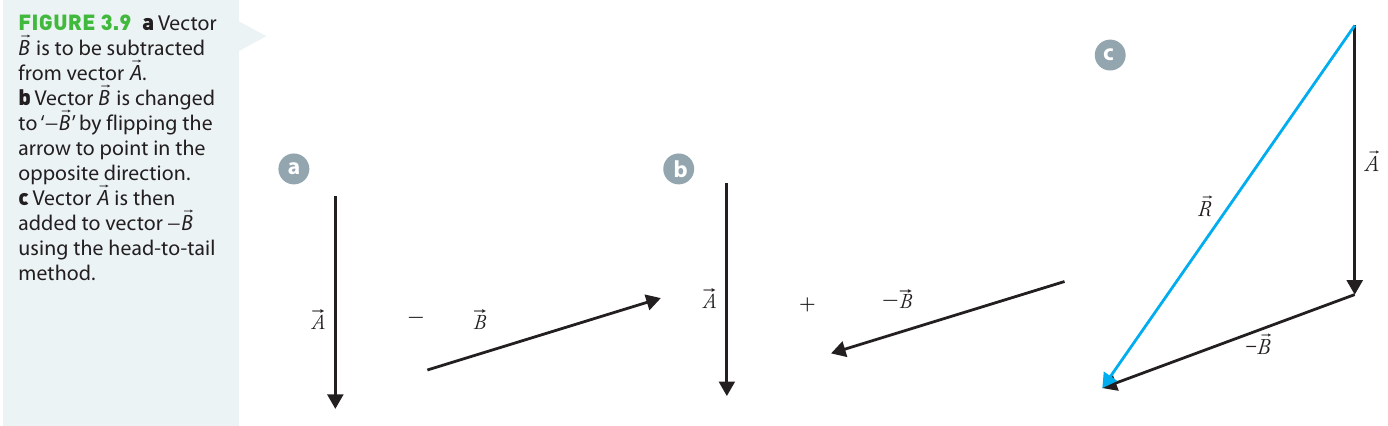
Once the second vector is reversed, the head-to-tail method can be applied as usual. The parallelogram rule also works for subtraction, provided you reverse the direction of the second vector before constructing the parallelogram.
Important
Vector Subtraction is NOT Commutative
Note that vector subtraction is not commutative:
but
This is a common mistake to avoid when working with vectors.
Vector subtraction is particularly important when calculating velocity, which is the change in displacement divided by the change in time. Since displacement is a vector, the change in displacement is found by subtracting the initial displacement from the final displacement.
Resolving and adding vectors using components
While graphical methods are useful for visualisation, a mathematical approach using vector components provides more precision and is essential for calculations.
The component method
To add vectors mathematically:
- Choose a coordinate system (typically with perpendicular x and y axes, or compass directions like East-West and North-South)
- Resolve each vector into its components along these axes
- Add all the components in each direction separately
- Combine the resulting components to find the magnitude and direction of the resultant vector
For two displacement vectors and , if the resultant is :
Each vector can be expressed in terms of its components:
The components can be added separately:
Therefore, the resultant vector can be written as:
This method works equally well for adding more than two vectors.
Finding magnitude and direction
Once you have the components of the resultant vector, you can find its magnitude using Pythagoras' theorem:
The direction can be found using trigonometry. The vectors , , and form a right-angled triangle, so:
where is the angle of the resultant vector relative to the x-axis.
Worked example: Orienteering displacement
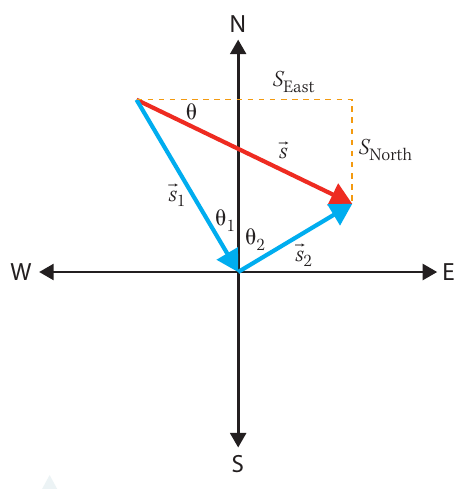
Example
Worked Example: Calculating Resultant Displacement
Let's examine a practical problem that demonstrates the component method for adding displacements.
Problem: Orienteers run two legs of a course. First, they run 600 m S30°E from the origin. Then they run 400 m N60°E. What is their final displacement relative to where they started? (Assume three significant figures for the distances.)
Solution:
First, we draw a diagram showing the two displacement vectors and define our coordinate system. We'll use compass directions, with East as the positive horizontal direction and North as the positive vertical direction.
Let be the first displacement (600 m S30°E) and be the second displacement (400 m N60°E). The resultant displacement is .
Given data:
- m;
- m;
Step 1: Resolve each displacement into East-West and North-South components
East-West components:
North-South components: (negative because it's southward)
Step 2: Substitute the values
| Calculation | Explanation |
|---|---|
| m E | Eastward component of first displacement |
| m E | Eastward component of second displacement |
| m N | Southward component (negative) |
| m N | Northward component |
Step 3: Add the components in each direction
The negative value for the North component indicates the net displacement is southward.
Step 4: Find the magnitude of the resultant displacement
Using Pythagoras' theorem:
Step 5: Calculate the direction
The negative angle indicates the direction is south of east.
Final Answer:
or equivalently:
(since )
This result tells us that the orienteers' final position is 721 metres from their starting point, in a direction 26° south of due east (or 64° east of due south). The actual distance they ran was 1000 m (600 m + 400 m), but their displacement is only 721 m.
Key considerations when working with vectors
Note
Important Guidelines for Vector Problems
When solving problems involving displacement in a plane:
-
Always define your coordinate system clearly - whether you're using x-y coordinates or compass directions (N, S, E, W), make sure you specify which direction is positive
-
Be careful with signs - in compass notation, north and south are opposites, as are east and west. Use positive and negative signs consistently
-
Distinguish between position and displacement - a position is measured from the origin, while a displacement can start anywhere
-
Remember that displacement depends on when you measure it - an object's displacement changes throughout its journey
-
Use appropriate units - always include units (metres, kilometres, etc.) in your calculations and final answer
-
Express direction clearly - use compass bearings or angles measured from a reference direction
Summary
Key Points to Remember:
-
Displacement is a vector with both magnitude and direction, representing the straight-line distance from start to finish. Distance is a scalar measuring the total path length travelled.
-
The path taken doesn't matter for displacement - only the starting and ending positions determine the displacement vector, regardless of the route travelled between them.
-
Vectors can be added graphically or mathematically - use the head-to-tail method or parallelogram rule for graphical addition, or resolve into components for precise calculations:
-
Vector subtraction means adding the negative - to subtract from , reverse the direction of and add:
-
Use Pythagoras and trigonometry to find resultants - after adding components, find magnitude with and direction with