Origins: Historical and Cultural Context (HSC SSCE Studies of Religion): Revision Notes
📚Revision Notes
Origins: Historical and Cultural Context
Buddhism's emergence from Brahmanism
Buddhism emerged approximately 2500 years ago as a distinct tradition growing out of Brahmanism, the religious system practised in ancient India. To understand Buddhism's origins, it is essential to grasp its relationship with Hinduism.
Brahmanism developed from an earlier religious system called Vedism. Over time, Brahmanism evolved into what we recognise today as classical Hinduism. Buddhism appeared during this period of religious transformation, adopting some Hindu concepts whilst rejecting others.
Note
Understanding the religious evolution from Vedism through Brahmanism to Hinduism provides crucial context for Buddhism's emergence. Buddhism didn't arise in a vacuum—it emerged from and responded to existing religious traditions.
Key timeline:
- Vedism (earliest Indian religious tradition)
- Development into Brahmanism
- Buddhism's emergence (c.563-483 BCE, during the life of Siddhartha Gautama)
- Brahmanism's evolution into classical Hinduism
The founder of Buddhism, Siddhartha Gautama—also known as Prince Shakyamuni or the Buddha—lived between approximately 563 and 483 BCE. His teachings emerged from deep engagement with Brahmanic religious ideas, which he both accepted and challenged.
Hindu concepts adopted by Buddhism
Buddhism inherited several fundamental concepts from the Hindu worldview, though it often reinterpreted them significantly.
Cosmic cycles and eternal existence
Like Hindus, Buddhists accept that the universe undergoes cycles of creation and destruction. However, existence itself is eternal—something always exists, even when the cosmos ceases and reforms. This cyclical view of time fundamentally shapes Buddhist thinking about existence and change.
Samsara: The cycle of rebirth
Samsara refers to the continuous cycle of rebirth or reincarnation. This Hindu concept became central to Buddhist thought, though Buddhism modified its interpretation.
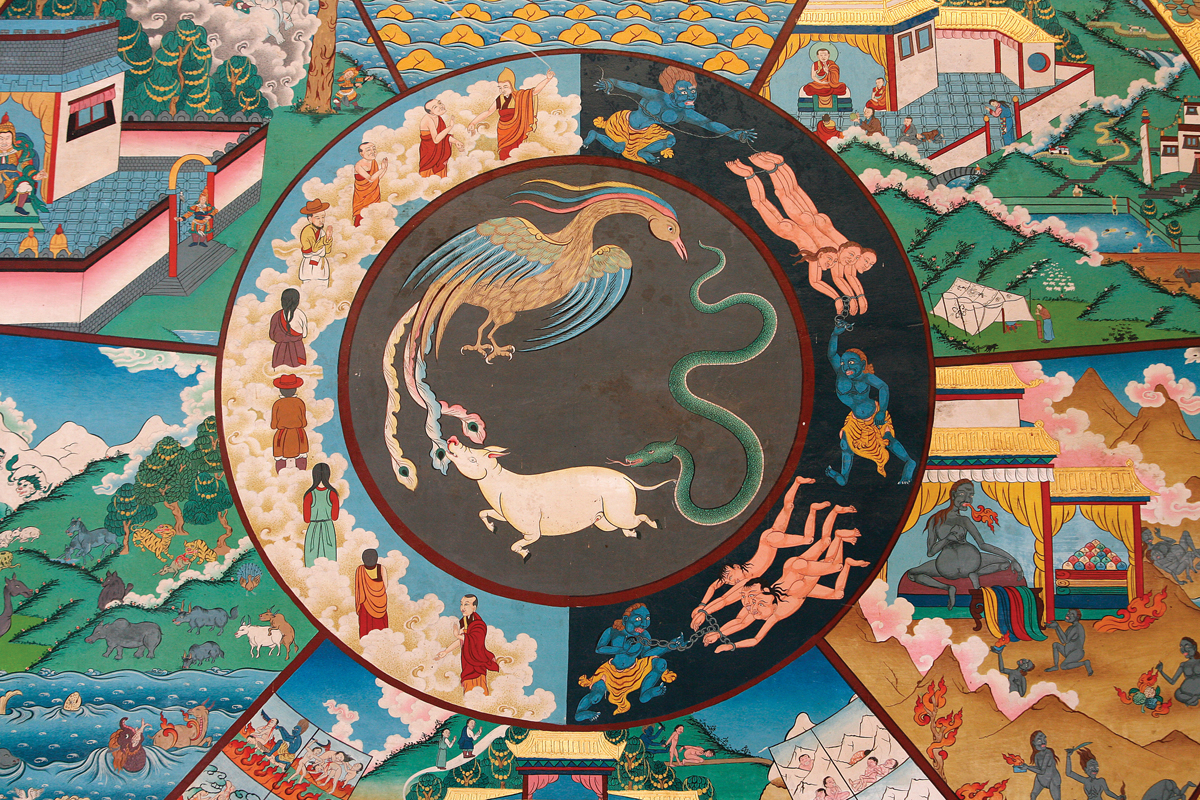
In Hinduism, when a person dies, their soul (atman) becomes attached to another body and mind, beginning a new life. The current life is merely one in a series of thousands of lives already lived and potentially thousands more to come. This process of being reborn repeatedly is called samsara or reincarnation.
The quality of each rebirth depends on actions in previous lives:
- Good behaviour in one life leads to rebirth into a better existence
- Bad behaviour results in rebirth into a worse life, potentially even as an animal
- This system explains differences in talent, opportunity and social position
Important
This belief system can be socially conservative, as it justifies existing inequalities as the result of past-life karma. Someone born into poverty or with disabilities might be seen as experiencing consequences of past misdeeds, whilst those born into privilege earned their position through previous good actions.
Buddhist modification: Rejecting atman
Whilst Buddhism accepted the concept of rebirth, the Buddha challenged the Hindu notion of atman (the eternal individual soul). Instead, Buddhism would later develop the concept of anatta (no-self), suggesting there is no permanent, unchanging soul passing from life to life. However, the cycle of rebirth continues, with the "essential person" moving through samsara.
Buddhist departures from Hindu tradition
Despite adopting key Hindu concepts, Buddhism introduced revolutionary changes to the Indian religious landscape.
Rejection of caste obligations
The most significant departure concerned the varna system—commonly known as caste. Hindu society was structured around four main castes:
- Brahmins (priests)—highest status, controlled all religious matters
- Kshatriyas (rulers, nobles, warriors)—second tier, held political and military power
- Two lower castes (merchants/farmers and labourers)
Hinduism taught that people were duty-bound to remain in the caste position they were born into. Social mobility was impossible within a single lifetime; only through good karma and rebirth could one move between castes.
Note
Buddhism's rejection of the caste system was revolutionary for its time. By offering universal religious and psychological development free from class or sex discrimination, Buddhism made spiritual practice accessible to groups traditionally excluded from Hindu religious authority—including women, lower castes, and non-Brahmins.
Buddhism rejected this rigid social structure. It denied that people must accept their caste position as fixed or divinely ordained. Instead, Buddhism offered universal religious and psychological development free from class or sex discrimination. This made Buddhism accessible to groups excluded from Hindu religious authority.
The path to ending rebirth: Nirvana
The Buddha proposed something revolutionary: a way to permanently end the cycle of samsara. Rather than accepting endless rebirths as inevitable, he taught that individuals could escape by extinguishing their desires for continued existence.
Nirvana means the state of no suffering, desire, or sense of self. It represents complete liberation from the rebirth cycle. By turning off the desires that fuel rebirth, practitioners could achieve enlightenment and break free from samsara entirely. The Buddha himself demonstrated that this was possible, showing others the path to follow.
Historical context: The Upanishadic period
Buddhism emerged during a time of intense religious and philosophical debate in India, known as the Upanishadic period. This era coincided with or slightly predated Buddhism's rise (approximately 563-483 BCE).
Religious ferment and social change
During this period, many people—particularly outside the traditional priestly class—wanted to discuss and debate gods, religion and philosophy. Religious change was "in the air," creating conditions for new movements to emerge.
The most eager participants in these discussions were members of the Kshatriya varna—the caste of kings, nobles and military leaders. Though powerful politically, Kshatriyas ranked below Brahmins in the religious hierarchy and were traditionally excluded from theological debate.
Brahmin dominance and ritual complexity
The Brahmin caste—the priestly class—held the highest social status and treated all religious matters as their exclusive domain. By this period, Brahmanism (and emerging Hinduism) had developed into an elaborate system characterised by:
- Rigid varna (caste) structure
- Complex liturgy and ritual sacrifices
- Multiple deities requiring specific worship practices
- Formal religious ceremonies controlled by Brahmin priests
- Strict social hierarchy dominated by priestly authority
Note
This religious monopoly frustrated many, particularly educated Kshatriyas who sought deeper spiritual understanding but were denied full participation in religious discourse. This tension between political power (Kshatriyas) and religious authority (Brahmins) created fertile ground for reform movements.
Emergence of reform movements
Against this background of Brahmin dominance and ritual complexity, several new religious movements arose, including:
- Buddhism, founded by Siddhartha Gautama (himself from the Kshatriya caste)
- Jainism, another reform tradition emphasising non-violence and asceticism
These movements challenged Brahmin authority, questioned ritualistic religion, and offered alternative paths to spiritual liberation. Prince Siddhartha, as a Kshatriya seeking to become a holy person, needed to master Brahmanic ideas before he could effectively critique and transcend them.
Understanding the rebirth system
To appreciate Buddhism's revolutionary nature, one must understand the rebirth system it sought to transcend.
How samsara operates
Note
The Mechanics of Samsara
The cycle of rebirth (samsara) functions as follows:
- When a person (or animal) dies, the soul/essential self continues to exist
- This soul becomes attached to a new body and mind
- The being is reborn and lives another complete life
- Upon death, the cycle repeats indefinitely
A Buddha's soul, for example, might live through thousands of individual lifetimes before achieving final enlightenment.
Karma and the quality of rebirth
The determining factor for each rebirth is karma—the accumulated moral consequences of actions in previous lives:
- Good karma: If someone lives virtuously, they are reborn into a better life—perhaps with greater talents, opportunities, health or social position
- Bad karma: If someone acts poorly, they are reborn into a worse life—potentially with disabilities, poverty, or even as an animal
- Progressive improvement: Through consistently good behaviour across multiple lifetimes, a soul can be reborn into progressively better existences
- Regression: Bad behaviour can result in rebirth into lower forms, including animal bodies
Social implications and critique
This system provides a comprehensive explanation for observable inequalities:
- Why some people are born talented whilst others struggle
- Why some enjoy wealth and opportunity whilst others face poverty
- Why physical and mental capabilities vary so dramatically
Important
Critical Perspective on the Karma System
This explanation can justify and perpetuate social injustice. If current suffering results from past-life misdeeds, there is less urgency to address present inequalities. The system becomes conservative, explaining away social differences rather than challenging them.
The Buddha's revolutionary approach
Siddhartha Gautama accepted the reality of samsara but fundamentally reconceived its purpose and solution. Rather than accepting endless rebirth as inevitable or seeking better rebirths through good karma, he proposed ending the cycle entirely through:
- Understanding the nature of suffering and desire
- Recognising that desire for continued existence fuels rebirth
- Systematically extinguishing these desires
- Achieving nirvana—complete liberation from the rebirth cycle
This approach offered hope beyond the Hindu framework: not better rebirths, but freedom from rebirth itself.
Exam guidance
Important
When analysing Buddhism's origins:
- Always connect Buddhism to its Hindu/Brahmanic roots—examiners expect you to demonstrate this relationship
- Explain both continuities (what Buddhism kept) and changes (what it rejected or modified)
- Use specific examples: the caste system rejection, the reinterpretation of samsara, the challenge to Brahmin authority
- Reference the historical context (Upanishadic period, Kshatriya-Brahmin tensions) to show understanding of why Buddhism emerged when it did
Note
For evaluation questions:
Consider multiple perspectives on Buddhism's relationship to Hinduism:
- How much did Buddhism actually change vs. reform existing ideas?
- Was Buddha's teaching revolutionary or evolutionary?
- To what extent did Buddhism succeed in breaking from caste-based thinking?
Command words:
- Explain: Show the connections between Hindu concepts and Buddhist adaptations
- Analyse: Break down the social, religious and philosophical factors that enabled Buddhism's emergence
- Evaluate: Assess the significance of Buddhism's departures from Hinduism and their impact
Remember!
Summary
Key concepts to retain:
-
Timeline: Buddhism emerged c.2500 years ago; the Buddha lived approximately 563-483 BCE during the Upanishadic period
-
Religious evolution: Vedism → Brahmanism → Hinduism (Buddhism branched from Brahmanism during this transformation)
-
Shared beliefs: Buddhism adopted Hindu concepts including samsara (rebirth), cosmic cycles, and karma, but modified the concept of atman (soul)
-
Revolutionary changes: Buddhism rejected caste obligations and offered universal spiritual development, challenging Brahmin religious monopoly
-
Social context: The Kshatriya class (including Prince Siddhartha) challenged Brahmin religious authority during a period of religious ferment
-
Ultimate goal: Whilst Hinduism accepted endless rebirth, Buddhism proposed nirvana—permanent escape from samsara through extinguishing desire
Key terms:
- Samsara: Cycle of rebirth/reincarnation
- Atman: The Hindu concept of eternal soul (questioned by Buddhism)
- Nirvana: State of no suffering or desire; liberation from rebirth
- Varna: Caste system (rejected by Buddhism as binding)
- Brahmanism: The religious tradition from which Buddhism emerged