Sacred Texts and Writings (HSC SSCE Studies of Religion): Revision Notes
📚Revision Notes
Sacred Texts and Writings
Hinduism possesses an extensive collection of sacred writings that form the foundation of religious understanding and practice. Unlike many other religious traditions with a single authoritative text, Hindu scripture encompasses hundreds of texts written across different time periods, languages, and regions. This diversity reflects the rich and varied nature of Hindu belief and practice.
The diversity of Hindu sacred texts
Hindu sacred writings exist in multiple forms and languages. While Sanskrit is widely regarded as the sacred language of Hinduism, many important texts also appear in regional languages including Tamil, Malayalam, and Hindi. This linguistic diversity makes Hindu scripture accessible to different communities across the Indian subcontinent.
These texts have been preserved through both written records and oral tradition. For countless generations, families and communities have passed down sacred stories through storytelling, dance performances, and dramatic presentations. Many villages maintain their own versions of these narratives, creating a living tradition that continues to evolve while maintaining core themes and messages.
Note
The oral tradition remains particularly important for communities where literacy rates have historically been low. Wealthy families often sponsor acting troupes to perform scenes from the epics at significant occasions such as weddings, inviting entire villages to participate in this form of religious education.
Two categories of sacred texts
Hindu sacred literature divides into two primary categories, distinguished by their origin and authority:
Important
Understanding Sruti vs Smrti
The distinction between these two categories is fundamental to understanding Hindu scripture:
- Sruti texts are considered direct divine revelations with the highest religious authority
- Smrti texts are sacred but of human composition, serving to interpret and apply sruti teachings
This hierarchy doesn't diminish the importance of smrti texts, which are often more accessible and influential in daily Hindu practice.
Sruti texts (revealed scripture)
The term 'sruti' means 'revealed' or 'heard'. These texts are considered direct divine revelations that were received by ancient sages. Committed to written form around the third century BCE, sruti texts carry the highest religious authority in Hinduism.
Sruti texts include:
- The Vedas (ancient ritual texts)
- The Upanishads (philosophical discussions)
These foundational scriptures are viewed as eternal truths that were heard by enlightened beings and then transmitted to humanity. Their status as revealed texts means they are considered infallible and beyond human authorship.
Smrti texts (remembered scripture)
The term 'smrti' means 'remembered' or 'memorised'. These texts, while still sacred and authoritative, are understood to be of human composition based on memory and tradition. They serve to interpret, explain, and apply the teachings found in the sruti texts.
Smrti texts include:
- The Epics (Ramayana and Mahabharata, including the Bhagavad Gita)
- The Puranas (collections of stories about the gods)
- The Dharma Shastras (legal and ethical texts)
Although smrti texts hold slightly lower authority than sruti, they remain central to Hindu religious life and are often more accessible and influential in popular devotion.
The Vedas and Upanishads
The Vedas represent the oldest and most foundational sacred texts in Hinduism. These ancient ritual texts contain hymns, prayers, and instructions for religious ceremonies. They form the bedrock upon which all later Hindu thought and practice is built.
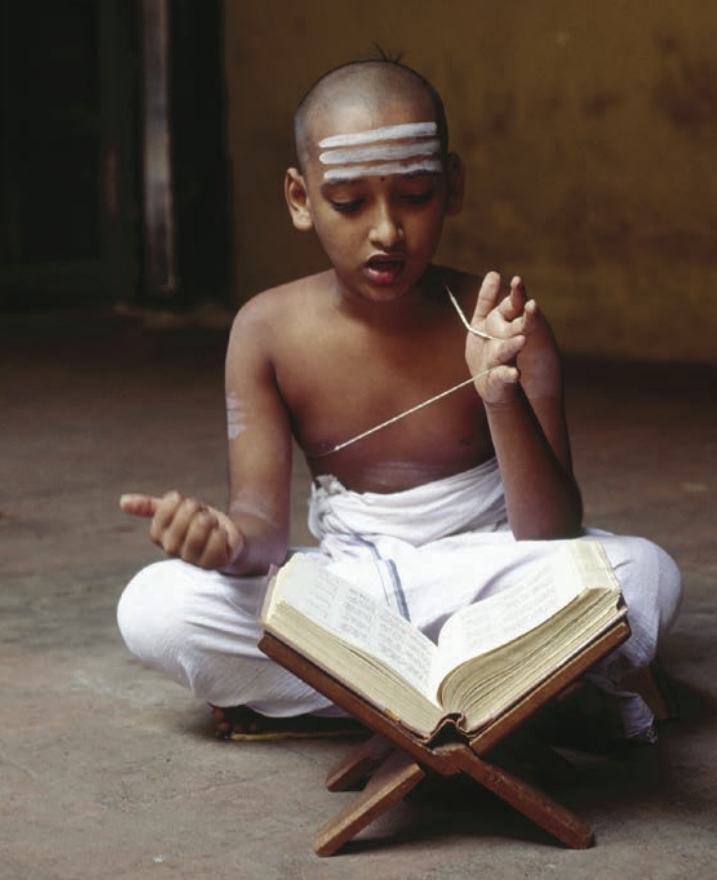
The Upanishads are philosophical texts that explore the deeper meanings behind Vedic rituals. They contain profound discussions about the nature of reality, the self (atman), and ultimate reality (Brahman). Together, the Vedas and Upanishads are considered the essential sacred texts that provide direct revelation from the divine realm.
Note
Both text collections are classified as sruti, meaning they are understood as divine revelations rather than human compositions. Their teachings address fundamental questions about existence, consciousness, and the path to spiritual liberation.
The Epics
As classical Hinduism developed between 500 BCE and 500 CE, a new body of more accessible religious literature emerged. These texts, known as the Epics, present religious teachings through engaging narratives rather than ritual instructions or philosophical discourse. The major epic works include the Ramayana and the Mahabharata (which contains the Bhagavad Gita).
The Ramayana
The Ramayana tells the compelling story of Prince Rama, whose wife Sita is kidnapped by Ravana, the demon king of Lanka. This epic was composed between 500 BCE and 100 CE, though tradition places it in the Tretā Yuga, the second cosmic age, many aeons ago.
Example
Story Summary: The Ramayana's Central Narrative
The epic explores multiple themes through its narrative:
The Heroic Journey: Prince Rama demonstrates vigorous bravery in his quest to rescue Sita from the demon king Ravana.
Testing Virtue: After rescuing Sita, Rama questions her integrity. She undergoes a trial by fire (agniparīksā) to prove her purity, which she passes.
Complex Consequences: Despite proving her virtue, doubts arise again in the seventh book, leading to Sita's banishment—demonstrating the sometimes harsh consequences of strict adherence to dharma.
Key Characters: The story introduces Hanuman, the devoted monkey king who becomes one of the most beloved deities in modern Hinduism.
Through this narrative, the Ramayana presents teachings about dharma (religious duty) and the conflicts that can arise from strict adherence to social and moral obligations. Rama himself is worshipped as an avatar (incarnation) of Lord Vishnu.
The Mahabharata
The Mahabharata stands as one of the greatest epic poems in world literature. With more than 100,000 couplets, it is among the longest poems ever composed. Tradition places the story between the Dvapara and Kali Yugas (approximately 400,000 years ago in mythological time), though scholars believe it was edited into its current form between 500 BCE and 500 CE.
The epic chronicles the rivalry and warfare between two families of warriors competing to expand their territories. Throughout the narrative, gods, spirits, and demons participate in the action, while the human characters engage in numerous conversations about the nature of life, duty, and spiritual truth.
Note
The "Fifth Veda"
The Mahabharata describes itself as the "fifth Veda", claiming equivalent authority to the foundational Vedic texts. This assertion reflects its role in spreading Hindu religious thought to all levels of society, regardless of literacy or social status. The text's vast scope touches upon virtually every aspect of religious life in India.
The epic's stories continue to be performed by acting and dance troupes throughout India and South-East Asia, serving as a vital form of religious education for communities where literacy remains limited.
The Bhagavad Gita
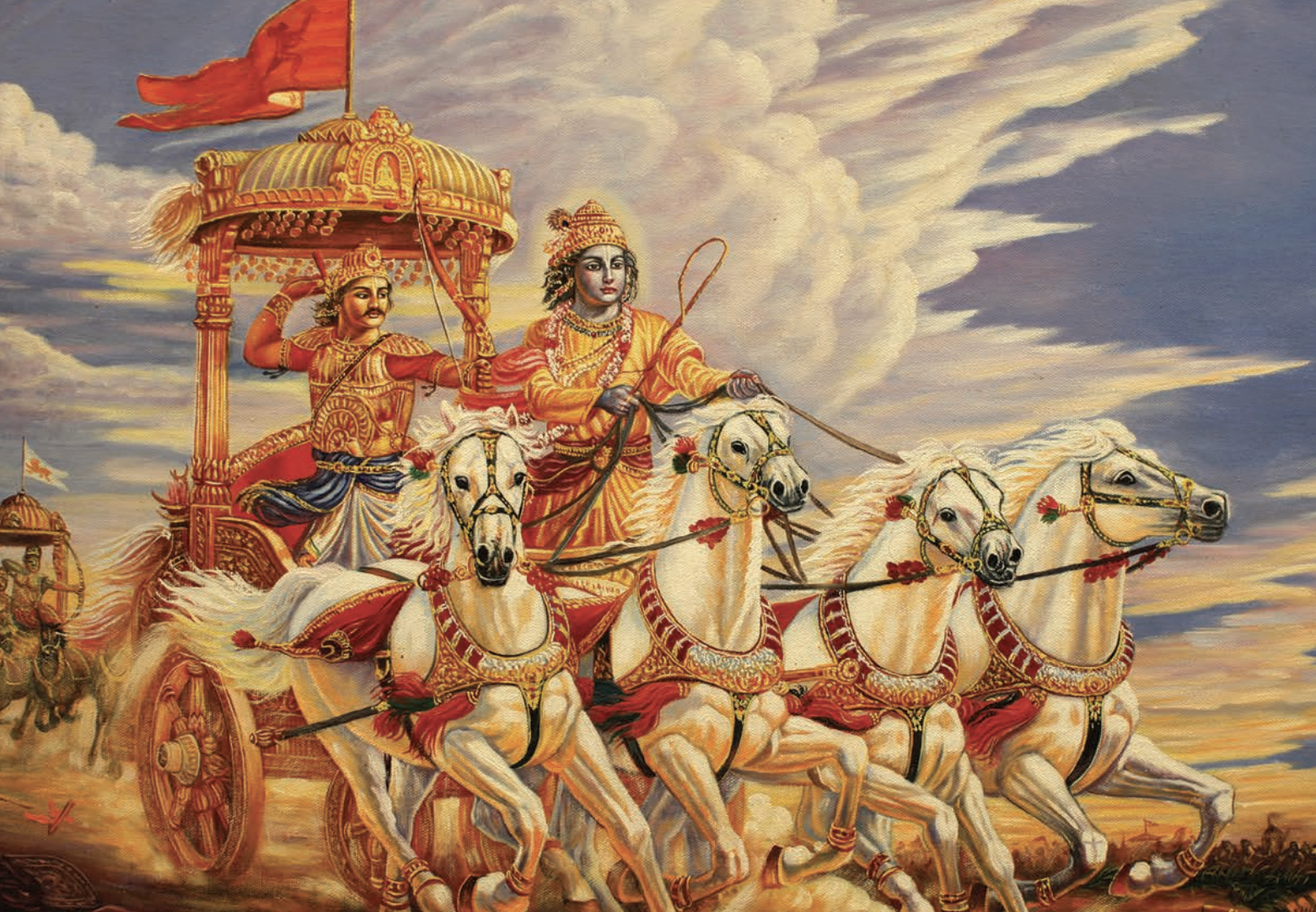
The Bhagavad Gita, or "Song of the Lord", is the most significant and influential section of the Mahabharata in contemporary Hinduism. This portion of the epic takes the form of an extended dialogue between Arjuna, one of the warrior heroes, and Krishna, who serves as his chariot driver but is actually a god in disguise.
Example
The Dramatic Setting of the Bhagavad Gita
The great battle between the two families is about to begin. Arjuna drives his chariot onto the battlefield to survey the opposing army and is horrified to recognise his uncles, childhood friends, and respected teachers among the enemies he must fight.
Arjuna's Crisis: Overwhelmed by the prospect of killing his own relatives, Arjuna sits down in his chariot and refuses to signal the start of the battle.
Krishna's Response: Krishna begins a profound teaching that addresses Arjuna's moral crisis, explaining his duty as a warrior and the eternal nature of the soul.
Krishna explains that because Arjuna was born into the Kshatriya (warrior) varna, it is his sacred duty to fight. Refusing to fulfil this duty would result in public shame and negative consequences in future rebirths. This teaching reinforces the conservative social message that individuals must accept and perform the duties associated with their birth status.
Important
Understanding Death and the Eternal Soul
Krishna provides spiritual comfort by explaining that death should not be feared, as it is merely part of the great cycle of rebirth (samsara). The soul is eternal and continues beyond the death of the physical body. This teaching addresses one of Arjuna's primary concerns about killing others on the battlefield.
The Bhagavad Gita explores multiple spiritual paths, including:
- The path of duty (karma yoga)
- The path of knowledge (jnana yoga)
- The path of devotion (bhakti yoga)
These teachings have made the Bhagavad Gita one of the most studied and beloved texts in Hinduism, influencing countless generations of spiritual seekers.
Extracts demonstrating principal beliefs
Hindu sacred texts contain numerous passages that express core beliefs and practices. The following extracts illustrate key theological and philosophical concepts.
From the Vedas
The Rig Veda (10.121.10) expresses the centrality of the divine creator:
"Lord of creation! no one other than you pervades all those that have come into being. May that be ours for which our prayers rise, may we be masters of many treasures!"
This passage emphasises that Brahman (ultimate reality) is central to all existence. The relationship between the devotee and God forms the foundation of religious experience. The text suggests that bringing body and mind into unified desire for God represents the most effective path for those seeking religious truth.
The Shvetashvatara Upanishad (3.20) describes the nature of the atman (soul):
"Subtlest of the subtle, greatest of the great, the atman is hidden in the cave of the hearts of all beings. He who, free from all urges, beholds Him overcomes sorrow, seeing by the grace of the Creator, the Lord and His glory."
Note
This verse teaches that the eternal soul dwells within every being, though it remains hidden from ordinary perception. Liberation from suffering comes through perceiving this inner divine presence with the help of divine grace.
The Katha Upanishad (1.12) describes the ultimate goal of spiritual practice:
"In heaven there is no fear at all. Thou, O Death, art not there, nor in that place does the thought of growing old make one tremble. There, free from hunger and from thirst and far from the reach of sorrow, all rejoice and are glad."
This passage describes moksha (liberation) as a state free from all suffering, fear, and the limitations of physical existence.
From the Bhagavad Gita
The dialogue between Arjuna and Krishna contains several crucial teachings:
On fulfilling one's dharma (1:47-2:3):
"Having spoken thus, on that field of battle, Arjuna sat down in the chariot pit, letting go of arrows and bow, his heart anguished with grief ... Then, to Arjuna, who was so overcome with compassion, despairing, his troubled eyes filled with tears, [Krishna] said – 'Why has this mood come over you at this bad time, Arjuna? This cowardice is unseemly to the noble, not leading to Heaven, dishonourable. Do not act like a eunuch, it does not become you! Rid yourself of this vulgar weakness of heart, stand up, enemy burner!"
Krishna challenges Arjuna to overcome his emotional reluctance and fulfil his warrior duty, regardless of personal feelings.
On the nature and duties associated with varna (2:31):
"Think also of your duty and do not waver. There is no greater good for a warrior than to fight in a righteous war."
This teaching reinforces the importance of accepting and performing one's social and religious duties according to one's birth status.
On yoga (2:49):
"Do your work in the peace of yoga and, free from selfish desires, be not moved in success or failure. Yoga is evenness of mind – a peace that is ever the same."
Note
This passage teaches that spiritual practice involves maintaining equanimity while performing one's duties, without attachment to outcomes.
On moksha (2:72):
"This is called the state of Brahman, O Arjuna, attaining which none is deluded. By abiding in this state even at the hour of death, one attains the cessation that is Brahman."
Krishna describes liberation as the state of realising one's identity with Brahman, which ends the cycle of rebirth.
On devotion and worship (9:26):
"He who offers to me with devotion only a leaf, or a flower, or a fruit, or even a little water, this I accept from that yearning aspirant, because with a pure heart it was offered with love."
Important
Accessibility of Spiritual Practice
This verse emphasises that sincere devotion matters more than elaborate offerings, making spiritual practice accessible to people of all social and economic backgrounds. This teaching demonstrates the inclusive nature of bhakti (devotional) practice in Hinduism.
Exam guidance
Note
When answering questions about Hindu sacred texts, remember to:
- Distinguish between sruti and smrti texts: Examiners often test understanding of the different levels of authority in Hindu scripture
- Connect texts to beliefs: Show how specific passages demonstrate core Hindu concepts like dharma, moksha, samsara, and the nature of Brahman
- Use specific examples: Reference particular stories (like the Ramayana) or passages (like those from the Bhagavad Gita) to support your answers
- Explain significance: Don't just describe what texts say – explain why these teachings matter to Hindu practitioners
- Consider diversity: Acknowledge that Hinduism contains many texts serving different communities and purposes
For evaluation questions, consider:
- How do oral traditions affect the preservation and transmission of sacred texts?
- Why might smrti texts be more influential in daily practice despite having lower authority than sruti texts?
- How do narrative texts (Epics) differ in their effectiveness as religious teaching compared to ritual or philosophical texts?
Summary
Key Points to Remember:
- Hindu sacred texts divide into two categories: sruti (revealed texts like the Vedas and Upanishads) and smrti (remembered texts like the Epics and Puranas)
- The Vedas and Upanishads form the foundational texts of Hinduism and are considered direct divine revelations
- The Ramayana tells the story of Prince Rama and his wife Sita, teaching about dharma and loyalty
- The Mahabharata is one of the world's longest poems, describing itself as the "fifth Veda" and containing teachings accessible to all social groups
- The Bhagavad Gita, part of the Mahabharata, presents Krishna's teaching to Arjuna about duty, yoga, and liberation, making it one of the most important texts in contemporary Hinduism
Essential Terms:
- Sruti: "revealed" texts with highest authority
- Smrti: "remembered" texts of human composition
- Dharma: religious and social duty
- Samsara: cycle of rebirth
- Moksha: liberation from rebirth
- Atman: individual soul
- Brahman: ultimate reality