Global Distribution of the Major Religious Traditions (HSC SSCE Studies of Religion): Revision Notes
📚Revision Notes
Global Distribution of the Major Religious Traditions
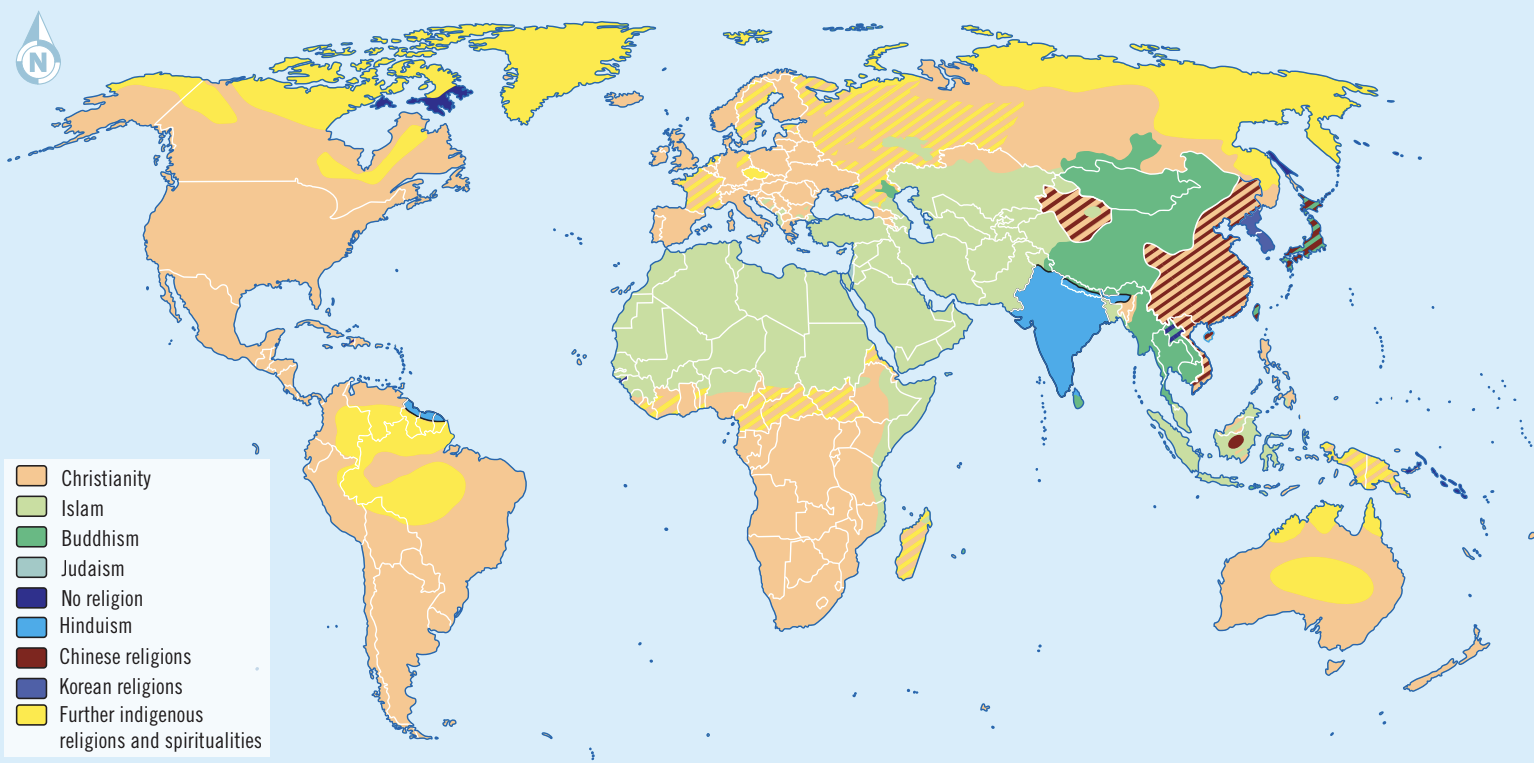
Introduction to religious distribution worldwide
Religious expression exists in every region of the world, manifesting in diverse forms across different cultures and societies. Understanding how religions spread and where they concentrate provides insight into human migration patterns, historical events, and cultural exchange.
Animism represents the earliest form of religious thought and emphasises the spirit world. This foundational concept underlies many subsequent religious expressions and remains significant in indigenous spiritualities globally.
Note
The study of religious distribution helps us understand not just where people practice different faiths, but also reveals the complex interplay between human movement, cultural exchange, and historical power dynamics that have shaped our modern world.
Historical factors influencing religious spread
The global distribution of major religious traditions reflects the movement and interaction of human populations throughout history. Several key factors have shaped where religions are practised today:
Colonial expansion
Christianity spread extensively across the world during the colonial period (15th–18th centuries) as European powers established territories in the Americas, Africa, Asia, and Oceania. Colonial governments and missionaries actively promoted Christian beliefs, leading to its presence on every continent.
Note
The colonial period's impact on religious distribution cannot be overstated. The deliberate spread of Christianity through colonial administration, education systems, and missionary work fundamentally transformed the religious landscape of entire continents, particularly in Africa and the Americas.
Evangelical and missionary work
Some traditions expanded through deliberate religious outreach. Buddhism spread significantly through:
- King Asoka's evangelical efforts in ancient India
- The popularisation of Mahayana Buddhism across East and Southeast Asia
Note
Unlike colonial expansion which often involved political and military power, evangelical work represents the spread of religion primarily through persuasion, education, and cultural influence. Buddhism's spread through King Asoka's efforts demonstrates how a ruler's personal conversion can lead to widespread religious transformation across vast regions.
Military conquest
Early Islamic expansion occurred through military campaigns and subsequent governance, establishing Islam across the Middle East, North Africa, and parts of Asia.
Geographic concentration
Not all religions spread widely. Hinduism remained largely concentrated in its region of origin around the Indian subcontinent, though diaspora communities have since established Hindu practices elsewhere.
Important
Understanding spread patterns: The different mechanisms of religious spread—colonial expansion, evangelical work, military conquest, and geographic concentration—each left distinct patterns on the global religious map. Recognising these patterns helps explain why certain religions dominate particular regions while remaining absent from others.
Major religious traditions and their locations
The world map of religious distribution reveals distinct patterns:
Christianity (33% of global population)
- Dominant in Europe, the Americas, sub-Saharan Africa, and Oceania
- Largest single religious tradition globally
Islam (21% of global population)
- Concentrated in the Middle East, North Africa, Central Asia, and Southeast Asia
- Second-largest religious tradition worldwide
Hinduism (13% of global population)
- Primarily located in India, Nepal, and surrounding regions
- Significant diaspora communities worldwide
Buddhism (5.8% of global population)
- Present across East Asia, Southeast Asia, and increasingly in Western nations
- Statistics potentially underestimate actual numbers (see challenges below)
Judaism (0.23% of global population)
- Distributed globally with significant populations in Israel, North America, and Europe
- Despite small numbers, Judaism remains historically significant as the source tradition for both Christianity and Islam
Sikhism (0.35% of global population)
- Concentrated in Punjab region (India/Pakistan)
- Growing diaspora communities in Western nations
Indigenous religions and Chinese/Korean religions
- Distributed according to specific cultural and geographic contexts
- Often combined with other religious practices
Note
Numerical significance vs. historical influence: While Christianity and Islam dominate the global religious landscape numerically, smaller traditions like Judaism have exercised profound influence far beyond their adherent numbers. Judaism's theological concepts and scriptural traditions form the foundation for both Christianity and Islam, demonstrating that a religion's significance extends well beyond population statistics.
Challenges in mapping religious distribution
Accurately charting global religious distribution presents several significant difficulties for researchers and demographers. Understanding these challenges is essential for critically evaluating any religious statistics you encounter.
Census limitations
Many countries do not include questions about religion in their national census. This occurs for several reasons:
- Constitutional restrictions preventing governments from collecting religious data
- Citizens declining to answer religious questions due to privacy concerns
- Political sensitivities surrounding religious identity
In Australia, the religion question on the census is optional, meaning not all residents provide this information.
Important
Data reliability concerns: Census limitations mean that even in countries that do collect religious data, the information may be incomplete or unrepresentative. Citizens may choose not to answer, may identify with multiple traditions, or may report cultural rather than active religious affiliation. This makes all global religious statistics approximate estimates rather than precise measurements.
Communist government policies
Until the late 1980s, Eastern Europe, Russia, and China maintained officially atheist governments. Communist ideology rejected religious affiliation, leading to:
- Citizens not being classified as adherents of any religious tradition
- Suppression of religious practice and expression
- Lack of official data on actual religious beliefs
Following the breakdown of communist systems in the 1990s, many countries experienced religious revivals, revealing that populations were not entirely atheist despite official policies.
Note
The collapse of communist regimes in Eastern Europe and the former Soviet Union in the late 1980s and early 1990s led to dramatic religious revivals. Churches, mosques, and temples that had been closed for decades reopened, and millions of people who had been officially classified as atheists openly embraced religious identities. This demonstrates how political systems can mask actual religious beliefs and practices.
The Chinese population anomaly
The case of China illustrates how official statistics can mislead. With 1.3 billion people, China's official atheist stance significantly affects global religious statistics. If Chinese citizens are primarily Buddhist—as may actually be the case—then Buddhism's global numbers could rival or exceed Islam's, rather than representing only 7% of the world's population.
Important
The China factor: China's population represents approximately 18% of all humanity. How Chinese citizens are classified religiously has enormous implications for global religious statistics. The official atheist classification may hide hundreds of millions of Buddhists, Taoists, or practitioners of traditional Chinese religions, potentially making current global religious statistics fundamentally inaccurate.
Understanding statistical representations
Global adherent percentages
According to available data (though with noted limitations):
- Christianity: 33%
- Islam: 21%
- Hinduism: 13%
- Buddhism: 5.8%
- Atheism: 2.3%
- Sikhism: 0.35%
- Judaism: 0.23%
- Baha'i Faith: 0.12%
- Other: 24%
Note
Notice that the "Other" category represents nearly a quarter of the global population. This substantial percentage includes indigenous religions, traditional Chinese and Korean religions, and various spiritual practices that don't fit neatly into major religious categories. The size of this category reminds us that the major world religions, while dominant, don't capture the full diversity of human religious expression.
Regional population distribution
Understanding where people live provides context for religious distribution:
| Continent | Population |
|---|---|
| Asia | 4,216,000,000 |
| Africa | 1,072,000,000 |
| The Americas | 942,000,000 |
| Europe | 740,000,000 |
| Oceania | 37,000,000 |
Asia's enormous population means that even relatively small percentages represent hundreds of millions of adherents.
Example
Worked Example: Understanding Percentages in Context
Consider Buddhism at 5.8% of the global population (approximately 7 billion people):
Step 1: Calculate total Buddhist population
Step 2: Consider Asia's population concentration With over 4.2 billion people in Asia, even if Buddhism represents just 10% of Asia's population, that would be:
This example demonstrates how small percentages in populous regions translate to massive absolute numbers, and why the China question matters so significantly for Buddhist statistics.
Significance beyond numbers
Judaism and Sikhism together comprise less than 1% of the world's population, yet both are studied as major religious traditions due to their:
- Historical significance (Judaism as the source of Christianity and Islam)
- Theological influence on other traditions
- Cultural and social impact beyond their numerical representation
Note
Religious traditions are considered "major" not solely based on adherent numbers, but also on their historical influence, theological sophistication, cultural impact, and role in shaping civilisations. Judaism's theological concepts have influenced billions of Christians and Muslims, while Sikhism represents a distinctive synthesis of Hindu and Islamic elements with unique contributions to religious thought.
Exam guidance
When analysing religious distribution, understanding question types and expectations is crucial for crafting appropriate responses.
Important
Exam Success Strategy
Describe questions should include:
- Specific geographic locations of religious traditions
- Historical factors explaining current distribution patterns
- Reference to colonial, evangelical, or conquest-driven spread
Explain questions require you to:
- Identify causes of distribution patterns
- Link historical events to current religious geography
- Consider multiple factors (political, social, historical)
Evaluate questions demand:
- Assessment of data reliability and limitations
- Recognition that official statistics may not reflect actual beliefs
- Consideration of how political systems affect religious reporting
- Critical analysis of what distribution patterns reveal about human history
Always acknowledge that religious statistics are estimates subject to significant limitations, particularly regarding census data availability and political influences on reporting.
Key terms
- Animism: The earliest expression of religious thought, emphasising the spirit world and underlying many religious traditions
- Colonial period: 15th–18th centuries when European powers established territories worldwide
- Evangelical work: Deliberate efforts to spread religious beliefs through missionary activity
- Adherents: People who follow or belong to a particular religious tradition
- Pejorative: A term of criticism or deprecation, used negatively
- Religious revival: Re-emergence or renewed practice of religion after suppression or decline
Note
These key terms represent essential vocabulary for discussing religious distribution. Understanding them allows you to communicate precisely about complex patterns of religious spread, demographic change, and the challenges of measuring religious affiliation globally.
Remember!
Summary
Key Points to Remember:
- Religious distribution reflects human migration, colonialism, conquest, and missionary work throughout history
- Christianity, Islam, and Buddhism spread widely; Hinduism remained geographically concentrated
- Official statistics about religion can be misleading due to census limitations, political systems, and citizen responses
- Communist countries historically classified populations as atheist despite actual religious beliefs
- China's official atheist stance significantly affects global Buddhist statistics—actual numbers may be much higher
- Judaism and Sikhism are significant traditions despite small global percentages
- Always evaluate religious data critically, recognising limitations and potential inaccuracies
- Understanding regional population distribution (especially Asia's 4.2 billion people) provides essential context for interpreting religious percentages
- The mechanisms of religious spread—colonial expansion, evangelical work, military conquest, and geographic concentration—each created distinct patterns on the global religious map
- Religious significance extends beyond numerical representation to include historical influence, theological impact, and cultural contributions