Taoism (HSC SSCE Studies of Religion): Revision Notes
📚Revision Notes
Taoism
The nature of Taoism
Taoism (also spelled Daoism) represents one of China's three major religious traditions, alongside Confucianism and Buddhism. Chinese adherents commonly practice all three systems simultaneously without conflict. Among these traditions, Taoism maintains the strongest connection to Chinese folk religion and the veneration of natural landmarks, particularly sacred mountains.
The religion originated through a collection of challenging philosophical writings before evolving into a more devotional and mystical tradition. This transformation demonstrates Taoism's dual nature as both a philosophical system and an organized religion.
Note
Note on romanization: Chinese words appear in English using two systems. Wade-Giles, created by English speakers, renders the tradition as 'Taoism'. The Chinese-developed Pinyin system, though less familiar in the West, presents it as 'Daoism'. Both spellings represent the same Chinese concept.
Historical timeline
Circa 500 BCE: The legendary philosopher Lao Zi (Old Master) reportedly lived during this period. Traditional sources credit him with authoring the Tao Te Ching, though historical evidence only confirms the text's existence around 300 BCE.
Circa 300 BCE: Zhuang Zi composed his influential work, considered one of China's most humorous and intellectually stimulating texts.
221 BCE: Emperor Qin Shi Huang unified China and standardized its writing system. His practice of Taoist alchemy ultimately caused his death.
Circa 200 CE: Taoism established itself as the dominant religion at the Imperial Court.
300-400 CE: Early Chinese Buddhism was interpreted as a branch of Neo-Taoism.
618-907 CE: The Tang Dynasty designated Taoism as China's first official state religion.
1368 CE: The Ming Dynasty recognized Buddhism, Taoism and Confucianism as China's three great religious teachings.
1644 CE: The foreign Manchurian Qing Dynasty maintained power by upholding Chinese traditions, though it failed to prevent European colonial expansion, leading to national chaos.
1912 CE: The Chinese Republic formed under Dr Sun Yat Sen, by which time Taoism had significantly declined.
1949 CE: The Communist People's Republic of China forced religious organizations to submit to government control, operate secretly, or relocate overseas. Contemporary Taoist activity concentrates primarily in Taiwan.
The origins of the universe
The Tao and cosmic generation
Chapter 42 of the Tao Te Ching describes creation through a progressive sequence: "The way begets one; one begets two; two begets three; three begets the myriad creatures. The myriad creatures carry on their backs the yin and embrace in their arms the yang and are the blending of the generative forces of the two."
The Tao (meaning 'the way') represents the natural flow of existence and the course of tradition. The Tao Te Ching also describes it as the 'nameless mother', emphasizing its mysterious and indefinable nature as the source of all existence. The Tao Te Ching itself serves as the fundamental Chinese classic text for Taoist philosophy.
Yin and yang
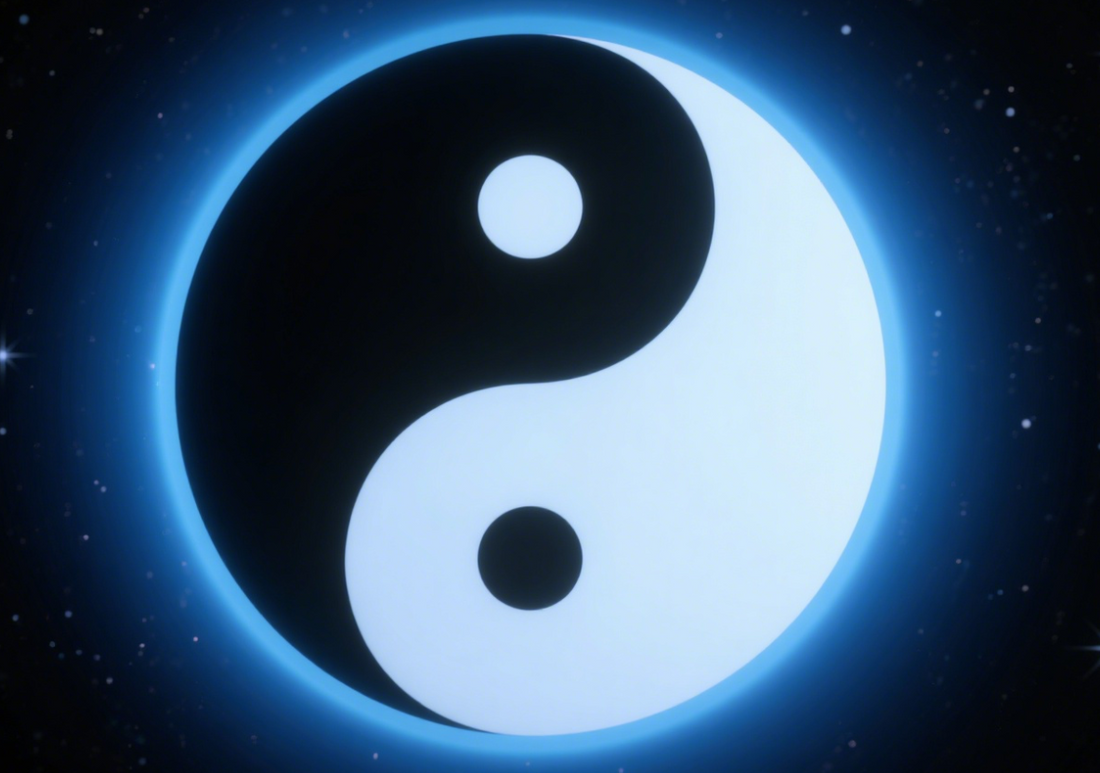
From this primordial source emerge the fundamental forces of yin and yang. Yang originally referred to the sunny, southern slope of a mountain, and by extension represents warmth, dryness and upward movement. The masculine and active principles align with yang energy.
Yin represents the complementary opposite—cold, dampness and downward motion. The feminine and passive principles correspond to yin energy. This dualistic framework organizes understanding of landscape, life, gender and even human anatomy.
The paradox of passivity
Taoist philosophy contains an essential paradox: true strength emerges from passivity. Water demonstrates this principle perfectly. When stepped upon, water yields completely, appearing entirely passive. However, as it flows through the landscape following the natural way (seeking the lowest points), it possesses sufficient power to carve canyons.
Important
The Taoist Paradox of Power
The principle that passivity contains the greatest strength is fundamental to understanding Taoism. This seemingly contradictory concept appears throughout Taoist teaching and practice, challenging conventional notions of power and control.
Sun Tzu's The Art of War (476-221 BCE) applies this Taoist principle to military strategy, demonstrating how concealment, patience and spontaneous attacks when enemies least expect them prove remarkably effective in warfare.
Creation mythology
Taoism incorporates traditional Chinese creation narratives, including the Pan Ku myth. According to this story, the primordial world resembled an egg that hatched after 18,000 years. The lighter, pure substances (yang) formed the heavens, while heavier, impure matter (yin) became the earth. The giant Pan Ku emerged alongside four creatures who shaped the earth into its present form. Upon Pan Ku's death, his breath transformed into wind, his eyes became the sun and moon, his perspiration turned to rain, and humans originated from parasites on his body.
Principal beliefs
Taoism as a philosophy
Early Taoist philosophy challenged conventional values regarding cultivation and education, often serving as a counterweight to Confucian restrictions. Confucianism promoted rigorous education, strict patriarchal family structures and traditional imperial authority. In contrast, the Tao Te Ching—simultaneously an emperor's handbook, comedic work and mystical text—consistently advocates inaction.
The text's authorship remains uncertain. Tradition attributes it to Lao Zi (Old Master), though this name may represent a collective pseudonym rather than a historical individual. The book likely developed over many centuries as an accumulation of wisdom sayings.
Note
The Tao Te Ching advises rulers paradoxically: eliminate criminals by abolishing laws, govern effectively by keeping people content but uneducated, and travel wisely by following established paths ('let your wheels move only along old ruts').
Zhuang Zi, Taoism's other major early philosopher, offered guidance to rulers while exploring the nature of the Tao. His writings sometimes describe this understanding through metaphor: a skilled cook who knows 'the Tao of the meat'—understanding precisely where fat, gristle and bone lie—carves perfectly every time. The Chuang Tzu also promotes uselessness and spontaneity as virtues.
Wu wei represents a crucial concept meaning a state of purposeful inaction that enables spontaneous, perfectly-timed responses.
Zhuang Zi particularly enjoyed exploring life's paradoxes. His famous butterfly dream illustrates this: after dreaming he was a butterfly, he awoke uncertain whether he was Zhuang Zi who had dreamed of being a butterfly, or a butterfly currently dreaming of being Zhuang Zi.
Example
Classic Illustration: The Butterfly Dream
Zhuang Zi once dreamed he was a butterfly, fluttering about happily and completely unaware of being Zhuang Zi. Upon awakening, he found himself uncertain: Was he Zhuang Zi who had just dreamed of being a butterfly, or was he actually a butterfly now dreaming of being Zhuang Zi?
This famous paradox illustrates the Taoist questioning of the nature of reality and identity.
Another story demonstrates Taoist irreverence toward officialdom: When an imperial official visited a renowned Taoist and expressed shock at finding him naked, demanding "Where are your trousers?", the Taoist replied that the entire world served as his trousers and his house as his undergarments, then asked the official to exit his undergarments. Such humor reveals Taoist disdain for bureaucratic pretension and official formality.
Taoism as a religion
From its philosophical foundations opposing Confucianism, Taoism evolved into an organized religion. Religious Taoism's primary focus shifted from spontaneous action to achieving adherent longevity and ultimately immortality. Texts like the Book of the Yellow Emperor's Court concentrated on health and extending life.
Alchemy—the mixing of transformative substances—became central to Taoist secret traditions. Alchemy represents an early form of scientific experimentation and philosophical investigation, particularly involving chemistry, metallurgy and mysticism. While the elixir of eternal life remained elusive, Taoist experimentation led to significant discoveries including gunpowder and other valuable chemicals.
Note
Religious practitioners believed immortality could be achieved by appealing to deities and immortals who had already discovered eternal life's secrets. Contemporary Taoism emphasizes meditation, longevity practices and following the Tao—the natural way of life.
Adherents believe ritual practice enables people to become deities. Harmony with nature, symbolized by balanced yin and yang, represents the fundamental aim of Taoist life.
Supernatural powers and deities
Chinese religious practice often blurs distinctions between local folk deities and specifically Taoist divine figures. The tradition's most celebrated deities are the Eight Immortals, who according to Taoist teachings possess the secret of eternal life. These beings disguise themselves and regularly appear in human society to test people, particularly targeting those behaving unethically. Shopkeepers who manipulate scales dishonestly and corrupt scholars or officials typically find themselves outwitted by these Immortals.
The Eight Immortals function as superhero-like protectors of ordinary, just people while punishing the corrupt and immoral. They represent the ultimate achievement for religious Taoist followers—righteous beings who live forever.
Additional deities populate the Taoist pantheon:
- The Jade Emperor (Yu-huang): Rules heaven and earth, dispensing divine justice
- The Three Officials: Record all good and evil actions, administering appropriate rewards or punishments
- The Three Pure Ones: Demonstrate benevolence and provide spiritual teaching
Adherents invoke these various deities through ceremonies addressing specific needs and concerns.
Rituals
Taoist ritual practice takes two primary forms, each serving distinct purposes.
Personal rituals for immortality
The first category connects intimately with alchemical preparation and the individual quest for eternal life. These personal practices aim to reverse normal bodily processes, theoretically halting or reversing aging. Techniques include:
- Strict dietary restrictions (such as grain avoidance)
- Meditation practices
- Specialized breathing techniques
One notable method involves 'breathing to one's feet', attempting to draw ch'i (vital essence) deeply through the lungs throughout the entire body. Ch'i originally meant 'steam', 'cloud' or 'mist', understood as the atmospheric force separating masculine heaven from feminine earth. Through Taoist practices, ch'i transforms into spiritual energy capable of transforming the body and achieving immortality. This ensures balanced flow of yin and yang forces.
Important
The Centrality of Breathing Practice
Breathing practice holds paramount importance in Taoism. Many concepts underlying traditional Chinese medicine originate from these ideas, as explored in Kristopher Schipper's research documented in The Taoist Body.
Cosmic and temple rituals
The second ritual category relates to understanding the cosmos as sacred space. Taoists conceptualize the human body as an internal landscape containing rivers, mountains, fields and presiding deities. Praying to these deities and performing rituals can transform this internal landscape. Through sympathetic magic principles, practitioners perform elaborate ritual dances tracing cosmic patterns in Taoist temples, mountain caves and sacred spaces.
Religious Taoism can therefore be understood as imagining microcosms within the body and macrocosms in ritual spaces, facilitating transformations leading to participant immortality.
Note
Taoist practices demonstrate strong interest in talismans, magical operations and spiritual services provided by priests. Adherents engage in prayers to Taoist deities, meditation and chanting of prayers and sacred texts.
Taoist priests regulate complex rituals where lay practitioners have minimal active roles. These ceremonies may include priestly chanting, ritual dancing, and playing wind and percussion instruments. Offerings are dedicated and rituals performed to restore communal peace and prosperity while maintaining universal order.
Influence on society
Taoism provided essential balance to Confucianism's strict, conservative nature in Chinese society. Through alchemical practices, Taoism significantly contributed to chemical innovation and traditional Chinese medicine development. Taoist experimentation produced not only gunpowder but also acupuncture techniques.
Taoist breathing and meditation practices prepared Chinese culture for Buddhism's arrival. Buddhism initially gained acceptance partly because the Chinese initially understood it as a Taoist school. Even after Buddhism established itself independently in China, Taoist influence gave Chinese Buddhism distinctive characteristics. Chan Buddhism's development (known as Zen when transmitted to Japan) shows strong Taoist influence from Taoist attitudes and practices.
Note
Taoism's Artistic Legacy
Emphasizing naturalness rather than formal education, Taoism inspired exceptional Chinese artistic and poetic achievements, including Li Bo's poetry and Wang Wei's poetry and landscape painting. These artists attempted to transcend personal consciousness and channel the Tao itself.
The Tao Te Ching's emphasis on spontaneity introduced vital spontaneity to Chinese society, whereas Confucianism focused on conservative tradition and rigorous education.
By seeking to restore communal balance—the 'Tao'—adherents learn to control emotions, freeing the inner world from sensory and emotional misdirection. This approach produces ordered society not through controlling nature but by embracing it. Consequently, environmental concerns feature prominently in contemporary Taoism.
The human search for meaning
From approximately 1000 CE, Taoism contributed to Chinese conceptions of a heavenly emperor presiding over a celestial court. However, reaching this heaven never constituted Taoism's ultimate objective—the focus remained firmly on achieving immortality. Taoist teaching explained human existence as a quest to live eternally. Initially pursued through crude chemical means, this quest later developed more metaphorical interpretations of what immortality might encompass.
Despite religious Taoism's growth, philosophical Taoism continued inspiring those fascinated by life's paradoxes. As philosophy (the study of the general principles of knowledge), Taoism illuminates life's absurdities and the inherent paradoxes in defining reality. Whether practiced as religion or philosophy, following 'The Way' provided Chinese culture an alternative vision beyond Confucian strict traditionalism.
Important
The Taoist Approach to Life's Meaning
Taoism's approach to life's meaning emphasizes acting naturally—cleansing negativity, accepting circumstances as they are, and appreciating the world's nature. Unlike many religions, Taoism does not focus on afterlife destinations but rather on discovering meaning within this present life.
Remember!
Summary
Key Points to Remember:
-
Taoism originated as provocative philosophical texts before developing into an organized religion focused on immortality and harmony with nature
-
The Tao represents the natural flow of existence; from it emerge yin (passive, cold, downward, feminine) and yang (active, warm, upward, masculine) as complementary forces
-
Philosophical Taoism emphasizes paradoxes, spontaneity (wu wei), and inaction as strength, contrasting with rigid Confucian structure and valuing uselessness over conventional productivity
-
Religious Taoism pursues immortality through alchemy, breathing techniques (ch'i cultivation), meditation and ritual practices involving deities like the Eight Immortals, Jade Emperor, Three Officials and Three Pure Ones
-
Taoist influence profoundly shaped Chinese medicine, chemistry, Buddhism, art, poetry and environmental consciousness, providing essential balance to Confucianism's conservatism
-
The human search for meaning in Taoism focuses on living naturally and finding significance in this life rather than seeking an afterlife, embracing the paradoxes of existence