Aerobic Cellular Respiration (VCE SSCE Biology): Revision Notes
📚Revision Notes
Aerobic Cellular Respiration
What is cellular respiration?
Cellular respiration is the process by which cells break down large molecules, particularly glucose, to produce usable energy in the form of ATP (adenosine triphosphate). This process is essential for all living organisms, as every cell requires a constant supply of energy to carry out its life-sustaining functions.
Glucose is a simple 6-carbon sugar molecule () commonly found in carbohydrates like bread, honey, and potatoes. However, the energy stored in glucose is too large to be useful for most cellular reactions. Cellular respiration breaks down this energy into smaller, more manageable packages stored in ATP molecules.
There are two main pathways for breaking down glucose:
- Aerobic cellular respiration: requires oxygen and produces 30 or 32 ATP molecules per glucose
- Anaerobic fermentation: occurs without oxygen and produces only 2 ATP molecules per glucose
Note
Think of glucose as a $1000 note. It contains a lot of value, but it's not very useful for everyday transactions. ATP is like a $10 note—much more practical for the day-to-day cellular processes that keep your cells running smoothly. Cellular respiration converts the large energy package of glucose into many smaller ATP packages that cells can actually use.
The overall equation
Aerobic cellular respiration can be summarised by this overall equation:
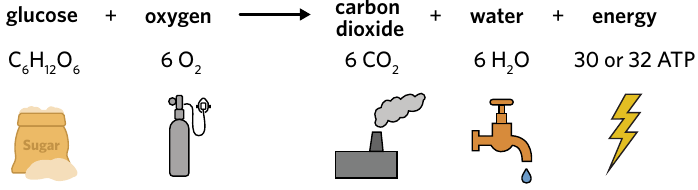
This shows that glucose and oxygen react together in cells to produce carbon dioxide, water, and energy in the form of ATP.
Important
Why is oxygen so important?
Breathing in oxygen allows our cells to produce large amounts of energy efficiently. Without oxygen, cells can only produce 2 ATP per glucose through anaerobic fermentation, compared to 30 or 32 ATP with oxygen present.
The role of mitochondria in aerobic respiration
Mitochondria are specialised double-membrane organelles that serve as the powerhouses of the cell. They are the site of the second and third stages of aerobic cellular respiration.
Mitochondrial structure
Understanding mitochondrial structure is crucial because different stages of cellular respiration occur in different parts of this organelle.
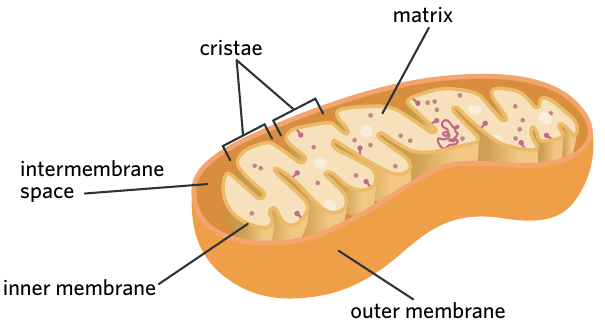
Key structures include:
- Outer membrane: forms the outer boundary of the mitochondrion
- Inner membrane: highly folded membrane that creates cristae
- Cristae: folds of the inner membrane that increase surface area for the electron transport chain
- Intermembrane space: narrow space between the outer and inner membranes; plays an important role in creating the proton gradient
- Mitochondrial matrix: the fluid-filled space inside the inner membrane; contains enzymes and is the site of the Krebs cycle
Note
The first stage of cellular respiration, glycolysis, occurs in the cytosol (the fluid surrounding organelles in the cell), not in the mitochondria. This is why glycolysis can occur even in cells without mitochondria.
Aerobic respiration and photosynthesis
Although aerobic cellular respiration and photosynthesis are not simply reverse reactions of each other, they are related processes that can recycle each other's products.
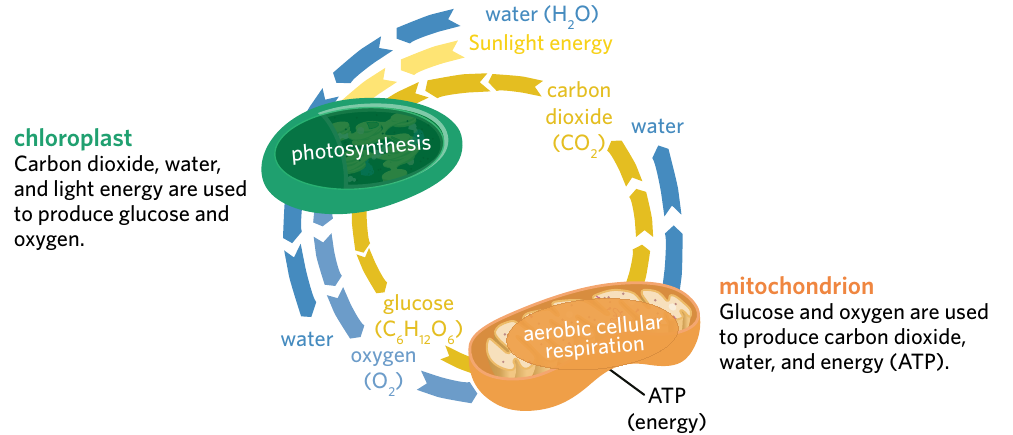
Key points:
- Photosynthesis (in chloroplasts) uses carbon dioxide, water, and light energy to produce glucose and oxygen
- Aerobic cellular respiration (in mitochondria) uses glucose and oxygen to produce carbon dioxide, water, and ATP
- For organisms that can perform both processes (like plants), this means they don't need to source all their inputs from the environment
- The processes use different enzymes and structures, so they are not true reverse reactions
The three stages of aerobic cellular respiration
Aerobic cellular respiration occurs in three distinct stages:
- Glycolysis (in the cytosol)
- The Krebs cycle (in the mitochondrial matrix)
- The electron transport chain (on the cristae)
Stage 1: Glycolysis
Glycolysis is the first stage of aerobic cellular respiration. It occurs in the cytosol of the cell and involves breaking down one 6-carbon glucose molecule into two 3-carbon pyruvate molecules.
Location and inputs/outputs
Location: Cytosol
Inputs:
- 1 glucose ()
- 2 ADP + 2 (inorganic phosphate)
- 2 NAD + 2 H
Outputs:
- 2 pyruvate
- 2 ATP
- 2 NADH
How glycolysis works
Glycolysis occurs through a sequence of ten enzyme-controlled reactions. While you don't need to know the details of each step, you should understand the overall process and the molecules involved.
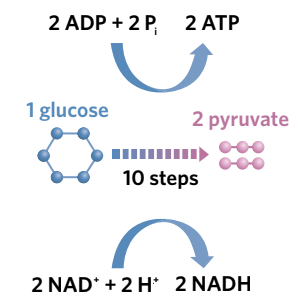
As glucose is broken down into pyruvate, energy is released. This energy powers two key reactions:
Example
How Energy is Captured in Glycolysis:
1. ATP production:
The ATP produced can immediately be used to power cellular reactions.
2. NADH formation:
The hydrogen ions (H) and electrons (e) come from the breakdown of glucose. NADH acts as an electron and proton carrier. The two NADH molecules will be transported to the mitochondria to help make more ATP in the electron transport chain.
The two pyruvate molecules produced are also transported to the mitochondria, where they will be modified and broken down further in the Krebs cycle.
Stage 2: The Krebs cycle
The Krebs cycle (also called the citric acid cycle or TCA cycle) is the second stage of aerobic cellular respiration. It occurs in the mitochondrial matrix and produces carbon dioxide, ATP, and high-energy electron carriers.
The link reaction
Before pyruvate can enter the Krebs cycle, it must first be converted to acetyl-CoA. This occurs through the link reaction:
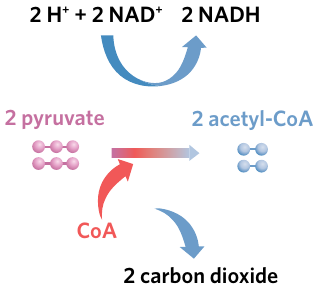
In the link reaction:
- Pyruvate combines with coenzyme A (CoA) to form acetyl-CoA
- Carbon dioxide is released as a waste product (which we exhale)
- NADH is produced, which will be used later at the electron transport chain
Note
Since one glucose produces two pyruvate molecules, the link reaction occurs twice per glucose molecule, producing:
- 2 acetyl-CoA
- 2 CO
- 2 NADH
Location and inputs/outputs
Location: Mitochondrial matrix
Inputs:
- 2 acetyl-CoA (derived from 2 pyruvate)
- 2 ADP + 2
- 6 NAD + 6 H
- 2 FAD + 4 H
Outputs:
- 4 CO
- 2 ATP
- 6 NADH
- 2 FADH
How the Krebs cycle works
The Krebs cycle is a series of eight enzyme-controlled reactions that extract energy from the acetyl group of acetyl-CoA. The coenzyme A molecule is then recycled back for reuse in the link reaction.
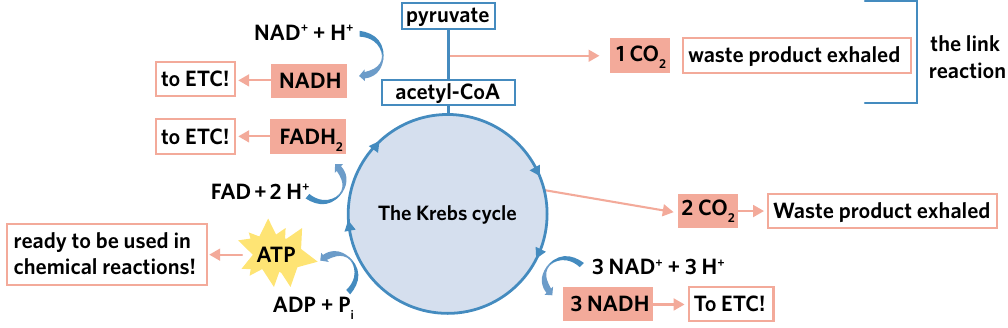
Key points about the Krebs cycle:
1. Production of electron carriers: As acetyl-CoA is broken down, protons and high-energy electrons are released. These are loaded onto NAD and FAD molecules to create the high-energy coenzymes NADH and FADH. These will deliver their energy to the electron transport chain.
2. Carbon dioxide production: The Krebs cycle produces 2 CO molecules for every acetyl-CoA molecule. Combined with the CO from the link reaction, this means a total of 6 CO molecules are produced per original glucose molecule. This CO is a waste product that we exhale.
3. Small ATP production: The Krebs cycle produces a small amount of ATP (2 ATP total, 1 per acetyl-CoA molecule). The majority of ATP will be produced in the next stage.
Note
Memory aid: Think of coenzymes NAD and FAD as waiters in a restaurant. At the kitchen (glycolysis, link reaction, and Krebs cycle), they fill their trays with food (high-energy electrons and protons) to become NADH and FADH. They then deliver this energy to tables (the electron transport chain). The empty trays (unloaded NAD and FAD) are then taken back to the kitchen to be reused.
Stage 3: The electron transport chain
The electron transport chain (ETC) is the third and final stage of aerobic cellular respiration. It occurs on the cristae (inner membrane) of the mitochondria and is where the majority of ATP is produced.
Location and inputs/outputs
Location: Cristae (inner mitochondrial membrane)
Inputs:
- 6 O + 12 H
- 26 or 28 ADP + 26 or 28
- 10 NADH
- 2 FADH
Outputs:
- 6 HO
- 26 or 28 ATP
- 10 NAD + 10 H
- 2 FAD + 4 H
How the electron transport chain works
The electron transport chain uses a series of protein complexes embedded in the inner mitochondrial membrane to extract energy from NADH and FADH and produce large amounts of ATP.
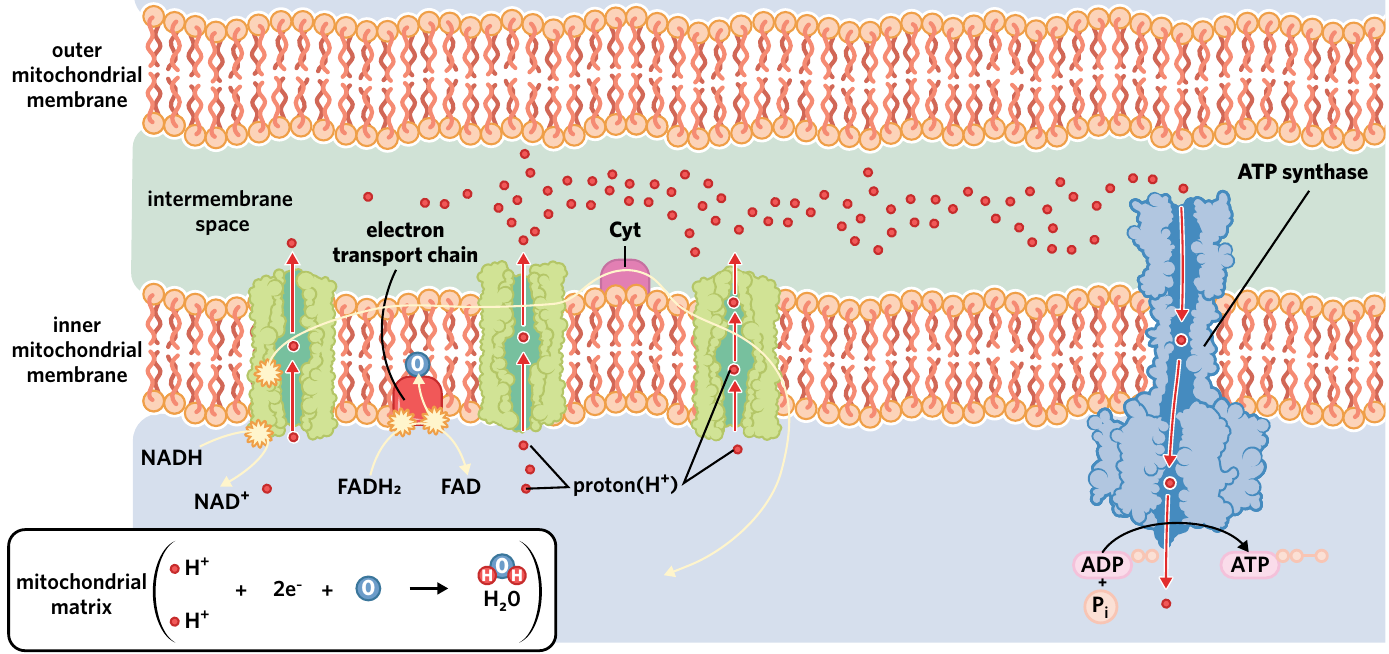
Example
Step-by-Step Process of the Electron Transport Chain:
Step 1: NADH and FADH unload their cargo
- NADH and FADH deliver electrons and protons to protein complexes in the electron transport chain
- NADH NAD + H + 2 e
- FADH FAD + 2 H + 2 e
Step 2: Electrons power proton pumping
- The high-energy electrons are transferred through several protein complexes
- As electrons move through these complexes, their energy is used to actively transport protons (H) from the mitochondrial matrix into the intermembrane space
Step 3: Proton gradient builds up
- The intermembrane space is very narrow and small, so proton concentration quickly increases
- This creates a steep concentration gradient across the inner membrane
Step 4: ATP synthase harnesses the gradient
- To move down their concentration gradient, protons must pass through the enzyme ATP synthase
- As protons flow through ATP synthase, they cause it to spin like a turbine
- This spinning motion provides the energy to combine ADP + ATP
- This process produces 26 or 28 ATP per glucose molecule
Step 5: Oxygen acts as the terminal electron acceptor
- Free protons and electrons build up in the matrix and can damage cellular components if not removed
- Oxygen binds with these protons and electrons to form harmless water: O + 2 H + 2 e HO
- This is why oxygen is essential for aerobic cellular respiration—without it, the electron transport chain cannot proceed
Important
Important exam note: Always specify that either 26 or 28 ATP is produced (not "26–28"). The exact number depends on which shuttle pathway transports NADH from the cytosol into the mitochondrial matrix.
Total ATP yield
Adding up the ATP from all three stages:
- Glycolysis: 2 ATP
- Krebs cycle: 2 ATP
- Electron transport chain: 26 or 28 ATP
- Total: 30 or 32 ATP per glucose molecule
Enzymes and coenzymes in cellular respiration
The complex series of reactions in cellular respiration relies on enzymes and coenzymes to proceed at biologically useful rates.
Role of enzymes
Enzymes catalyse (speed up) the reactions of cellular respiration. Without enzymes, these reactions would occur too slowly to meet the cell's energy demands. Since each enzyme catalyses only one specific reaction, many different enzymes are involved throughout the process.
Examples of key enzymes
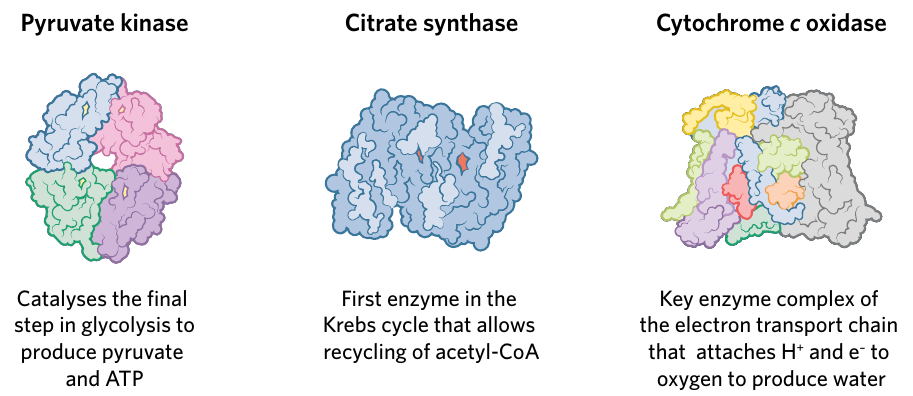
Three important enzymes in cellular respiration:
- Pyruvate kinase: Catalyses the final step of glycolysis to produce pyruvate and ATP
- Citrate synthase: The first enzyme of the Krebs cycle that allows acetyl-CoA to enter the cycle
- Cytochrome c oxidase: A key enzyme complex in the electron transport chain that helps attach H and electrons to oxygen to produce water
Note
These enzymes are tightly regulated to ensure the correct amount of ATP is produced. One regulatory mechanism is end-product inhibition, where the final product of a pathway prevents an earlier enzyme from working. This ensures cells only produce ATP when needed.
Role of coenzymes
Some enzymes require assistance from non-protein organic molecules called coenzymes. Three key coenzymes in cellular respiration are ATP, NAD, and FAD.
Loaded vs unloaded states
Coenzymes cycle between "unloaded" and "loaded" states as they participate in cellular respiration reactions:
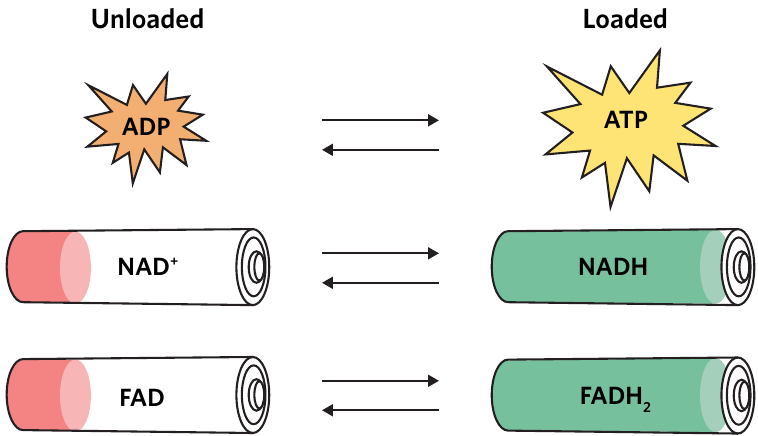
Unloaded coenzymes (require energy to load):
- ADP: becomes loaded with energy to form ATP
- NAD: accepts protons and electrons to form NADH
- FAD: accepts protons and electrons to form FADH
Loaded coenzymes (carry energy):
- ATP: provides energy when broken down to ADP
- NADH: carries high-energy electrons and protons
- FADH: carries high-energy electrons and protons
Note
Some reactions require the unloaded form to proceed (energy-requiring reactions), while others require the loaded form (energy-releasing reactions). This cycling ensures coenzymes are continuously recycled and reused—they are not consumed in the process.
Remember!
Summary
Key Points to Remember:
-
Overall equation:
-
Glycolysis (cytosol): Breaks 1 glucose into 2 pyruvate, producing 2 ATP and 2 NADH
-
Krebs cycle (mitochondrial matrix): Breaks down 2 acetyl-CoA to produce 4 CO, 2 ATP, 6 NADH, and 2 FADH. Don't forget the link reaction that converts pyruvate to acetyl-CoA first.
-
Electron transport chain (cristae): Uses energy from NADH and FADH to create a proton gradient that drives ATP synthase, producing 26 or 28 ATP. Oxygen is essential as the terminal electron acceptor.
-
Total ATP yield: 30 or 32 ATP per glucose molecule (specify "or", not a range)
-
Coenzymes (NAD/NADH, FAD/FADH, ATP/ADP) cycle between loaded and unloaded states and are recycled throughout the process—they are not used up.