Biofuel From Fermentation (VCE SSCE Biology): Revision Notes
📚Revision Notes
Biofuel From Fermentation
Introduction
Modern society requires enormous amounts of energy for heating homes, generating electricity, and powering transport. Currently, most of this energy comes from fossil fuels like coal and oil. However, these fuels are non-renewable, meaning they cannot be replaced at the rate we consume them. Scientists are therefore searching for sustainable alternatives, and biofuels represent one promising solution.
Note
The global demand for energy continues to grow as populations increase and developing nations industrialize. Finding sustainable alternatives to fossil fuels is not just an environmental concern - it's essential for long-term energy security.
What is biofuel?
Understanding fossil fuels
Before exploring biofuels, it's important to understand what they're replacing. Fossil fuels are fuels that formed over tens of millions of years from the remains of dead organic material. Fossil fuels are considered non-renewable.

The formation of fossil fuels occurs through fossilisation:
- Plants die and retain their carbon content, especially in low-oxygen environments like lakes and oceans where decomposition is slow
- Over tens of millions of years, dead plants become buried deeper into the Earth
- Pressure and heat transform the high-carbon plant matter into fossil fuels such as coal, oil, and natural gas
Important
The timing problem: Fossil fuels are non-renewable resources - they are replenished at a much slower rate than they are being used, meaning that they will eventually run out. The formation process takes tens of millions of years, but humanity is consuming these fuels in mere centuries.
Additionally, burning fossil fuels releases large amounts of CO₂ into the atmosphere, contributing to climate change, biodiversity loss, and ecosystem alterations.
Defining biofuels
Biofuels are fuels created from organic material known as biomass. Unlike fossil fuels, biofuels offer a renewable alternative that can be produced much more quickly.
Biomass refers to organic material, including plants, animal by-products, and biological waste material. Biomass can be sourced from many industries, including farming, forestry, and food manufacturing.
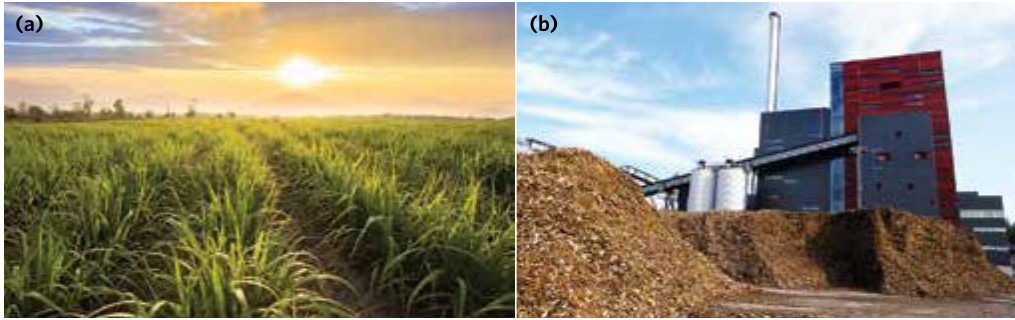
Examples of biomass include:
- Edible crops: corn, wheat, sugarcane
- Non-edible crops: waste wood, straw, crop residues
- Animal by-products: fats and waste materials
- Municipal waste: paper, food scraps
Why biofuels are renewable
Biofuels are considered renewable - they can typically be replenished at the same (or faster) rate than they are being used, meaning they are unlikely to run out. Instead of waiting millions of years for organic material to fossilise, biomass can be harvested today and converted into biofuel tomorrow.
The renewable nature comes from several factors:
- Plants can be grown continuously through agriculture
- Waste materials are constantly generated by existing industries
- The production cycle is measured in months or years, not millions of years
Note
Speed comparison: While fossil fuels require 10-100 million years to form, biomass crops like sugarcane can be grown and harvested in as little as 12-18 months. This dramatic difference in timescales is what makes biofuels truly renewable.
Carbon neutrality
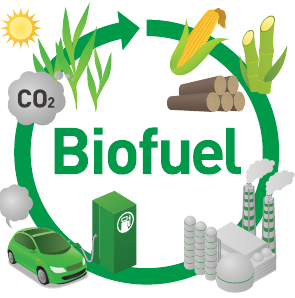
An important environmental advantage of biofuels is that they are largely carbon neutral - there is no net release of carbon dioxide into the atmosphere. This occurs because:
- Plants absorb CO₂ from the atmosphere during photosynthesis
- This carbon is stored in the plant's biomass
- When the biofuel is burned (combusted), it releases CO₂ back into the atmosphere
- This CO₂ can then be reabsorbed by new plants during photosynthesis
Important
Carbon neutrality explained: The carbon is cycled through the system rather than adding new carbon to the atmosphere, as happens when fossil fuels are burned. The CO₂ released during biofuel combustion was recently removed from the atmosphere by the plants used to make the fuel, creating a balanced cycle.
Comparison: fossil fuels vs biofuels
| Feature | Fossil fuels | Biofuels |
|---|---|---|
| Sustainability | Non-renewable | Renewable |
| Source | Fossilised organic matter formed over millions of years | Modern crops, plant residue, organic waste, and animal by-products |
| Environmental impact | High carbon emissions | Largely carbon neutral |
How are biofuels made?
Biofuels can be produced through various methods, but for VCE Biology, we focus on bioethanol production through anaerobic fermentation. Bioethanol is a type of biofuel produced via the anaerobic fermentation of plants such as sugarcane or corn.
The bioethanol production process
The conversion of biomass into bioethanol involves four main stages:
1. Deconstruction
The biomass must first be broken down to increase its surface area, making subsequent steps more efficient. This involves breaking down cell walls and cellulose through various methods:
- Biological approaches: enzyme breakdown
- Chemical approaches: exposure to acids
- Physical approaches: mashing, grinding, or crushing
- Physiochemical approaches: heating
This step prepares the biomass for enzymatic digestion by making the plant material more accessible.
2. Enzymatic hydrolysis
Hydrolysis is a chemical reaction in which water is used to break down the chemical bonds of a substance.
In this stage, the broken-down biomass is exposed to enzymes (such as amylase) which catalyse the breakdown of complex carbohydrates:
- Starch and cellulose (polysaccharides) are broken down
- The enzymes cleave the bonds between sugar molecules
- Water molecules participate in the reaction
- The result is simple sugars, primarily glucose
Note
Why enzymes matter: Enzymes are crucial here because they lower the activation energy needed for these reactions, speeding up the process significantly. The enzymes act as biological catalysts, breaking large polymer molecules into their monomer building blocks.
3. Anaerobic fermentation
Fermentation is the anaerobic chemical breakdown of high-energy organic molecules, typically via the action of enzymes. For many plants, fermentation involves the conversion of glucose to ethanol and carbon dioxide.
Yeast cells are introduced to facilitate this process:
- Yeast performs anaerobic respiration in the absence of oxygen
- Glucose is converted into ethanol (C₂H₅OH) and carbon dioxide (CO₂)
- The ethanol diffuses out of the yeast cells
- This ethanol is the key product for biofuel production
The word equation for this process is:
Important
The role of oxygen: This is the same anaerobic fermentation pathway that yeast uses in brewing and baking, but here the ethanol is captured for use as fuel rather than for beverages. The absence of oxygen is critical - if oxygen is present, yeast will perform aerobic respiration instead, producing CO₂ and water rather than ethanol.
4. Purification and dehydration
The final stage involves refining the ethanol:
- Water is removed through distillation
- The ethanol is purified to increase its concentration
- The result is bioethanol ready for use as liquid fuel
- The CO₂ produced is released back into the atmosphere
Factors affecting bioethanol production
Several factors influence the efficiency of bioethanol production, relating to both enzyme activity and cellular respiration:
- Temperature: Enzymes have optimal temperatures for activity. Too cold and reactions are slow; too hot and enzymes denature. The production process must maintain appropriate temperatures for efficient hydrolysis and fermentation.
- Substrate concentration: High glucose levels are needed to supply the yeast cells with sufficient reactants. Without adequate substrate, the fermentation rate decreases.
- Oxygen levels: Fermentation must occur anaerobically (without oxygen). If oxygen is present, yeast will perform aerobic respiration instead, producing CO₂ and water rather than ethanol.
Note
Optimizing production: These three factors - temperature, substrate concentration, and oxygen levels - must be carefully controlled throughout the production process to maximize bioethanol yield and minimize production costs.
Uses and applications of biofuels
Types of biofuels
Two main types of biofuels are currently produced from biomass:
Bioethanol:
- Produced through fermentation of plant carbohydrates (sugars and starches)
- Made from crops like corn, wheat, and sugarcane
- Used primarily in transport as a petrol additive
Biodiesel:
- Produced from natural oils and fats
- Made from vegetable oils and animal fats combined with short-chain alcohols (like methanol or bioethanol)
- The process involves breaking down lipids rather than carbohydrates
- Used as an alternative to traditional diesel fuel
Note
Interconnected processes: Interestingly, bioethanol can serve as an input for biodiesel production, showing how biofuel outputs can become inputs for other biofuel processes.
Applications in transport
Biofuels are widely used as alternatives or supplements to traditional transport fuels:
- Can be burned in most combustion engines (cars, trucks, planes)
- Often blended with conventional fuels to reduce emissions
- Example: E10 fuel contains 10% ethanol and 90% petrol
- Help reduce carbon monoxide and smog-causing emissions
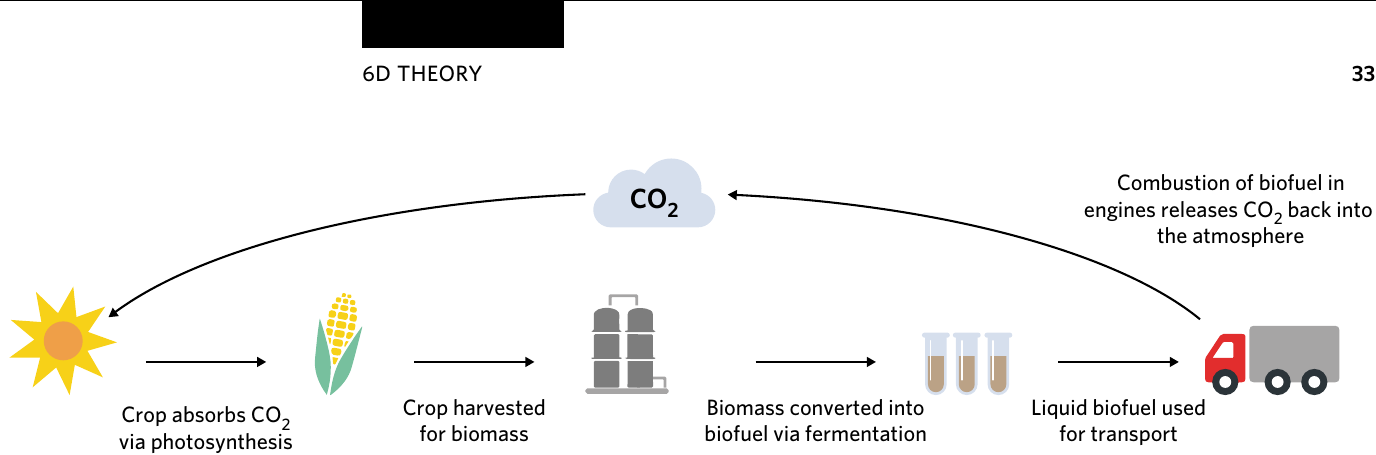
The carbon cycle of biofuel use in transport demonstrates carbon neutrality:
- Crops absorb CO₂ from the atmosphere during photosynthesis
- Crops are harvested for biomass
- Biomass is converted into biofuel through fermentation
- Liquid biofuel is used in vehicle engines
- Combustion releases CO₂ back into the atmosphere
- The cycle repeats as new crops absorb this CO₂
Energy generation applications
Beyond transport, biofuels serve various energy needs:
- Backup power systems and generators (where low emissions are essential)
- Powering schools, hospitals, and community facilities
- Residential and commercial heating systems
- Potential future applications in cleaning products
As production becomes more cost-effective and efficient, the range of applications continues to expand.
Implications of biofuels
While biofuels offer promising benefits, their production and use come with both advantages and challenges.
Strengths of biofuels
| Strength | Explanation |
|---|---|
| Climate impact | Substituting fossil fuels with biofuels helps reduce carbon emissions and combat climate change, given that biofuels are largely carbon neutral. |
| Energy security | Biofuels reduce reliance on finite fossil fuels, helping provide ongoing energy security as biomass can be sourced relatively easily in the long term. |
| Localised energy | Biomass can be sourced and farmed globally, reducing international dependence on fossil fuel imports and exports. This decentralises fuel supply control, creates local jobs, and reduces transport-related risks like oil spills. |
Weaknesses and challenges
| Weakness | Explanation |
|---|---|
| Food vs fuel debate | Using viable agricultural land for biomass production may decrease food output and conflict with growing food demands globally. |
| Cost and market penetration | Biofuels are typically more expensive to produce than traditional fuels. The small scale of the biofuel industry and lower oil prices make market penetration difficult. Additionally, not all current vehicles and energy systems are compatible with biofuels. |
| Second-order environmental impacts | Despite lower carbon emissions, biofuel production can cause other environmental problems including increased nitrous oxide emissions, deforestation for cropland, and reduced genetic diversity in crop species. |
Important
Critical consideration: While biofuels offer many advantages, they are not a perfect solution. The food vs fuel debate raises ethical questions about using agricultural land for fuel production when global food security remains a concern. Additionally, second-order environmental impacts such as deforestation and biodiversity loss must be carefully managed.
First-generation vs second-generation biofuels
An important distinction exists between two categories of biofuels, which relates directly to the food vs fuel debate:
First-generation biofuels:
- Produced from edible food crops such as corn or sugarcane
- Compete directly with agricultural land needed for food production
- Easier to convert into biofuel due to simpler structures
- Can lead to habitat loss for native species
- Raise ethical concerns about fuel production versus food security
Second-generation biofuels:
- Produced from non-edible crops such as agricultural and forestry residues and municipal waste
- Compete less with agricultural land for food
- Examples include wood waste, straw, and other by-products
- Harder to break down due to high cellulose and lignin content
- Require more energy-intensive processing technologies
- More environmentally sustainable regarding land use
| Aspect | First-generation | Second-generation |
|---|---|---|
| Competition with food crops | Yes – made from edible food crops | No – made from non-edible crop waste |
| Conversion to biofuels | Easy conversion | Difficult – harder to break down |
Note
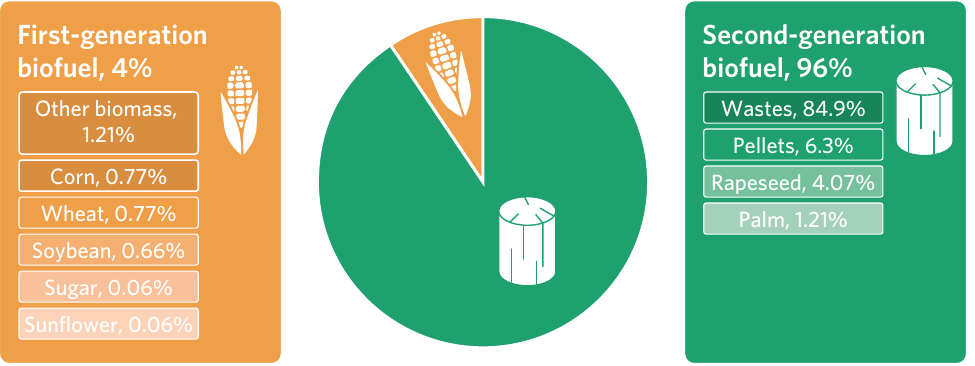
Industry shift: Current commercial biofuel production consists of approximately 96% second-generation biofuels (primarily from wastes at 84.9%) and only 4% first-generation biofuels. This shift reflects concerns about competition with food production and efforts to use waste materials more effectively.
Exam tips
Important
Key exam skills:
- Be able to define all key terms precisely, especially the difference between renewable and non-renewable resources
- Understand the complete carbon cycle of biofuels and why they are considered carbon neutral
- Know all four stages of bioethanol production in order
- Be able to explain the role of enzymes in both hydrolysis and fermentation
- Understand the connection between anaerobic fermentation and bioethanol production
- Be prepared to discuss both advantages and disadvantages of biofuel use
- Know the distinction between first and second-generation biofuels and the food vs fuel debate
- Remember that biofuels involve the same photosynthesis and respiration processes studied elsewhere in the course
Remember!
Summary
Key Points to Remember:
-
Biofuels are renewable energy sources made from organic biomass (plant and animal material), unlike fossil fuels which take millions of years to form.
-
Biofuels are largely carbon neutral because the CO₂ released during combustion was originally absorbed by plants during photosynthesis, creating a balanced carbon cycle.
-
Bioethanol production involves four key steps: deconstruction of biomass, enzymatic hydrolysis to produce glucose, anaerobic fermentation by yeast to produce ethanol, and purification for use as fuel.
-
Anaerobic fermentation is essential - yeast converts glucose into ethanol and CO₂ in the absence of oxygen, and this ethanol becomes the biofuel.
-
Two main types of biofuels exist: bioethanol (from carbohydrates) and biodiesel (from fats and oils), each with different production processes and applications.
-
Biofuels have both benefits and challenges: while renewable and carbon neutral, they face issues including cost, the food vs fuel debate, and second-order environmental impacts.
-
Second-generation biofuels (from waste materials) are preferable to first-generation biofuels (from edible crops) as they don't compete with food production.