Introducing Enzymes (VCE SSCE Biology): Revision Notes
📚Revision Notes
Introducing Enzymes
Every second, your body carries out an estimated 37 thousand billion billion chemical reactions. These include processes like DNA replication, cell communication, cellular respiration, and breaking down toxins in the liver. However, most of these reactions cannot occur on their own - they need help to get started. This is where enzymes become essential.
What are enzymes?
An enzyme is an organic molecule, typically a protein, that catalyses (speeds up) specific reactions. Enzymes act as biological catalysts, which are substances capable of increasing the rate of a reaction without being used up in the process.
Enzymes work by binding to molecules called substrates. A substrate is the reactant of a reaction catalysed by an enzyme. When an enzyme binds to its substrate, the substrate undergoes a chemical reaction and forms one or more products. The products then leave the enzyme, which remains unchanged and free to catalyse further reactions. This reusability is one of the key features that makes enzymes so efficient.
Note
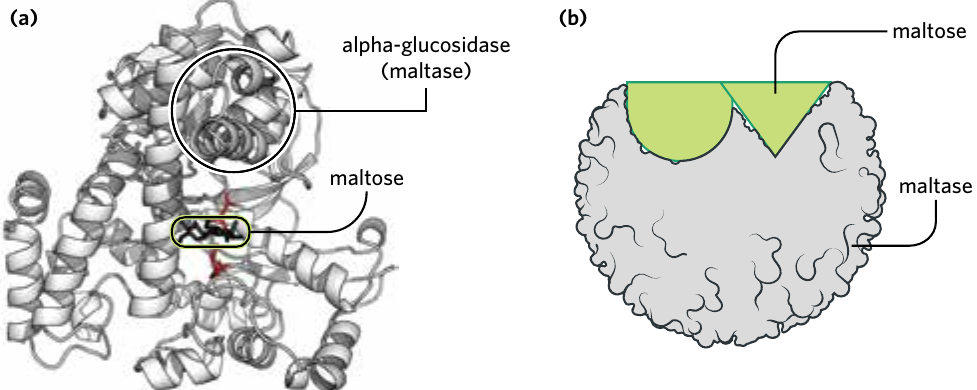
The structure of enzymes can be quite complex. For example, the enzyme alpha-glucosidase (also known as maltase) contains alpha-helices and beta-pleated sheets that form an intricate three-dimensional structure. However, for simplicity, enzymes are usually represented as simplified two-dimensional shapes in diagrams, making them easier to understand.
Key features of enzymes
Enzymes have several important characteristics that define how they function in biological systems. Understanding these features will help you grasp how enzymes contribute to the countless reactions occurring in living organisms.
Reusable
Enzymes are not consumed or broken down during the reactions they catalyse. After helping transform a substrate into a product, the enzyme remains intact and available to catalyse additional reactions. This makes enzymes incredibly efficient - a single enzyme molecule can facilitate thousands or even millions of reactions.
Specific to their substrates
Most enzymes are highly specific, meaning they only bind to one particular substrate or a small group of related substrates. This specificity means that each enzyme typically catalyses just one type of chemical reaction, though some enzymes are less specialised and can work with multiple substates.
Reversible
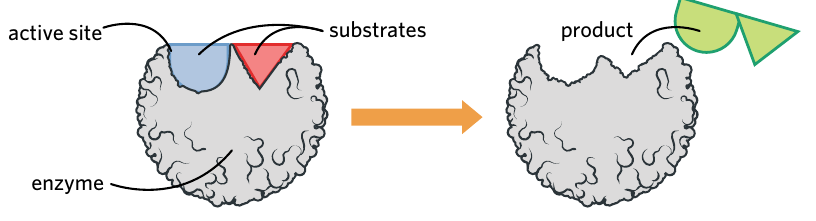
Many enzyme-catalysed reactions can proceed in both directions. The same enzyme can often catalyse both anabolic reactions (building up larger molecules from smaller ones) and catabolic reactions (breaking down larger molecules into smaller ones), depending on the conditions in the cell.
Speed up reactions, not create them
Important
Enzymes do not create new chemical reactions. Instead, they dramatically accelerate reactions that would occur naturally, given enough time. They achieve this by lowering the activation energy required for the reaction to proceed.
Have an active site
Each enzyme contains a region called an active site - the part of the enzyme where the substrate binds. The active site has a specific shape that is complementary to the substrate's shape, allowing them to fit together. The corresponding area on the substrate that binds to the active site is called the binding site.
Are proteins
Most enzymes are proteins, built from long chains of amino acids that fold into specific three-dimensional structures. However, it's worth noting that some RNA molecules can also act as enzymes. Enzymes can be referred to as protein catalysts or catalytic proteins.
Are a subset of catalysts
While all enzymes are catalysts, not all catalysts are enzymes. Enzymes are organic catalysts, but there are also inorganic catalysts, such as metal ions, that can speed up reactions.
Act on biochemical pathways
Enzymes frequently work together in sequences called biochemical pathways. In these pathways, each enzyme catalyses one step of a multi-step process, with the product of one reaction becoming the substrate for the next enzyme.
End in '-ase'
Note
Enzyme names typically end with the suffix '-ase'. Examples include catalase, polymerase, ligase, and lactase. When you see a word ending in '-ase', you can usually assume it refers to an enzyme.
Appear above reaction arrows
In chemical equations, enzymes are written above the reaction arrow rather than with the reactants or products. This notation indicates that the enzyme facilitates the reaction but is neither consumed nor produced by it.
How enzyme-catalysed reactions work
Understanding how enzymes interact with their substrates is crucial to grasping their role in speeding up reactions. This process involves several key steps and concepts.
The enzyme-substrate complex
When a substrate binds to an enzyme's active site, they form an enzyme-substrate complex. The active site is a pocket-like region of the enzyme's three-dimensional structure where the substrate fits. Due to the compatibility of their complex shapes, we say that an enzyme's active site and substrate are complementary in shape - they fit together like pieces of a puzzle.
Upon binding, the active site undergoes a conformational change - a change in its three-dimensional shape - to better accommodate the substrate. At the same time, the substrate also changes slightly. Think of this interaction like a handshake or a hug, where both parties adjust their positions to create a stronger, more effective connection. Multiple chemical bonds, including hydrogen bonds and hydrophobic interactions, hold the substrate and active site together in this complex.
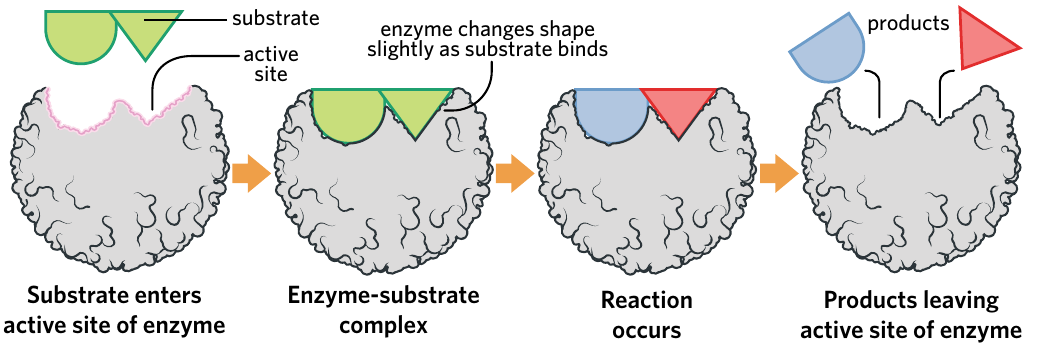
The diagram above shows the complete process of enzyme catalysis:
- The substrate enters the enzyme's active site
- An enzyme-substrate complex forms, with the enzyme changing shape slightly to fit the substrate
- The reaction occurs while the substrate is bound
- The products leave the active site, and the enzyme returns to its original shape, ready to catalyse another reaction
Lock and key vs induced fit models
Scientists use models to help visualise what happens during enzyme-substrate binding at the molecular level. Initially, researchers believed that substrates fit into active sites perfectly, like a key fitting into a lock. This was called the lock and key model.
Important
However, we now know that perfect fits are incredibly rare. Usually, there is a slight adjustment when the substrate binds to the enzyme, allowing them to fit together better. This updated understanding is called the induced fit model, which states that an enzyme undergoes a conformational change to become complementary in shape to the substrate. The induced fit model more accurately represents what actually happens during enzyme catalysis.
A helpful analogy
Example
Worked Example: The Screwdriver Analogy
Imagine you need to screw 100 metal screws into a piece of wood. You would instinctively reach for a screwdriver to complete this task more easily and quickly.
- The screwdriver represents the enzyme - it makes the job (the reaction) much faster and easier
- The screwdriver is specific to certain types of screws (just as enzymes are specific to certain substrates)
- The tip of the screwdriver (like the active site) is where contact is made
- After turning one screw, the screwdriver remains unchanged and ready to turn many more screws, just as an enzyme remains unchanged after catalysing a reaction
Writing enzyme reactions
Enzyme-catalysed reactions are written similarly to other chemical equations, with one important difference: the reactant is called the substrate, and the enzyme appears above the reaction arrow. Here's an example:
This equation shows the enzyme catalase breaking down hydrogen peroxide (the substrate) into water and oxygen (the products).
Activation energy and how enzymes work
Every chemical reaction requires an initial input of energy to begin. This minimum energy requirement is called the activation energy - the amount of energy needed to energise atoms or molecules so they can undergo a chemical transformation.
Collision theory
Note
According to collision theory, molecules must collide with one another with sufficient kinetic energy (energy from movement) to overcome the activation energy barrier before they can react. You can think of activation energy as a hurdle that reactants need to jump over to start a chemical reaction.
All reactions have an activation energy requirement, regardless of whether they build molecules up or break them down. An anabolic reaction occurs when two or more smaller molecules combine to form a larger one (building things up), while a catabolic reaction involves a larger molecule breaking down into two or more smaller molecules (breaking things down).
How enzymes lower activation energy
Important
Enzymes function by significantly lowering the activation energy required for chemical reactions. They do this by bringing reactants closer to the state they need to be in to react with one another. In other words, enzymes make the hurdle much smaller, allowing reactions to proceed at a far quicker rate.
The effect can be dramatic. For example, the enzyme carbonic anhydrase can catalyse the reaction of carbon dioxide and water into carbonic acid 10 million times faster than the uncatalysed reaction would occur naturally.
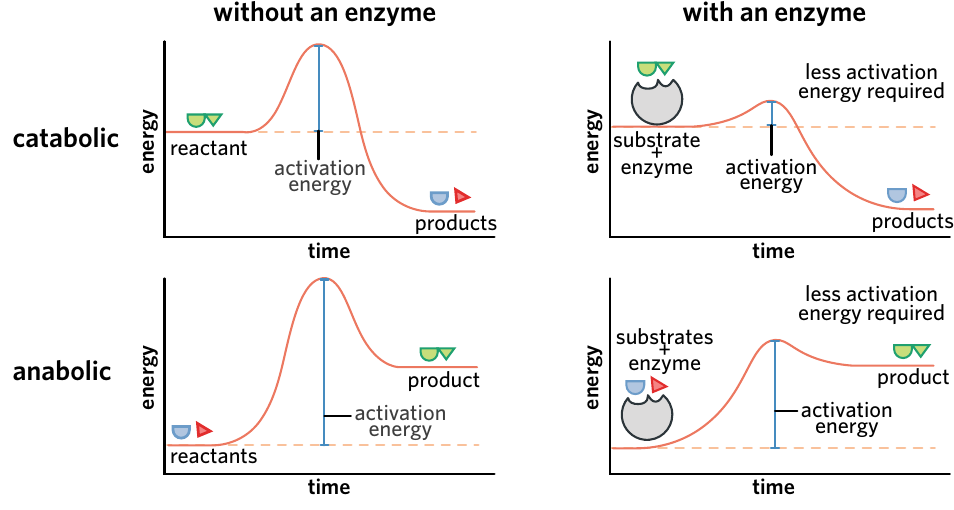
The diagram above shows how activation energy differs in reactions with and without enzymes. Notice that:
- In catabolic reactions (top panels), the reactants have higher energy than the products, and energy is released
- In anabolic reactions (bottom panels), the reactants have lower energy than the products, and energy is required
- In both cases, enzymes (right panels) significantly reduce the activation energy compared to uncatalysed reactions (left panels)
- The lower activation energy allows reactions to proceed much more quickly
Enzymes and biochemical pathways
Enzymes rarely work in isolation. Instead, they frequently "team up" to work in chains of reactions called biochemical pathways (also known as metabolic pathways). In these pathways, one enzyme catalyses the conversion of a substrate into a product, which then becomes the substrate for a second enzyme. Since enzymes are specific to their substrates, multiple enzymes must work sequentially in pathways to achieve the desired final outcome.
Example
Worked Example: The Glycolysis Pathway
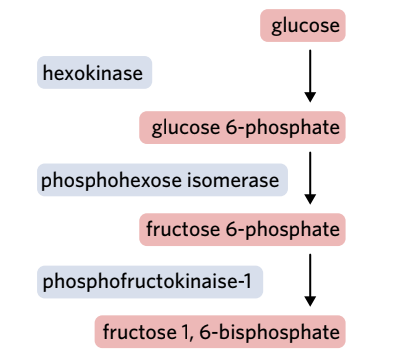
The diagram above shows the first three steps of glycolysis, a biochemical pathway that breaks down glucose. In this example:
Step 1: Hexokinase catalyses the conversion of glucose into glucose 6-phosphate
Step 2: Phosphohexose isomerase then catalyses the conversion of glucose 6-phosphate into fructose 6-phosphate
Step 3: Phosphofructokinase-1 catalyses the next step, converting fructose 6-phosphate into fructose 1,6-bisphosphate
This pattern continues through multiple steps, with each enzyme performing a specific transformation. While you don't need to memorise the details of glycolysis, this example demonstrates how vital enzymes are to biological processes and how complex biochemical pathways can be.
Real-world application: lactose intolerance
Lactose intolerance is a common condition affecting approximately 65% of the global population. It results from a deficiency of the enzyme lactase, which is responsible for breaking down lactose - the sugar found in milk and dairy products.
Normally, when a person consumes lactose, the enzyme lactase in the small intestine breaks it down into glucose and galactose, which can then be absorbed. Nearly everyone produces lactase when they are young to digest their mother's milk. However, as people age, lactase levels typically decrease, often resulting in intolerance.
Note
Without sufficient lactase, lactose cannot be properly digested. Instead, bacteria in the intestines break down the lactose. A nasty side effect of this bacterial breakdown is the production of large amounts of gas, which causes the symptoms associated with lactose intolerance: bloating, cramps, and diarrhoea.
For those with lactose intolerance who still want to enjoy dairy products, oral enzyme supplements containing lactase are available as short-term aids. These supplements provide the missing enzyme, allowing temporary digestion of lactose.
Remember!
Summary
Key Points to Remember:
-
Enzymes are biological catalysts: They are organic molecules (usually proteins) that speed up chemical reactions without being consumed in the process.
-
Enzymes work by lowering activation energy: By reducing the energy barrier required to start a reaction, enzymes allow reactions to proceed millions of times faster than they would naturally.
-
Enzymes are specific and reusable: Most enzymes bind to only one specific substrate or a small group of related substrates, and they can be used repeatedly because they remain unchanged after catalysing a reaction.
-
The induced fit model explains enzyme action: When a substrate binds to an enzyme's active site, both the enzyme and substrate undergo slight conformational changes to fit together better, forming an enzyme-substrate complex.
-
Enzymes work in biochemical pathways: Multiple enzymes often work sequentially, with the product of one enzyme-catalysed reaction becoming the substrate for the next enzyme, creating complex metabolic pathways essential for life.