The Fossil Record (VCE SSCE Biology): Revision Notes
📚Revision Notes
The Fossil Record
Introduction
The fossil record provides crucial evidence about how life on Earth has changed over billions of years. By studying fossils - preserved remains of ancient organisms - scientists can trace evolutionary pathways, identify when different species existed, and understand how species are related to one another. This evidence helps us piece together the story of life from simple single-celled organisms to the diverse array of species we see today.
Note
The fossil record is like a biological history book, with each fossil representing a page that helps us understand the progression of life across geological time periods. However, unlike a complete book, the fossil record has many missing pages due to the rarity of fossilisation.
Changes in species over time
Earth's evolutionary timeline
Life on Earth has undergone remarkable transformation over approximately 4 billion years. Understanding this timeline helps us appreciate the vast timescales involved in evolution and the major milestones that have shaped modern biodiversity.
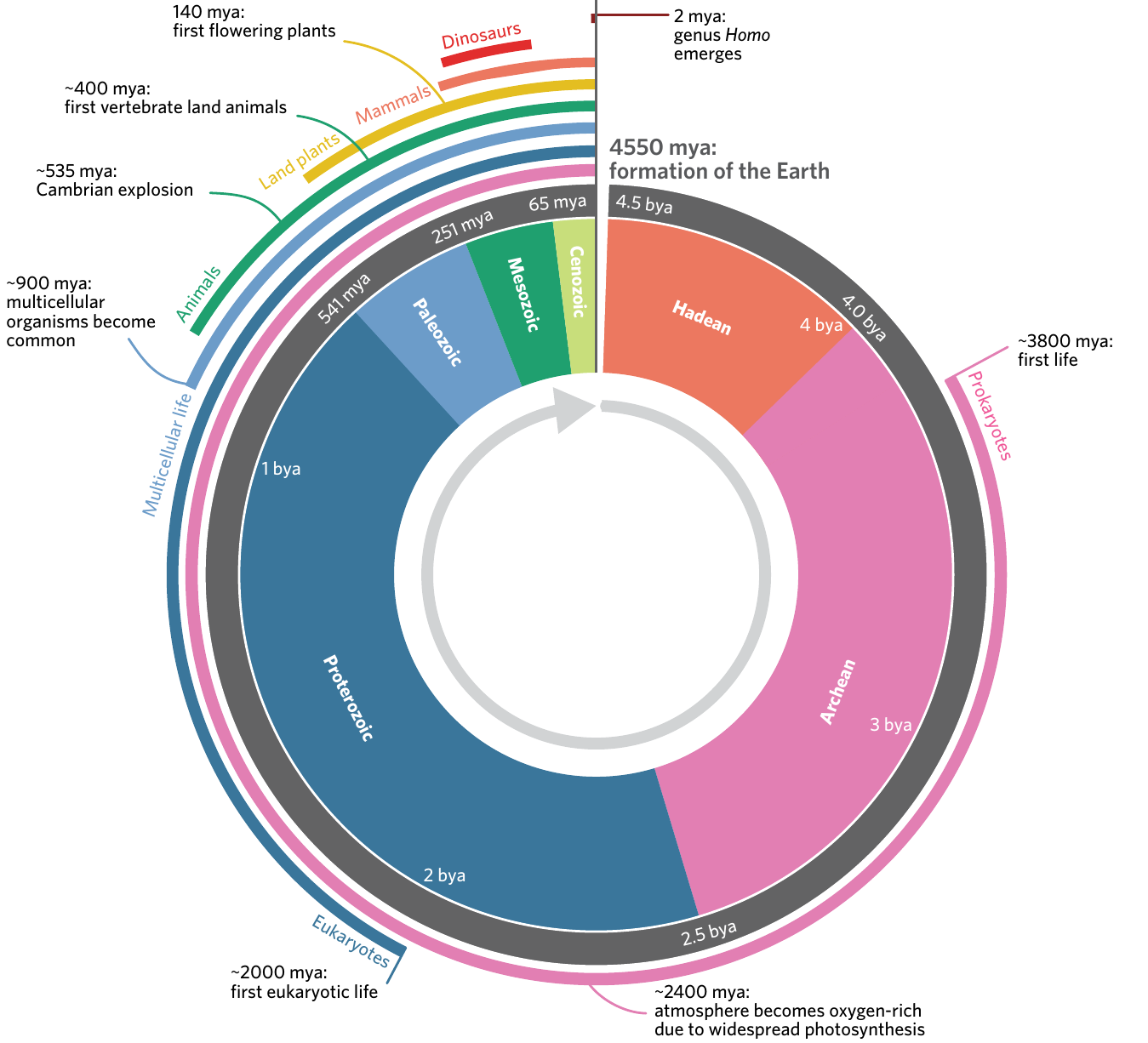
The major events in Earth's evolutionary history include:
- 3.8 billion years ago (bya): First prokaryotes (simple single-celled organisms) emerged
- 2.4 bya: Widespread photosynthesis began, gradually oxygenating the atmosphere
- 2 bya: First eukaryotes (cells with nuclei) appeared
- 900 million years ago (mya): Multicellular organisms became common
- 535 mya: The Cambrian explosion occurred - a period of rapid diversification of multicellular life, characterised by the evolution of hardened body parts such as shells or bones
- 530-400 mya: First animals moved onto land
- 251 mya: Mammals appeared
- 140 mya: First flowering plants evolved
- 2 mya: The genus Homo (humans) emerged

All living organisms on Earth today evolved from a single-celled prokaryote that existed around 3.8 bya. Through successive generations, some descendants evolved the ability to photosynthesise. This innovation was transformative because photosynthesis released oxygen into the atmosphere, creating conditions where organisms capable of aerobic respiration (like early eukaryotes) could survive. From these eukaryotes, multicellular life eventually arose, culminating in the Cambrian explosion.
The Cambrian explosion
The Cambrian explosion represents one of the most significant events in evolutionary history. During this period around 535 mya, there was a massive increase in the diversity of living organisms. Almost all major animal groups began appearing, including organisms with hard shells and skeletal structures.
Important
This widespread emergence of complex species across Earth's surface is particularly important because hard body parts are much more likely to fossilise than soft tissue. Therefore, the Cambrian explosion marks the point where the fossil record becomes substantially richer and more detailed.
Mass extinctions and evolutionary opportunities
Throughout Earth's history, life has experienced several mass extinction events - the dying out of species on a regional or global level. These extinction events, particularly those occurring during transitions between geological eras, have played a crucial role in shaping evolutionary history.
When species go extinct, they create evolutionary opportunities for other organisms to flourish and diversify. A prime example occurred approximately 65 mya when a mass extinction event - likely caused by an asteroid impact - wiped out the dinosaurs along with roughly three-quarters of plant and animal life on Earth. This catastrophic event cleared ecological niches, allowing new and emerging species to thrive and evolve.
Note
Mammals, which had existed alongside dinosaurs for millions of years but remained relatively small and limited, were able to diversify extensively after the dinosaurs' extinction. This sequence of extinction events paved the way for modern plant and animal life, including eventually humans.
Exam tip: While you don't need to memorise specific dates and species names for all evolutionary events, understanding the general sequence and significance of major milestones can help you answer questions about evolutionary timelines and the relationships between different groups of organisms.
What is the fossil record?
Understanding fossils
A fossil is the preserved body, impressions, or traces of a dead organism. The fossil record refers to the information derived from all fossils, both discovered and undiscovered. This record is arranged in chronological order and helps us map the history of life on Earth, placing species in their appropriate geological time frames.
Fossils are relatively rare because specific conditions must be met for preservation to occur. In most cases, when an organism dies, its body is either consumed by scavengers or decomposes completely through the action of bacteria and fungi, leaving no trace of its existence. However, under certain circumstances, remains can be preserved through the process of fossilisation.
The fossilisation process
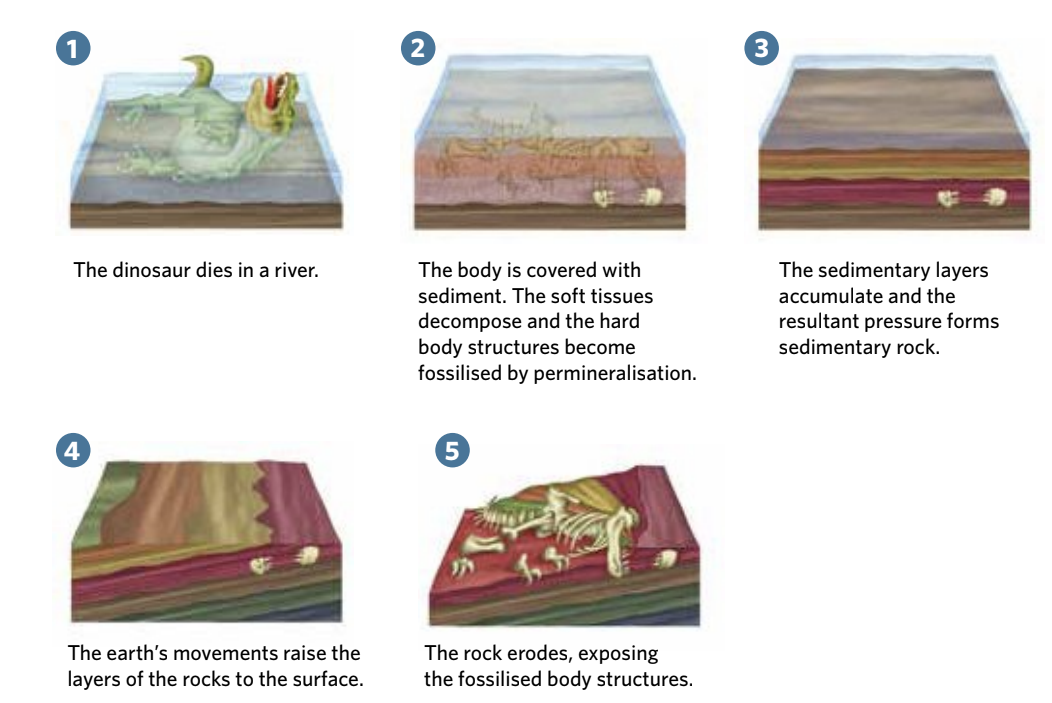
Fossilisation is the process by which an organism becomes a fossil. It typically involves three main stages:
Stage 1: Rapid burial
The remains of an organism must be quickly covered by sediment (naturally occurring solid material such as earth and rock that has broken down into very fine pieces). This rapid burial is crucial because it protects the remains from oxygen, microorganisms, and other factors that would accelerate decomposition.
Stage 2: Sediment accumulation and compaction
Over extended periods, additional layers of sediment accumulate on top of the buried remains. As these layers build up, the weight creates increasing pressure. This pressure gradually compacts the sediment layers, squeezing out water and air, and pushing the particles closer together.
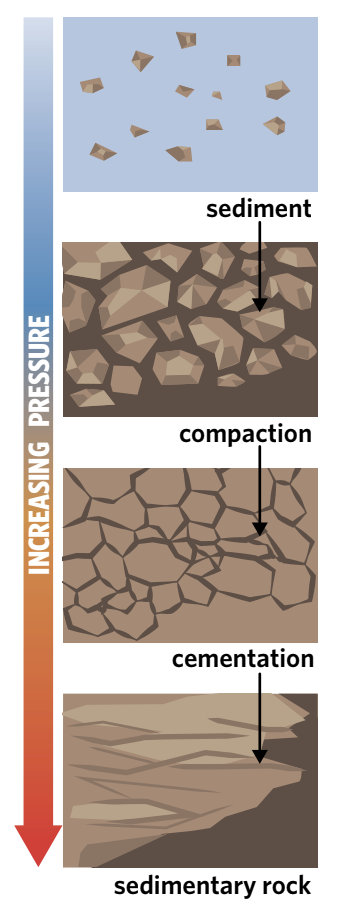
Stage 3: Formation of sedimentary rock
Eventually, the intense pressure cements the compacted sediment layers together, forming sedimentary rock - rock that has formed through the accumulation and hardening of sediment under pressure. Within this rock, fossilised remains can take various forms.
Types of fossils
Fossils can form in several different ways, resulting in various types:
Permineralised fossils
A permineralised fossil forms when mineral-rich groundwater seeps through the buried organic material. Minerals such as silica and calcite are deposited into the spaces within bones, wood, or other tissues, essentially creating a mineral replica of the original structure. This is one of the most common types of fossil preservation.
Mould fossils
A mould fossil forms when a buried organism decomposes completely beneath sediment layers, leaving behind a cavity in the exact shape of the organism. This hollow impression captures the external form of the original organism.
Cast fossils
A cast fossil forms when a mould fossil is subsequently filled with sediment or minerals. This creates a three-dimensional replica of the organism's external features.
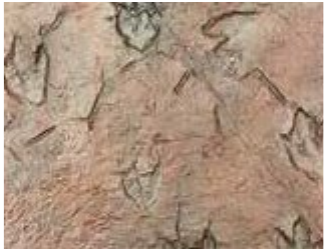
Trace fossils
A trace fossil is a fossil or structure indicating the presence of organisms rather than the organisms themselves. Examples include footprints, nests, burrows, and tracks. These fossils provide valuable information about organism behaviour and movement patterns.
Other preservation types
In rare cases, fossils can preserve actual soft tissue that has not yet decomposed. Examples include human mummies preserved through desiccation, mammoths frozen in ice, and insects trapped in amber (fossilised tree resin).
Conditions favouring fossilisation
The likelihood of fossilisation increases when specific environmental conditions are present:
- Physical protection from scavengers and decomposers (such as fungi and bacteria)
- Rapid sediment accumulation to quickly bury and protect remains
- Constant cool temperatures that slow decomposition
- Low oxygen availability that inhibits aerobic decomposition
- Low light exposure that reduces photochemical breakdown
Important
These conditions explain why aquatic environments tend to produce more fossils than terrestrial ones. Water bodies regularly deposit large amounts of sediment, have lower temperatures in deeper areas, contain less oxygen in sediment layers, and provide protection from scavengers. Organisms that die in rivers, lakes, or oceans are more likely to be rapidly buried and preserved.
Exam tip: When answering questions about why certain fossils are more common, consider environmental factors that affect decomposition rates and sediment deposition. For example, you might explain that aquatic organisms fossilise more readily because aquatic systems have rapid sediment accumulation, lower temperatures, and reduced oxygen levels - all conditions that slow decomposition and increase preservation likelihood.
Relative dating techniques
Understanding relative dating
Relative dating is a technique used to determine the approximate age of a fossil by comparing its position to other fossils or rock layers in surrounding rock strata. Rather than providing an exact age in years, relative dating places fossils in sequence, telling us which fossils are older or younger relative to each other. This approach has been fundamental to organising fossils chronologically and understanding the sequence of evolutionary changes.
The law of fossil succession
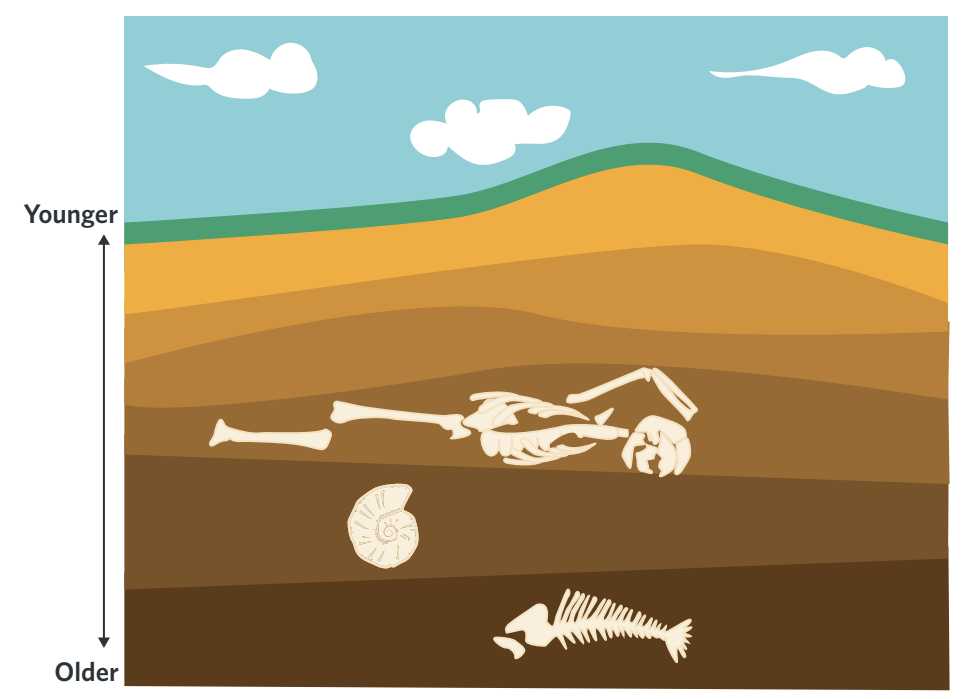
The foundation of relative dating is the law of fossil succession (also called faunal succession). This principle states that because sedimentary rock forms through the accumulation of sediment layers deposited one on top of another over time, fossils found closer to the surface must be younger than fossils found in deeper layers.
Note
Think of sedimentary rock layers like pages in a history book stacked chronologically. The bottom pages (layers) were written (deposited) first and are therefore oldest, while the top pages (layers) were written (deposited) most recently and are youngest.
Each layer, or stratum (plural: strata), represents a distinct period of sediment deposition. The relative age of a fossil refers to its approximate age as determined by comparing its position to other fossils, rather than stating its exact age in years.
Geological timescales
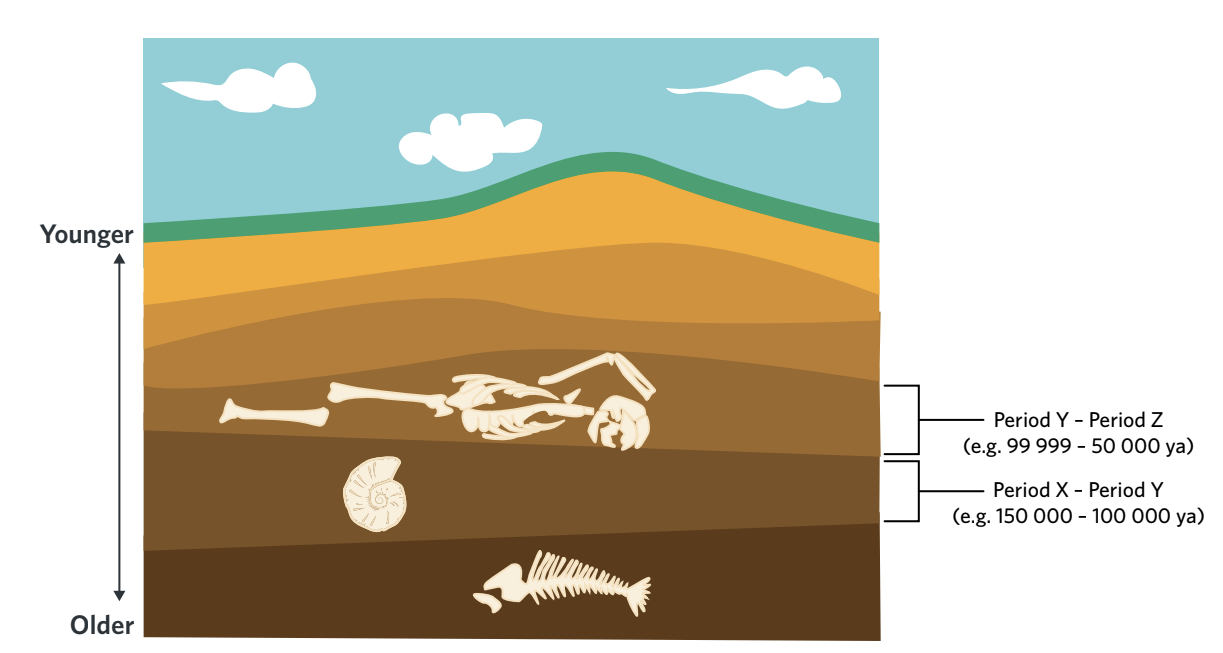
The law of fossil succession allows scientists to create geological timescales by assigning age ranges to different rock strata. Since sedimentary layers develop in chronological order, researchers can determine that lower rock layers formed during earlier time periods whilst upper layers formed later.
Example
Understanding Geological Timescales
For example, scientists might identify that a particular stratum formed during Period X (perhaps 150,000 to 100,000 years ago), whilst the layer above it formed during Period Y (99,999 to 50,000 years ago). When a fossil is discovered in one of these layers, it can be assigned the relative age range corresponding to that stratum's geological time period.
This system enables researchers to date fossils even without finding other fossils for direct comparison - they simply need to identify which rock stratum contains the fossil and refer to the established geological timescale.
Index fossils
Index fossils are particularly useful tools for relative dating. An index fossil comes from an organism that was geographically widespread, existed for a short but precisely known period, and can be used as a reference to easily determine the age of unknown fossils.
When palaeontologists discover an index fossil in a rock layer, they immediately know the approximate age of that stratum because index fossils existed during known, limited time periods. Any other fossils found in the same layer can then be assumed to have lived during that same time period.
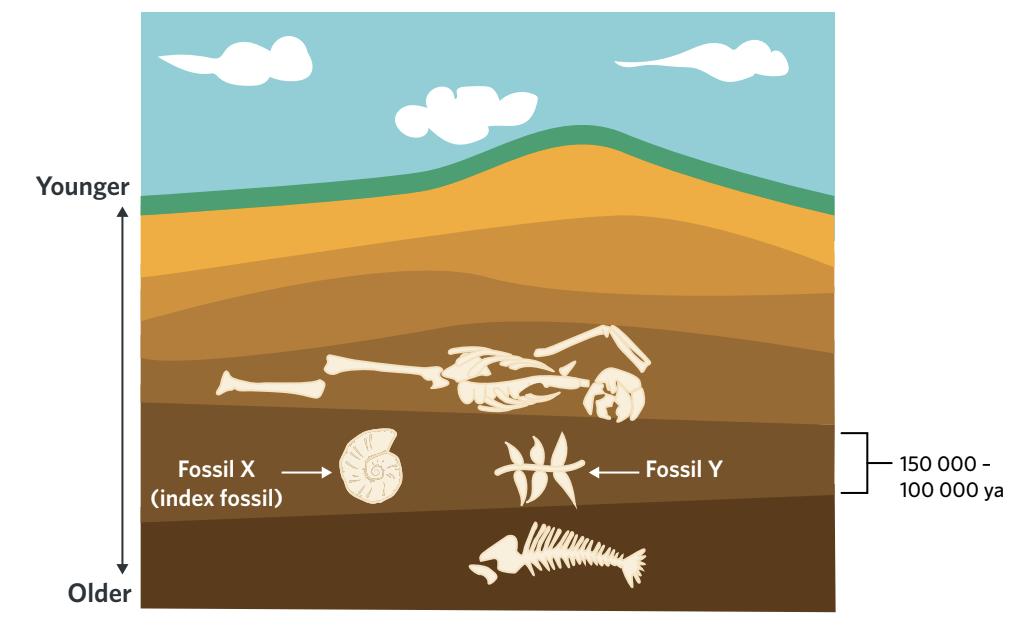
For an organism to serve as a good index fossil, it must have these characteristics:
- Physically distinctive: easily recognisable and difficult to confuse with other species
- Large population: numerous individuals existed, increasing the likelihood of fossilisation
- Widespread geographical distribution: found across many different locations and environments
- Short existence: lived for a relatively brief, well-defined period of geological time
Note
Trilobites (ancient marine arthropods) are excellent examples of index fossils. Different trilobite species existed across vast geographical ranges during specific, relatively short time periods. When researchers find a particular trilobite species in a rock layer, they can quickly determine the age range of that layer and any other fossils it contains.
Transitional fossils
Transitional fossils are fossils that show traits common to both an ancestral group and its descendant group. They are particularly important when descendant species are physically very distinct from their ancestral species, as transitional fossils help demonstrate the evolutionary changes that occurred between the two.
Think of transitional fossils as "missing links" that fill gaps in our understanding of evolutionary pathways. They demonstrate intermediate forms that existed during a genus's evolutionary journey, showing how certain features evolved progressively over time.
Example
Case Study: Tiktaalik roseae - From Water to Land
One exceptional example of a transitional fossil is Tiktaalik roseae, which lived approximately 375 million years ago. Discovered in 2004, this fossil was crucial in demonstrating how four-legged (tetrapod) creatures first developed the ability to live on land.
Tiktaalik shared many features with earlier aquatic relatives:
- Gills for breathing underwater
- Scales covering its body
- Fins for swimming
However, it also possessed key characteristics linking it to later land-dwelling descendants:
- Bones inside its fins (indicating weight-bearing capabilities necessary for walking)
- A mobile neck (allowing the head to move independently from the body)
- A strong ribcage (supporting the body's weight out of water)
This combination of aquatic and terrestrial features makes Tiktaalik a perfect example of how transitional fossils bridge evolutionary gaps, especially when morphological changes between ancestors and descendants are substantial.
Absolute dating techniques
Understanding absolute dating
Whilst relative dating provides approximate ages by comparing fossil positions, absolute dating (also called radiometric dating) determines the actual age of fossils in years. The absolute age gives us a specific numerical estimate rather than just knowing whether a fossil is older or younger than another.
The most common absolute dating method used in palaeontology is radioactive dating, which relies on the predictable decay of unstable atomic isotopes.
Principles of radioactive decay
Radioactive dating is based on three fundamental principles:
Principle 1: Radioisotope breakdown
Radioactive isotopes (also called radioisotopes) are unstable atoms of specific elements that break down over time into more stable products through radioactive decay. For instance, carbon-14 (a radioisotope) breaks down into nitrogen-14 (a stable product). This breakdown process is spontaneous and inevitable.
Principle 2: Constant decay rate
Although individual radioisotope atoms can decay at any moment, the overall rate of decay for a large sample is constant and predictable. We can model this decay mathematically, which allows us to use it as a "radioactive clock" for dating purposes.
Principle 3: Half-life measurement
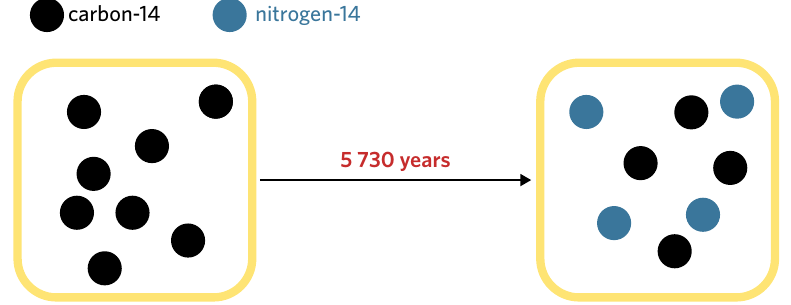
The half-life is the time taken for half the mass of a radioisotope sample to break down into its products.
Important
Understanding Half-Life
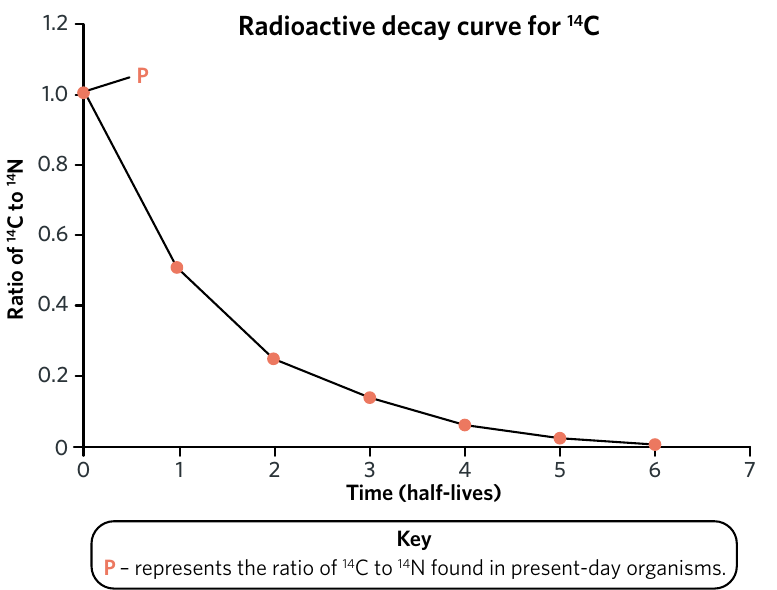
For example, carbon-14 has a half-life of 5,730 years. This means that if an organism contains a certain amount of carbon-14 when it dies, after 5,730 years, exactly half of those carbon-14 atoms will have decayed into nitrogen-14 atoms. After another 5,730 years (11,460 years total), half of the remaining carbon-14 will have decayed, leaving only one-quarter of the original amount.
How radioactive dating works
Scientists measure the ratio of a radioisotope present in a fossil to its stable decay product. By comparing this ratio to what would be expected in a living organism, they can calculate how long the decay process has been occurring - which equals the time since the organism died.
The more decay product present relative to the original radioisotope, the older the fossil. Different radioisotopes are suitable for dating different age ranges because they have different half-lives.
Common radioisotope dating methods
| Radioisotope series | Half-life | Dating period | Dating of |
|---|---|---|---|
| Carbon-14 → nitrogen-14 | 5,730 years | 1,000 - 50,000 years | Organic materials |
| Uranium-235 → lead-207 | 700 million years | 1 million - 4.5 billion years (used together with U-238 → Pb-206 dating) | Uranium-containing materials (shells, corals) |
| Uranium-238 → lead-206 | 4.5 billion years | 1 million - 4.5 billion years (used together with U-235 → Pb-207 dating) | Uranium-containing materials (shells, corals) |
| Potassium-40 → argon-40 | 1.3 billion years | 100,000+ years | Igneous (volcanic) rocks |
Note
The dating period refers to the range of time since fossilisation in which a particular radioisotope series can be used. Beyond this period, too much of the radioisotope has broken down into its products, making accurate age estimation difficult or impossible. This is why different radioisotopes are chosen depending on the suspected age of the fossil.
Radiocarbon dating in detail
Radiocarbon dating (also called carbon dating) is one of the most widely used absolute dating methods. It uses the carbon-14 (¹⁴C) to nitrogen-14 (¹⁴N) radioisotope series and is particularly useful for dating organic materials up to about 50,000 years old.
Example
The Radiocarbon Dating Process
The radiocarbon dating process works according to these steps:
Step 1: Carbon absorption during life
All living organisms contain carbon, which exists as two main isotopes: carbon-12 (¹²C, a stable isotope) and carbon-14 (¹⁴C, a radioactive isotope). Whilst alive, organisms continuously exchange carbon with their environment through processes like eating, breathing, and photosynthesis. This means the ratio of ¹⁴C to ¹²C in a living organism matches the ratio present in the atmosphere.
Step 2: Decay after death
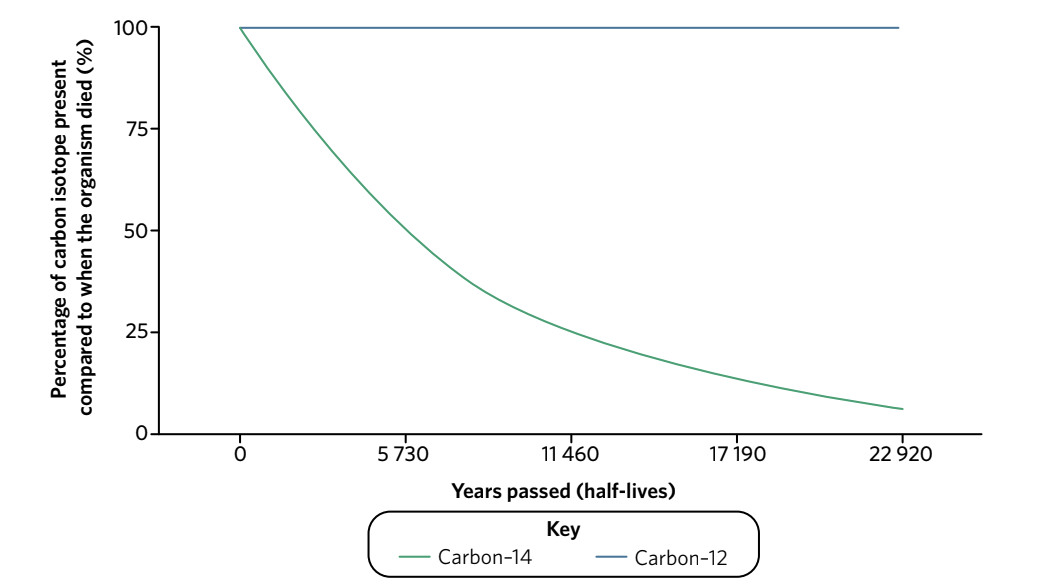
When an organism dies, it stops exchanging carbon with its environment. The ¹⁴C within its tissues begins to decay into ¹⁴N at a known rate (with a half-life of 5,730 years). Meanwhile, the stable ¹²C remains constant because it doesn't undergo radioactive decay. This causes the ratio of ¹⁴C to ¹²C in the dead organism to change predictably over time.
Step 3: Measuring the ratio
Scientists can measure the current amount of ¹⁴C present in a fossil and compare it to the amount of ¹²C (which hasn't changed since death). By comparing this ¹⁴C:¹²C ratio to the ratio found in living organisms today (which matches the atmospheric ratio), scientists can calculate how much time has passed since the organism died.
The longer ago the organism died, the less ¹⁴C remains. After one half-life (5,730 years), only 50% of the original ¹⁴C remains. After two half-lives (11,460 years), only 25% remains. After three half-lives (17,190 years), only 12.5% remains, and so on.
Important
Limitations: Radiocarbon dating becomes unreliable for fossils older than about 50,000 years because by that time, very little ¹⁴C remains to measure accurately. For older fossils, scientists must use radioisotopes with longer half-lives, such as uranium or potassium series.
Comparing dating techniques
Understanding both relative and absolute dating techniques provides scientists with complementary tools for studying the fossil record. Relative dating quickly places fossils in chronological sequence and is useful when exact ages aren't necessary. Absolute dating provides precise ages but requires sophisticated equipment and suitable material for radioisotope analysis.
Relative dating techniques:
- Law of fossil succession
- Geological timescales
- Index fossils
- Transitional fossils
Absolute dating techniques:
- Radioactive dating
- Radiocarbon dating
Together, these methods allow palaeontologists to construct detailed timelines of evolutionary history, track changes in species over geological time, and understand the relationships between different organisms across Earth's 4-billion-year history.
Remember!
Summary
Key Points to Remember:
-
The fossil record provides chronologically arranged information about life's history on Earth, from prokaryotes 3.8 billion years ago to modern humans 2 million years ago
-
Fossilisation requires specific conditions: rapid burial by sediment, protection from decomposers, cool temperatures, low oxygen, and minimal light exposure. This explains why aquatic fossils are more common than terrestrial ones
-
Relative dating assigns approximate ages by comparing fossil positions in rock layers, using tools like the law of fossil succession, geological timescales, index fossils (widespread species from known short periods), and transitional fossils (showing intermediate evolutionary stages)
-
Absolute dating determines exact ages in years using radioactive decay. Different radioisotopes suit different time ranges: carbon-14 for 1,000-50,000 years, uranium series for millions to billions of years
-
Half-life is the time for half a radioisotope sample to decay. By measuring the ratio of remaining radioisotope to its stable product, scientists can calculate a fossil's age. Radiocarbon dating is particularly important for dating organic materials using the carbon-14 to nitrogen-14 series