Emergence of Pathogens (VCE SSCE Biology): Revision Notes
📚Revision Notes
Emergence of Pathogens
Understanding infectious diseases
Not all diseases are caused by pathogens. Non-infectious diseases are illnesses not caused by pathogens. Some non-infectious diseases, such as cystic fibrosis, result from abnormal genes. Others, like cardiovascular disease, are largely caused by lifestyle factors such as diet and exercise.
Infectious diseases are illnesses caused by pathogens. A pathogen is an agent that causes disease. These pathogens harm their host and cause the symptoms that patients experience. A subset of infectious diseases are contagious diseases, which are infectious diseases that can be transmitted and spread between different people.
When thinking about how a pathogen may impact a population, there are two important characteristics to consider:
- Contagiousness: how easily the pathogen is transmitted between people. This is a property of a pathogen or disease meaning that it can be transmitted from one organism to another.
- Virulence: how severe is the disease the pathogen causes. This refers to the potential of a pathogen or disease to cause serious illness or harm.
Important
Pathogens that are highly contagious and highly virulent pose the greatest concern. They have the potential to infect large numbers of people and cause severe disease. Understanding these two aspects is essential for effectively managing emerging and re-emerging diseases.
What are emerging and re-emerging pathogens?
In addition to pathogens that currently circulate among human populations, there are always different pathogens threatening to infect us and cause emerging or re-emerging diseases.
Emerging diseases are infectious diseases that are new to the human population, or that are rapidly increasing in incidence. They can be:
- Diseases that have not occurred in humans before
- Diseases that occurred previously but only affected particular populations in isolated places
- Diseases that have occurred throughout history but have only recently been recognised as being caused by pathogens
Re-emerging diseases are infectious diseases that were previously under control but are now increasing in incidence. These are diseases that were once major public health problems, then declined dramatically, but are again becoming health problems for a large number of people.
Note
The incidence of a disease refers to its frequency in a population. Tracking incidence helps public health authorities identify when diseases are emerging or re-emerging in human populations.
Factors contributing to disease emergence
Where do these emerging and re-emerging diseases come from? A number of factors contribute to the emergence and re-emergence of diseases:
| Factor | Contribution |
|---|---|
| Evolution of causative organism | Pathogens causing disease can evolve to either infect humans or, if previously capable of infecting humans, evolve to evade treatments by acquiring resistance. |
| Globalisation and travel | Due to our ability to quickly travel around the world, diseases that would otherwise have remained localised to a specific area can quickly spread to multiple countries. |
| Increased exposure of humans to animals | As the human population grows and climate change alters the environment, humans are more likely to come into contact with animals. A zoonosis is a disease caused by a pathogen that has been transmitted to humans from another species. An estimated 70% of all emerging diseases originate from some type of animal reservoir. |
| Increasing human population | Larger populations lead to increased population densities in cities, increasing the likelihood of a disease spreading and causing large scale health problems for a population. |
| Changing technology | Sometimes new technology can be responsible for the emergence or re-emergence of a disease. For example, Legionnaires' disease is caused by a pathogen that inhabits air conditioning systems. |
| Insufficient vaccination of the population | Previously managed diseases can re-emerge if the proportion of a population that is vaccinated against the disease decreases. This stems from the loss of herd immunity, with an increase in the number of susceptible individuals allowing the pathogen to more easily spread between individuals. |
A reservoir is a population of animals or environment in which a pathogen normally lives. A zoonosis is a disease caused by a pathogen that has been transmitted to humans from another species.
Important
An estimated 70% of all emerging diseases originate from some type of animal reservoir. This makes zoonotic diseases one of the most significant threats to human health in terms of emerging infections.
Global spread of diseases
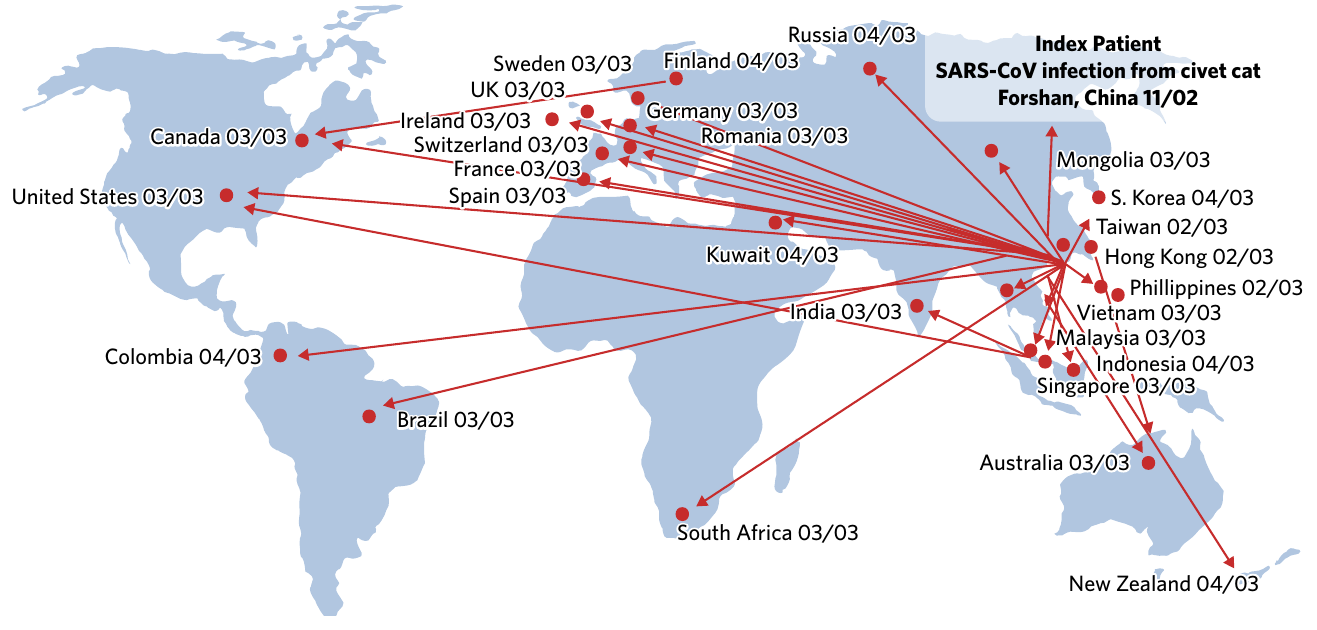
Modern global travel enables diseases to spread rapidly across continents. In 2002, an outbreak of the SARS-CoV-1 virus (which causes severe acute respiratory syndrome, or SARS) demonstrated this dramatically. The first known case occurred in China in November 2002, and by the end of April 2003, it had spread to every continent on the globe through international air travel.
Note
The SARS-CoV-1 outbreak illustrated how globalisation and travel can transform a local outbreak into a global health crisis within just a few months. This pattern was later repeated with the COVID-19 pandemic.
Zoonotic diseases
Many diseases affecting humans originate from animals. The following diagram shows how different diseases can be transmitted between humans, wildlife, and livestock.
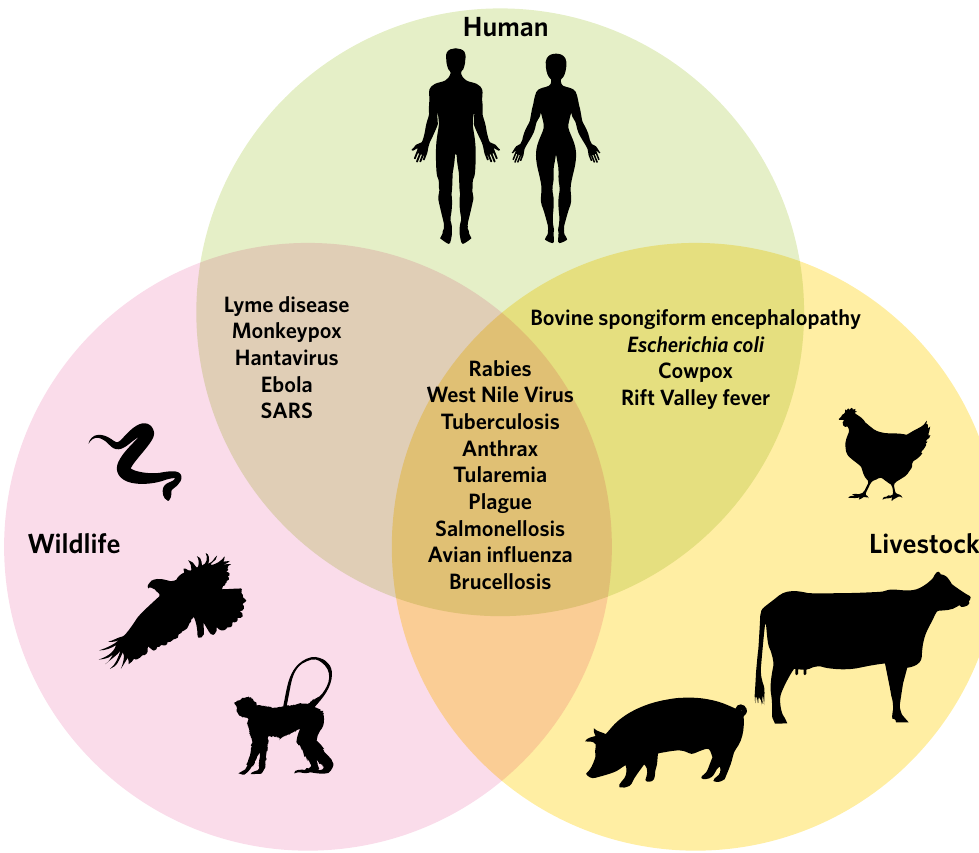
As shown in the diagram, some diseases affect only the overlap between two groups (such as Lyme disease affecting humans and wildlife), whilst others like rabies, tuberculosis, and plague can affect all three groups.
Examples of emerging and re-emerging diseases
The factors contributing to emerging and re-emerging diseases are complex and differ depending on the causative organism. The following table outlines some examples:
| Disease | Pathogen | Emerging/re-emerging | Contributing factors |
|---|---|---|---|
| Ebola haemorrhagic fever | Ebola virus | Re-emerging | Zoonosis – it is currently believed that bats are a natural reservoir of the virus and are responsible for many instances of human infection |
| Measles | Morbillivirus | Re-emerging | Reduction in vaccination coverage leading to outbreaks |
| Cholera | Vibrio cholerae | Re-emerging | Evolution of a new strain leading to increased virulence and survival in environment |
| Malaria | Plasmodium | Re-emerging | Evolution of drug resistance – changes in environmental conditions leading to an increase in mosquitoes that can transmit disease |
| Coronavirus disease 2019 (COVID-19) | SARS-CoV-2 | Emerging | Suspected zoonosis – with global travel allowing it to quickly spread throughout the world |
| 2009 Pandemic influenza | Swine-origin H1N1 influenza virus | Emerging | Zoonosis – transmission of the virus from pigs to humans |
| Acquired immunodeficiency syndrome (AIDS) | Human immunodeficiency virus (HIV) | Emerging | Zoonosis – believed to have originated in non-human primates, increased populations in cities, global travel, medical treatments including organ transplants and blood transfusions, drug use, and multiple sexual partners |
Note
Notice how multiple factors often contribute to a single disease's emergence. For example, HIV/AIDS involves zoonosis, population density, global travel, and medical technology - demonstrating the complex nature of disease emergence.
Classifying disease outbreaks
It is important that authorities respond to emerging and re-emerging diseases quickly. If they do not, an unexpectedly large group of people may become infected, causing an outbreak. An outbreak is a sudden and unexpected increase in the occurrence of a disease.
Disease outbreaks can be classified into categories based on the geographic spread:
Epidemic: A dramatically increased occurrence of a disease in a particular community at a particular time. Epidemics involve a sudden, widespread increase in the occurrence of an infectious disease among a specific population in a specific location.
Pandemic: An epidemic that has spread across multiple countries and/or continents. Pandemics involve epidemics that have spread to different countries and/or continents in different regions of the world. As such, pandemics typically affect a greater number of people when compared to epidemics and are much more difficult to control.
Endemic: When a disease occurs at a relatively constant baseline level in a population. A disease is endemic in a given population when it is found at a constant baseline level throughout the population in a specific location at a particular time. For example, influenza (the flu) is currently an endemic disease in Australia – it is present in the Australian population at a relatively constant level.
Example
Worked Example: Classifying Disease Outbreaks
Consider a disease scenario:
- A new virus emerges in a single city, causing 500 cases in one month (normally 10 cases/month)
- Classification: Outbreak - sudden, unexpected increase in a localised area
If the disease then spreads:
- To multiple cities across one country with thousands of cases
- Classification: Epidemic - widespread increase in a specific region
If it continues spreading:
- To countries across multiple continents with millions of cases
- Classification: Pandemic - global spread across countries and continents
After control measures:
- The disease remains present at a steady 50 cases/month in the population
- Classification: Endemic - constant baseline level in the population
Pathogens introduced by European arrival to Australia
Background to colonisation
Throughout history, the arrival of a colonising nation in a land occupied by an Indigenous population has resulted in the introduction of disease and mortality to that population. The European colonisation of Australia is no different.
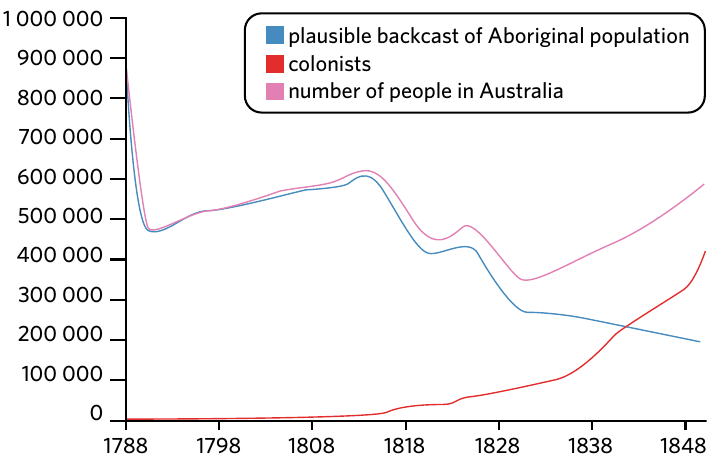
The arrival of the first convicts and settlers from England to Australia in 1788 brought about the introduction of disease and dispossession among the Indigenous population. The major diseases in Europe during the late 18th century were smallpox, syphilis, tuberculosis, influenza, and measles. When colonists arrived in Australia, they brought these diseases with them, unleashing them on the local population and causing widespread disease and death.
Important
The graph above illustrates the dramatic effect of European arrival on the Australian Indigenous population. Note that the Aboriginal population numbers are estimates only. The graph shows that whilst the colonist population grew exponentially, the Indigenous population declined sharply.
Factors making Indigenous populations susceptible
A number of factors contributed to Australia's Indigenous population being particularly susceptible to European diseases at this time.
Lack of immunity in the Indigenous population
Some diseases, such as measles, were frequently contracted during childhood by Europeans. When contracted during childhood, the symptoms of measles are much less severe, and the immunity generated lasts into adulthood. For Indigenous populations, however, many individuals first encountered measles as adults and, as a consequence, experienced severe disease.
Additionally, other diseases brought by Europeans, such as influenza and smallpox, were highly contagious and can be highly virulent regardless of age. European arrivals to Australia would have encountered these diseases in childhood and, having survived them, had some form of natural active immunity to them. Natural active immunity is protection against a disease created by antibodies and memory cells produced by an individual's own immune system without medical intervention.
Important
Unfortunately for the Indigenous Australian population, no such immunity for these diseases existed, meaning they were more likely to contract and experience severe symptoms from them. This represents a critical difference in disease exposure history between the two populations.
Lack of knowledge and experience with European diseases
Indigenous populations had centuries of knowledge relating to the management and treatment of diseases present in their population. When Europeans arrived, however, and brought new diseases with them, Indigenous people had no knowledge about how to avoid or treat infections. Furthermore, their ability to practise Indigenous medicine was often prevented, meaning Indigenous people were left without any form of medical treatment to help them when infected.
Note
The combination of unfamiliar diseases and the disruption of traditional healing practices created a particularly dangerous situation. Indigenous Australians could not draw on their existing medical knowledge because these were entirely new pathogens to their population.
The disruption caused by colonisation
Prior to colonisation, Indigenous people lived in societies that were well adapted to the local environment and were typically spread out and uncrowded. They also had a mixed diet rich in carbohydrates and protein, with most individuals being very healthy.
However, after European arrival, their access to food and water was restricted and denied. Medicine practices were disrupted, and their relationship with Country and culture was irrevocably changed. They were also forced into camps at the edges of towns, where the opportunities for infection were heightened due to increased population densities.
Important
All of these conditions led to a general decrease in the health status of Aboriginal and Torres Strait Islander people, making them more susceptible to disease and death. This was not merely the introduction of new pathogens, but a comprehensive disruption of the factors that maintained population health.
Impact on the Indigenous population
It is difficult to accurately quantify the sheer impact that the Europeans had on the population and health status of Indigenous Australians. However, in Victoria, it is thought that in the first 50 years of contact with European settlers, over 60% of the Indigenous population had succumbed to a series of epidemics.
The decline of the Indigenous population in Australia continued into the 20th century, with the negative impacts of European arrival in Australia still being felt by many Indigenous Australians today.
Note
This devastating population decline was driven by the combination of three major factors: lack of immunity to European diseases, lack of knowledge about these new infections, and the comprehensive disruption of Indigenous societies and their traditional way of life.
Remember!
Summary
Key Points to Remember:
-
Emerging diseases are new to human populations or rapidly increasing, whilst re-emerging diseases were previously controlled but are now increasing again.
-
Six main factors contribute to disease emergence: evolution of pathogens, globalisation and travel, increased human-animal contact (zoonosis), population growth, changing technology, and insufficient vaccination.
-
An estimated 70% of emerging diseases originate from animal reservoirs (zoonoses).
-
Disease outbreaks are classified as epidemics (local) or pandemics (global spread), whilst endemic diseases occur at constant baseline levels.
-
European colonisation of Australia in 1788 introduced diseases like smallpox, influenza, and measles to Indigenous populations who lacked immunity, knowledge of these diseases, and experienced disruption to their societies, resulting in devastating population decline.
-
Three key factors made Indigenous Australians particularly susceptible: lack of immunity, lack of knowledge about European diseases, and disruption of their societies and traditional practices.