Pedigree Analysis (VCE SSCE Biology): Revision Notes
📚Revision Notes
Pedigree Analysis
What is a pedigree chart?
A pedigree chart is a diagram that shows how a trait is passed down through multiple generations of a family. Geneticists use these charts to analyse inheritance patterns and determine whether traits are dominant, recessive, or sex-linked.
Pedigree charts help us understand how genetic conditions are inherited and can be used to predict the likelihood of offspring inheriting particular traits.
Note
Understanding pedigree charts is essential for genetic counselling, medical diagnosis, and predicting the probability of inherited conditions appearing in future generations.
Pedigree symbols and conventions
Pedigree charts use standardised symbols to represent different individuals and relationships. Understanding these symbols is essential for reading and interpreting pedigree charts.
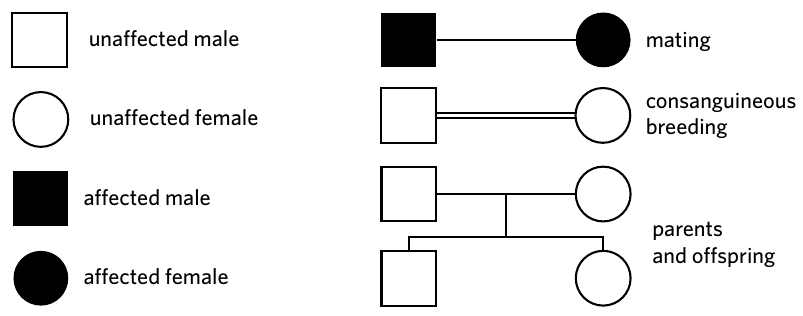
The key conventions used in pedigree charts are:
- Circles represent females
- Squares represent males
- Filled (coloured) shapes indicate affected individuals who express the trait
- Empty (uncoloured) shapes indicate unaffected individuals who do not express the trait
- Horizontal lines between two individuals show they are partners or parents (mating)
- Vertical lines connect parents to their offspring, showing the link between generations
Consanguineous breeding refers to mating between two closely related individuals (also called inbreeding). This is shown by a double horizontal line between two symbols.
Note
Memory Aid for Symbols:
- Shape: Circles = Females, Squares = Males
- Fill: Filled = Affected, Empty = Unaffected
- Connections: Horizontal = Parents/Mating, Vertical = Offspring
Reading pedigree charts
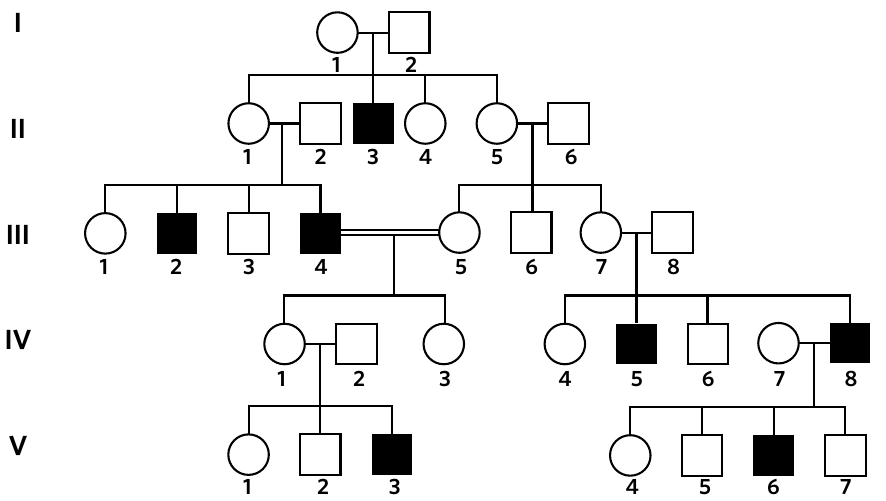
Each person in a pedigree chart has a unique reference code based on their generation and position.
Generation notation:
- Generations are labelled with Roman numerals (I, II, III, IV, V)
- Generation I is the oldest, with numbers increasing for younger generations
Individual notation:
- Within each generation, individuals are numbered from left to right using standard numbers (1, 2, 3, 4, etc.)
Example
Reading Pedigree Notation:
Looking at this pedigree:
- Individual II-3 is an affected male in the second generation, third from the left
- Individual IV-1 is the unaffected mother of individuals V-1, V-2, and V-3
- Individuals III-4 and III-5 have engaged in consanguineous breeding (they are related)
- Individual III-8 is unrelated to previous generations in this family line
Patterns of inheritance
The location of an allele (autosomal or sex-linked) and whether it is dominant or recessive affects how the trait appears in a pedigree chart. There are five main inheritance patterns to understand.
Autosomal dominant
In autosomal dominant inheritance:
- If both parents are affected, offspring may be unaffected
- If neither parent is affected, offspring must be unaffected
- If an offspring is affected, at least one parent must be affected
- The trait cannot skip a generation (appears in every generation)
Examples include Huntington's disease and achondroplasia (dwarfism).
Autosomal recessive
In autosomal recessive inheritance:
- If both parents are affected, offspring must be affected
- If neither parent is affected, offspring may still be affected (if both are carriers)
- If an offspring is affected, parents may or may not be affected
- The trait can skip a generation
Examples include cystic fibrosis, Tay-Sachs disease, albinism, and phenylketonuria (PKU).
X-linked dominant
In X-linked dominant inheritance:
- If a male is affected, his mother must be affected
- If a male is affected, all his daughters must be affected
- If a female is unaffected, her father must be unaffected
- If a female is unaffected, all her sons must be unaffected
- The trait cannot skip a generation
Examples include Rett syndrome and fragile X syndrome.
Important
Sex-linked inheritance cannot be confirmed with certainty using just a pedigree chart.
X-linked recessive
In X-linked recessive inheritance:
- If a female is affected, her father must be affected
- If a female is affected, all her sons must be affected
- If a male is affected, his mother may or may not be affected
- The trait can skip a generation
Examples include red-green colour blindness and haemophilia.
Important
Sex-linked inheritance cannot be confirmed with certainty using just a pedigree chart.
Y-linked
In Y-linked inheritance:
- Only males can show the trait
- All males in a direct lineage will show the same phenotype
- The trait cannot skip a generation
Examples include hypertrichosis pinnae auris and Y chromosome infertility.
Important
Sex-linked inheritance cannot be confirmed with certainty using just a pedigree chart.
Important note about sex-linked traits
When identifying inheritance patterns, we can rule out sex-linked traits if the pedigree does not satisfy all the criteria listed above. However, sex-linked inheritance cannot be definitively confirmed from a pedigree alone.
This is because autosomal traits can sometimes produce pedigree charts that look like sex-linked inheritance. For example, a Y-linked inheritance pattern could theoretically be caused by an autosomal dominant trait that, by chance, only affected males.
Important
Critical Distinction:
To conclusively identify sex-linked traits, additional evidence such as gene sequencing and chromosome mapping is required. When analysing pedigrees, we say sex-linked inheritance is "more likely" rather than "confirmed".
Steps to determine inheritance patterns
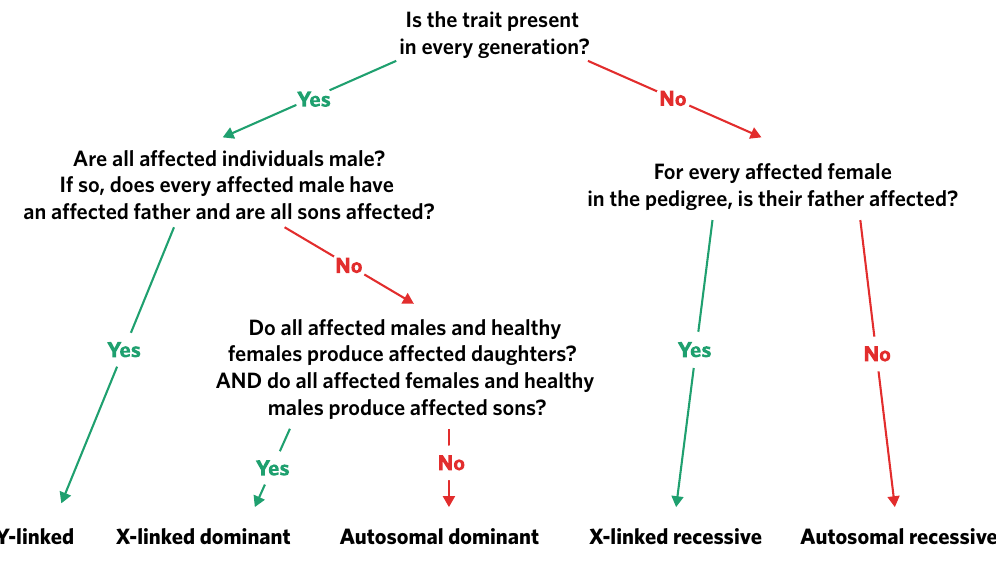
When analysing a new pedigree, follow this systematic approach to identify the inheritance pattern:
Note
Systematic Analysis Approach:
The flowchart guides you through key questions in order:
Step 1: Is the trait present in every generation?
- If YES → trait cannot skip generations (dominant or Y-linked)
- If NO → trait can skip generations (recessive)
Step 2: For traits present in every generation:
- Check if only males are affected and follow Y-linked rules
- Check if affected males and females follow X-linked dominant rules
- Otherwise, likely autosomal dominant
Step 3: For traits that can skip generations:
- Check if affected females always have affected fathers (X-linked recessive)
- Otherwise, likely autosomal recessive
Important
Common Mistake to Avoid:
A trait is not necessarily sex-linked just because it appears more often in one sex. It must satisfy the specific criteria for sex-linked inheritance.
Worked examples
Example
Worked Example 1: Phenylketonuria (PKU)
Phenylketonuria (PKU) is a metabolic disorder where an amino acid called phenylalanine is incorrectly produced. This leads to malfunctioning proteins that can cause seizures, intellectual disabilities, and mental disorders.
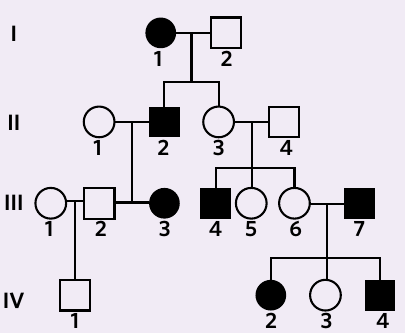
Analysis of the pedigree:
Step 1: Is this trait present in every generation? No
Step 2: For every affected female in the pedigree, is their father affected? No
Conclusion: This is an autosomal recessive disorder.
Explanation: The trait skips generations (not present in generation II but appears in generations I, III, and IV), which indicates recessive inheritance. Since affected females do not always have affected fathers, it cannot be X-linked recessive, so it must be autosomal recessive.
Example
Worked Example 2: Haemophilia
Haemophilia is a blood disorder that affects an individual's ability to form blood clots. This can lead to prolonged internal bleeding and deep bruising.
Analysis of the pedigree:
Step 1: Is this trait present in every generation? No
Step 2: For every affected female in the pedigree, is their father affected? Yes
Conclusion: It is likely this is an X-linked recessive disorder. However, sex-linked inheritance cannot be confirmed with certainty, as it is possible the trait is autosomal recessive.
Example
Worked Example 3: Retinitis Pigmentosa
Retinitis pigmentosa (RP) is a rare disorder involving the breakdown and loss of cells in the retina. This can lead to decreased night vision, vision disorders, and tunnel vision.
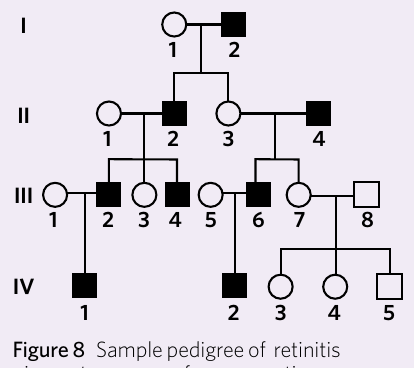
Analysis of the pedigree:
Step 1: Is this trait present in every generation? Yes
Step 2: Are all affected individuals male? If so, does every affected male have an affected father and are all sons affected? Yes
Conclusion: It is likely this is a Y-linked disorder. However, sex-linked inheritance cannot be confirmed with certainty, as it is possible the trait is autosomal dominant or recessive and, by chance, only affects males.
Determining genotypes from pedigrees
Pedigree charts allow us to work out the genotypes of certain individuals, depending on the inheritance pattern.
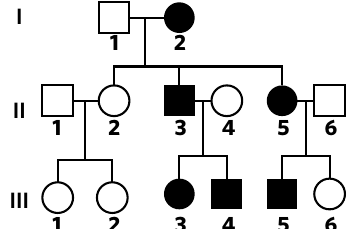
This pedigree shows an autosomal dominant trait. Let's determine the genotypes of individuals I-1 and I-2.
Note
Key Principles for Determining Genotypes:
- For autosomal traits, all individuals have two alleles
- For dominant traits, affected individuals may be homozygous dominant or heterozygous (they are not carriers)
- If an affected individual produces an unaffected child (who must be homozygous recessive), that parent must be heterozygous (they passed on a recessive allele)
Analysis:
- Individual I-1 is unaffected, so must be homozygous recessive
- Individual I-2 is affected but has produced offspring II-2 who is unaffected (homozygous recessive)
- Therefore, I-2 must be heterozygous (has passed on a recessive allele to II-2)
Note
Helpful Tip:
Write all possible genotypes above each symbol in the pedigree chart to keep track as you work through the analysis. This visual organization helps prevent errors and makes patterns easier to spot.
Carrier: A carrier is an organism that has inherited one copy of a recessive allele for a genetic trait but does not display the trait because it is masked by the presence of a dominant allele. Carriers are heterozygous for the trait.
Summary
Key Points to Remember:
- Pedigree charts are diagrams showing how traits pass through multiple generations of a family
- Standard symbols include circles (females), squares (males), filled shapes (affected), and empty shapes (unaffected)
- Generations are labelled with Roman numerals (I, II, III), and individuals are numbered left to right within each generation
- Five main inheritance patterns exist: autosomal dominant, autosomal recessive, X-linked dominant, X-linked recessive, and Y-linked
- Use systematic analysis (flowchart) to identify inheritance patterns by checking if traits skip generations and which sex is affected
- Sex-linked inheritance cannot be definitively confirmed from pedigree charts alone - additional genetic evidence is needed
- Genotypes can be determined by analysing whether affected individuals produce unaffected offspring