Agricultural Applications of CRISPR-Cas9 (VCE SSCE Biology): Revision Notes
📚Revision Notes
Agricultural Applications of CRISPR-Cas9
Introduction to CRISPR-Cas9 technologies
CRISPR-Cas9 represents one of the most powerful tools in modern genetic engineering. This technology harnesses a natural bacterial immune system to precisely edit DNA sequences in living organisms. Understanding how CRISPR-Cas9 works is essential for appreciating its revolutionary applications in agriculture.
Note
CRISPR-Cas9 technology originated from studying how bacteria defend themselves against viruses. Scientists discovered they could repurpose this natural defense mechanism as a precision gene editing tool that works in any organism, from bacteria to plants to animals.
CRISPR (Clustered Regularly Interspaced Short Palindromic Repeats) are short, clustered repeats of DNA found in prokaryotes which protects them against viral invasion. These sequences act as a molecular memory system, storing fragments of viral DNA that the bacteria have encountered before.
CRISPR-associated protein 9 (Cas9) is an endonuclease that creates a blunt end cut at a site specified by guide RNA (gRNA). Cas9 functions like molecular scissors, cutting DNA at precise locations and allowing new genetic material to be inserted or unwanted sequences to be removed.
Together, CRISPR and Cas9 form a powerful gene editing system. The CRISPR sequence provides the targeting information, whilst Cas9 performs the actual cutting and modification of DNA. This combination enables scientists to make precise changes to an organism's genome, creating genetically modified organisms with desired characteristics.
Genetic modification is the manipulation of an organism's genetic material using biotechnology. When CRISPR-Cas9 is used to alter an organism's DNA, the result is a genetically modified organism (GMO) - an organism with genetic material that has been altered using genetic engineering technology.
Why improve photosynthetic efficiencies and crop yields?
The global agricultural system faces unprecedented challenges that demand innovative solutions. CRISPR-Cas9 technology offers potential answers to several critical problems affecting food security worldwide.
The challenge of feeding a growing population
By 2050, agricultural productivity will need to almost double to meet the demands of a rising global population. This represents an enormous challenge, as we must produce significantly more food in the coming decades than we currently do. Traditional farming methods alone cannot achieve this level of productivity increase.
Climate change impacts
Climate change poses a significant threat to agricultural productivity. Rising temperatures, changing rainfall patterns, and extreme weather events can all reduce crop yields. Many agricultural regions are experiencing conditions that make farming more difficult and less predictable.
Limited arable land
Arable land - land that is suitable for growing crops - is already largely exhausted globally. We cannot simply clear more land to grow more food, as this approach has severe environmental consequences. Clearing additional land releases greenhouse gases into the atmosphere, contributing to the very climate change that threatens agriculture. Furthermore, deforestation destroys ecosystems and reduces biodiversity.
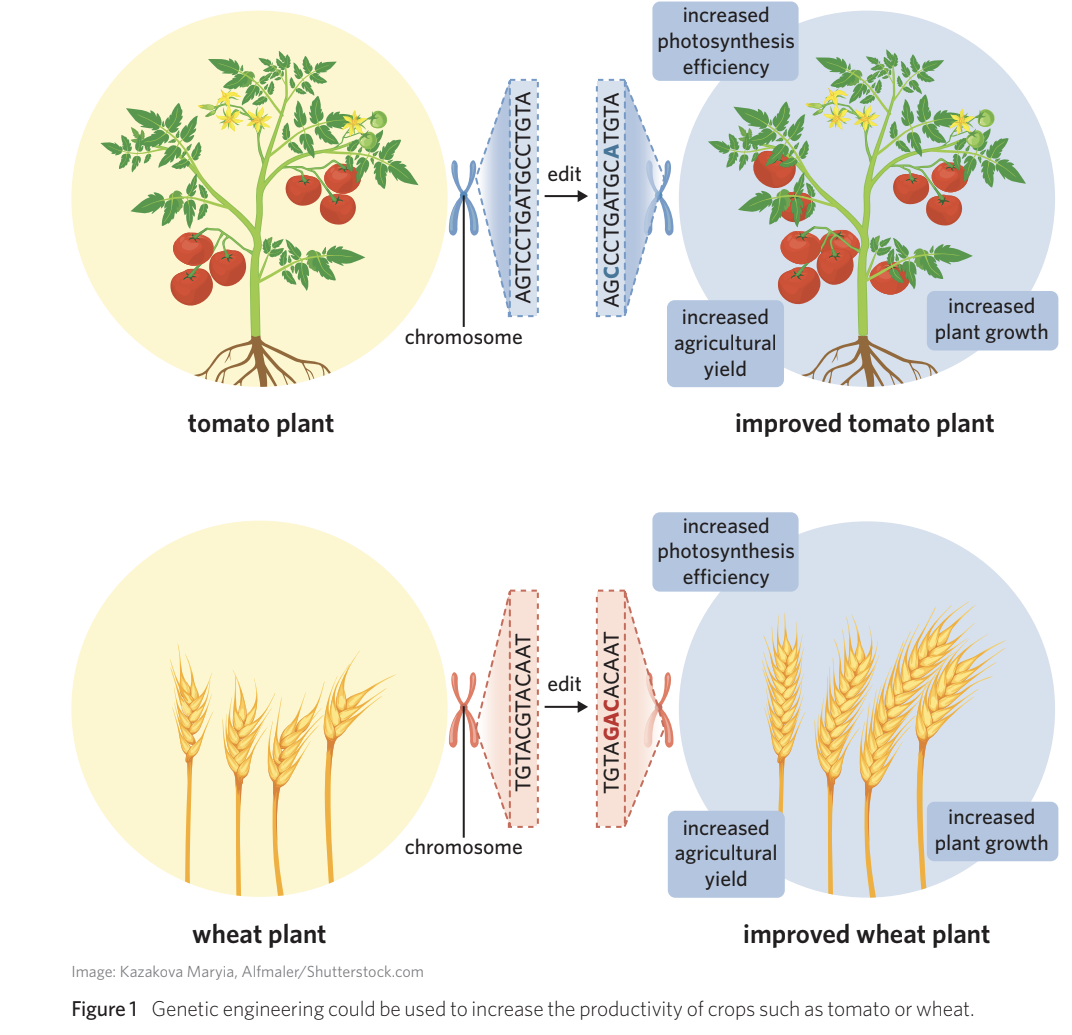
Important
The convergence of three critical factors creates an urgent need for agricultural innovation:
- Population growth: Agricultural output must nearly double by 2050
- Climate change: Rising temperatures and extreme weather reduce crop yields
- Land exhaustion: Arable land is already maximally utilized, and clearing more land accelerates climate change
We cannot expand farmland, so we must produce more food from existing agricultural areas through improved crop efficiency.
The role of photorespiration
Rubisco is a pivotal enzyme involved in initial carbon fixation during the light-independent stage of photosynthesis. However, Rubisco can also initiate photorespiration - a wasteful process in plants initiated by Rubisco that limits photosynthesis. This process reduces the efficiency of photosynthesis, particularly in C3 plants.
C3 plants are plants with no evolved adaptation to minimise photorespiration. Unfortunately, C3 plants represent the most abundant plant type on Earth and include most major agricultural crop species such as wheat, rice, and soybeans. In contrast, C4 plants are plants that minimise photorespiration by separating initial carbon fixation and the remainder of the Calvin cycle over space, whilst CAM plants are plants that minimise photorespiration by separating initial carbon fixation and the remainder of the Calvin cycle over time.
Note
The inefficiency of C3 plants presents both a challenge and an opportunity. Since most major crops are C3 plants, even small improvements in their photosynthetic efficiency could have enormous impacts on global food production. If scientists could engineer C3 crops to function more like C4 or CAM plants, yields could increase substantially without requiring additional farmland.
The solution: maximising crop productivity
The situation requires that we get more food from the land we already use. Agricultural yields (the amount of agricultural product harvested per area of land) need to increase whilst using the same amount of agricultural land. Gene editing with CRISPR-Cas9 offers a way to achieve this goal by creating crops that photosynthesise more efficiently and produce higher yields.
How CRISPR-Cas9 improves photosynthesis and crop yields
CRISPR-Cas9 technology provides a precise, affordable, and accessible method for improving crop productivity. Researchers can use this tool to target specific genes that limit photosynthetic efficiency or reduce crop yields, then modify these genes to enhance plant performance.
Improving photosynthetic efficiency
One primary method of increasing agricultural productivity involves engineering crops that bypass photorespiration. By modifying the relevant genes, scientists can create C3 plants that function more like C4 or CAM plants, avoiding the wasteful photorespiration process. This approach could significantly boost the efficiency of photosynthesis in major crop species.
Other strategies to maximise photosynthetic efficiency include:
- Targeting Rubisco function directly: Modifying genes that control Rubisco's activity to make the enzyme more efficient and less likely to initiate photorespiration
- Editing chloroplast function: Improving the efficiency of chloroplasts, the organelles where photosynthesis occurs, to capture light more effectively
- Modifying stomata: Adjusting the behaviour of stomata (pores in leaves) to optimise carbon dioxide uptake whilst minimising water loss
Target crops
CRISPR-Cas9 research focuses on crops that can be grown and harvested on a large scale. Priority targets include:
- Cereal grains such as wheat, rice, and barley
- Vegetables such as potatoes and tomatoes
- Fruits such as apples and bananas
These crops form staple foods for much of the world's population, making improvements to their productivity particularly valuable.
Potential applications of CRISPR-Cas9 in agriculture
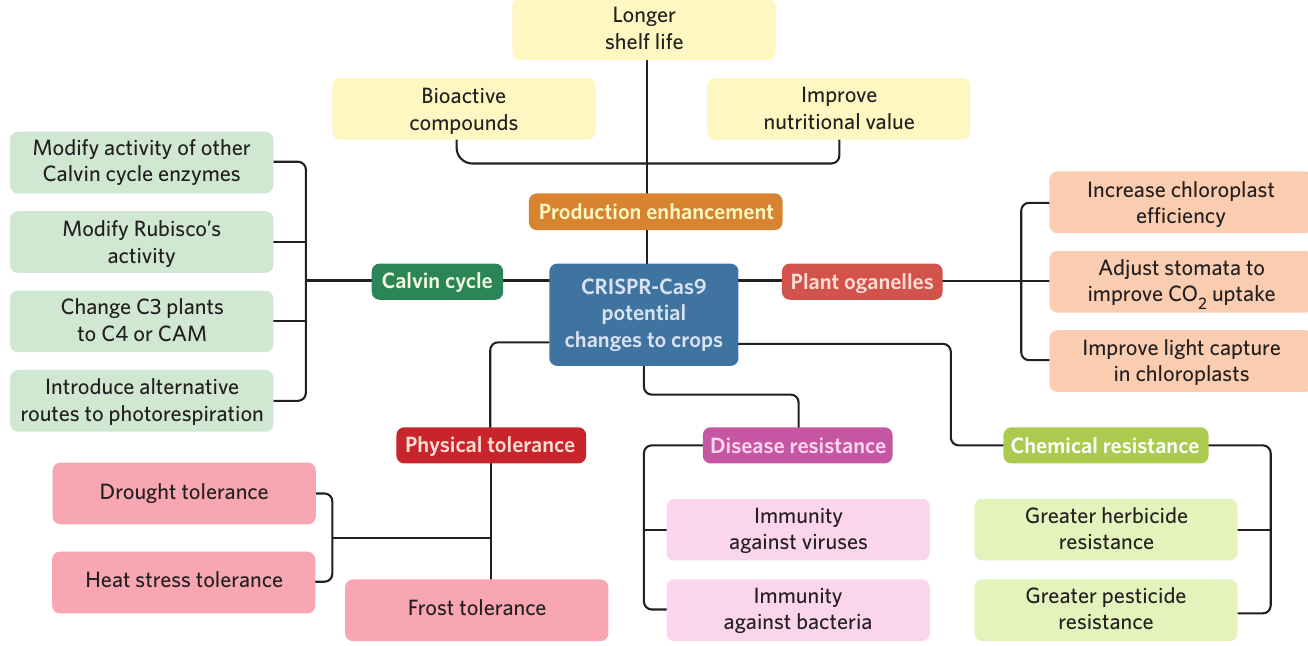
CRISPR-Cas9 can theoretically modify almost any aspect of a plant's characteristics. The technology's versatility means it has numerous potential applications beyond just improving photosynthesis. The following diagram illustrates the breadth of possible applications.
Note
The diversity of CRISPR-Cas9 applications demonstrates why this technology is so revolutionary. Rather than being limited to a single type of improvement, researchers can target everything from fundamental metabolic processes to stress tolerance to nutritional content. This flexibility means CRISPR-Cas9 can address multiple agricultural challenges simultaneously.
The main categories of CRISPR-Cas9 applications in agriculture include:
Calvin cycle modifications
The Calvin cycle is central to photosynthesis, and several modifications could improve its efficiency:
- Modifying Rubisco's activity: Enhancing the enzyme's specificity for carbon dioxide over oxygen to reduce photorespiration
- Introducing alternative routes to photorespiration: Creating new metabolic pathways that bypass the wasteful photorespiration process
- Modifying other Calvin cycle enzymes: Improving the efficiency of other enzymes involved in carbon fixation
- Converting C3 plants to C4 or CAM: Introducing the genetic machinery that allows C4 and CAM plants to minimise photorespiration
Plant organelle improvements
Enhancing the function of cellular structures can boost overall plant productivity:
- Increasing chloroplast efficiency: Making the photosynthetic machinery more effective at converting light energy to chemical energy
- Improving light capture in chloroplasts: Optimising the light-harvesting complexes to absorb more photons
- Adjusting stomata to improve CO₂ uptake: Fine-tuning stomatal opening to maximise carbon dioxide absorption whilst conserving water
Physical stress tolerance
Climate change makes it essential for crops to withstand harsh environmental conditions:
- Drought tolerance: Enabling plants to survive and produce yields with less water
- Heat stress tolerance: Allowing crops to maintain productivity during high temperature events
- Frost tolerance: Protecting plants from damage by cold temperatures
Disease resistance
Protecting crops from pathogens reduces losses and increases overall yield:
- Immunity against viruses: Engineering resistance to common viral diseases that affect crops
- Immunity against bacteria: Providing protection against bacterial pathogens
Chemical resistance
Modern agriculture relies on chemicals, and resistance can prevent crop damage:
- Greater herbicide resistance: Allowing crops to survive herbicide applications that kill competing weeds
- Greater pesticide resistance: Reducing damage from pesticides used to control insect pests
Production enhancement
Modifications can improve the quality and longevity of harvested crops:
- Bioactive compounds: Increasing the production of beneficial compounds such as vitamins or antioxidants
- Improved nutritional value: Enhancing the nutrient content of crops
- Longer shelf life: Reducing spoilage and extending the time crops remain fresh after harvest
Research process for CRISPR-Cas9 applications
Developing and implementing CRISPR-Cas9 applications in agriculture involves a systematic research process:
Understanding the target crop's photosynthesis
Researchers must first gain a comprehensive understanding of the entire photosynthetic process in the target crop species. This involves:
- Mapping the complete genome of the crop
- Identifying which specific genes contribute to photosynthesis and growth
- Understanding how the photorespiration pathway is regulated
- Determining which genes control key enzymes and processes
This foundational knowledge is essential for identifying appropriate targets for gene editing.
Computational modelling
Scientists use high-level computer software to model the photosynthetic pathway. These models help researchers:
- Visualise how the entire system works
- Identify inefficiencies in the photosynthetic process
- Predict what changes might improve efficiency
- Test modifications virtually before attempting real gene editing
Note
Computer modelling saves enormous time and resources by allowing researchers to test thousands of potential genetic modifications virtually before conducting expensive laboratory experiments. This approach helps identify the most promising targets for CRISPR-Cas9 editing.
Gene editing with CRISPR-Cas9
Once inefficiencies are identified, researchers use CRISPR-Cas9 technologies to target and edit the genes responsible for these limitations. The editing process involves:
- Designing guide RNAs that direct Cas9 to the correct location in the genome
- Cutting the DNA at the target site
- Either removing unwanted sequences or inserting beneficial genetic material
- Verifying that the edit was successful
Regulatory approval and commercialisation
Before CRISPR-modified crops can be grown commercially and consumed by the public, they must undergo rigorous testing and approval:
- Testing the genetically modified crop to verify improvements
- Ensuring the crop meets all GMO standards and regulations in Australia
- Conducting safety assessments
- Obtaining regulatory approval
- Providing appropriate labelling and communication to consumers
Important
Regulatory approval is a critical step that ensures consumer safety and environmental protection. GMO crops must demonstrate that they are:
- Safe for human consumption
- Environmentally sustainable
- Properly labelled for consumer awareness
- Effective at achieving their intended improvements
This process can take several years but is essential for maintaining public trust in genetically modified foods.
This process ensures that only safe and effective genetically modified crops reach the market.
Real-world examples of CRISPR-Cas9 in agriculture
Whilst CRISPR-Cas9 technology is relatively new, several promising applications have already been developed. These examples demonstrate the practical potential of gene editing in agriculture.
Hormones and more productive rice
Rice is a staple food for a large proportion of the world's population, making it an ideal candidate for CRISPR-Cas9 applications.

Example
Real-World Application: Increasing Rice Yields Through Hormone Modification
Research Location: China
Target: A family of genes relating to responses to the plant hormone abscisic acid
Method: Using CRISPR-Cas9 to create strategic mutations in hormone response genes
Results: 25-30% increase in grain yield
Significance: This substantial improvement demonstrates how understanding and modifying hormone signalling pathways can dramatically boost crop productivity. Since rice feeds billions of people worldwide, even a 25% yield increase represents an enormous contribution to global food security.
Altering Rubisco in tobacco plants
Tobacco plants serve as a model organism for photosynthesis research due to their relatively simple genetics and fast growth.

Example
Research Application: Understanding Rubisco Function in Tobacco
Research Location: United Kingdom
Target: Genes relating to Rubisco's complex function
Method: Using CRISPR-Cas9 to systematically edit genes controlling Rubisco activity
Initial Findings: Editing certain genes resulted in lower Rubisco content and subsequently lower photosynthesis rates
Current Focus: Researchers are working to uncover how genes can be edited to improve Rubisco and overall photosynthesis efficiency
Significance: This research provides valuable insights that could eventually be applied to food crops. Understanding which genetic modifications reduce efficiency helps researchers identify the opposite changes that might enhance it.
Longer shelf life of mushrooms
Extending shelf life reduces food waste and improves the economics of food production and distribution.

Example
Commercial Application: Extending Mushroom Shelf Life
Research Location: United States
Target: A gene that contributes to faster browning of mushrooms
Method: Using CRISPR-Cas9 to delete the unwanted gene
Results: 30% extension in shelf life
Significance: This application demonstrates how CRISPR-Cas9 can improve food quality and reduce waste beyond just increasing yields. Longer shelf life means less food spoilage during transport and storage, reducing both economic losses and environmental waste.
Engineering gluten-free wheat
CRISPR-Cas9 applications extend beyond productivity to address health concerns and dietary requirements.

Example
Health-Focused Application: Reducing Gluten in Wheat
Research Location: Spain
Target: DNA sequences responsible for gluten production
Goal: Produce wheat safe for individuals with coeliac disease
Method: Using CRISPR-Cas9 to edit wheat DNA and reduce gluten content
Results: 85% reduction in immunoreactivity to gluten
Current Status: Whilst not completely gluten-free, this represents significant progress towards wheat products that are safe for people with gluten sensitivities
Significance: This application shows how CRISPR-Cas9 can address dietary restrictions and health conditions, potentially allowing millions of people with coeliac disease to safely consume wheat products.
Current status and future prospects
It is important to recognise that CRISPR-Cas9 technology is still relatively new to agricultural applications. Most current uses remain in the research and development phase rather than commercial production. The enormous potential shown in laboratory studies must be balanced against the need for:
- Rigorous safety testing
- Regulatory approval processes
- Public acceptance of GMO foods
- Long-term environmental impact assessment
Note
The transition from laboratory success to commercial agriculture requires patience and careful evaluation. While the technology shows tremendous promise, ensuring safety and gaining regulatory approval takes time. Public education about the benefits and safety of CRISPR-edited crops is also crucial for widespread acceptance.
Nevertheless, CRISPR-Cas9 gene editing technologies offer clear advantages over previous genetic modification methods. They are generally easier to use, more cost-effective, and more accessible to researchers worldwide. Recent research has produced extremely promising results, suggesting that CRISPR-Cas9 will play an increasingly important role in meeting global food security challenges.
Summary
Key Points to Remember:
-
CRISPR-Cas9 is a precise gene editing tool that can target and modify specific DNA sequences in crop genomes to improve agricultural productivity.
-
Agricultural yields must nearly double by 2050 to feed the growing population, but climate change threatens productivity and arable land is exhausted, making genetic improvements to crops essential.
-
CRISPR-Cas9 can improve crops in multiple ways: enhancing photosynthesis efficiency by modifying Calvin cycle enzymes and reducing photorespiration, increasing stress tolerance to drought and heat, improving disease and chemical resistance, and enhancing nutritional value and shelf life.
-
The research process involves understanding the crop's genome and photosynthesis, using computer models to identify inefficiencies, editing target genes with CRISPR-Cas9, and obtaining regulatory approval before commercialisation.
-
Real-world applications have already shown remarkable success: rice yields increased by 25-30% through hormone pathway modification, mushroom shelf life extended by 30%, and wheat gluten immunoreactivity reduced by 85%, demonstrating the practical potential of this technology.