Designing and Planning Investigations (VCE SSCE Biology): Revision Notes
📚Revision Notes
Designing and Planning Investigations
Introduction to key science skills
Key science skills are the essential abilities that students must demonstrate when designing, conducting, analysing, and presenting scientific investigations. These skills are fundamental not only to VCE Biology but also to critical thinking in everyday life. At their core, these skills help us discover truth by asking important questions about the evidence we encounter.
Key science skills are the set of capabilities that VCE Biology students must learn to design, conduct, analyse, and report valid experiments.

Note
You demonstrate key science skills in everyday life whenever you critically evaluate information. Before accepting a claim as true, key science skills encourage you to question the evidence and consider alternative explanations.
You demonstrate key science skills when you critically evaluate information by asking:
- Do I believe this claim? Why or why not?
- What evidence supports this conclusion?
- Is this evidence trustworthy?
- Is the evidence weak or strong?
- Does any evidence undermine this conclusion or support an alternative position?
In VCE Biology, you will apply these skills more rigorously and methodically. You will learn to distinguish between weak evidence (such as personal opinions) and strong evidence (such as data from well-designed controlled experiments). You can apply key science skills by either designing your own investigation or by examining someone else's investigation.
Opinion is the personal belief or viewpoint of an individual which typically has not been verified as fact.
Controlled experiment is an investigation into the effect of an independent variable on a dependent variable, whilst keeping all other factors constant.
Reliable describes an experiment, tool, or measurement that produces similar results when repeated and reproduced.
Bias is an inclination to favour a particular position or outcome.
Error refers to differences between observed values and the true value.
Data gathered from investigations guided by key science skills are broadly considered more trustworthy and reliable. This is because key science skills help you reduce bias, minimise the effects of errors, and ensure results are not due to chance.
Constructing a research question and aim
Most scientific investigations begin by noticing something unusual or a pattern in the world. Scientists then narrow their inquiry down to one specific question they wish to answer. A well-designed research question has three essential characteristics:
Research question is a testable, achievable, and specific question that an investigation sets out to answer.
Characteristics of a good research question
Testable: You must be able to measure the factors you are interested in. For example, "What is the effect of salinity on the life cycle of sea monkeys?" is testable because both salinity and life cycle stages can be measured. In contrast, "How do sea monkeys grow?" is too vague.
Important
Testable means you can measure it! If you cannot quantify or observe the factors in your research question, you cannot design a valid experiment to answer it.
Achievable: The scientist must have the funding, ethical approval, and resources available to answer the question. For example, preventing all school students from eating before a test would not be achievable or ethical. A better question would focus on a specific, accessible group: "What is the average test score for students at this particular school if they have fasted for 0, 4, 8, or 12 hours?"
Specific: Only particular individuals will be sampled at particular times and locations. For example, "Is bird behaviour affected by light pollution?" is too broad. A more specific question would be: "Is silver gull (Chroicocephalus novaehollandiae) nighttime behaviour affected by light pollution in Melbourne from June to September?"
Note
Sometimes you need to conduct background research and go through several draft questions to refine your research question. This is a normal part of the scientific process – your first attempt doesn't need to be perfect!
From the research question, you can easily develop an aim.
Aim is the objective of an investigation or experiment.
The aim typically starts with the word "To" and clearly states what the investigation intends to determine. For example:
- To determine if the salinity of water affects the duration of life cycle stages in developing sea monkeys
- To determine if fasting before tests affects student performance
- To determine if silver gull (Chroicocephalus novaehollandiae) nighttime behaviour is different in light-polluted Melbourne compared to non-light-polluted areas
Note that where required, we include scientific names for species in research questions and aims.
Identifying independent, dependent, and controlled variables
Creating a testable, achievable, and specific research question means that investigations tend to measure the effect of one variable on another variable.
Dependent variable (DV) is the factor measured in the experiment that changes when the independent variable is manipulated.
Independent variable (IV) is the factor that is manipulated in an experiment.
Controlled variable is a factor that is kept constant throughout the experiment. Also known as a constant variable.
Uncontrolled variable is a factor that is not kept constant or accounted for throughout the experiment. Also known as an extraneous variable.
Note
To identify variables you need to control in your investigation, ask yourself: "What other factors might cause my dependent variable to change?" Any factor that could influence your DV should be controlled to ensure a valid experiment.
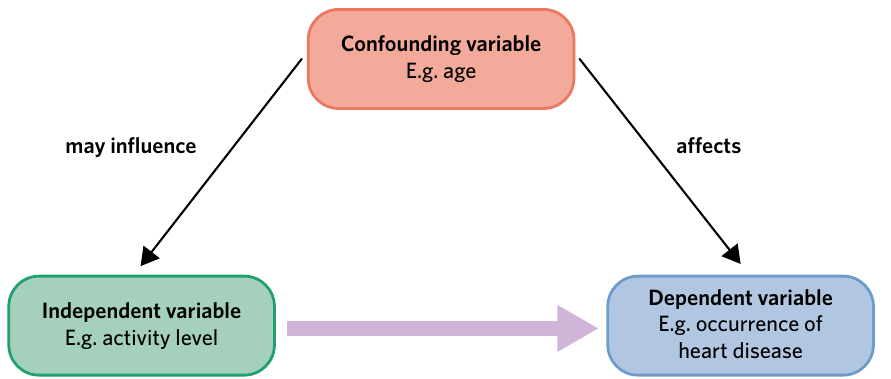
For example, when testing the effect of activity level (IV) on occurrence of heart disease (DV), you would want to ensure that each participant was of a similar age. If age is not constant, it becomes an uncontrolled variable that could affect the results, making the experiment inaccurate and invalid.
Important
In this diagram, age is a confounding variable because it may influence both the independent variable (activity level) and the dependent variable (occurrence of heart disease). If age is not controlled, it becomes difficult to determine if exercise alone impacts heart disease.
A confounding variable is a type of uncontrolled variable that affects both your IV and DV, making it impossible to establish a clear cause-and-effect relationship.
Formulating a hypothesis
From your aim, question, and variables, you can build a hypothesis. A hypothesis is more than just "what you expect to happen" during your experiment.
Hypothesis is a testable statement that describes how experimenters expect the dependent variable to change as the independent variable changes.
A hypothesis should:
- Be a testable statement
- Describe how you think your IV will affect your DV, including the direction of change (increase, decrease, etc.)
Your hypothesis will either be supported or refuted by your results. A simple hypothesis format is: "If [change in IV], then [change in DV]."
Example
Worked Example: Writing a Hypothesis
Research question: "What is the effect of temperature on enzyme activity?"
Simple hypothesis format: "If temperature increases, then enzyme activity will increase up to an optimal point, then decrease."
Extended hypothesis format (with reasoning): "If temperature increases, then enzyme activity will increase up to an optimal point, then decrease, because higher temperatures increase molecular movement and collision rates, but temperatures that are too high will denature the enzyme."
Sometimes you are also required to include an explanation. In this case, your hypothesis template could be: "If [change in IV], then [change in DV] because [existing evidence]."
Selecting a scientific investigation methodology
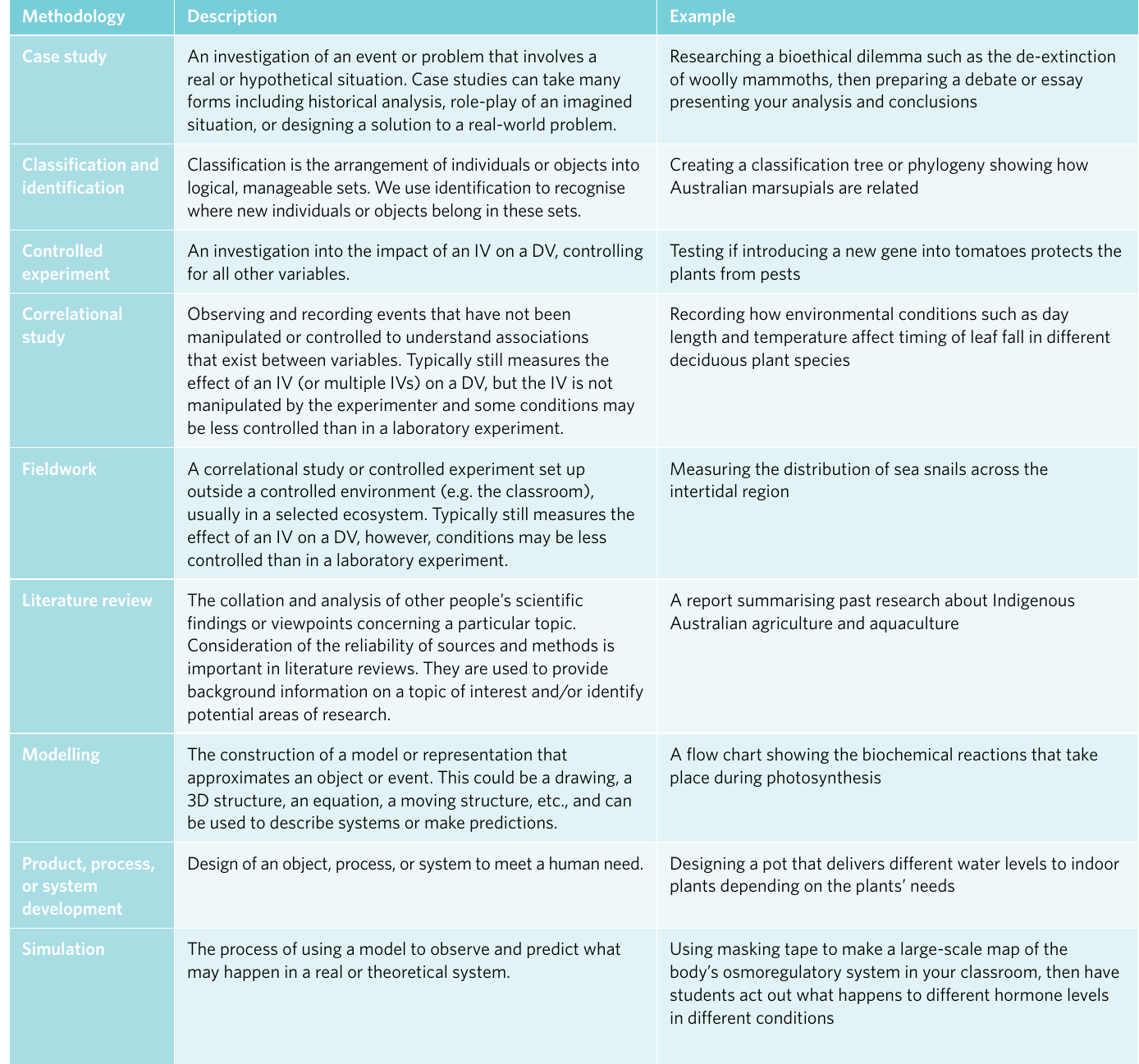
Scientific investigations can be undertaken in various ways depending on your research question and aim. These broad frameworks for inquiry are called scientific investigation methodologies, and they guide how you will design your specific methods (the actual steps in your experiment).
Methodology is the strategy or overarching framework followed in a scientific investigation.
Method is the steps followed in a scientific investigation.
Note
Think of methodology as the "big picture" approach to your investigation, while the method is the detailed, step-by-step procedure. The methodology answers "What type of investigation am I doing?" while the method answers "Exactly how am I doing it?"
For instance, if you want to learn what species of bacteria live on human skin, it might make sense to use a classification and identification methodology. However, if you want to understand cause and effect, you would perform a controlled experiment where you test the effect of an IV on a DV whilst controlling all other variables.
Controlled experiments are often difficult to set up properly, but they can provide very reliable results. Most of the key science skills you will learn relate directly to controlled experiments.
Designing a repeatable, reproducible, and valid investigation
For controlled experiments, there are broad rules around what needs to be included in your experimental design. These rules help ensure that your experiment is:
Repeatable: an experiment/measurement in which scientists, using the methods they designed, can obtain the same result multiple times.
Reproducible: an experiment/measurement in which a group of scientists, using methods designed by others, can obtain the same results as another group's experiment.
Valid: a measurement or experiment that actually tests what it claims to be testing.
Important
If your experiment is not repeatable, reproducible, or valid, then the results are typically not useful, reliable, or meaningful. These three characteristics are the foundation of trustworthy scientific research.
Identifying experimental and control groups
Experimental group is a group of individuals/samples in which the independent variable is manipulated. Also known as the treatment group.
Control group is a group of individuals/samples that are not exposed to the independent variable. Also known as an experimental control, control treatment, or the control.
The experimental group has individuals exposed to your IV treatment or intervention. There may be different levels of your experimental group. For instance, if you are testing the effect of a new pesticide on crop yield, your experimental groups could be three groups of crops exposed to either low, medium, or high levels of pesticide.
Control groups are used as a comparison with experimental groups, and every controlled experiment should include at least one control group. Control groups can be:
- Negative controls: samples not exposed to any level of the IV, which means we do not expect them to produce any results. If they do produce results, we know that something other than the IV (an uncontrolled variable) may be causing the change in the DV, indicating our method is flawed.
- Positive controls: groups where you would expect to see a result. Scientists apply a treatment to this group which induces a well-understood effect on the DV, which can be compared against the effects of other IVs.
Note
Negative controls are the most common type of control group and should be present in all controlled experiments. They help you verify that your method is working correctly and that any changes in your DV are truly due to your IV.
Important
Don't confuse control groups with controlled variables!
- Controlled variables are factors that must be kept constant during your experiment (like temperature, pH, or time)
- Control groups are samples that are not exposed to the independent variable (like the group receiving no pesticide)
These are completely different concepts despite having similar names.
Placebo is a substance that has no active ingredients or side effects.
Placebo groups are often used as a type of control group, especially when testing medicines. Placebos are medicines/procedures that seem identical to the treatment medicine/procedure but have no active ingredients and do not result in therapeutic benefit. This means participants do not know if they are part of the treatment group or the placebo group. The improvement often noted in patients treated with placebos is known as the "placebo effect" and is due to the psychological beliefs of the person.
When thinking about your experimental and control groups, you also need to consider practical aspects:
- What tools will I use to take measurements of each group?
- How often will I take measurements of each group?
- How long will the experiment run for?
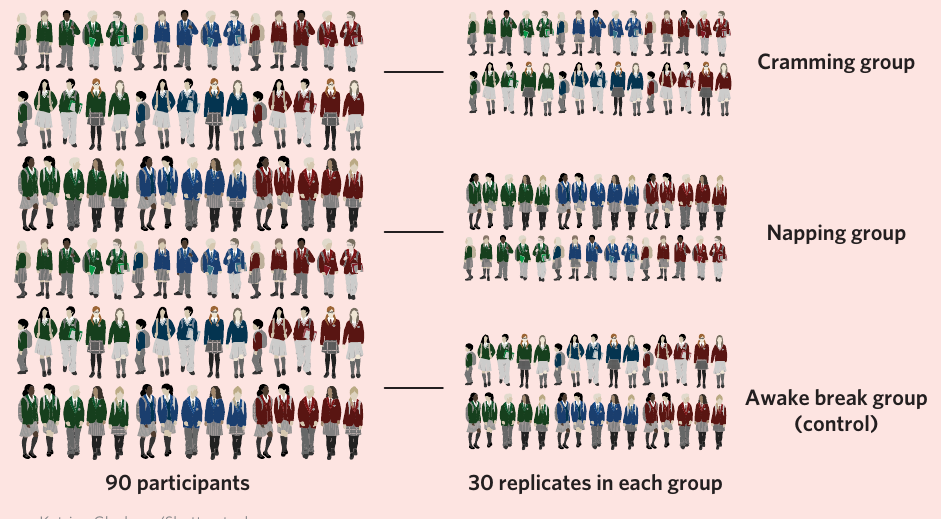
Replicating experimental and control groups
Replication is the process of running your test/experiment multiple times.
Replication involves having multiple experimental and control groups. Instead of having four different fields exposed to either no pesticide, low, medium, or high levels of pesticide, a replicated experiment would ensure there were two or more fields exposed to each treatment.
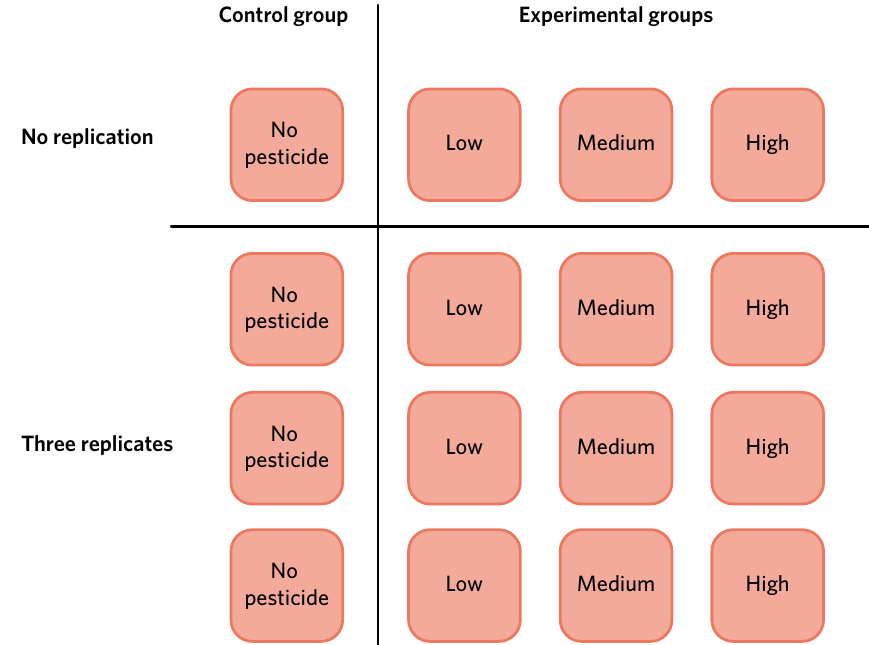
Increasing replication is good scientific practice because:
You can find out if your results are precise:
- Precise results indicate that your method is valid and reliable, and that you may be able to assume the same results would be found in a larger sample
- If you get a wide spread of values across replicates, then results are imprecise
- If replicates get similar results, your results are precise
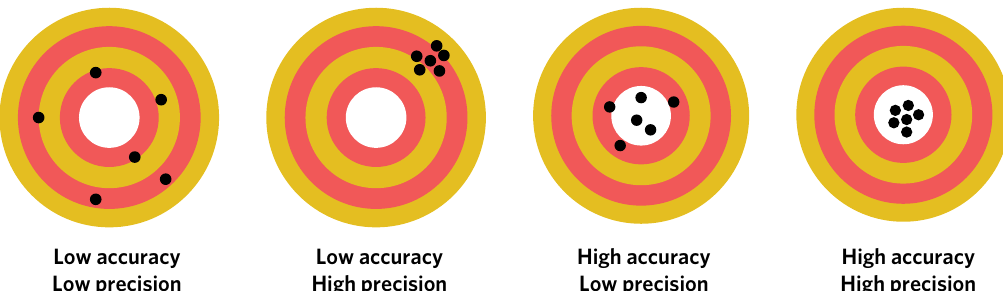
Precise describes two or more measurements that closely align with each other.
Replicates are multiple measurements that are exposed to the same level of the IV, are very close in value, and are close to the "true" value of the quantity being measured.
You can take the average of your results:
- This reduces the impact of outliers and random error
- This might make your results more accurate, as it may bring your final values closer to the true value
Outlier is a reading that varies drastically from other results.
Random error is variation in results caused by uncontrollable conditions between replicates, resulting in a less precise spread of readings. Can be reduced using more replicates or refining the measurement process.
Accurate describes how close a measurement is to the true value.
True value is the value that would be obtained by a perfect measurement without the influence of errors.
Important
It is important to note that calculating the average of your results after replicating the experiment only brings your final values closer to the true value if the range of your data (maximum value minus minimum value) is not too large.
In other words, if your data has a large range and you calculate the average, your final results will actually be further away from the true value. This is why precision matters – you need your replicates to be close together for averaging to be useful.
Sometimes there is not enough funding, time, or resources to replicate an experiment many times. Nevertheless, you must design treatment groups with at least two replicates if you want to be able to trust your results. Depending on the field of Biology, it may be standard practice to replicate treatments hundreds or even thousands of times.
Deciding how to sample your groups
It is hard to take measurements of every single individual in a population, so scientists tend to collect data on only a small subset of that population called a sample.
Population is a set of similar objects or individuals that are studied in a scientific investigation.
Sample is a subset of the larger population being studied.
Because sampling only looks at a subset of a population, scientists need to ensure that their samples are:
Representative: a sample that accurately reflects the characteristics of the larger population.
Unbiased: a sample or measurement that is unaffected by a scientist's expectations.
Note
It is a good idea to get as large a sample size as possible, as this will increase the likelihood that you have collected representative and unbiased data. A larger sample size also means that you will have a better understanding of the precision of your data and can take averages to reach a final value that should be more accurate.
Sampling techniques
Random sampling ensures each member of the population is equally likely to be included.
Systematic sampling involves taking samples at regular intervals along an environmental gradient (such as depth, soil type, rainfall, altitude, or temperature).
Stratified sampling is used when a population has clearly defined zones or characteristics, and you wish to sample proportionately from each zone.
Note
Judgement sampling (also known as selective sampling) involves the researcher choosing which individuals to sample (or asking an expert's advice) according to their needs. Judgement sampling can be biased and lead to unrepresentative data, so should only be used when necessary.
Convenience sampling involves taking a sample from a group of individuals who are easy to reach. Convenience sampling can lead to biased and unrepresentative samples that make results unreliable, so should be avoided where possible.
Important
Be aware that judgement sampling and convenience sampling are generally considered poor scientific practice because they introduce bias into your results. Always try to use random, systematic, or stratified sampling techniques when possible.
Minimising the potential for error throughout the method
There are three main types of errors that you should plan to avoid during your experiment:
Personal error refers to mistakes or miscalculations due to human fault. Can be eliminated by performing the experiment again correctly.
Personal errors include mistakes or miscalculations made by the experimenter. Counting incorrectly, rounding to the wrong decimal place, or labelling samples incorrectly are all examples of personal errors. To avoid these, repeat the experiment again. For measurements relying on human accuracy (such as counting plant numbers), you can get two or three people to make the same measurement.
Systematic error refers to errors which cause results to differ by a consistent amount each time, typically due to faulty equipment or calibration, resulting in a less accurate result. Can be reduced by calibrating and maintaining instruments.
Systematic errors cause results to differ from the true value by a consistent amount each time, typically due to faulty equipment or calibration. They affect the accuracy of the experiment and cannot be minimised through replication. To avoid these, re-calibrate your instruments or use more reliable equipment.
Important
Key Difference: Systematic vs Random Error
-
Systematic errors affect accuracy (how close you are to the true value) and occur in the same direction every time. They cannot be reduced by taking more measurements.
-
Random errors affect precision (how close your measurements are to each other) and occur in unpredictable directions. They can be reduced by taking more measurements and calculating an average.
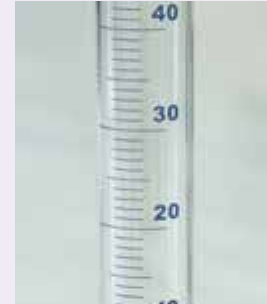
Random errors are caused by unpredictable variations in the measurement process and result in a spread of readings. For example, when a quantity is estimated by reading between the lines on a measuring cylinder – is it 5.6 mL or 5.7 mL? Perhaps we will just say 5.65 mL. Random errors reduce precision. To avoid these, replicate the experiment, increase the sample size, refine the measurement process, or use more precise measuring equipment.
Uncertainty is a quantification of the error associated with a measurement, often represented by the symbol "±" after a reading.
When you are designing your method, you should choose appropriate equipment to use for measurement, calibrate equipment where needed, and build in a sufficient number of replicates to minimise error. It is also important to identify parts of the method where errors may occur (such as during delicate or complex processes), then either find ways to reduce the risk of error or practise the process prior to conducting the experiment.
Quantifying uncertainty
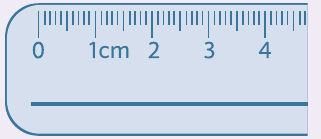
Some instruments are more precise than others. Digital devices like scales typically state the uncertainty on a sticker somewhere. For analogue instruments like rulers and measuring cylinders, uncertainty is determined as follows:
- If you have to set up the instrument before measuring (such as with a ruler, where you need to put it in place before measuring), then the uncertainty is the smallest measurement.
- When you do not need to set the instrument up before measuring (such as a measuring cylinder or thermometer), then the uncertainty is half of the smallest measurement.
Note that the uncertainty assigned to standard digital stopwatches is ± 0.1 of a second due to human reaction time.
Writing your method out clearly
Once you know your treatment groups, replication number, sampling method, and have identified any methodological stages which may introduce error, you should write the steps of your experiment out clearly. Remember that anyone should be able to follow your method exactly – other scientists will not be able to reproduce your results if they cannot follow your method.
Note
RICHES Checklist for a Good Controlled Experiment
You can think of the characteristics of a good controlled experiment as a checklist:
- Replication
- Independent variable/dependent variable
- Control group
- Hypothesis
- Errors are minimised
- Sample is large and randomly collected
Use this checklist when designing your experiment to ensure you haven't missed any important elements.
Following ethical and safety guidelines
Ethical guidelines
Before starting your experiment, you need to ensure that your method is ethical.
Ethics is a field of knowledge that helps individuals exercise moral judgement and determine what is right and wrong.
Ethical conduct is valued so highly in modern science that, at universities and research facilities, experimental procedures must be presented to an ethics board before being permitted to proceed.
Important
Ethical Considerations Checklist
To check if your experiment is ethically sound before starting, you should ask yourself the following questions:
- Is my method designed to avoid harming living things or ecosystems as much as possible?
- Has this research considered the beliefs, perceptions, customs, and cultural heritage of those involved in, or affected by, the experiment?
- Are all participants aware of the risks associated with this research and have they provided their consent?
- If I make a great discovery, will there be equal access to, and fair distribution of, any benefits that have arisen from this research?
- Will I acknowledge all sources of funding and help for this research?
- Will I be transparent about any errors with the data or methods?
- Is the identity of participants protected?
If you answered "No" to any of these questions, your experiment may not be ethical and you may need to revise your method.
Safety guidelines
It is likely that, during Year 11 and 12, your teacher will ask you to take ownership of your own safety during an experiment by doing a risk assessment. This involves writing down all potential risks in an experiment, keeping in mind any contextual factors that may affect the safety of the experiment, and identifying ways to minimise these risks.
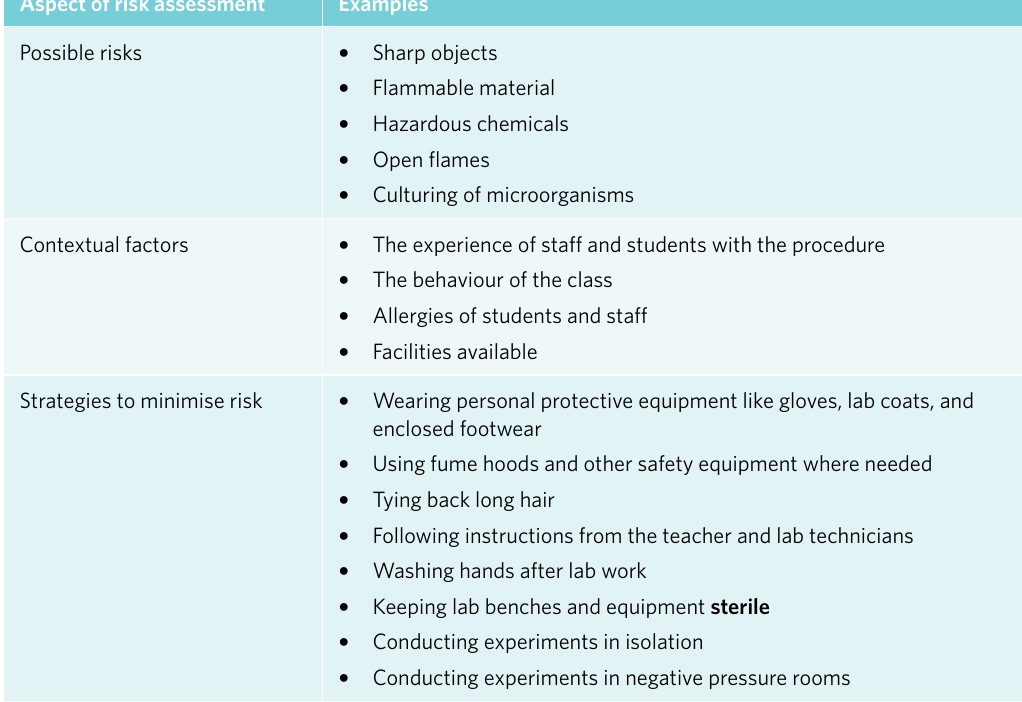
Sterile means surgically clean and free from contamination by microorganisms. Also known as aseptic.
Note
You can undertake a risk assessment online or use a printed template provided by your school. Online risk assessments are helpful because they typically outline standard handling procedures for all equipment and safety data sheets for chemicals.
Remember!
Summary
Key Points to Remember:
-
Key science skills are essential capabilities for designing, conducting, analysing, and presenting scientific investigations that help reduce bias and minimise errors.
-
A good research question must be testable, achievable, and specific, and should lead to a clear aim for the investigation.
-
Controlled experiments measure the effect of an independent variable on a dependent variable whilst keeping all other variables constant.
-
All controlled experiments require both experimental groups (exposed to the IV) and control groups (not exposed to the IV) to determine if the IV truly causes changes in the DV.
-
Replication increases the reliability of results by allowing you to assess precision, calculate averages, and reduce the impact of random errors and outliers.
-
Proper sampling techniques (random, systematic, stratified) help ensure your sample is representative and unbiased, making your results more reliable and applicable to the broader population.
-
Three types of errors must be minimised: personal errors (human mistakes), systematic errors (equipment/calibration issues), and random errors (unpredictable variations in measurement).
-
All experiments must follow ethical guidelines to avoid harm, respect participants, and maintain transparency, as well as safety guidelines to identify and minimise risks.