The Prokaryotic Cell Cycle (VCE SSCE Biology): Revision Notes
📚Revision Notes
The Prokaryotic Cell Cycle
Introduction
Cell replication is a fundamental process for all living organisms. In everyday life, we encounter the consequences of rapid bacterial replication – for instance, when bacteria like Salmonella multiply in improperly cooked chicken. Understanding how prokaryotic cells replicate helps explain why food safety measures, such as thoroughly cooking meat above 75°C, are so important.
Note
The temperature threshold of 75°C isn't arbitrary – at this temperature, the proteins in bacterial cells denature and the bacteria die, preventing the risk of food poisoning from bacterial contamination.
Why cells replicate
Cell replication serves three essential purposes for organisms:
| Purpose | Explanation |
|---|---|
| Growth and development | Multicellular organisms begin as a single cell and grow by producing more cells, not by existing cells becoming larger. A human embryo develops into a baby through countless rounds of cell replication, adding more cells rather than enlarging individual ones. |
| Maintenance and repair | Cells constantly die due to ageing or damage. Cell replication produces replacement cells, ensuring organisms continue to function properly. |
| Reproduction | Both prokaryotic and eukaryotic cells use replication to reproduce and increase their population numbers. |
Exponential growth in prokaryotic cells
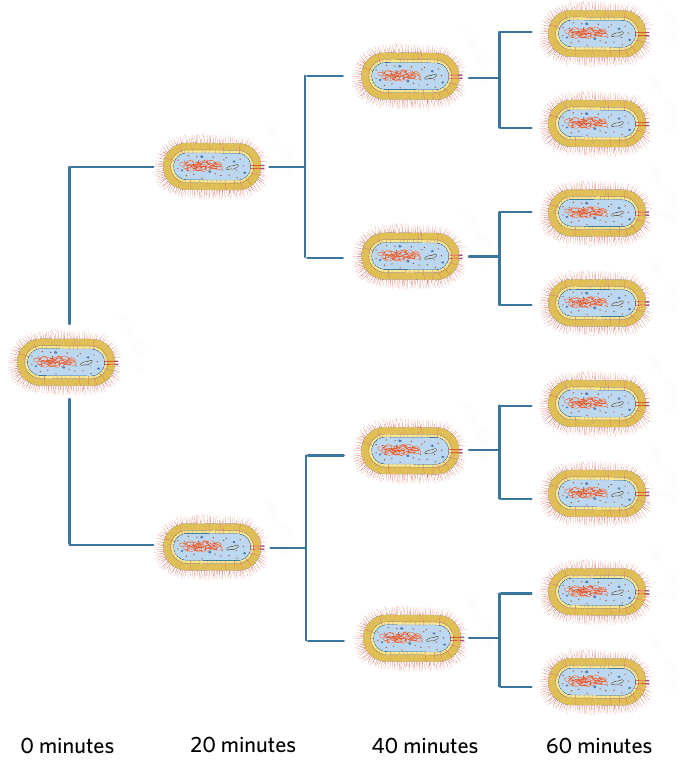
Prokaryotic cells replicate at a remarkably fast rate. The growth pattern is exponential, meaning the number of cells doubles after each replication cycle. This rapid multiplication explains how bacterial infections can develop so quickly.
Example
Worked Example: Exponential Growth in E. coli
Consider Escherichia coli (E. coli) bacteria as an example. A single E. coli bacterium divides every 20 minutes under optimal conditions. Starting with just one bacterium:
- After 20 minutes: 2 bacteria
- After 40 minutes: 4 bacteria
- After 60 minutes: 8 bacteria
- After 7 hours: over 2 million bacteria
This exponential growth demonstrates why bacterial contamination of food can become dangerous so rapidly. In the time it takes chicken to sit in your fridge or on your kitchen counter, Salmonella bacteria could multiply from thousands to millions.
Important
The exponential nature of bacterial growth means that even a small initial contamination can quickly become a serious health hazard. This is why proper food storage and cooking temperatures are critical for preventing foodborne illness.
Binary fission
Binary fission is the method of cell replication used by prokaryotes. This process is a form of asexual reproduction – a method of reproduction that produces genetically identical cells without the fusion of gametes (sex cells).
Unlike eukaryotic cells which use mitosis, prokaryotic cells like bacteria reproduce through this simpler process. Binary fission produces two daughter cells that are genetically identical to the parent cell.
Stages of binary fission
Binary fission proceeds through several distinct stages:
Stage 1: DNA replication
The process begins with a prokaryotic cell in its normal state. The cell contains a circular chromosome, plasmids (small, circular loops of DNA that are separate from a chromosome, typically found in bacteria), and ribosomes.
The circular chromosome uncoils and the DNA replicates, creating a copy of the genetic material. Plasmids also replicate independently during this stage.
Stage 2: Elongation
The cell elongates and increases in length as it prepares to divide. The duplicated circular chromosomes migrate to opposite ends of the cell. This ensures each daughter cell will receive a complete copy of the genetic information.
Stage 3: Septum formation and cytokinesis
The cell begins cytokinesis – the division of the cytoplasm and formation of two daughter cells. The cell membrane pinches inward, creating a septum, a dividing wall formed during binary fission.
Note
Because plasmids replicate independently of the circular chromosome, they will not always be distributed evenly between the two new cells. One daughter cell might receive more plasmids than the other. This uneven distribution can have important implications for bacterial genetics and antibiotic resistance.
Stage 4: Cell division
A new cell wall and membrane form down the centre of the cell, completing the physical separation. Finally, two new genetically identical daughter cells are formed, each capable of independent growth and further replication.

Memory aid: The DESC acronym
Note
Remember the stages with DESC
To remember the stages of binary fission, use the acronym DESC (think of a desk):
- D – DNA replication
- E – Elongation
- S – Septum formation
- C – Cell division
Real-world application
Understanding binary fission has practical implications for food safety. Salmonella bacteria, commonly found in raw chicken, have a replication time of approximately 40 minutes. From the moment chicken is purchased at the supermarket, through storage in the fridge, and during food preparation, these bacteria can multiply into thousands or millions.
Important
Critical Food Safety Information
Chicken must be thoroughly cooked to temperatures above 75°C until the meat is no longer pink. At these temperatures, the bacteria are killed, preventing food poisoning. The rapid exponential growth through binary fission is precisely what makes proper cooking so crucial.
Never rely on visual inspection alone – always use a food thermometer to ensure chicken has reached the safe internal temperature throughout.
Remember!
Summary
Key Points to Remember:
- Cell replication serves three main purposes: growth and development, maintenance and repair, and reproduction.
- Prokaryotic cells replicate exponentially through binary fission, with cell numbers doubling after each cycle.
- Binary fission is asexual reproduction that produces two genetically identical daughter cells.
- The four stages of binary fission are: DNA replication, elongation, septum formation, and cell division (remember DESC).
- Plasmids replicate independently and may not be evenly distributed between daughter cells.