Calculations Involving Gases (VCE SSCE Chemistry): Revision Notes
📚Revision Notes
Calculations Involving Gases
Introduction to gas calculations
When working with chemical reactions involving gases, you'll often need to perform calculations using stoichiometry. Stoichiometry is the study of quantitative relationships between substances in chemical reactions. In this note, you'll learn how to use stoichiometry to carry out three main types of calculations:
- Mass-mass calculations: finding the mass of a gas produced from a known mass of reactant
- Mass-volume calculations: finding the volume of a gas produced from a known mass of reactant
- Volume-volume calculations: finding the volume of one gas from the volume of another gas
Note
All of these calculations rely on the mole as a central concept. The mole allows us to connect masses, volumes, and the numbers in balanced chemical equations. Think of the mole as the "bridge" between what you can measure (mass and volume) and what the equation tells you (ratios between substances).
Mass-mass stoichiometry
Converting between mass and moles
In the laboratory, quantities of chemicals are usually measured in grams, not moles. However, balanced chemical equations give us ratios in moles. This means we need to convert between mass and moles when doing calculations.
The key relationships you need are:
where:
- = number of moles (mol)
- = mass (g)
- = molar mass (g/mol)
Rearranging this formula gives:
Note
Memory Aid: "MnM"
Remember the formula by thinking of the candy brand M&M! This helps you recall that mass equals moles times molar mass.
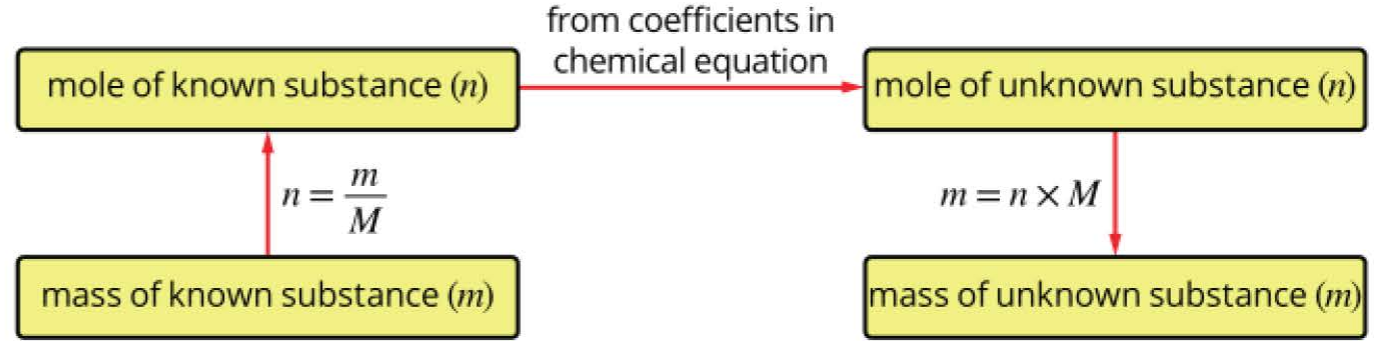
Three-step process for mass-mass calculations
To calculate the mass of a gas produced from a known mass of reactant, follow these three steps:
Important
The Three-Step Process for Mass-Mass Calculations
Step 1: Calculate the number of moles of the known substance (reactant) using:
Step 2: Use the mole ratio from the balanced chemical equation to find the number of moles of the unknown substance (product). The mole ratio comes from the coefficients (the numbers in front of each substance) in the balanced equation.
Step 3: Calculate the mass of the unknown substance using:
Remember: "Start with what you know → convert to moles → use mole ratio → convert to what you want"
Worked example: propane combustion
Let's look at a worked example to see how this process works in practice.
Calculate the number of moles of the known substance using:
Find the mole ratio:
Calculate the number of moles of the unknown substance using:
Calculate the mass of the unknown substance using:
Example
Key Points from the Propane Combustion Example:
- Always start by finding the moles of the substance you know about (the reactant)
- Use the coefficients from the balanced equation to find the mole ratio between substances
- The mole ratio for to is , meaning 3 moles of carbon dioxide are produced for every 1 mole of propane burned
- Remember to convert units if needed (the final answer was converted from grams to kilograms)
Mass-volume stoichiometry
Mass-volume stoichiometry follows the same general pattern as mass-mass stoichiometry, but instead of calculating a final mass, you calculate a final volume. The key difference is the last step, where you convert moles to volume instead of mass.
Note
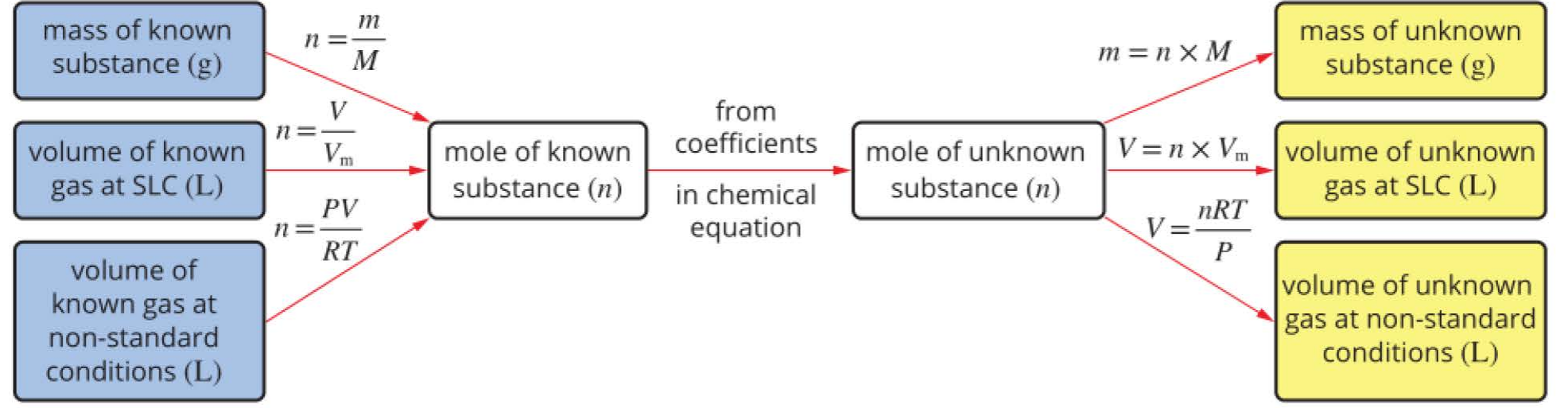
Understanding the Stoichiometry Flowchart
This flowchart shows the general approach for all stoichiometric calculations. Notice that:
- You can start with mass, volume at SLC, or volume at non-standard conditions
- The central pathway always involves finding moles and using mole ratios from the chemical equation
- You can end with mass or volume, depending on what the question asks for
The flowchart emphasizes that the mole is always the connecting link between different quantities in chemical calculations.
Calculations at standard laboratory conditions
Standard Laboratory Conditions (SLC) provide a reference point for gas measurements. At SLC, one mole of any gas occupies 24.8 litres. This value is called the molar volume, .
To calculate the volume of a gas at SLC, use:
where:
- = volume (L)
- = number of moles (mol)
- = molar volume = 24.8 L/mol at SLC
The process for mass-volume calculations at SLC is:
Step 1: Calculate the number of moles of the known substance using
Step 2: Use the mole ratio from the balanced equation to find the number of moles of the gas
Step 3: Calculate the volume using
Note
SLC Reminder
When you see "Standard Laboratory Conditions" in a problem, this is your cue to use the molar volume of 24.8 L/mol. This makes calculations much simpler than using the full ideal gas equation!
Calculate the number of moles of the known substance using:
Find the mole ratio:
Calculate the number of moles of the unknown substance using:
Calculate the volume of the unknown substance using:
Example
Key Points from the Glucose to Methane Example:
- The process is identical to mass-mass calculations until the final step
- Instead of using , we use
- At SLC, multiply the number of moles by 24.8 to get the volume in litres
- The mole ratio of came from the coefficients in the balanced equation
Calculations at non-standard conditions
When gases are not at standard laboratory conditions, you cannot use the simple formula . Instead, you must use the ideal gas equation:
Rearranging this to find volume gives:
where:
- = pressure (kPa)
- = volume (L)
- = number of moles (mol)
- = gas constant = 8.31 kPa L K mol
- = temperature (K)
Important
Critical Temperature Conversion
Temperature must always be in Kelvin when using the ideal gas equation. To convert from Celsius to Kelvin:
This is one of the most common mistakes students make - forgetting to convert temperature to Kelvin! Always check your temperature units before substituting into the ideal gas equation.
The process for mass-volume calculations at non-standard conditions is:
Step 1: Calculate the number of moles of the known substance using
Step 2: Use the mole ratio from the balanced equation to find the number of moles of the gas
Step 3: Convert temperature to Kelvin if needed
Step 4: Calculate the volume using
Calculate the number of moles of the known substance using:
Find the mole ratio:
Calculate the number of moles of the unknown substance using:
Express the pressure and temperature in required units.
Calculate the volume of the unknown substance using:
Example
Key Points from the Aluminium and Hydrogen Example:
- The process is the same as for SLC calculations until the final step
- You must convert temperature from Celsius to Kelvin ( K)
- Make sure pressure is in kilopascals (kPa)
- Use kPa L K mol when pressure is in kPa
- Substitute all values into to calculate the volume
Common pitfall: Forgetting to convert temperature to Kelvin will give you an incorrect answer!
Gas volume-volume calculations
When volume ratios equal mole ratios
For chemical reactions where both reactants and products are gases, there's a useful shortcut. When all gases are at the same temperature and pressure, it's often easier to measure volumes rather than masses.
Here's the key principle:
Important
Fundamental Principle for Gas Volume Calculations
Equal amounts, in moles, of different gases occupy equal volumes when measured at the same temperature and pressure.
This means that mole ratios equal volume ratios when temperature and pressure are constant.
This is a powerful simplification that allows you to work directly with volumes without converting to moles as an intermediate step!
For example, in the equation:
The mole ratio tells us that:
- 1 mole of propane reacts with 5 moles of oxygen
- This produces 3 moles of carbon dioxide and 4 moles of water vapour
Because volume ratios equal mole ratios at constant temperature and pressure, we can also say:
- 1 litre of propane reacts with 5 litres of oxygen
- This produces 3 litres of carbon dioxide and 4 litres of water vapour
Note
Why This Works
This relationship works because of Avogadro's Law: at the same temperature and pressure, equal volumes of gases contain equal numbers of molecules (or moles). This means the coefficients in the balanced equation directly tell you the volume ratios!
Process for volume-volume calculations
The process for gas volume-volume calculations is straightforward:
Step 1: Find the mole ratio from the coefficients in the balanced equation
Step 2: Recognise that volume ratios are the same as mole ratios (at constant temperature and pressure)
Step 3: Calculate the volume of the unknown gas using:
Find the mole ratio:
The temperature and pressure are constant, so volume ratios are the same as mole ratios.
Calculate the volume of the unknown substance using:
Example
Key Points from the Methane Combustion Example:
- The temperature and pressure are constant, so volume ratios equal mole ratios
- The mole ratio of from the equation becomes a volume ratio
- No need to convert to moles as an intermediate step - you can work directly with volumes
- This method only works when temperature and pressure remain constant
Volume-Volume Shortcut: Same gas conditions? Just use ratios!
Important
Conditions Required for Volume-Volume Calculations
For volume ratios to equal mole ratios, you need:
- All substances must be gases
- Temperature must be constant
- Pressure must be constant
If any of these conditions are not met, you must use the longer mass-volume calculation method instead.
Remember!
Summary
Key Points to Remember:
-
Three types of gas calculations: mass-mass, mass-volume, and volume-volume stoichiometry
-
Central concept: All calculations use moles and mole ratios from balanced equations as the connecting link
-
Key formulas:
- and for mass-mole conversions
- for volume at SLC (where L/mol)
- for volume at non-standard conditions
-
Volume-volume shortcut: When all substances are gases at the same temperature and pressure, volume ratios equal mole ratios - no need to convert to moles
-
Temperature conversion: Always convert Celsius to Kelvin by adding 273 when using the ideal gas equation
-
Three-step process: 1. Find moles of known, 2. Apply ratio, 3. Calculate unknown