Greenhouse Gases (VCE SSCE Chemistry): Revision Notes
📚Revision Notes
Greenhouse Gases
What are greenhouse gases?
The atmosphere surrounding Earth is composed of a mixture of gases that make life possible. One crucial function of the atmosphere is temperature regulation through the greenhouse effect.
Note
A greenhouse gas is defined as a gas that can absorb infrared radiation. The main greenhouse gases include:
- Carbon dioxide ()
- Methane ()
- Water vapour ()
- Chlorofluorocarbons (CFCs)
- Nitrous oxide ()
These gases play a vital role in maintaining Earth's temperature at levels that support life.
The natural greenhouse effect
The greenhouse effect is a natural process that maintains Earth's surface temperature at a level warm enough to support life. Without this effect, our planet would be too cold for most living organisms to survive.
How the natural greenhouse effect works
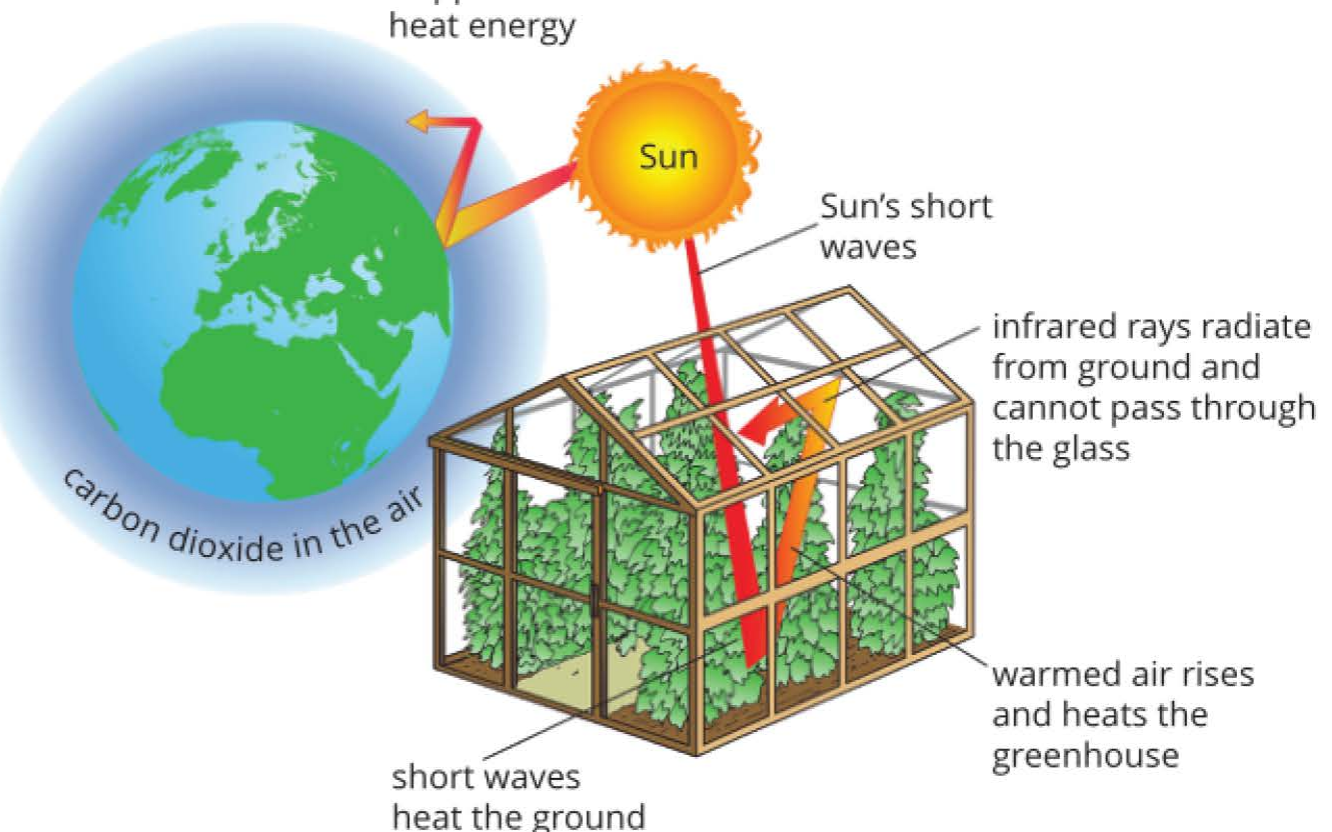
When solar energy reaches Earth's atmosphere, some radiation reflects back into space. However, most of the Sun's energy is absorbed by Earth's surface, causing it to warm up. This warmed surface then releases heat energy back towards space in the form of infrared radiation.
Greenhouse gases in the atmosphere intercept and trap some of this infrared radiation before it can escape into space. This trapped energy keeps Earth's surface temperature relatively stable and warm enough for human habitation.
Important
The greenhouse gases function similarly to the glass panels in a garden greenhouse. Just as glass allows sunlight to enter but prevents heat from escaping, greenhouse gases allow solar radiation to reach Earth's surface but trap the infrared radiation that radiates back from the warmed ground.
Exam tip: Be able to explain the difference between solar radiation (short wavelength) passing through the atmosphere and infrared radiation (long wavelength) being trapped by greenhouse gases.
The enhanced greenhouse effect
Human activities have significantly altered the natural balance of greenhouse gases in the atmosphere. The enhanced greenhouse effect refers to additional warming beyond natural levels, caused by human-generated increases in greenhouse gas concentrations.
Human sources of greenhouse gases
Several human activities contribute to elevated greenhouse gas levels:
- Burning fossil fuels for energy releases large amounts of water vapour and carbon dioxide
- Production and transport of coal, natural gas, and oil emit methane
- Agricultural practices release methane from livestock and rice paddies
- Organic waste decay in landfills produces methane
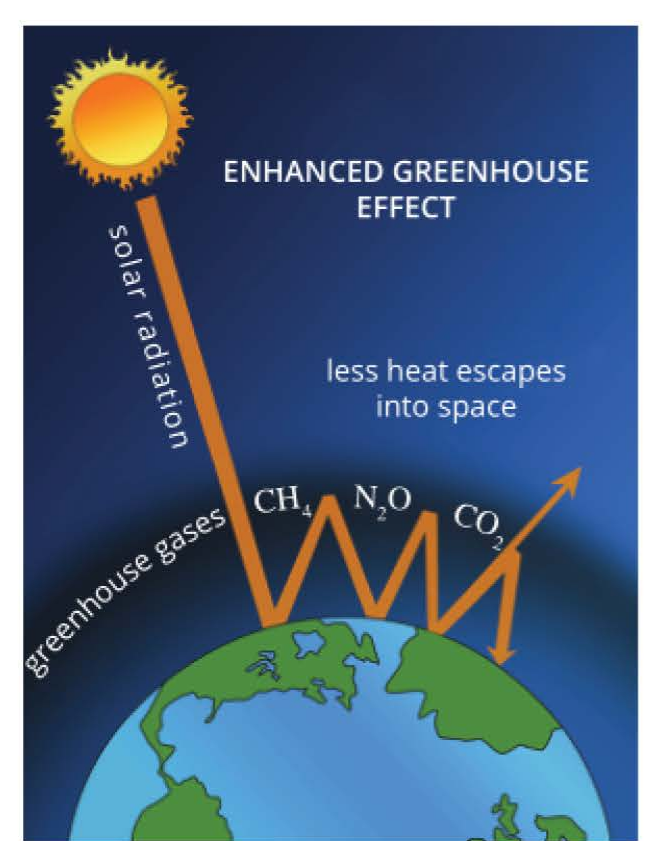
As greenhouse gas concentrations increase in the atmosphere, more infrared radiation becomes trapped, leading to greater warming of Earth's surface. This phenomenon is also known as climate change or global warming.
Comparing different greenhouse gases
Different greenhouse gases contribute to warming in different ways:
Note
Water vapour:
- Accounts for 60-80% of the natural greenhouse effect
- Short-lived in the atmosphere as it condenses into clouds
- Clouds have a complex effect: they trap heat below them but also reflect solar radiation from their upper surfaces
Note
Carbon dioxide:
- Accounts for 10-25% of the greenhouse effect
- Remains in the atmosphere for extended periods without condensing
- Causes sustained warming of the planet
- Increased temperatures lead to more water vapour entering the atmosphere, creating a feedback loop that amplifies warming
Note
Methane:
- Comprises only 0.00017% of the atmosphere
- More than 25 times more potent than carbon dioxide as a greenhouse gas
- Traps significant quantities of heat energy
- Human activities increasing methane emissions make a substantial contribution to global warming despite its low concentration
Important
Key point: Although methane exists in much smaller quantities than , its greater potency means that reducing methane emissions is an important climate change mitigation strategy.
Impacts of the enhanced greenhouse effect
The enhanced greenhouse effect is causing observable changes to Earth's climate and environment.
Important
Climate change is associated with:
- Temperature increases across the globe
- More frequent and intense heat waves
- Increased hazardous fire weather and drought conditions
- More extreme weather events leading to flooding
- Ocean warming contributing to sea level rise
- Impacts on coastal habitats and human dwellings
These changes have far-reaching consequences for ecosystems, human communities, agriculture, and infrastructure worldwide.
Understanding the importance of the greenhouse effect
Mars: A planet without an atmosphere
Mars provides a stark illustration of what happens without an effective greenhouse effect. Scientists and science fiction writers have long considered the possibility of establishing a human colony on Mars, but the planet presents enormous challenges.

Example
Mars: Demonstrating the Importance of the Greenhouse Effect
Mars has almost no atmosphere capable of trapping radiated energy from the Sun, resulting in very little greenhouse effect. This causes extreme temperature fluctuations:
- Summer days near Mars' equator may reach
- Night-time temperatures can plummet to
Such extreme temperature swings would make it impossible for living organisms, including humans and food crops, to survive without substantial artificial environmental controls. This demonstrates why Earth's natural greenhouse effect is essential for life.
Addressing the enhanced greenhouse effect
Carbon sequestration
The release of carbon dioxide from fossil fuel combustion has become a matter of significant international concern due to its contribution to climate change. Scientists are investigating various methods to reduce atmospheric levels.
Carbon sequestration is a process in which atmospheric carbon dioxide is captured and stored in locations called 'carbon sinks'. This approach aims to remove from the atmosphere or prevent it from being released in the first place.
Note
Natural carbon sinks include:
- Forests (trees absorb during photosynthesis)
- Wetlands and mangroves
- Oceans (which absorb dissolved )
Technological approaches are also being developed. For example, the proposed CarbonNet Project in Gippsland, Victoria, would capture carbon dioxide from various industries in the Latrobe Valley and transport it via underground pipeline to offshore storage sites beneath Bass Strait. This demonstrates how captured can be stored underground or under oceans rather than released into the atmosphere.
Summary
Key Points to Remember:
-
A greenhouse gas is any gas that can absorb infrared radiation, including , , , CFCs, and .
-
The natural greenhouse effect is essential for life on Earth, maintaining surface temperatures warm enough to support living organisms by trapping infrared radiation.
-
The enhanced greenhouse effect results from human activities that increase greenhouse gas concentrations, causing additional warming beyond natural levels and leading to climate change.
-
Different greenhouse gases have different effects: water vapour contributes most but is short-lived; persists longer; methane is 25 times more potent than despite its very low atmospheric concentration.
-
Climate change impacts include rising temperatures, extreme weather events, bushfires, flooding, and sea level rise, with significant consequences for ecosystems and human societies.
-
Carbon sequestration offers a potential solution by capturing atmospheric and storing it in natural carbon sinks (forests, wetlands) or engineered underground storage facilities.