Introducing Properties of Gases (VCE SSCE Chemistry): Revision Notes
📚Revision Notes
Introducing Properties of Gases
Understanding the properties of gases is essential for chemistry students, particularly when studying atmospheric composition, greenhouse effects, and gas behaviour. Gases behave very differently from liquids and solids, and these differences can be observed, measured, and predicted using mathematical relationships.
Note
The mathematical relationships governing gas behaviour allow us to make accurate predictions about how gases will respond to changes in temperature, pressure, and volume - essential skills for both laboratory work and real-world applications.
Comparing states of matter
Gases differ significantly from liquids and solids in several key ways. Understanding these differences helps explain why gases behave as they do.
| Property | Gases | Liquids | Solids |
|---|---|---|---|
| Density | Low | High | High |
| Volume and shape | Fill all available space because particles move independently | Fixed volume, adopt shape of container because particles are affected by attractive forces | Fixed volume and shape because particles are affected by attractive forces |
| Compressibility | Compress easily | Almost incompressible | Almost incompressible |
| Ability to mix | Mix together rapidly | Mix together slowly unless stirred | Do not mix unless finely divided |
These property differences are evident in everyday examples. Air in vehicle tyres compresses to absorb impacts. The aroma from fresh coffee rapidly fills a room because gas particles mix readily and occupy all available space. Weather balloons expand as they rise because of pressure changes in the atmosphere.
Note
Weather balloons provide a practical demonstration of gas behaviour: as they ascend to higher altitudes where atmospheric pressure is lower, the gas inside expands. This expansion continues until the balloon reaches its elastic limit or achieves equilibrium with the surrounding pressure.
Physical properties of gases
Physical properties are those properties that can be observed and measured without changing the nature of the substance itself. For gases, physical properties include how they compress, expand, mix, and respond to changes in temperature and pressure.
Kinetic molecular theory
Scientists developed the kinetic molecular theory to explain gas behaviour based on particle movement. According to this theory:
Note
Fundamental Principles of Kinetic Molecular Theory
- Gases are composed of small particles, either atoms or molecules
- The volume of the particles themselves is very small compared with the total volume the gas occupies. Most of a gas is empty space
- Gas particles move rapidly in random, straight-line motion
- Particles collide with each other and with the walls of their container
- The forces between particles are extremely weak
- Kinetic energy is the energy of motion. The average kinetic energy of gas particles increases as temperature increases
This theoretical model helps explain why gases behave the way they do and allows us to predict their behaviour under different conditions.
Measurable quantities of gases
Four key quantities are commonly measured to describe a gas: amount, volume, pressure, and temperature. Changing any one of these affects one or more of the others.
Amount
Like solids and liquids, the amount of gas present in a sample is measured in moles (mol). The amount of gas can be calculated from its mass using the formula:
where is the number of moles, is the mass in grams, and is the molar mass in .
Volume
Volume is the space that a gas occupies. Common units for measuring gas volume include millilitres (mL) and litres (L). The relationship between these units is:
To convert from millilitres to litres, divide by 1000. To convert from litres to millilitres, multiply by 1000.
Example
Worked Example: Converting Volume Units
A gas has a volume of 255 mL. To convert to litres:
Pressure
When gas particles collide with the walls of their container, they exert a force. Pressure is defined as the force applied per unit area:
The smaller the volume occupied by a gas, the more frequently particles collide with the container walls, increasing the pressure.
Several units are used to measure pressure:
| Unit name | Symbol | Conversions |
|---|---|---|
| Pascal | Pa | 1 Pa = 1 N m⁻² |
| Kilopascal | kPa | 1 kPa = 1 × 10³ Pa |
| Atmosphere | atm | 0.987 atm = 100 kPa |
The pascal (Pa) is the SI unit for pressure and equals one newton per square metre. The standard atmosphere (atm) is the average atmospheric pressure at sea level, where 1 atm = 101.3 kPa.
Important
For practical chemistry calculations, the relationship to remember is:
This conversion is frequently used when working with gas law problems.
Example
Worked Example: Converting Pressure Units
At the top of Mount Everest, atmospheric pressure is 0.333 atm. To convert to kilopascals:
Torricelli's barometer
Note
Historical Development of Pressure Measurement
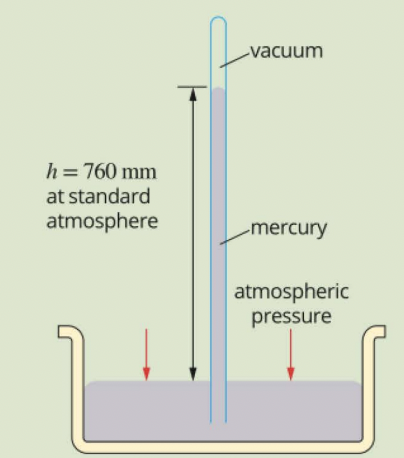
In the seventeenth century, Italian physicist Evangelista Torricelli invented the barometer to measure atmospheric pressure. His device consisted of a glass tube filled with mercury, inverted into a bowl of mercury. Atmospheric pressure on the mercury surface supported a column of mercury 760 mm high at sea level. At higher altitudes, with fewer air particles, the column was shorter.
Partial pressure
Air is a mixture of gases including nitrogen, oxygen, carbon dioxide, and argon. In a gas mixture, each gas exerts its own partial pressure. The total measured pressure equals the sum of all partial pressures.
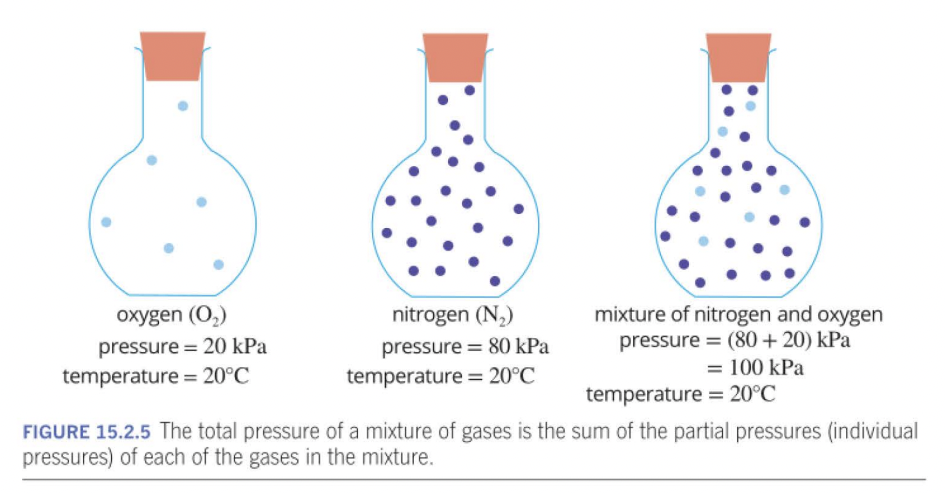
This principle, known as Dalton's Law of Partial Pressures, is important when working with gas mixtures in the laboratory.
Temperature
Temperature is a crucial quantity for describing gases. According to kinetic molecular theory, increasing temperature increases the average kinetic energy of gas particles.
Experiments show that gas volume increases as temperature increases when pressure remains constant. When experimental data plotting volume against temperature in degrees Celsius is extrapolated to zero volume, it crosses the temperature axis at -273°C.
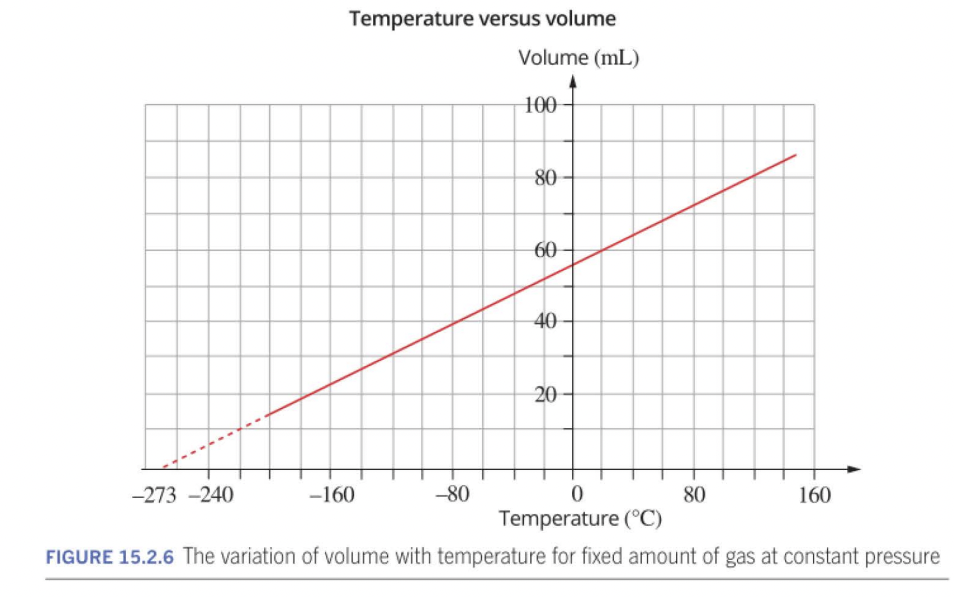
This observation led scientists to develop the kelvin scale (also called the absolute temperature scale). On this scale:
- Each degree increment equals one Celsius degree
- 0°C equals 273 K
- 0 K equals -273°C
The temperature 0 K is called absolute zero - the lowest temperature theoretically possible. At absolute zero, all molecules and atoms have minimum kinetic energy.
The relationship between Celsius and kelvin scales is:
Important
The kelvin scale has no degree symbol - we write 300 K, not 300°K.
Example
Worked Example: Converting Temperature Units
To convert 300°C to kelvin:
Relationship between volume and temperature
For a fixed amount of gas at constant pressure, volume is directly proportional to temperature (in kelvin):
This can also be written as:
where is a constant for the fixed amount of gas at constant pressure.
Molar volume of a gas
The molar volume of a gas () is the volume occupied by one mole of gas at a particular temperature and pressure. Importantly, molar volume does not depend on the identity of the gas.
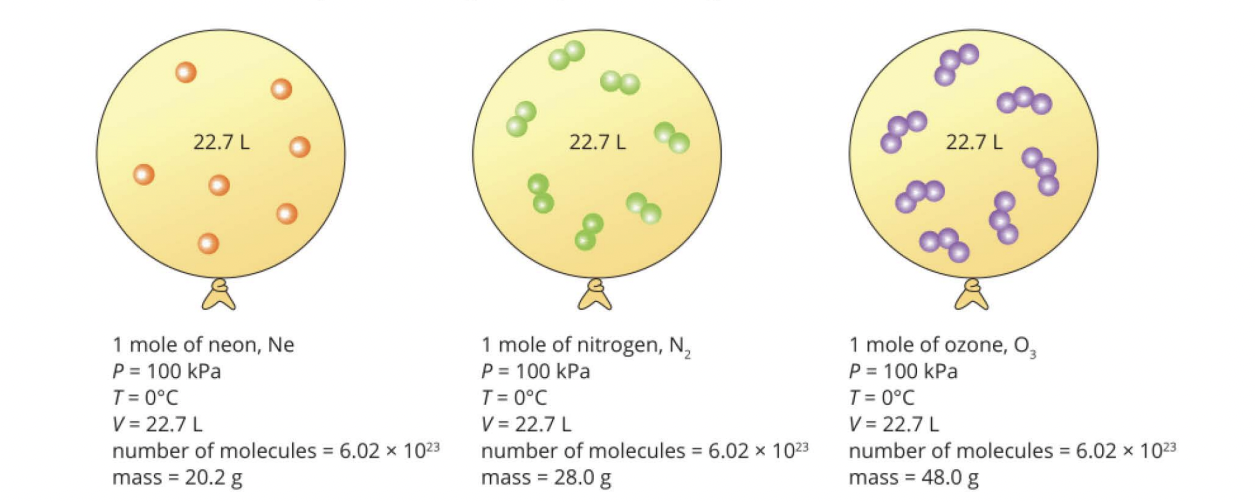
One mole of neon, one mole of nitrogen, and one mole of ozone all occupy the same volume at the same temperature and pressure, even though their masses differ. This is because all contain the same number of particles (Avogadro's number, ).
Standard laboratory conditions
Standard laboratory conditions (SLC) refer to a temperature of 25°C (298 K) and a pressure of 100 kPa. These represent typical laboratory conditions.
An ideal gas is a theoretical gas where particles do not interact except during elastic collisions. Real gases behave very similarly to ideal gases at SLC.
| Gas | Formula | Molar volume at SLC (L mol⁻¹) |
|---|---|---|
| Ideal gas | - | 24.79 |
| Helium | He | 24.83 |
Important
For practical calculations, we assume:
This value is used throughout gas calculations at standard laboratory conditions.
The amount of gas can be calculated from its volume at SLC using:
Example
Worked Example: Calculating Volume from Amount
Calculate the volume occupied by 0.24 mol of nitrogen gas at SLC.
Rearranging the equation:
Rounding to two significant figures:
The ideal gas equation
Mathematical relationships linking volume, pressure, temperature, and amount were developed by different scientists through experiments. Robert Boyle determined the pressure-volume relationship, while Jacques Charles identified the volume-temperature relationship.
Volume and pressure
For a fixed amount of gas at constant temperature, volume is inversely proportional to pressure:
This can also be written as:
where is a constant at constant temperature.
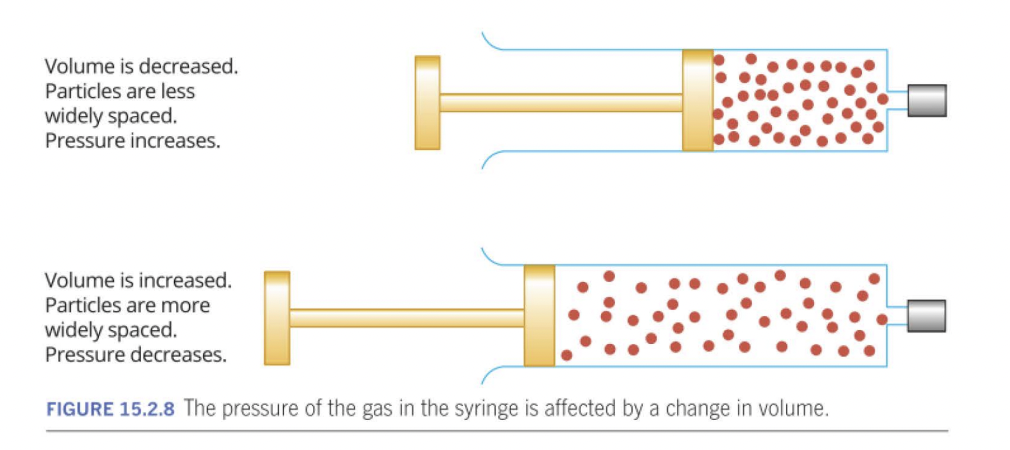
When volume decreases, particles are more closely spaced and collide more frequently with container walls, increasing pressure. When volume increases, particles are more widely spaced and pressure decreases.
Volume and amount of gas
At constant temperature and pressure, volume is directly proportional to the amount of gas:
This can also be written as:
where is a constant at constant temperature and pressure.
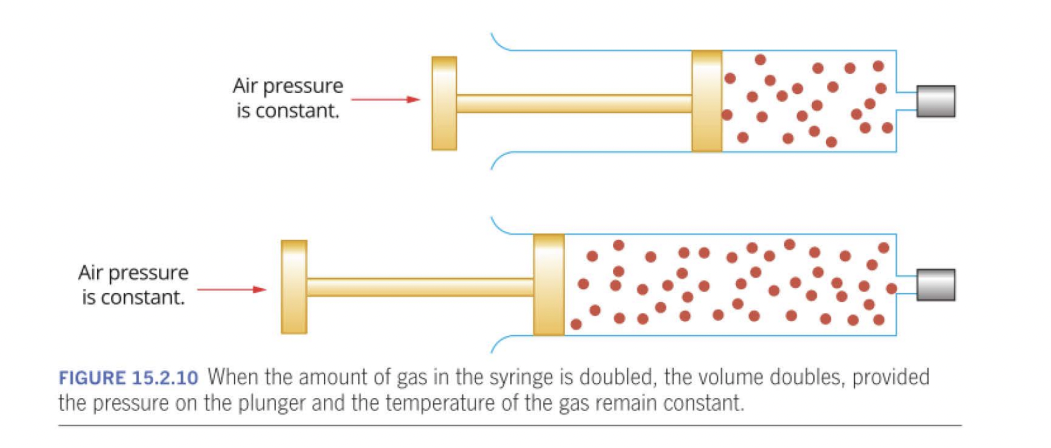
Doubling the amount of gas doubles the volume if pressure and temperature remain constant.
Combining the relationships
Three mathematical relationships describe gas behaviour:
- (for constant and )
- (for constant and )
- (for constant and )
Important
The Ideal Gas Equation
These relationships combine to show that volume is affected by amount, temperature, and pressure:
This relationship is expressed in the ideal gas equation:
where:
- is pressure in kilopascals (kPa)
- is volume in litres (L)
- is amount in moles (mol)
- is the ideal gas constant = 8.31 J K⁻¹ mol⁻¹
- is temperature in kelvin (K)
The ideal gas equation can be used to calculate any one variable when the other three are known.
Example
Worked Example: Using the Ideal Gas Equation
Calculate the volume occupied by 2.24 mol of oxygen gas at 200 kPa and 50°C.
First, convert temperature to kelvin:
Rearrange the ideal gas equation to make volume the subject:
Substitute the values:
Calculating molar mass or molar volume
Experimental data from laboratory investigations can be used to determine the molar volume or molar mass of a gas.
Molar volume determination
If you know the mass and volume of a gas sample, you can calculate its molar volume. First, calculate the amount in moles using:
Then calculate molar volume using:
Example
Worked Example: Determining Molar Volume
Calculate the molar volume of oxygen gas if 0.500 g occupies 360 mL.
Calculate moles of oxygen (molar mass = 32.0 g mol⁻¹):
Convert volume to litres and calculate molar volume:
Molar mass determination
Molar mass can be determined from experimental measurements of mass, volume, pressure, and temperature. Use the ideal gas equation to find the amount in moles:
Then calculate molar mass using:
Example
Worked Example: Determining Molar Mass
Calculate the molar mass of an unknown gas if 0.0766 g occupies 32.0 mL at 19°C and 100 kPa.
Convert units:
- kPa
- K
- mL L
Calculate amount in moles:
Calculate molar mass:
Summary
Key Points to Remember:
- Gases have low density, compress easily, mix rapidly, and fill all available space because particles move independently with weak forces between them
- The kinetic molecular theory explains gas behaviour based on particle motion and collisions
- Four measurable quantities describe a gas: amount (mol), volume (L or mL), pressure (kPa or atm), and temperature (K or °C)
- Key conversions: 1 L = 1000 mL; 100 kPa = 0.987 atm; T(K) = T(°C) + 273
- At standard laboratory conditions (25°C and 100 kPa), the molar volume is 24.8 L mol⁻¹
- The ideal gas equation relates all four measurable quantities, where J K⁻¹ mol⁻¹