Formation of Ionic Compounds (VCE SSCE Chemistry): Revision Notes
📚Revision Notes
Formation of Ionic Compounds
Introduction to ion formation
When metal atoms react with non-metal atoms, they form ionic compounds through a process of electron transfer. These reactions can be highly energetic - for example, the reaction between sodium and chlorine to produce sodium chloride releases substantial heat and energy. During these reactions, atoms reorganise their electrons to form stable ions that arrange themselves into three-dimensional lattice structures.
Understanding how individual ions form from atoms and how to determine the ratio of different ions in a compound is fundamental to working with ionic compounds in chemistry.
Forming ions
When metal and non-metal atoms react to form ionic compounds, two key processes occur:
- Metal atoms lose electrons to form positively charged ions called cations
- Non-metal atoms gain electrons to form negatively charged ions called anions
This electron transfer happens because metals and non-metals have different electronegativities. Metals typically have low electronegativity values, meaning they have a weak attraction for electrons. In contrast, non-metals are more electronegative, meaning they have a stronger attraction for electrons. During ionic compound formation, non-metal atoms take one or more electrons from the outermost shell of metal atoms.
Note
The difference in electronegativity between metals and non-metals is what drives the transfer of electrons during ionic compound formation. Non-metals, being more electronegative, essentially "pull" electrons away from metal atoms.
The octet rule and ionic compounds
Important
The Octet Rule
The octet rule states that atoms tend to react in ways that result in eight electrons in their outer shell. This configuration represents the most stable arrangement of valence electrons and is a strong motivating factor in reactions between metals and non-metals.
Noble gases (group 18 elements) already possess this stable configuration, which is why they rarely react. Another way to understand the octet rule is that atoms tend to gain or lose electrons until they achieve an electron configuration identical to that of the nearest noble gas on the periodic table.
For example, when sodium reacts with chlorine:
- Each sodium atom loses one electron
- Each chlorine atom gains one electron
- The sodium ion achieves the electron configuration (same as neon)
- The chloride ion achieves the electron configuration (same as argon)
When atoms lose electrons, they become more positively charged because the number of protons now exceeds the number of electrons. This positive charge is indicated with a superscript sign. If two electrons are lost, the charge is written as . Similarly, when atoms gain electrons, they become negatively charged, indicated with a superscript sign. If three electrons are gained, the charge is written as .
Electron transfer diagrams
An electron transfer diagram is a visual representation showing how electrons move from metal atoms to non-metal atoms during ionic compound formation. These diagrams use Bohr models to show the electron shells before and after the transfer.
Sodium and chlorine reaction
Example
Example: Sodium and Chlorine Reaction
When sodium reacts with chlorine, the electron transfer can be represented as follows:
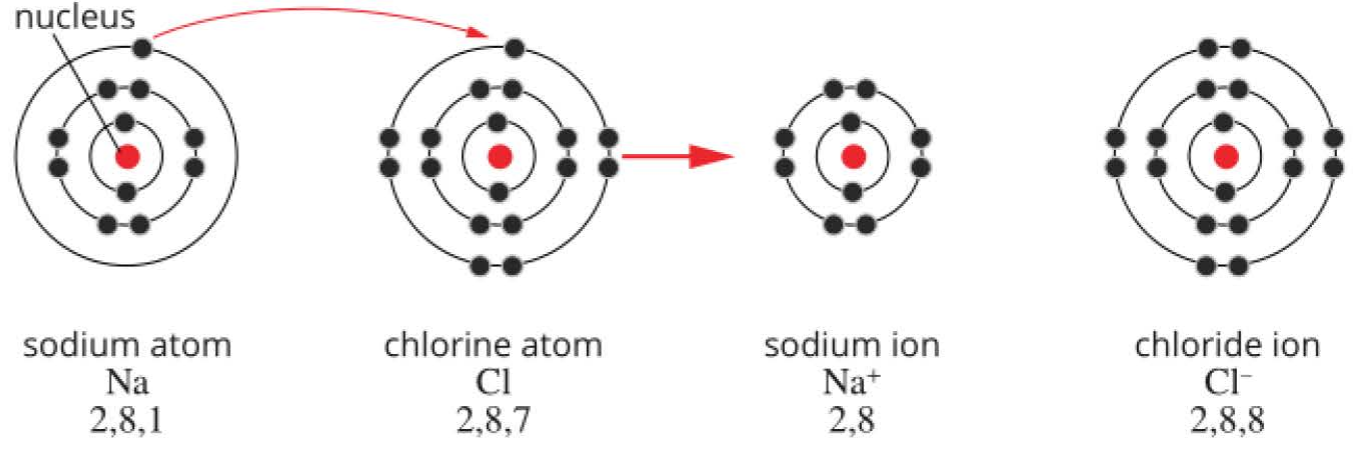
Group 17 non-metals, such as chlorine, have seven electrons in their valence shell. They readily gain one electron to fill the valence shell according to the octet rule, forming anions with a charge. In this reaction, the chlorine atom gains an electron from the sodium atom to form a chloride ion (). The sodium atom becomes a sodium ion () with the same electron configuration as the noble gas neon.
Lithium and oxygen reaction
Example
Example: Lithium and Oxygen Reaction
The reaction between lithium and oxygen demonstrates a different ratio of atoms:
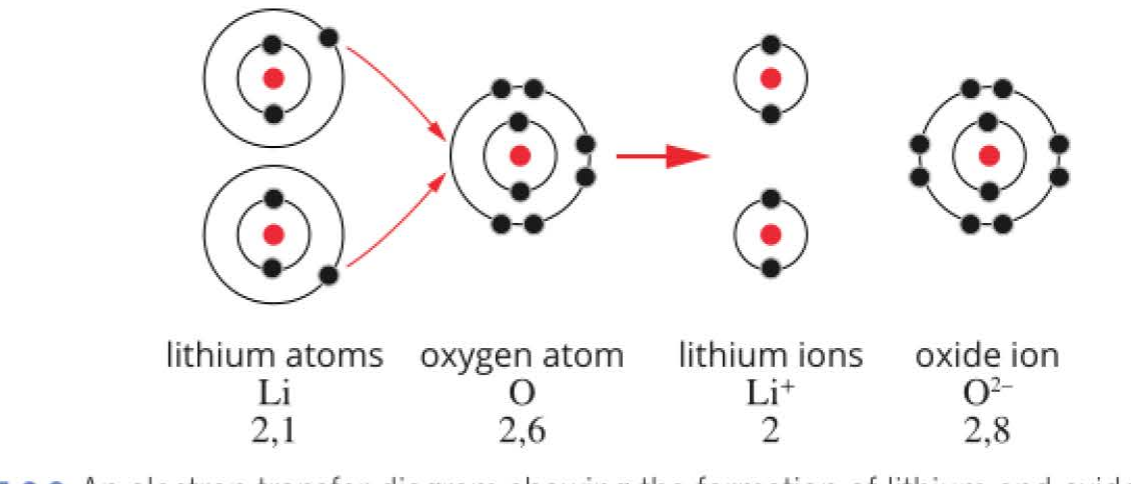
Oxygen is in group 16 and has six electrons in its valence shell. To achieve a stable configuration with eight electrons, an oxygen atom needs to gain two electrons, forming an ion with a charge. To provide these two electrons, one oxygen atom must react with two lithium atoms, taking one electron from each.
Note
Although atoms are generally most stable with eight electrons in their valence shell, lithium is an exception. Since lithium has only one electron in its second shell, it loses this electron and the first shell becomes the valence shell. The first shell can only hold two electrons, so a lithium ion is stable with an electronic configuration of - the same as helium.
Magnesium and oxygen reaction
Example
Example: Magnesium and Oxygen Reaction
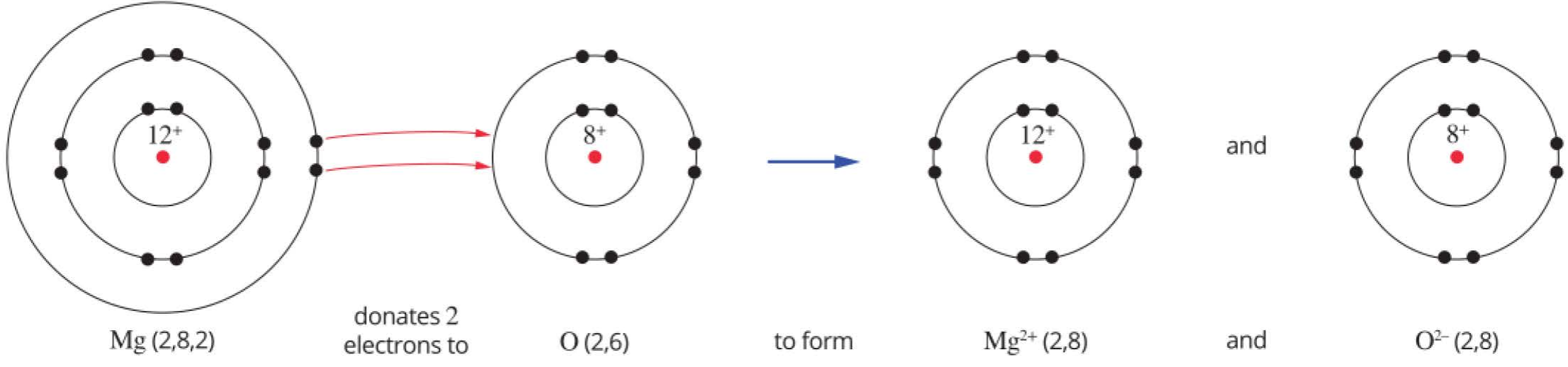
Metals in group 2, such as magnesium, have two electrons in their valence shell. They readily form ions with a charge by losing both electrons:
Magnesium and chlorine reaction
Example
Example: Magnesium and Chlorine Reaction
When magnesium reacts with chlorine, the different charges on the resulting ions mean that two chlorine atoms are needed for each magnesium atom:
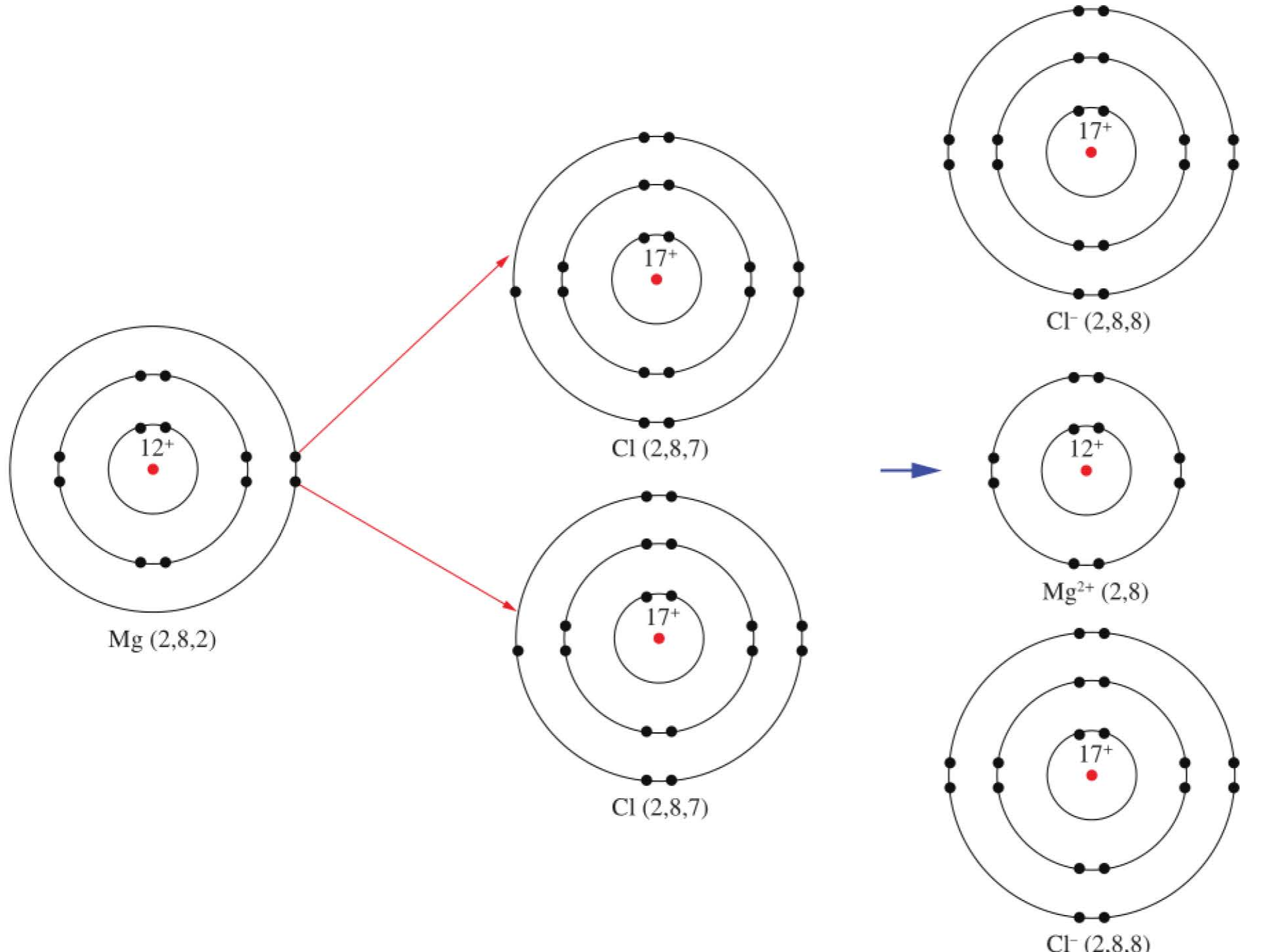
Note that while this diagram shows a single ion between two ions, this is not how the ions are actually arranged in solid magnesium chloride. Like all ionic solids, magnesium chloride consists of a lattice of alternating positively and negatively charged ions, with a ratio of to ions of .
Writing equations for ionic reactions
To ensure you understand ion formation, it can be helpful to write equations showing the electronic configurations of both reactants and products. Here's an example for the reaction between lithium and nitrogen:
Example
Worked Example: Lithium and Nitrogen Reaction
The equation shows:
The ratio of ensures that the total number of electrons lost by metal atoms equals the total number gained by non-metal atoms. This balance is essential for charge neutrality.
Chemical formulas of ionic compounds
Ionic compounds contain oppositely charged ions arranged in three-dimensional lattices. Different ions can have different charges - for example, aluminium forms ions with a charge, whilst oxygen forms ions with a charge. Understanding how to use ion charges to write the overall formula for an ionic compound is an essential skill.
Writing formulas of simple ionic compounds
Important
Electrical Neutrality Principle
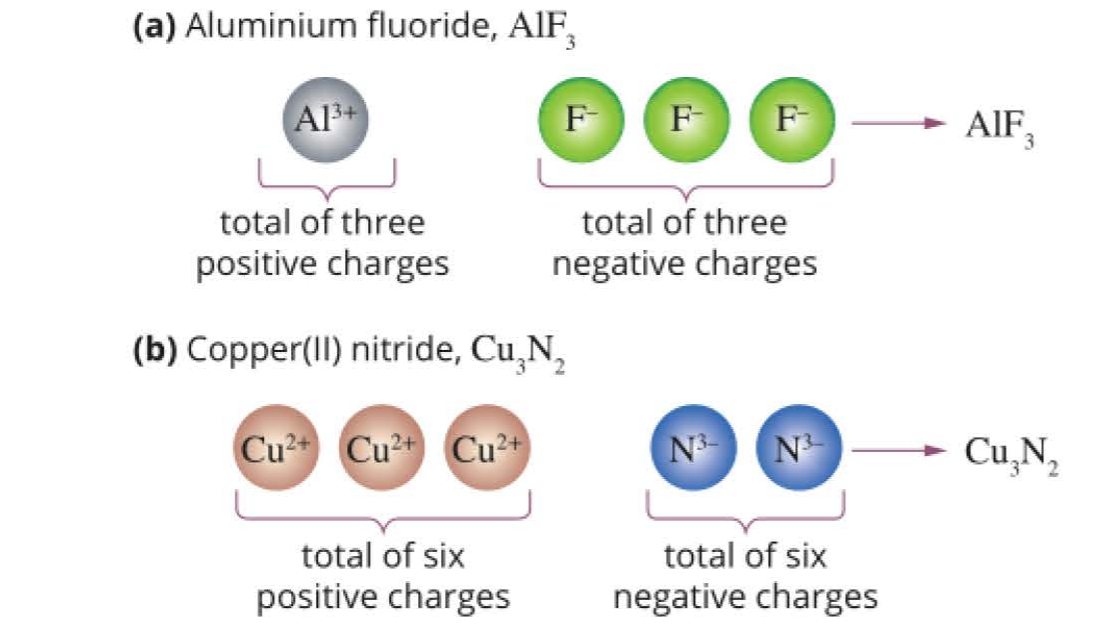
Because ionic compounds are electrically neutral, the total number of positive charges on the metal ions must equal the total number of negative charges on the non-metal ions. This is the fundamental principle for determining ionic compound formulas.
For sodium chloride:
- A sodium ion () has a charge
- A chloride ion () has a charge
- Therefore, the ratio is and the formula is
For magnesium chloride:
- A magnesium ion () has a charge
- A chloride ion () has a charge
- Therefore, two chloride ions are needed to balance the charge
- The ratio is and the formula is
The following diagram illustrates how formulas are determined for other ionic compounds:
Common ions reference
Here are some frequently encountered cations:
| Charge | 1+ | 2+ | 3+ | 4+ |
|---|---|---|---|---|
| Ions | caesium () | barium () | aluminium () | lead(IV) () |
| copper(I) () | cadmium(II) () | chromium(III) () | tin(IV) () | |
| lithium () | calcium () | gold(III) () | ||
| potassium () | cobalt(II) () | iron(III) () | ||
| silver () | copper(II) () | |||
| sodium () | iron(II) () | |||
| lead(II) () | ||||
| magnesium () | ||||
| manganese(II) () | ||||
| mercury(II) () | ||||
| nickel () | ||||
| strontium () | ||||
| tin(II) () | ||||
| zinc () |
Common anions include:
| Charge | 1- | 2- | 3- |
|---|---|---|---|
| Ions | bromide () | oxide () | nitride () |
| chloride () | sulfide () | ||
| fluoride () | |||
| iodide () |
Rules for writing chemical formulas
Important
Four Key Rules for Writing Chemical Formulas
Follow these rules when writing chemical formulas for ionic compounds:
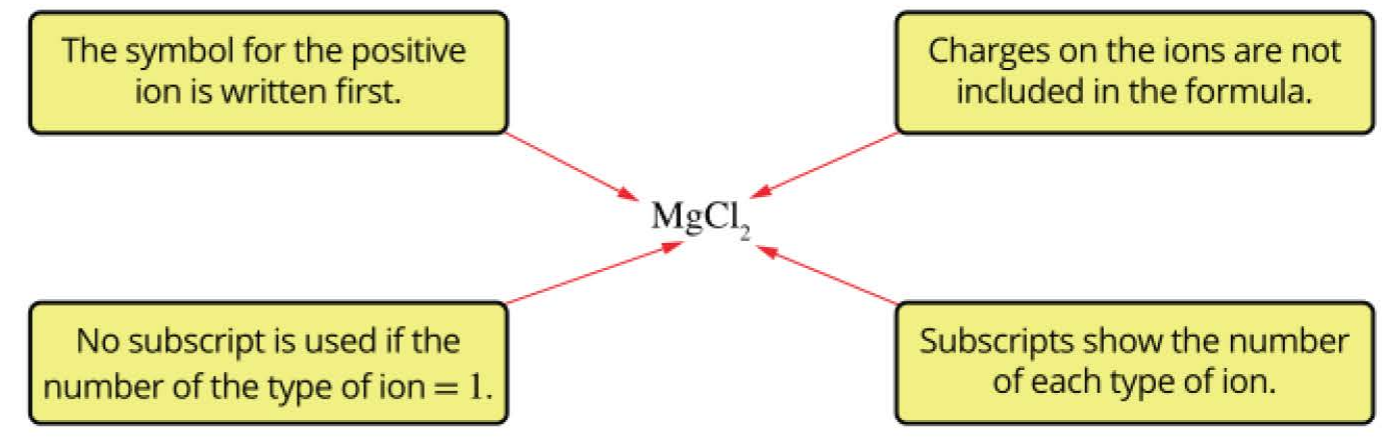
- Write the symbol for the positively charged ion first
- Use subscripts after each ion symbol to indicate the number of that ion in the formula
- If there is only one ion of a particular type, omit the subscript ''
- Do not include the charges on the ions in the balanced formula
Worked example: determining chemical formulas
Example
Worked Example: Determining the Formula of Zinc Nitride
Here is the step-by-step process for determining the formula of zinc nitride:
The working shows:
- Zinc ion: , nitride ion:
- Lowest common multiple of and is
- Three ions provide positive charges
- Two ions provide negative charges
- Formula:
Writing formulas of more complex ionic compounds
Polyatomic ions
Up to this point, we have dealt with simple ions containing only one atom of an element. However, many ions contain two or more atoms, which may be of different elements. These are called polyatomic ions.
Characteristics of polyatomic ions:
- If different elements are present, they are combined in a fixed ratio
- The group of atoms behaves as a single unit with a specific charge
- Subscripts within the ion formula indicate the number of each type of atom
Note
A carbonate ion () contains one carbon atom and three oxygen atoms combined together to form an ion with a charge. The entire group acts as a single charged unit in chemical reactions.
Common polyatomic ions
| Charge | 1+ | 1- | 2- | 3- |
|---|---|---|---|---|
| Ions | ammonium () | cyanide () | carbonate () | phosphate () |
| hydrogen phosphate () | chromate () | |||
| ethanoate () | dichromate () | |||
| hydrogen carbonate () | hydrogen phosphate () | |||
| hydrogen sulfide () | oxalate () | |||
| hydrogen sulfite () | sulfite () | |||
| hydrogen sulfate () | sulfate () | |||
| hydroxide () | ||||
| nitrite () | ||||
| nitrate () | ||||
| permanganate () |
Important
Using Brackets with Polyatomic Ions
When more than one polyatomic ion is required in a formula to balance the charge, it is placed in brackets with the required number written as a subscript after the brackets.
Examples:
- Magnesium nitrate:
- Aluminium hydroxide:
- Ammonium sulfate:
Note that brackets are not required for sodium nitrate (), where there is only one nitrate ion for each sodium ion.
A formula expressed in terms of the simplest whole-number ratio of particles is called an empirical formula.
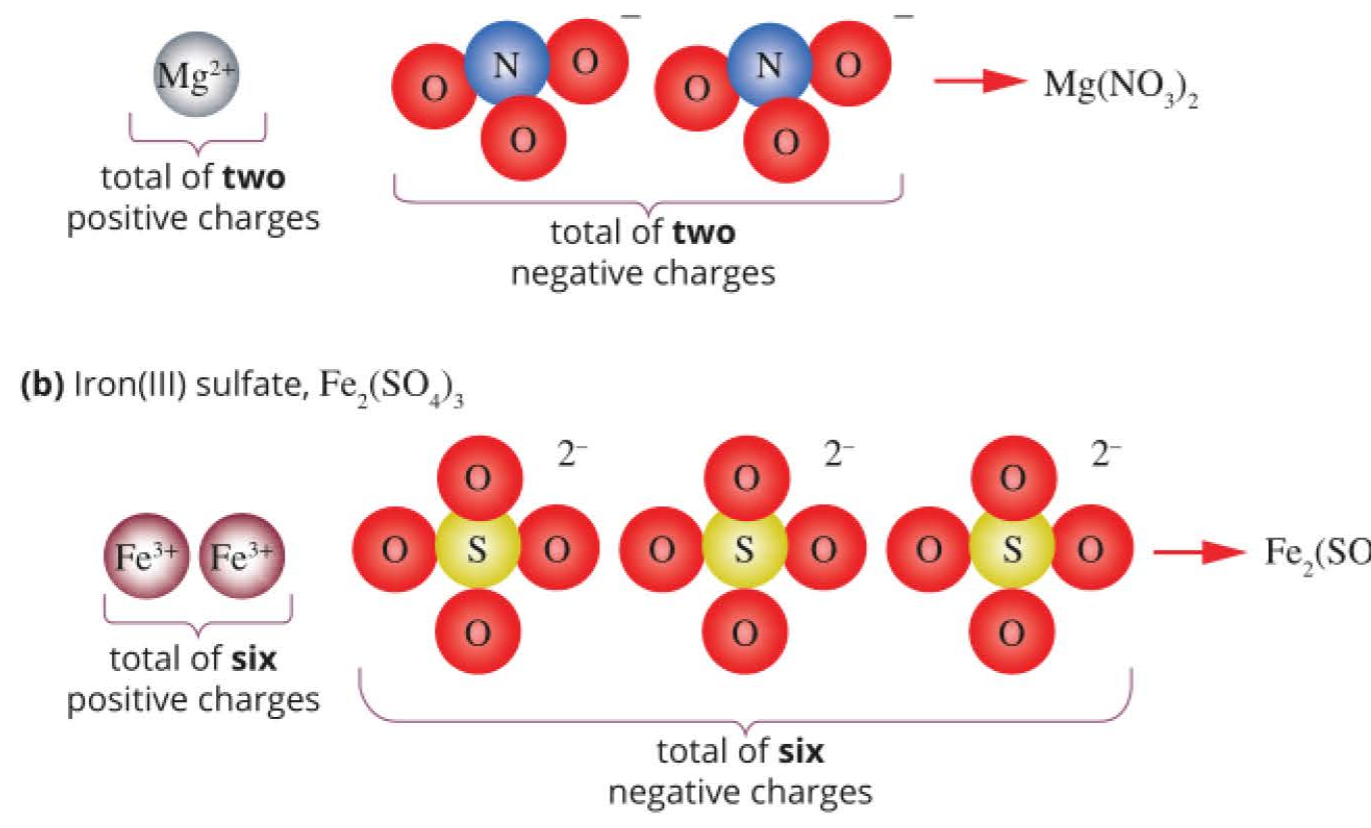
The diagram shows how charge balance works with polyatomic ions in magnesium nitrate and iron(III) sulfate.
Formulas involving elements with multiple electrovalencies
The electrovalency of an ion refers to the charge on that ion. Some transition metals, including copper, lead, iron and tin, can form ions with several different electrovalencies. For example, copper can form ions (charge of ) and ions (charge of ).
Other metals with variable electrovalency include:
- Lead: and
- Iron: and
- Tin: and
Note
For compounds of these metals, you must specify the charge on the ion when naming the compound. This is done by placing a Roman numeral (in brackets) immediately after the metal name.
Examples:
- Iron(II) chloride contains ions: formula is
- Iron(III) chloride contains ions: formula is
- Copper(I) sulfide contains ions: formula is
Naming ionic compounds
Standard naming rules for ionic compounds are:
Note
Naming Conventions for Ionic Compounds
For cations:
- The name of a positively charged metal ion is the same as the name of the metal
- Example: sodium atom → sodium ion; aluminium atom → aluminium ion
For simple anions:
- The name ends in '-ide'
- Example: chlorine atom → chloride ion; oxygen atom → oxide ion
For polyatomic anions containing oxygen:
- Names usually end in '-ite' or '-ate'
- Example: is nitrite; is nitrate
- Generally, the ion with fewer oxygen atoms ends in '-ite', whilst the one with more oxygen atoms ends in '-ate'
Summary
Key Points to Remember:
- Metal atoms lose electrons to form positively charged cations; non-metal atoms gain electrons to form negatively charged anions.
- The octet rule drives ionic compound formation: atoms gain or lose electrons to achieve eight electrons in their outer shell (or two for the first shell).
- Electron transfer diagrams use Bohr models to show how electrons move from metals to non-metals during ionic bonding.
- When writing formulas, the total positive charges must equal total negative charges to ensure electrical neutrality.
- Polyatomic ions are groups of atoms with an overall charge that behave as a single unit; use brackets when more than one polyatomic ion is needed in a formula.
- For transition metals with variable charges, use Roman numerals in the compound name to indicate the electrovalency, such as iron(II) or iron(III).