Precipitation Reactions (VCE SSCE Chemistry): Revision Notes
📚Revision Notes
Precipitation Reactions
Introduction
A precipitation reaction happens when dissolved ions in a solution join together to create a compound that cannot dissolve in water. The solid compound that forms and settles out of solution is known as a precipitate.
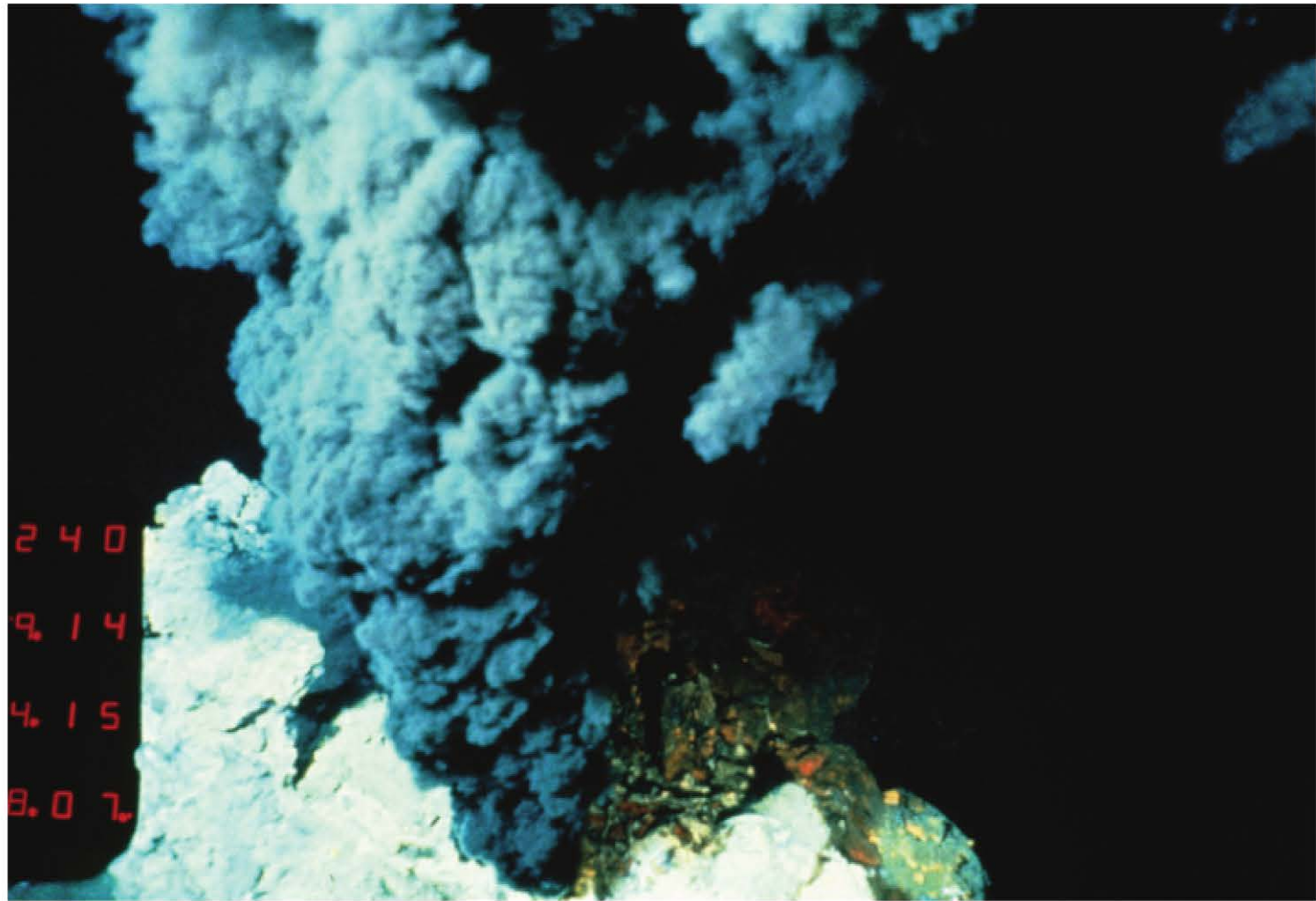
Note
Precipitation reactions occur naturally in undersea hydrothermal vents. These vents release superheated water containing sulfide ions (), which combine with metal ions to form mineral sulfide precipitates. These precipitates build up to create chimney-like structures on the ocean floor. The areas around these chimneys support rich biological communities that thrive on the dissolved chemicals in the vent fluids.
Precipitation reactions have important practical applications, including:
- Removing minerals from drinking water
- Eliminating heavy metals from wastewater
- Purifying water in reservoir treatment plants
Ions in aqueous solution
When ionic compounds dissolve in water, they form aqueous solutions where the ions separate from each other and move freely. This process can be represented by equations showing the dissolving process.
For example, when sodium chloride dissolves:
When copper(II) sulfate dissolves:
Note
The notation (aq) indicates that the ions are dissolved in water (aqueous means 'in water'). When these compounds dissolve, their ions break apart and move independently through the solution.
If you mixed solutions of sodium chloride and copper(II) sulfate together, the mixture would contain separate , , , and ions all moving about independently without combining with each other.
Reactions between ionic compounds in solution
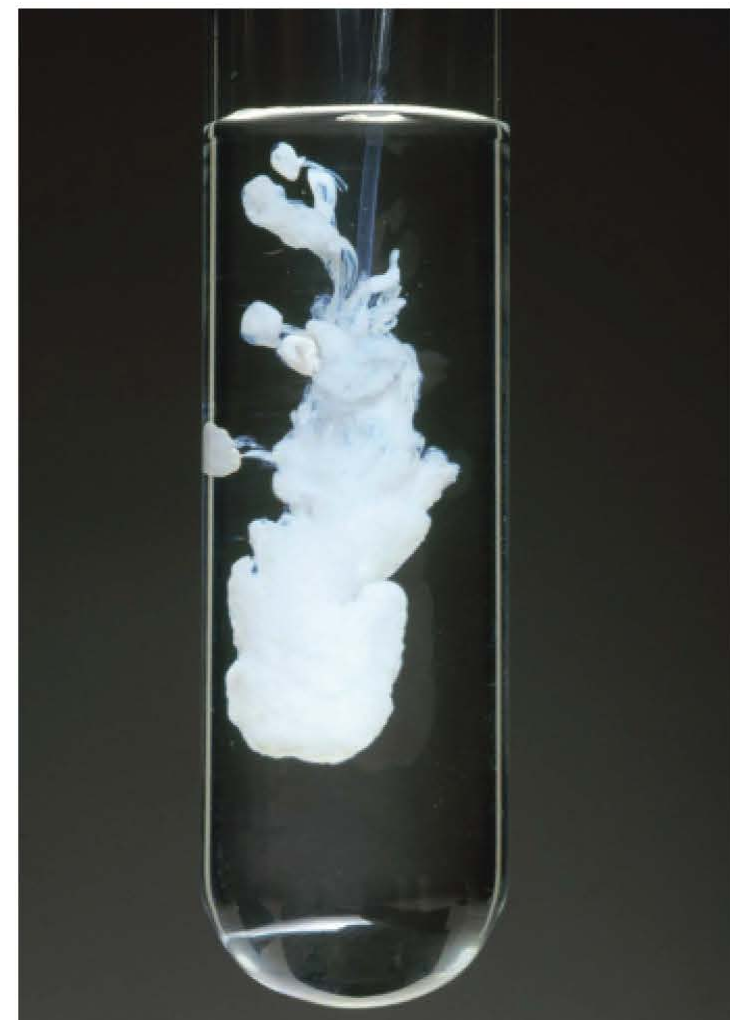
In some cases, mixing two ionic solutions produces a visible reaction. For example, when a colourless solution of silver nitrate () is mixed with a colourless solution of sodium chloride (), the solution turns cloudy because a fine white solid has formed.
To understand what happens in this reaction, you need to identify the ions present:
In silver nitrate solution:
- Silver ions ()
- Nitrate ions ()
In sodium chloride solution:
- Sodium ions ()
- Chloride ions ()
When the solutions are mixed, all four types of ions are present in the mixture. As the ions move around in solution, they collide with each other. When positive and negative ions collide, they may join together to form a new, insoluble precipitate.
Two new combinations of positive and negative ions are possible:
- Sodium and nitrate ions (forming sodium nitrate)
- Silver and chloride ions (forming silver chloride)
To work out which compound forms the precipitate, you need to check the solubility tables.
Solubility rules
Solubility tables help you predict whether mixing two ionic solutions will produce a precipitate. The tables classify compounds as soluble, insoluble, or slightly soluble based on how much dissolves in water at 25°C.
Soluble compounds in water
| Compound type | Soluble (>0.1 mol/L at 25°C) | Insoluble exceptions (<0.01 mol/L at 25°C) | Slightly soluble exceptions (0.01-0.1 mol/L at 25°C) |
|---|---|---|---|
| Chlorides (), bromides (), iodides () | Most chlorides, bromides, and iodides | , , , | , |
| Nitrates () | All nitrates | No exceptions | No exceptions |
| Ammonium salts () | All ammonium salts | No exceptions | No exceptions |
| Sodium () and potassium () salts | All sodium and potassium salts | No exceptions | No exceptions |
| Ethanoates () | All ethanoates | No exceptions | No exceptions |
| Sulfates () | Most sulfates | , , | , |
Insoluble compounds in water
| Compound type | Insoluble (<0.01 mol/L at 25°C) | Soluble exceptions | Slightly soluble exceptions |
|---|---|---|---|
| Hydroxides () | Most hydroxides | , , | , |
| Carbonates () | Most carbonates | , , | No exceptions |
| Phosphates () | Most phosphates | , , | No exceptions |
| Sulfides () | Most sulfides | , , | No exceptions |
Important
Key solubility patterns to remember:
- All compounds containing nitrate ions are soluble in water
- All compounds containing sodium ions are soluble in water
- All compounds containing potassium ions are soluble in water
- Most compounds containing chloride ions are soluble, but silver chloride is an important exception
Therefore, in the reaction between silver nitrate and sodium chloride, the precipitate must be silver chloride ().
How precipitation occurs
When the hydrated and ions come into contact in solution, the strong attraction between them causes an ionic lattice of to form. The sodium and nitrate ions remain dissolved in solution.
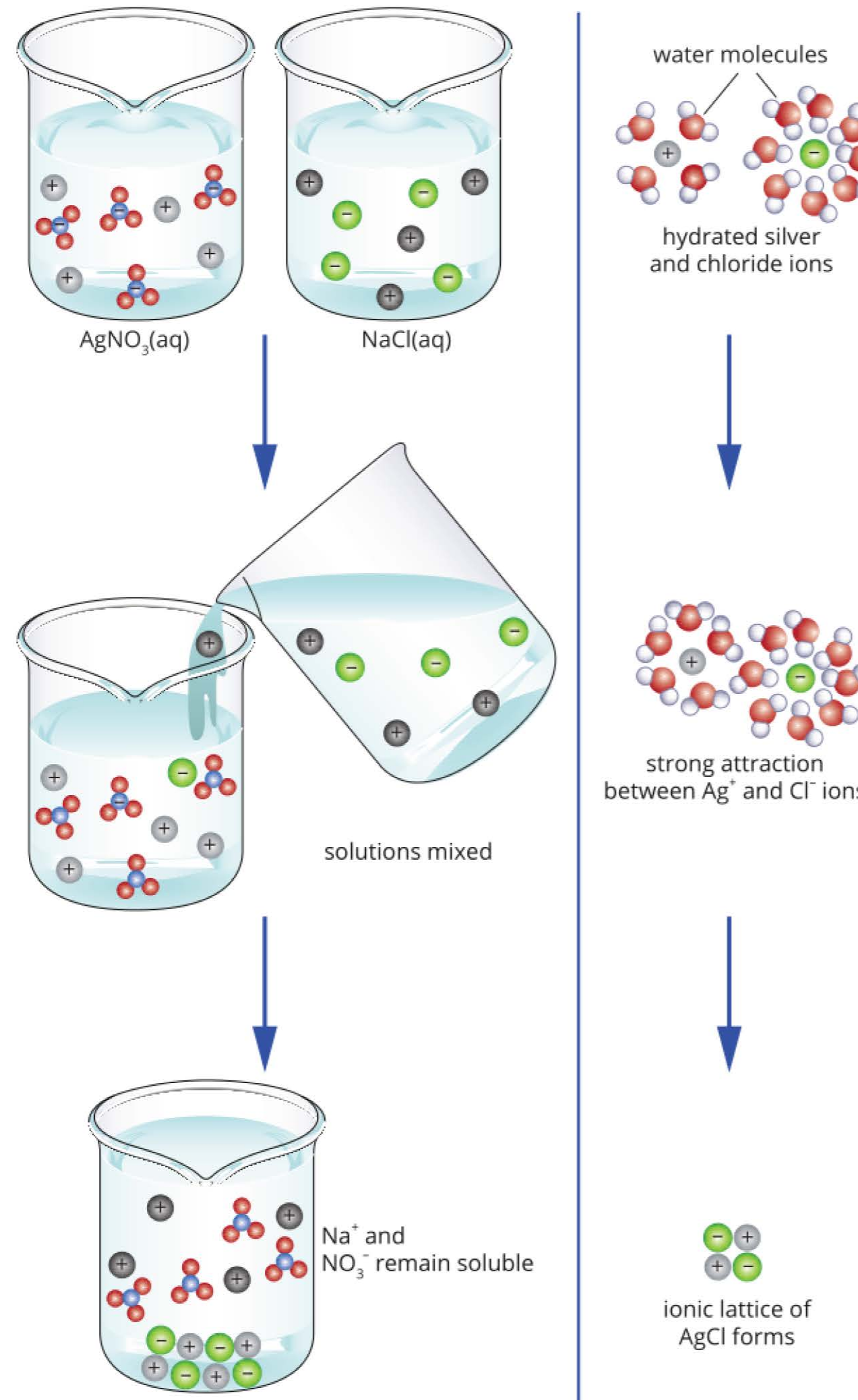
This diagram shows the complete process:
- Initially, the two solutions contain their respective ions surrounded by water molecules
- When mixed, the ions move freely in the combined solution
- The strong attraction between and ions causes them to form an ionic lattice
- The precipitate settles to the bottom
- The and ions remain soluble and don't participate in the reaction
Note
Limescale accumulation
Have you ever noticed the flaky white build-up on your kettle's heating element? When water is boiled repeatedly, dissolved ions can precipitate out, leaving a white coating called limescale. This consists mainly of calcium carbonate () that precipitates as a crystalline solid when water is heated.
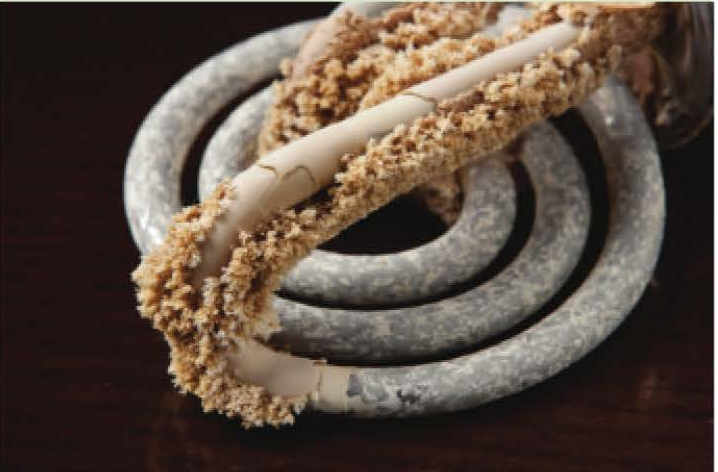
The amount of limescale depends on water hardness in your area. Hard water contains high levels of dissolved ions and produces more limescale. Even a thin coating of 1.5 mm over a heating element can reduce its efficiency by up to 12%. Many modern houses use ion filters or water conditioners to remove dissolved ions and reduce limescale accumulation.
Predicting which compound precipitates
There's a simple visual method to work out which compound will form the precipitate:
- Write down the positive ion from the first compound, followed by its negative ion
- Write down the positive ion from the second compound, followed by its negative ion
- Draw two lines: one connecting the positive ion of the first compound to the negative ion of the second compound, and another connecting the negative ion of the first compound to the positive ion of the second compound
- Use solubility tables to determine which of the two new combinations will be insoluble
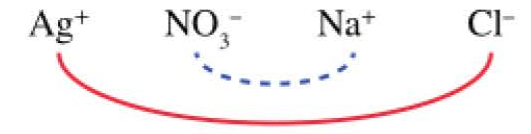
For example, with silver nitrate and sodium chloride:
- , , ,
- New combinations: and
- From solubility tables: AgCl is insoluble (precipitate), is soluble
Example
Worked Example: Predicting precipitation products
Question: What precipitate, if any, will form when solutions of potassium hydroxide and lead(II) nitrate are mixed?
Solution:
| Step | Working |
|---|---|
| Identify the ions in each solution | , , , |
| Identify possible new combinations | and and |
| Check solubility tables | Compounds containing potassium ions are usually soluble, so potassium nitrate will not precipitate. Compounds containing hydroxide ions are usually insoluble, so lead(II) hydroxide will form a precipitate. |
Writing full equations for precipitation reactions
Once you've identified the precipitate, you can write a chemical equation to represent the complete reaction.
The reaction between silver nitrate and sodium chloride can be written in words as:
silver nitrate solution + sodium chloride solution → silver chloride solid + sodium nitrate solution
Using formulas and state symbols, this becomes a full equation:
Important
State symbols are essential:
- (aq) = aqueous (dissolved in water)
- (s) = solid
- (l) = liquid
- (g) = gas
Always include state symbols in your equations to show the physical state of each species.
Example
Worked Example: Writing a full equation
Question: Write a balanced equation for the reaction between iron(III) nitrate and sodium sulfide, in which the precipitate is iron(III) sulfide. Identify the spectator ions.
Solution:
| Step | Working |
|---|---|
| Write an incomplete, unbalanced equation showing reactants and precipitate with state symbols | |
| Add the formula of the other compound formed | |
| Balance the equation | |
| Identify spectator ions | and are spectator ions |
Spectator ions
Although sodium nitrate () is written as a product in the equation, the sodium and nitrate ions are not actually combined with each other. They move freely through the solution and are present as separate ions at both the start and end of the reaction.
Important
What are spectator ions?
Spectator ions do not undergo chemical change in the reaction. In a precipitation reaction, they remain as aqueous ions throughout. Think of them as "watching from the sidelines" – they're present but don't participate in forming the precipitate.
Writing ionic equations
An ionic equation shows only the species that directly participate in forming the precipitate. Spectator ions are not included because they don't change during the reaction.
You can think of an ionic equation as a simplified version of the full equation with the spectator ions removed. For the reaction between silver nitrate and sodium chloride:
Full equation:
Ionic equation:
The ionic equation focuses on the essential chemistry – the combination of silver and chloride ions to form the precipitate.
Example
Worked Example: Writing an ionic equation
Question: Write an ionic equation for the precipitation reaction between solutions of aluminium nitrate and sodium sulfide, in which the precipitate is aluminium sulfide.
Solution:
| Step | Working |
|---|---|
| Write the formula of the precipitate on the right with an arrow to its left | |
| Add the formulas of the two types of ions that form the precipitate, using the ratio shown in the precipitate formula | |
| Add state symbols and check the equation is balanced |
Important
Exam tip: When writing ionic equations, make sure the charges balance on both sides. In this example, the left side has , which equals the neutral charge on the right side.
The chemistry of colour
Precipitation reactions have played an important role in the history of art. Many traditional paint pigments were created using precipitation reactions, with the coloured precipitate collected and used as the pigment.
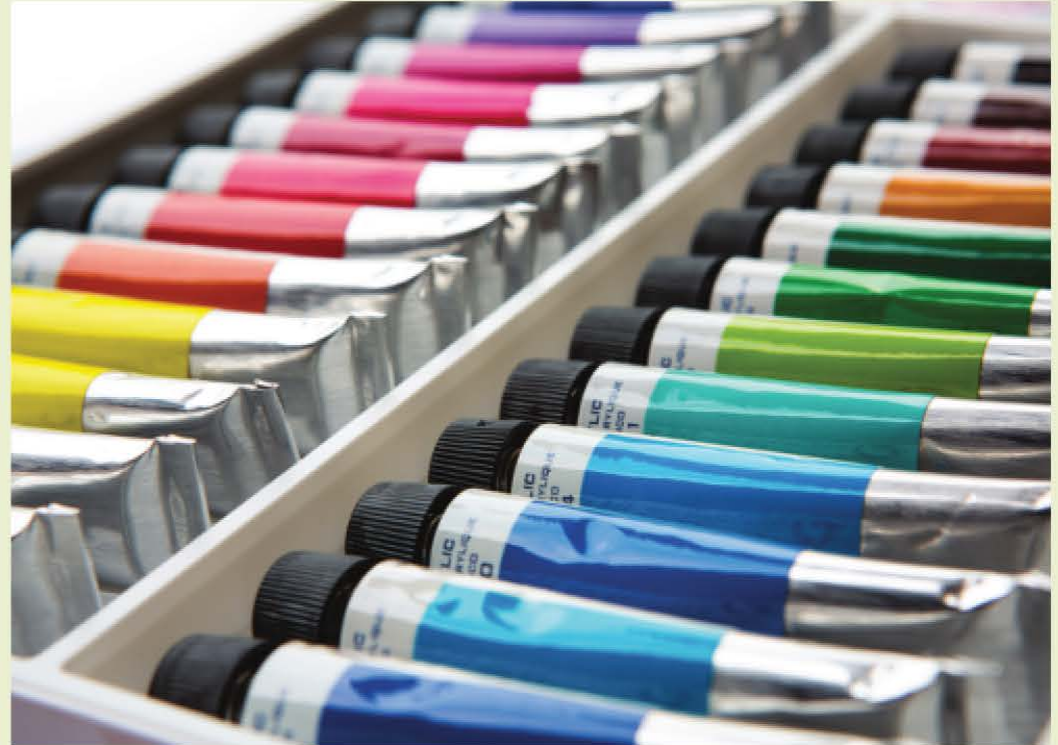
Historical pigments from precipitation reactions
Ancient civilizations ground natural minerals to make pigments, but in the nineteenth century, chemists learned to manufacture pigments more reliably through precipitation reactions. This created a much wider range of colours for artists to use.
| Pigment | Chemical formula |
|---|---|
| Cadmium yellow | |
| Chrome yellow | |
| Mosaic gold | |
| Titanium white | |
| Vermilion | |
| Zinc yellow |
Note
Prussian blue was a particularly popular colour in the nineteenth century. Made from a precipitate of iron(III) hexacyanoferrate(II), it was used extensively in ceramics and painting, including the famous Japanese woodblock print The Great Wave off Kanagawa.
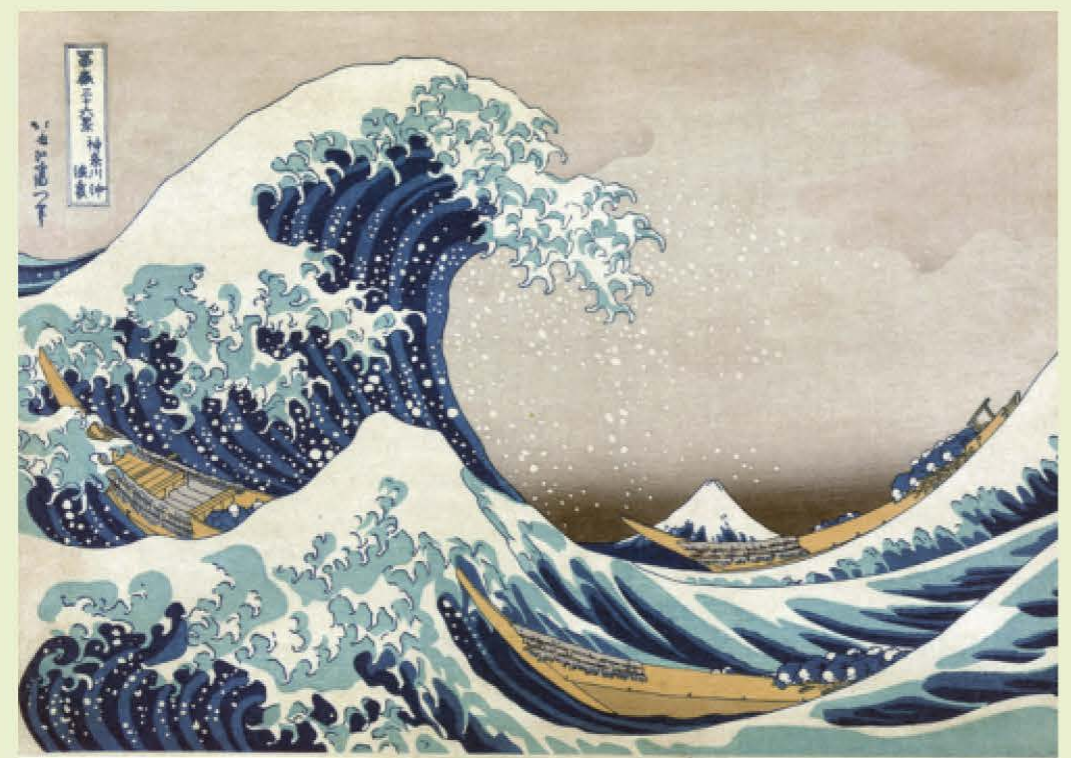
The availability of pigments based on ionic precipitates provided artists with a much wider palette. This helped enable the more vibrant use of colour seen in the works of the French Impressionists. For example:
- Cadmium sulfide was used to make red pigments, and cadmium red is still widely used today
- Viridian, a deep green pigment, is manufactured from chromium(III) oxide dihydrate
Summary
Key Points to Remember:
- A precipitation reaction occurs when dissolved ions combine to form an insoluble compound called a precipitate
- Use solubility tables to predict which compound will precipitate when two ionic solutions are mixed
- Full equations show all reactants and products including spectator ions, while ionic equations show only the species that form the precipitate
- Spectator ions remain unchanged throughout the reaction and don't participate in forming the precipitate
- Remember that all nitrates, all sodium and potassium salts, and all ammonium salts are soluble in water
- State symbols (aq), (s), (l), and (g) must always be included in equations to show the physical state of each species