Properties of Ionic Compounds (VCE SSCE Chemistry): Revision Notes
📚Revision Notes
Properties of Ionic Compounds
What are ionic compounds?
Ionic compounds are substances formed when metallic and non-metallic elements chemically combine. These materials are extremely common in the natural world.
Where you'll find ionic compounds:
- The Earth's crust contains large amounts of complex ionic compounds
- Most rocks, minerals and gemstones
- Soil (weathered rocks mixed with organic material)
- Ceramics, kitchen crockery and bricks (made from clays)
- Table salt (sodium chloride, ) is a pure ionic compound

Note
Ionic compounds are all around us in everyday life - from the salt we sprinkle on food to the bricks that build our homes. Understanding their properties helps explain why these materials behave the way they do.
Common properties of ionic compounds
The table below shows properties of some typical ionic compounds you might encounter in everyday life:
| Ionic compound | Melting point (°C) | Conductive as solid | Conductive as liquid | Conductive in aqueous solution | Solubility in water at 25°C (g/100 g water) | Commercial example |
|---|---|---|---|---|---|---|
| Copper(II) sulfate | Decomposes 110 | No | Yes | Yes | 22 | Bluestone spray |
| Sodium chloride | 801 | No | Yes | Yes | 36 | Food salt |
| Calcium carbonate | 1339* | No | Yes | - | 0.0013 | Marble |
| Zinc oxide | 1975 | No | Yes | - | Insoluble | Zinc cream |
| Sodium hydroxide | 318 | No | Yes | Yes | 114 | Oven cleaner |
*Melting point determined under pressure to prevent decomposition
Note
Looking at this data, notice the patterns: all ionic compounds have high melting points, none conduct electricity as solids, but all conduct when molten. These shared properties tell us something fundamental about the structure of ionic compounds.
Understanding ionic structure from properties
By studying the properties of ionic compounds like sodium chloride, scientists can deduce information about their structure:
| Property | What it tells us about structure |
|---|---|
| High melting point | Forces between particles are strong |
| Hard but brittle | Forces between particles are strong, but particles break apart when force is applied |
| Conducts electricity when molten or in solution | Free-moving charged particles are present |
| Does not conduct electricity when solid | Charged particles may be present, but they are not free to move in the solid state |
Important
The properties of a substance provide direct evidence about its internal structure. The fact that ionic compounds share similar properties across different materials suggests they all have a similar type of structure at the atomic level.
The ionic bonding model
The ionic bonding model explains how ionic compounds form and why they have their characteristic properties.
How ionic compounds form:
- Electron transfer: Metal atoms lose electrons to non-metal atoms
- Metal atoms become positively charged ions called cations
- Non-metal atoms gain electrons and become negatively charged ions called anions
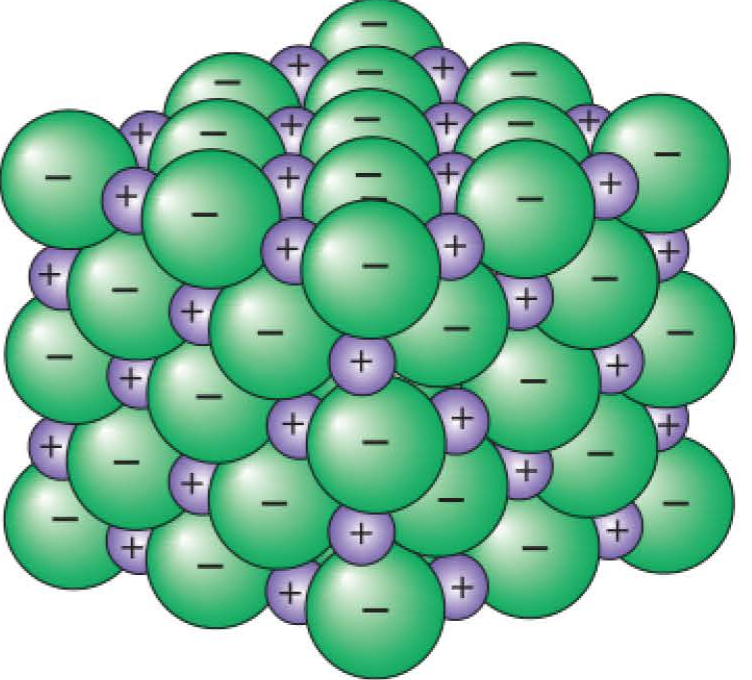
- Lattice formation: Large numbers of cations and anions combine to form a three-dimensional ionic lattice
- Ionic bonding: The lattice is held together by strong electrostatic forces of attraction between oppositely charged ions. This force is called ionic bonding.
Example
Example: Sodium chloride structure
In sodium chloride:
- Each sodium ion () is surrounded by six chloride ions ()
- Each chloride ion is surrounded by six sodium ions
- This arrangement maximises the forces of attraction
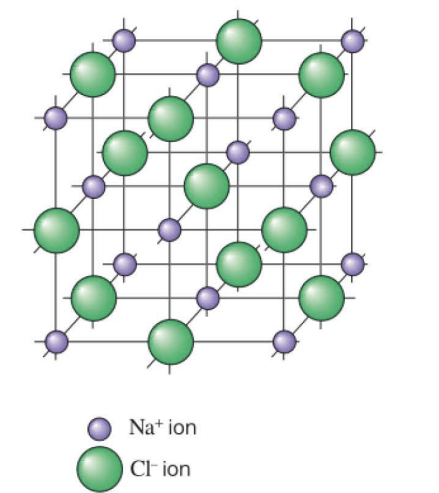
Even though chloride ions sit close to other chloride ions (which would normally repel each other), the attractive force between the sodium and chloride ions is stronger than the repulsive force between like-charged ions. This keeps the lattice stable.
Important
Understanding the chemical formula:
The formula doesn't represent individual pairs of ions. Instead, it shows the simplest whole number ratio of ions in the lattice (1:1 ratio of sodium to chloride ions). This type of formula is called an empirical formula.
Explaining properties using the ionic bonding model
High melting points
To melt an ionic solid, you must provide enough energy to overcome the strong electrostatic attraction between oppositely charged ions.
Sodium chloride melts at 801°C. This high temperature shows that:
- Ionic bonds are very strong
- A large amount of energy is needed to break them
- The ions can then move freely as a liquid
Note
Practical applications:
- Bricks lining furnaces and kilns are made from ionic compounds like magnesium oxide
- Ceramic brake discs in high-performance cars contain ionic compounds that withstand extreme heat better than metals


Hardness
Strong electrostatic forces between ions mean that:
- A strong force is needed to disrupt the crystal lattice
- Ionic compounds are hard
- They cannot be scratched easily
The strength of house bricks, concrete bridges and cobbled streets comes from ionic bonding in their structures.
Example
Case study: Tooth enamel
Tooth enamel is the hardest material in the human body - harder than iron. The main compound responsible is hydroxyapatite, .
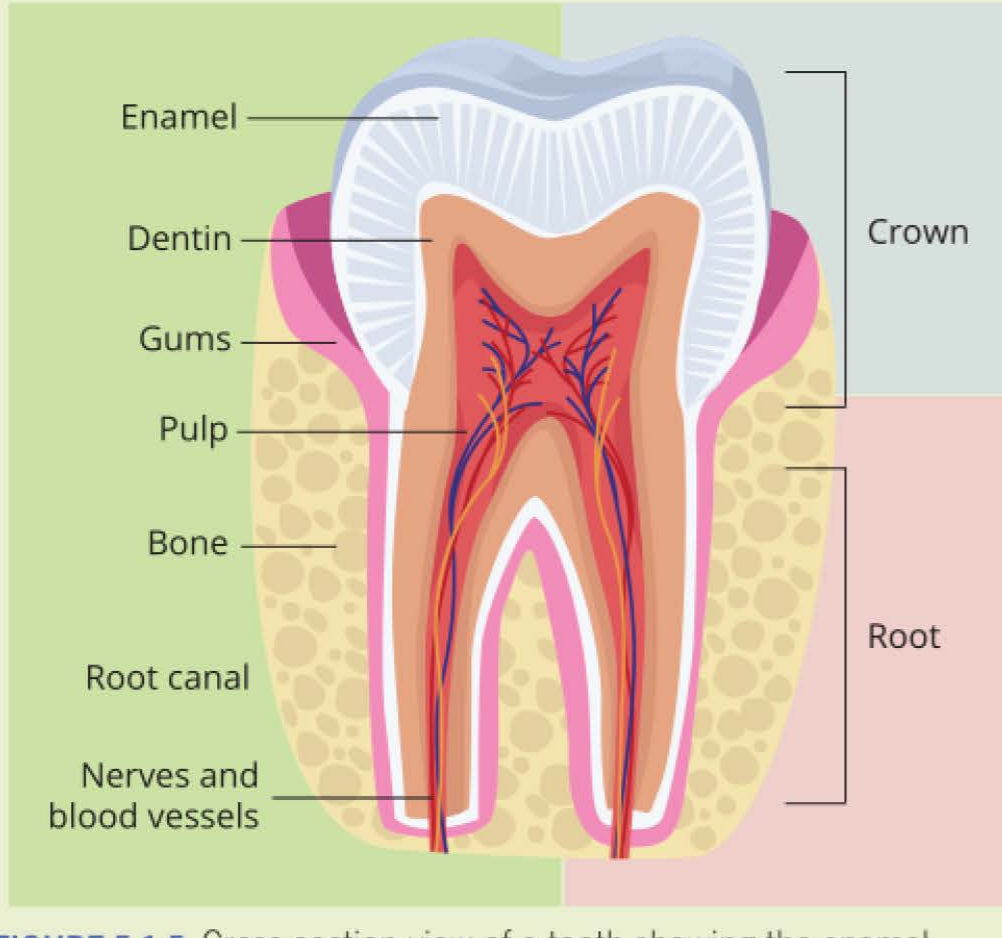
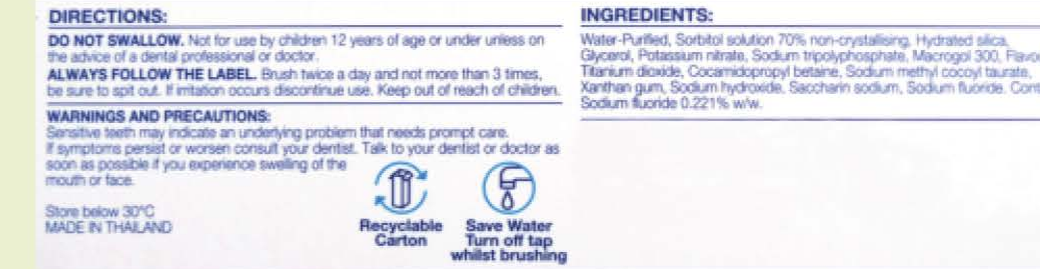
However, enamel is vulnerable to acid attack from sugary foods. Toothpaste helps protect teeth by:
- Including abrasive ionic compounds (sodium bicarbonate, calcium carbonate) to remove plaque
- Adding fluoride compounds that replace hydroxyl ions in hydroxyapatite
- The resulting compound, fluoroapatite , is more resistant to acid attack
Brittleness
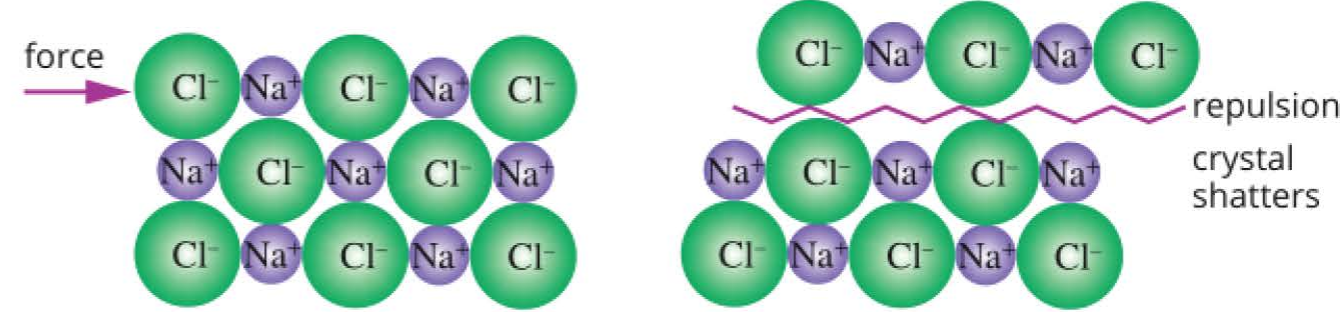
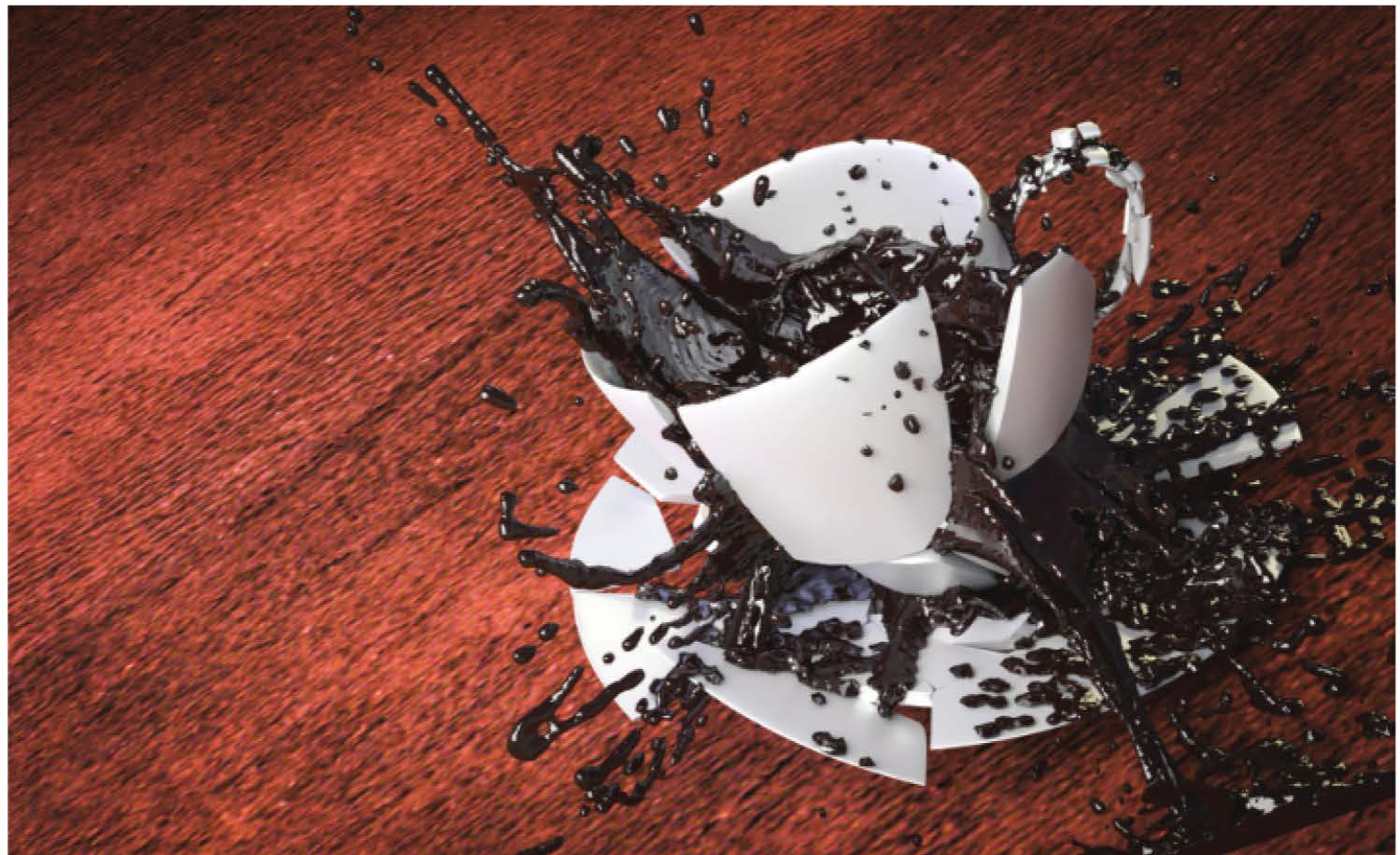
Although ionic compounds are hard, they shatter when struck with force. This property is called brittleness.
Why ionic compounds are brittle:
When force is applied to an ionic crystal:
- Layers of ions shift relative to each other
- Ions of like charge end up next to each other
- Repulsion between similarly charged ions causes the crystal to shatter
Note
Materials made from ionic compounds (ceramic tiles, bricks, kitchen crockery) are all hard but brittle. This is why a ceramic plate can withstand the weight of food but will shatter if dropped on a hard floor.

Electrical conductivity
Solid ionic compounds do not conduct electricity because:
- Ions are held firmly in the crystal lattice
- They cannot move freely
- For a substance to conduct electricity, it must contain charged particles that are free to move
Note
This non-conducting property is useful in ceramic insulators that keep high-voltage power lines and electric fence wires insulated.

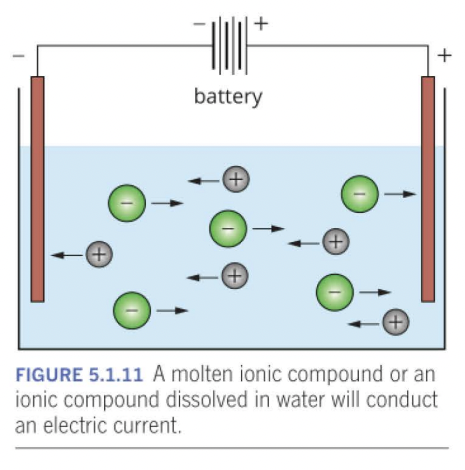
Molten ionic compounds and solutions do conduct electricity because:
- When melted, ions become free to move
- When dissolved in water, ionic bonds break and ions separate
- Free-moving ions can carry electric current
When an electric current is applied:
- Positive ions (cations) move toward the negative electrode
- Negative ions (anions) move toward the positive electrode
- This movement of ions creates an electric current
A solution or molten substance that conducts electricity through ion movement is called an electrolyte.
Important
Key point for exams: Solid ionic compounds are made of a crystal lattice where particles are not free to move, so they cannot conduct electricity. When molten or dissolved in water, the charged particles become free to move and can conduct.
Solubility
Solubility describes how readily a compound dissolves in a solvent (usually water).
Some ionic compounds are very soluble in water, while others are very insoluble.
When a soluble ionic compound is added to water:
- Ions break away from the ionic lattice
- They mix with water molecules
- A solution forms
When an insoluble compound is added to water:
- Ions remain bonded in the ionic lattice
- No solution forms
What determines solubility?
Whether an ionic compound dissolves depends on the relative strength of:
- The forces of attraction between positive and negative ions in the lattice
- The forces of attraction between water molecules and the ions
Important
If water-ion attractions are stronger than ion-ion attractions in the lattice, the compound will dissolve.
Remember!
Summary
Key Points to Remember:
-
Ionic compounds form when metal atoms transfer electrons to non-metal atoms, creating cations and anions that arrange in a crystal lattice
-
High melting points result from strong electrostatic forces of attraction between oppositely charged ions
-
Hardness comes from the strong forces needed to disrupt the crystal lattice
-
Brittleness occurs because layers of ions can shift, bringing like charges together and causing repulsion
-
Electrical conductivity only occurs when ions are free to move (in molten state or solution), not in solid form
-
Solubility depends on the balance between ion-ion forces in the lattice and water-ion forces