Effect of Changes of Conditions on Rate of Reaction (VCE SSCE Chemistry): Revision Notes
📚Revision Notes
Effect of Changes of Conditions on Rate of Reaction
Chemical reactions don't always proceed at the same speed. The rate at which a reaction occurs can be controlled by changing certain conditions. Understanding these factors helps chemists optimise reactions for industrial processes and everyday applications.
Research has identified five key factors that can alter reaction rates:
- Surface area of solid reactants
- Concentration of reactants in solution
- Pressure of gaseous reactants
- Temperature of the reaction system
- Presence of a catalyst
All of these factors relate to a fundamental concept in chemistry: collision theory. For a reaction to occur, particles must collide. However, not all collisions lead to a reaction. Only successful collisions result in product formation.
Important
Requirements for a Successful Collision:
A successful collision requires two conditions:
- The particles must collide with energy equal to or greater than the activation energy ()
- The particles must collide with the correct orientation to allow bonds to break and new products to form
To increase reaction rate, you can take two approaches:
- Increase the frequency of successful collisions by creating more collision opportunities per unit time
- Increase the proportion of collisions that possess sufficient energy to overcome the activation energy barrier
Increasing the frequency of collisions
Increasing concentration or pressure
When you increase the concentration of a solution or the pressure of a gas, you're essentially packing more reactant particles into the same volume of space. This has a direct effect on how often particles collide.
Consider a reaction in solution. At low concentration, reactant particles are spread out, moving through the solution with plenty of empty space between them. Collisions happen occasionally. Now increase the concentration tenfold. Suddenly there are ten times as many particles moving through the same volume. The particles are closer together, so they bump into each other much more frequently.
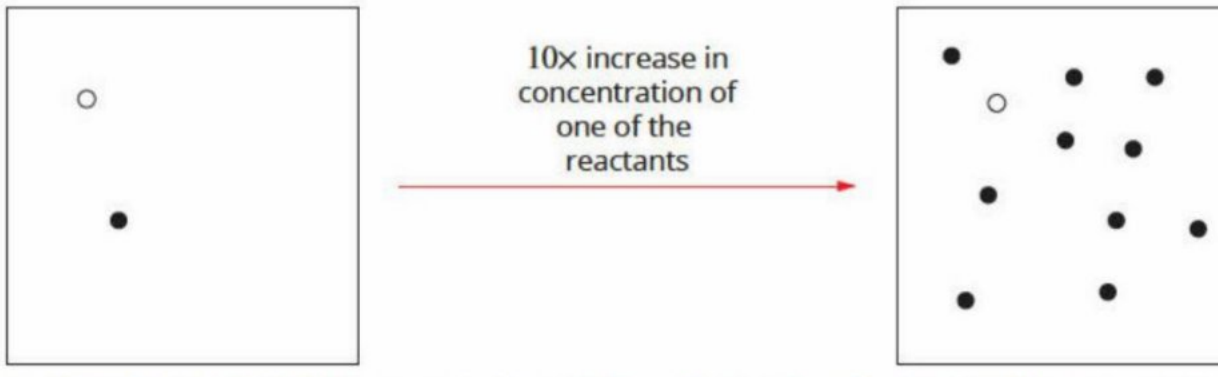
Each collision represents a potential reaction event. More collisions per second means more opportunities for successful collisions (those with correct energy and orientation). Therefore, the overall reaction rate increases.
For gaseous reactions, pressure works similarly to concentration. You can increase gas pressure by:
- Adding more gas molecules to a fixed-volume container
- Reducing the volume of the container (such as compressing a gas in a syringe)
Either method increases the concentration of gas molecules, bringing them closer together and increasing collision frequency. More collisions per unit time means more successful collisions, so the reaction proceeds faster.
Note
Exam Tip: Explaining Concentration and Pressure Effects
When explaining concentration or pressure effects, always link your answer to collision frequency and successful collisions. Simply stating "more particles" is insufficient - you must explain how this leads to increased collision frequency.
Increasing surface area
Reactions involving solid reactants have a special consideration: only particles at the surface of the solid can participate in the reaction. Particles buried inside the solid cannot collide with other reactants until the surface particles have reacted away.
The surface area of a substance determines how many solid particles are exposed and available to react. Breaking a solid into smaller pieces dramatically increases the total surface area.
Imagine a large cube of zinc metal. Only the atoms on the outer faces can react with hydrochloric acid in solution. The atoms inside the cube are locked away, unable to participate. Now break that cube into hundreds of tiny pieces. Each piece has its own surface, and suddenly thousands more zinc atoms are exposed to the acid. The reaction can occur at many more sites simultaneously.
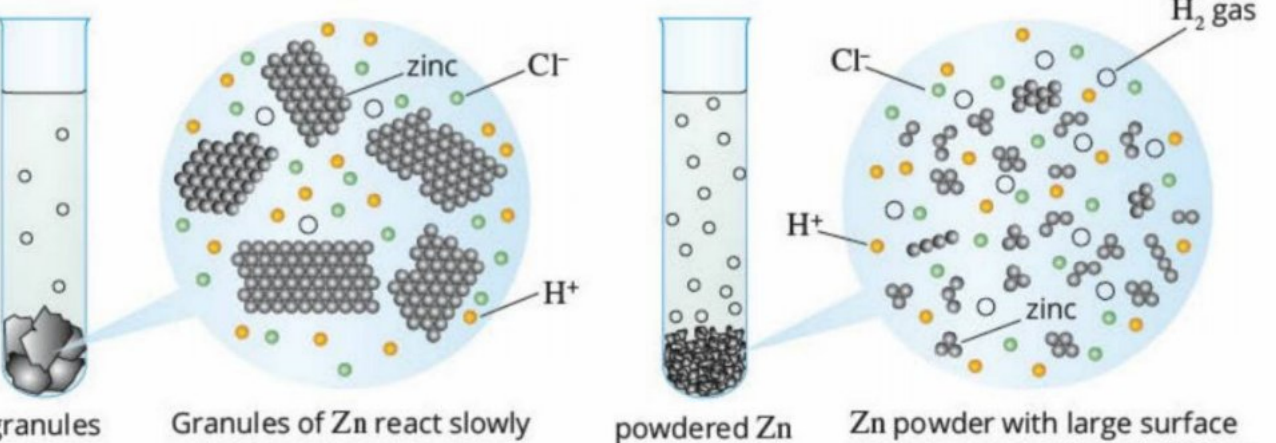
This increased surface area means more frequent collisions between reactant particles per unit time, leading to a faster reaction rate.
Note
Practical Demonstration: Kindling vs. Logs
When lighting a campfire, you don't start by trying to ignite large logs. Instead, you use small kindling - thin twigs and wood shavings. The kindling has a much larger surface area compared to its mass than logs do. This large surface area means the wood can react rapidly with oxygen, catching fire easily. The sustained heat from the burning kindling then provides enough energy to ignite the logs.
Worked example: coal dust explosions
Example
Worked Example: Coal Dust Explosions in Mines
Underground coal mines have experienced devastating explosions due to coal dust accumulation. This phenomenon demonstrates the dramatic effect of surface area on reaction rate.
Analysis:
Coal is a solid fuel. In mines, you find both large lumps of coal and fine powdered coal dust.
The surface area of powdered coal dust is vastly greater than that of solid coal lumps. When surface area increases, the frequency of collisions between coal particles and oxygen in the air increases dramatically. This causes the rate of combustion reaction to increase.
An explosion is simply a very rapid reaction. The enormous surface area of coal dust suspended in air allows for such a massive increase in collision frequency that the combustion reaction occurs almost instantaneously. This releases huge amounts of energy in a fraction of a second - an explosion.
Real-world implications: This same principle explains why flour mills and grain silos can also experience explosions if fine particles become suspended in air.
Increasing the energy of collisions
While increasing collision frequency does speed up reactions, there's an even more powerful way to increase reaction rate: increasing the energy of the collisions themselves. Temperature is the key factor here.
Effect of temperature on rate of reaction
Temperature and kinetic energy are intimately connected. The kinetic energy (energy of motion) of a particle depends on its mass and velocity according to the formula:
When you heat a reaction mixture, you increase the average kinetic energy of all the particles. This means particles move faster on average.
Faster-moving particles create two important effects:
1. Increased collision frequency Particles moving at higher speeds cover more distance per unit time, so they collide with other particles more often. More collisions per second means more opportunities for successful collisions.
2. Increased collision energy (the dominant effect) More importantly, collisions between faster-moving particles have greater energy. A greater proportion of these collisions will possess energy equal to or exceeding the activation energy (). Since only collisions with sufficient energy can lead to product formation, this dramatically increases the proportion of successful collisions.
Important
The Dramatic Effect of Temperature on Reaction Rate
Here's a striking fact: when temperature increases by just , the collision frequency increases by only about 3%. Yet many reactions double in rate with a increase - a 100% increase!
This tells us that the increased collision frequency contributes relatively little. The main reason for the rate increase is that more particles possess sufficient energy to react.
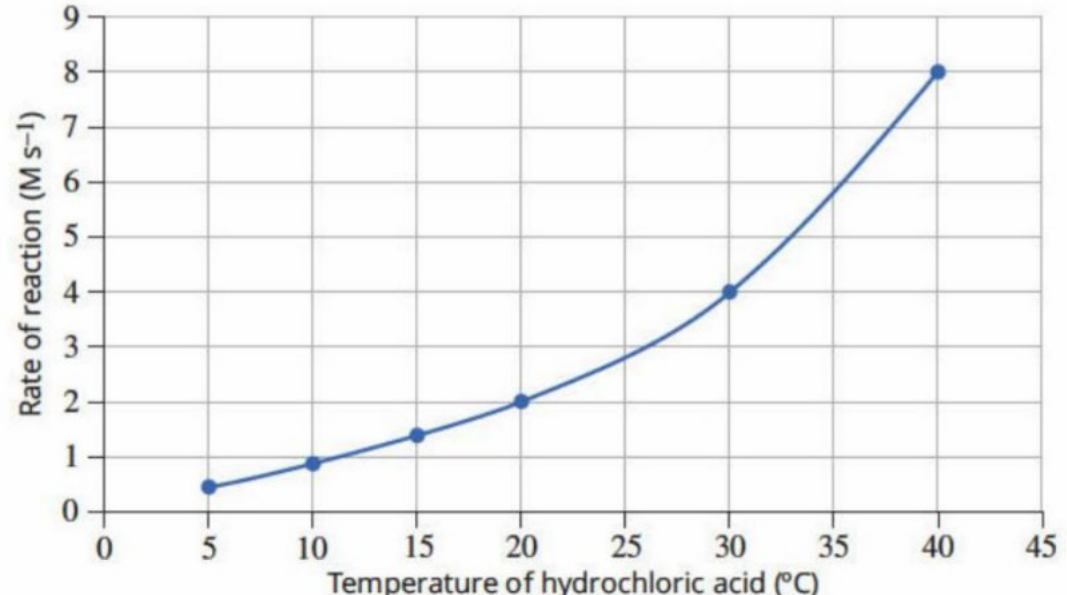
The graph above shows data for the reaction between hydrochloric acid and calcium carbonate:
Notice how the rate increases exponentially with temperature. For every increase in temperature, the reaction rate approximately doubles.
Case study: Ötzi the Iceman
Note
Real-World Application: Preservation Through Low Temperature
In September 1991, hikers in the Ötztal Alps near the Austria-Italy border discovered what they initially thought was a recently deceased mountaineer. Remarkably, the body and belongings turned out to be approximately 5300 years old - a Bronze Age individual now known as Ötzi the Iceman.

What's extraordinary is the state of preservation. Ötzi's body was so well preserved that scientists could identify the contents of his stomach and even find spring plant pollen on his clothing. This exceptional preservation occurred because the body remained frozen in ice for millennia.
This demonstrates the powerful effect of temperature on reaction rates. Decomposition is a complex series of chemical reactions. At the low temperatures found in glacial ice, these reactions proceed extremely slowly. The particles involved have very low kinetic energy, resulting in very few collisions with energy exceeding the activation energy for decomposition reactions. In contrast, at room temperature, decomposition would have been rapid and complete within weeks or months.
Note
Exam Tip: Explaining Temperature Effects
When answering questions about temperature effects, mention both the frequency increase AND the energy increase, but emphasise that the energy effect (proportion of particles with ) is more significant.
Maxwell-Boltzmann distribution
To understand why temperature has such a dramatic effect on reaction rate, we need to examine how kinetic energy is distributed among particles at different temperatures.
At any given temperature, not all particles in a substance possess the same kinetic energy. Some particles are moving slowly (low kinetic energy), most are moving at moderate speeds (average kinetic energy), and a few are moving very rapidly (high kinetic energy). This spread of energies is represented by a Maxwell-Boltzmann distribution curve.
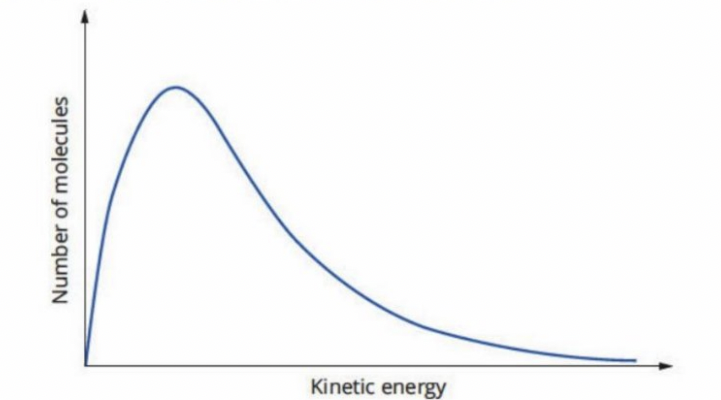
The Maxwell-Boltzmann curve shows:
- Y-axis: Number of molecules (or particles) with a particular energy
- X-axis: Kinetic energy
- Peak: The kinetic energy possessed by the greatest number of particles
- Total area under curve: The total number of particles in the sample (this remains constant)
Important
Critical Insight: Activation Energy and Reaction Rate
The key insight is that at any temperature, only a small proportion of particles possess kinetic energy greater than or equal to the activation energy. These are the only particles that can successfully react when they collide with correct orientation.
Now consider what happens when temperature increases:
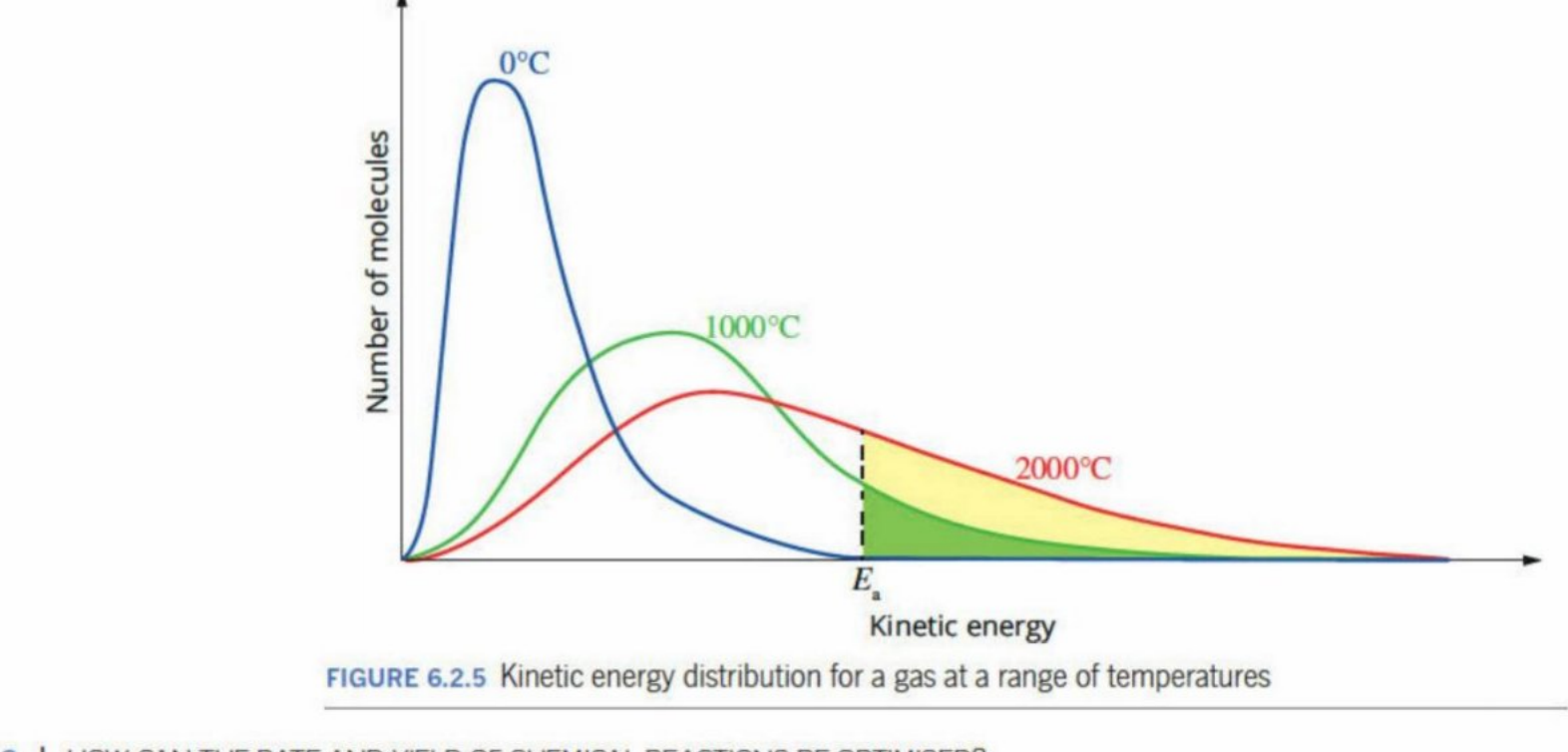
This diagram shows Maxwell-Boltzmann distributions at three temperatures: , , and . The vertical dashed line represents the activation energy (). The shaded regions show the proportion of molecules with energy exceeding .
Notice several important features:
- As temperature increases, the peak of the curve becomes lower and broader
- As temperature increases, the peak shifts to the right (toward higher energies)
- The area under each curve remains the same (same total number of particles)
- The shaded area to the right of increases dramatically with temperature
This last point is crucial. The shaded area represents the proportion of particles that can successfully react. At , only a tiny fraction of particles have sufficient energy. At , a much larger proportion can react. At , an even greater proportion possesses the required energy.
This explains why a modest temperature increase can cause such a large increase in reaction rate. You're not just making particles collide more often (the 3% frequency increase), you're dramatically increasing the proportion of collisions that can lead to products.
Note
Exam Tip: Sketching Maxwell-Boltzmann Curves
When sketching Maxwell-Boltzmann curves, remember that the area under the curve must remain constant. As temperature increases, draw the curve lower and broader, with the peak shifted to the right. Always mark the activation energy and shade the relevant area.
Summary
Key Points to Remember:
-
Five factors affect reaction rate: concentration, pressure, surface area, temperature, and catalysts (through different mechanisms explained by collision theory).
-
Successful collisions require two conditions: sufficient energy () and correct particle orientation.
-
Concentration and pressure increase reaction rate by increasing collision frequency - more particles in the same volume means particles collide more often.
-
Surface area matters for solid reactants because only surface particles can react. Smaller particle size = larger surface area = more frequent collisions = faster reaction.
-
Temperature increases reaction rate through two mechanisms, with the second being dominant: (1) increased collision frequency (~3% per 10°C), and (2) greatly increased proportion of particles with (leading to ~100% rate increase per 10°C).
-
Maxwell-Boltzmann distributions show that at higher temperatures, a much greater proportion of particles possess energy exceeding the activation energy, explaining temperature's dramatic effect on reaction rates.