Oxidation Numbers (VCE SSCE Chemistry): Revision Notes
📚Revision Notes
Oxidation Numbers
Introduction
Oxidation numbers (also called oxidation states) are a useful tool in chemistry for identifying which substances act as reducing agents and which act as oxidising agents in redox reactions. They help us extend the concept of redox reactions beyond simple ionic compounds to include reactions where electron transfer is less obvious.
Note
Oxidation numbers serve as a systematic way to track electron movement in chemical reactions, making it easier to identify and understand redox processes even when electron transfer isn't immediately apparent.
It's important to understand that oxidation numbers have no physical meaning. They don't necessarily indicate a formal charge or describe the physical or chemical properties of a substance. Instead, they serve as a systematic way to track electron movement in chemical reactions.
Oxidation numbers vs ionic charges
Important
Critical Distinction: Signs Matter!
A key distinction to remember is how oxidation numbers are written compared to ionic charges:
- Oxidation numbers: The sign (plus or minus) comes before the number. For example, or
- Ionic charges: The sign comes after the number. For example, or
As an example, consider the magnesium ion . Its oxidation number is while its charge is written as . Similarly, the oxide ion has an oxidation number of and a charge of .
While the numerical values may be the same in these cases, oxidation numbers don't always represent actual ionic species that carry a charge.
Determining oxidation numbers
To assign oxidation numbers to elements in a reaction, chemists follow a specific set of rules. When applying these rules, we treat all compounds and polyatomic ions as if they were composed of individual ions.
Oxidation number rules
There are six main rules for determining oxidation numbers:
Rule 1: Free elements have an oxidation number of zero
Any element in its uncombined state has an oxidation number of . This applies to monatomic elements like sodium () and chlorine (), as well as diatomic molecules like and polyatomic molecules like .
Rule 2: Simple ions have oxidation numbers equal to their charge
For a simple ion (a single atom with a charge), the oxidation number equals the charge on that ion. For example:
- has an oxidation number of
- has an oxidation number of
- has an oxidation number of
- has an oxidation number of
- has an oxidation number of
- has an oxidation number of
Rule 3: Certain elements have fixed oxidation numbers in compounds
Some elements consistently have the same oxidation number in their compounds, with only a few exceptions:
(a) Main group metals have oxidation numbers equal to the charge on their ions. For example, in ionic compounds like and , potassium has an oxidation number of and magnesium has .
(b) Hydrogen usually has an oxidation number of when combined with non-metals. For instance, in , hydrogen has an oxidation number of .
Note
Exception: In metal hydrides (compounds where hydrogen combines with metals), hydrogen has an oxidation number of . Examples include and .
(c) Oxygen typically has an oxidation number of in most compounds.
Note
Exceptions:
- In peroxides (like and ), oxygen has an oxidation number of
- In compounds with fluorine (like ), oxygen has a positive oxidation number of
Rule 4: Oxidation numbers in neutral compounds sum to zero
In any neutral compound, the sum of all oxidation numbers must equal zero. For example, in , carbon has an oxidation number of and each oxygen has . The calculation is: .
Important
When writing oxidation numbers, we write the value for each individual atom. In , we write for oxygen, not for the two oxygen atoms combined.
Rule 5: Oxidation numbers in polyatomic ions sum to the ion's charge
For a polyatomic ion, the sum of oxidation numbers equals the overall charge on the ion. For instance, in the sulfate ion , the oxidation numbers must sum to . In the ammonium ion , they sum to .
Rule 6: The most electronegative element gets the negative oxidation number
When two non-metals combine, the more electronegative element is assigned the negative oxidation number. For example, in , fluorine (the most electronegative element) has an oxidation number of , while oxygen has .
Common oxidation states
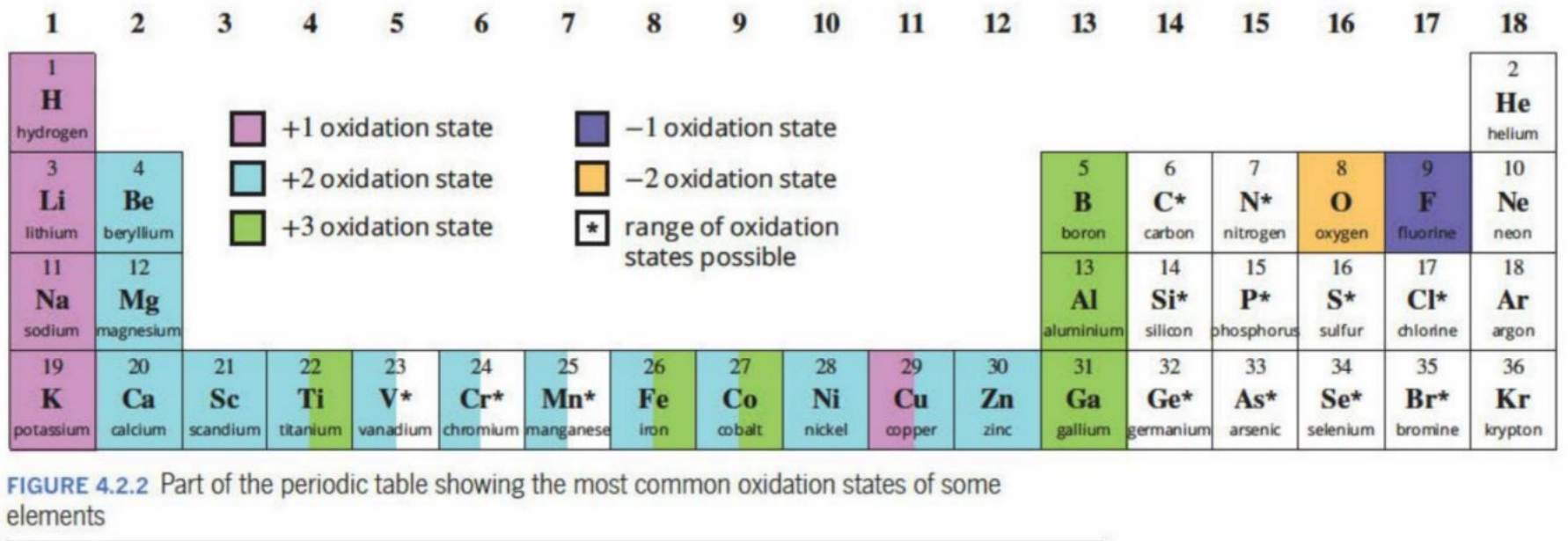
The periodic table below shows the most common oxidation states for the first 36 elements in their compounds. The asterisk (*) indicates elements that can have a range of oxidation states, particularly transition metals and some non-metals.
Note
For elements with variable oxidation states, the specific oxidation number is usually calculated after applying the rules for all other elements in the compound.
Calculating oxidation numbers using algebra
When a compound contains several elements, you can use algebra combined with the oxidation number rules to calculate unknown oxidation numbers.
Example
Worked Example: Finding the Oxidation Number of Sulfur in
Step 1: Identify what you know from the rules:
- Hydrogen has an oxidation number of (Rule 3b)
- Oxygen has an oxidation number of (Rule 3c)
- The sum must equal zero because it's a neutral compound (Rule 4)
Step 2: Let the oxidation number of sulfur equal . Then write an equation:
Step 3: Simplify:
Answer: Therefore, sulfur has an oxidation number of +6 in .
Colourful oxidation states
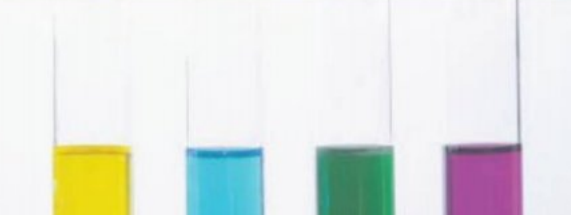
A characteristic property of transition elements is that they form brightly coloured compounds. Different oxidation states of the same transition metal can result in different colours.
Note
Vanadium: A Rainbow of Oxidation States
Vanadium is an excellent example of this property. Depending on its oxidation state, vanadium solutions display different colours:
- Oxidation state : yellow
- Oxidation state : light blue
- Oxidation state : green
- Oxidation state : magenta
These colorful solutions can be produced by adding a reducing agent to a solution containing vanadium ions, progressively changing the oxidation state.
Using oxidation numbers to name chemicals
Since transition elements can form ions with several different charges, many have variable oxidation numbers. This can create confusion when naming compounds.
For example, iron forms two different chloride compounds:
Using the oxidation number rules, we know chloride has an oxidation number of . Therefore:
- In , iron has an oxidation number of
- In , iron has an oxidation number of
Example
Naming System with Roman Numerals
To distinguish between compounds with variable oxidation states, we insert Roman numerals in the name to indicate the oxidation number:
- is named iron(II) chloride
- is named iron(III) chloride
This Roman numeral naming system can also be used for non-metal compounds where an element has several possible oxidation states. For instance:
- (nitrogen dioxide) can be called nitrogen(IV) oxide
- (nitric oxide) can be called nitrogen(II) oxide
This method makes it much easier to determine the formula from the compound name.
Using oxidation numbers to identify oxidation and reduction
The concept of oxidation numbers allows us to extend our definition of oxidation and reduction beyond simple electron transfer.
In this expanded definition:
- Oxidation involves an increase in oxidation number
- Reduction involves a decrease in oxidation number
This alternative definition is particularly useful for non-ionic compounds where it's difficult to determine whether electrons have actually been transferred.
Important
Oxidation and Reduction Always Occur Together
An important principle to remember is that oxidation and reduction always occur together in a redox reaction. One process cannot happen without the other. If there is no change in oxidation number for any element in a reaction, then it is not a redox reaction.
Identifying redox reactions
Let's examine the combustion of carbon in excess oxygen:
At first glance, this may not appear to be a redox reaction because none of the species are ionic compounds. However, by assigning oxidation numbers, we can identify both oxidation and reduction processes.
Example
Worked Example: Identifying Redox in Carbon Combustion
Step 1: Assign oxidation numbers to each element:
Step 2: Analyze the changes:
- Carbon's oxidation number increases from to → carbon is oxidised
- Oxygen's oxidation number decreases from to → oxygen is reduced
Conclusion: This confirms it is indeed a redox reaction.
Step-by-step method for identifying oxidation and reduction
The systematic approach involves:
- Determining the oxidation number of each element on both sides of the equation
- Identifying which elements have changed oxidation number
- Determining whether each change represents an increase (oxidation) or decrease (reduction)
Example
Worked Example: Combustion of Methane
Consider the combustion reaction:
Step 1: Assign oxidation numbers:
Step 2: Identify changes in oxidation number:
- Carbon: (increase of 8) → oxidised
- Oxygen: (decrease of 2) → reduced
- Hydrogen: (no change) → neither oxidised nor reduced
Using oxidation numbers to identify conjugate redox pairs
When we write a half-equation for an oxidation reaction, the reactant acts as a reducing agent and loses electrons. The product formed is an oxidising agent. The reactant and the product it forms together make up a conjugate redox pair.
Oxidation half-equations
Consider the oxidation of zinc:
In this half-equation:
- Zinc metal () is the reducing agent
- It forms , which is an oxidising agent
- Together, and form a conjugate redox pair, written as
Looking at oxidation numbers in this pair, zinc's oxidation number increases from to , confirming this is an oxidation half-reaction.
Reduction half-equations
In a reduction half-equation, the reactant is an oxidising agent that gains electrons, forming a reducing agent as the product. This creates another conjugate redox pair.
For example, consider the reduction of silver ions:
In this half-equation:
- is the oxidising agent
- It forms , which is a reducing agent
- and form a conjugate redox pair
The oxidation number of silver decreases from to , confirming this is a reduction half-reaction.
Understanding conjugate pairs in complete reactions
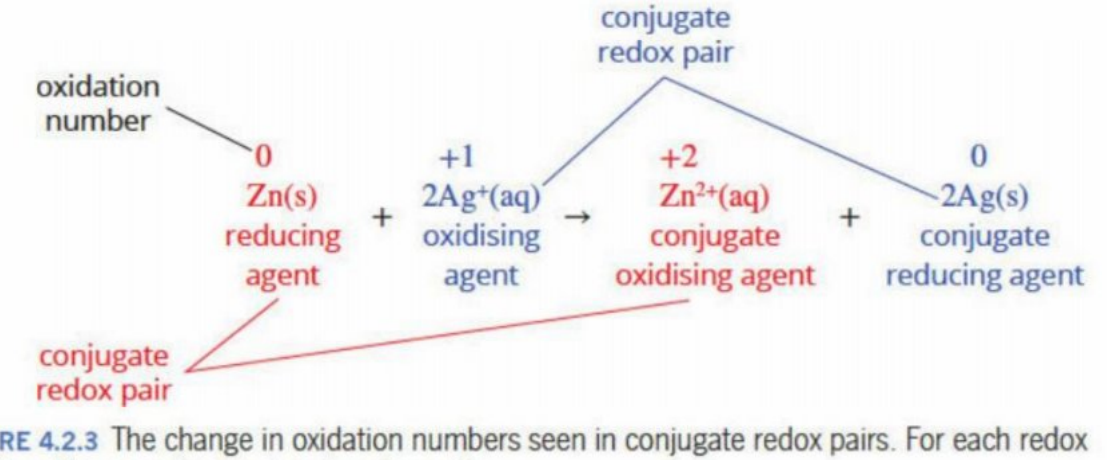
For every redox reaction, there are two conjugate redox pairs - one associated with oxidation and one with reduction.
Note
Key Features of Conjugate Redox Pairs:
- The oxidation number of the oxidising agent is always more positive than that of the reducing agent
- When listing pairs, always include the states of both species (e.g., , , , )
The diagram above shows how oxidation numbers change in conjugate redox pairs for a complete redox reaction involving zinc and silver ions.
Remember!
Summary
Key Points to Remember:
-
Oxidation numbers are written with the sign before the number (e.g., ), while ionic charges have the sign after (e.g., )
-
Six key rules govern how to assign oxidation numbers:
- Free elements = 0
- Simple ions = their charge
- Hydrogen usually =
- Oxygen usually =
- Neutral compounds sum to 0
- Polyatomic ions sum to their charge
-
Oxidation means an increase in oxidation number, while reduction means a decrease in oxidation number
-
Conjugate redox pairs consist of an oxidising agent and the reducing agent it forms (or vice versa), with the oxidising agent always having the more positive oxidation number
-
Transition metals can have variable oxidation states, leading to differently coloured compounds and the need for Roman numerals in naming