Principles of Chromatography (VCE SSCE Chemistry): Revision Notes
📚Revision Notes
Principles of Chromatography
What is chromatography?
Chromatography is an analytical technique that works by exploiting differences in how soluble different compounds are. This powerful method allows chemists to:
- Separate the different substances present in a mixture
- Identify numerous inorganic and organic substances
- Analyse contaminants in water, toxic gases in air, impurities in food, and drugs in blood
Note
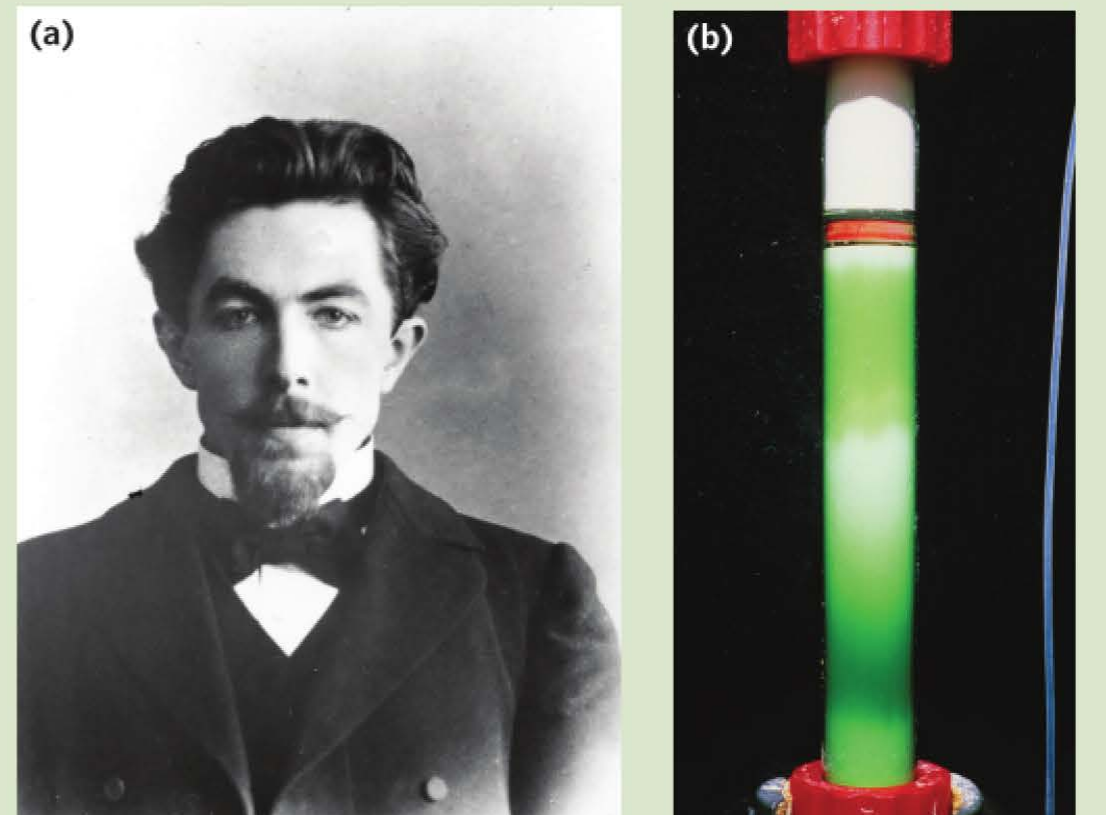
The word "chromatography" literally means "colour writing". It was developed by Russian botanist Mikhail Tsvet while studying coloured pigments in plants. When Tsvet analysed plant extracts using his new technique, he discovered that different pigments appeared as different coloured bands. In 1903, only chlorophyll and xanthophyll were known as plant pigments, but Tsvet's chromatograms revealed two forms of chlorophyll and eight other pigments.
How chromatography works
All chromatography methods rely on two essential components:
- A stationary phase (the material that stays in place)
- A mobile phase (the material that moves)
You can perform a simple chromatography experiment using chalk and ink. When you dip a stick of chalk into water-soluble black ink and then stand the chalk in a beaker containing a small amount of water, the water carries the ink up the chalk. As this happens, the ink separates into bands of different colours. Each band contains one of the substances present in the ink mixture. This pattern of bands or spots is called a chromatogram.
In this chalk-and-ink experiment:
- The stationary phase is the chalk
- The mobile phase is the water
The separation process
The different substances in the ink are called components. As the mobile phase (solvent) sweeps the components upwards over the stationary phase, the components repeatedly go through two processes:
- Adsorption - sticking onto the solid stationary phase
- Desorption - dissolving back into the mobile phase
The rate at which each component moves depends mainly on:
- How strongly the component adsorbs onto the stationary phase
- How readily the component dissolves in the mobile phase (its solubility)
Important
Components separate because they undergo adsorption and desorption to different degrees. The ability of components to stick to the stationary phase depends on the polarity of both the stationary phase and the component molecules. Similarly, the attraction between components and solvent molecules is determined by their polarities.
For example, if water (a polar solvent) is the mobile phase, a more polar component will move faster up the stationary phase than a less polar component. This is because the polar component dissolves more readily in the polar water and bonds less strongly to the stationary phase.
Paper and thin-layer chromatography
In the laboratory, two common types of chromatography are used for qualitative analysis:
Paper chromatography uses high-quality absorbent paper (similar to filter paper) as the stationary phase.
Thin-layer chromatography (TLC) is very similar to paper chromatography, but the stationary phase is a thin layer of fine powder, such as alumina (aluminium oxide) or silica (silicon dioxide), spread on a glass or plastic plate.
Setting up paper and thin-layer chromatography
The procedure for both techniques is similar:
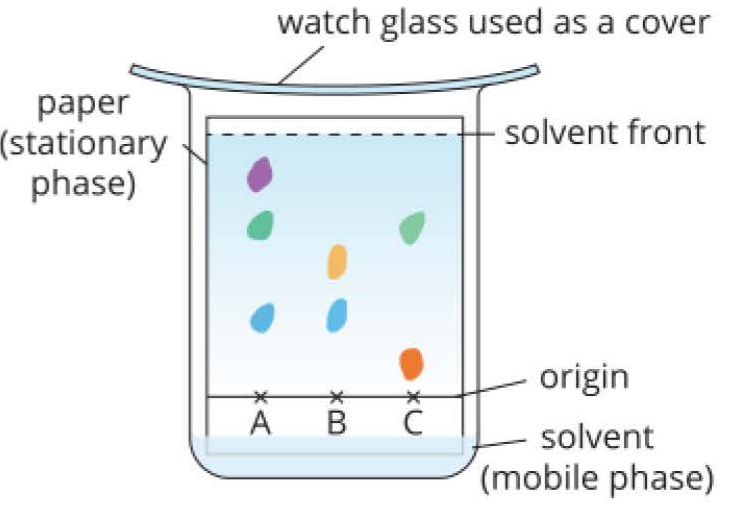
- Place a small spot of the sample solution at one end of the paper or plate. This position is called the origin.
- Place the paper or plate in a container with solvent. The origin must sit slightly above the level of the solvent (not submerged in it). This ensures the components are carried up the paper or plate rather than dissolving directly into the liquid.
- As the solvent rises up the paper or plate by capillary action, it carries the components with it. Different components move at different rates, causing them to separate.
- The solvent continues to move until it reaches the solvent front - the furthest point of solvent travel.
Testing purity
Paper or thin-layer chromatography can quickly and cheaply determine the purity of a sample. You compare the chromatogram of the sample with one of the pure material. Any impurities appear as extra spots on the chromatogram.
Identifying the components of a mixture
The components in a mixture can be identified using chromatography in two main ways:
- Including standards of known chemicals on the same chromatogram
- Calculating the retardation factor () of the sample
Method 1: Using standards
A standard is a substance with an identity and concentration that are precisely known. To use this method, you need to know which chemicals might be present in your sample.
Note
For example, to find out whether a vitamin tablet contains vitamins A and D:
- Place a sample of the vitamin tablet alongside pure samples of vitamins A and D on the same chromatogram
- If spots from the tablet sample move the same distance from the origin as spots from the pure samples, the tablet likely contains those vitamins
Important
The sample and standards must be run on the same chromatogram because the distances moved depend on how far the solvent front travels. The further the solvent front travels, the further the spots travel and the greater the separation between them.
Method 2: Calculating values
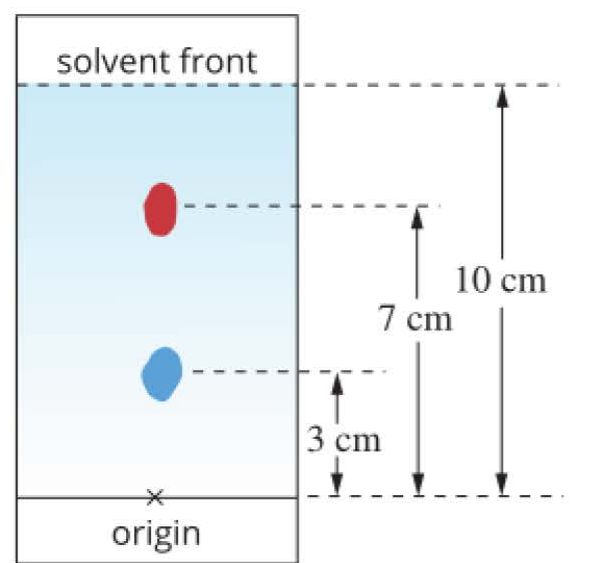
Another way to identify components is by comparing how far they travel relative to the solvent front. This is expressed as the retardation factor ():
Key points about values:
- values are always less than 1 (because a component cannot travel further than the solvent front)
- The component most strongly adsorbed onto the stationary phase moves the shortest distance and has the lowest value
- Each component has a characteristic value under specific conditions
By comparing the values of components in a mixture with values of known substances determined under identical conditions, you can identify the components present.
Note
The advantage of using values is that the actual distance travelled by the solvent front doesn't matter, as long as the conditions are the same. However, changes in temperature, type of stationary phase, water vapour in the air, or type of solvent will all change the value for a particular chemical.
Example
Worked Example: Calculating Values
If a red component travels 7 cm from the origin and the solvent front travels 10 cm from the origin:
The value is 0.7, which is less than 1 as expected.
Making components visible
In chromatograms of plant pigments and food dyes, the components are easily visible because they are coloured. However, most compounds are colourless and must be made visible:
Note
- Many organic compounds fluoresce (appear blue) when viewed under ultraviolet light
- The chromatogram can be sprayed with a chemical that reacts to form coloured or fluorescent compounds
- For example, amino acids can be sprayed with ninhydrin to give blue and brown-coloured compounds
Comparing paper and thin-layer chromatography
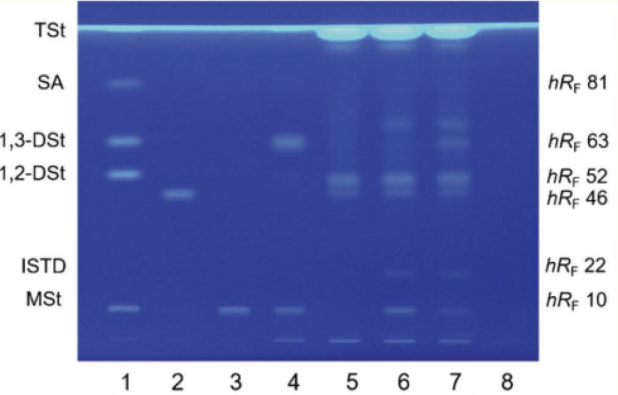
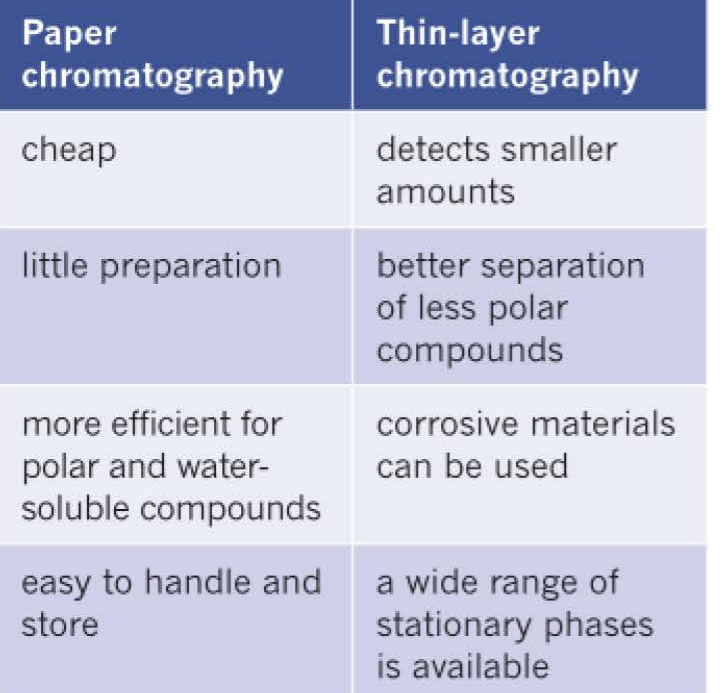
The choice between paper and thin-layer chromatography depends on the sample being analysed:
Important notes about identification
Important
For a particular combination of stationary phase and mobile phase, many different chemicals may have similar values. Therefore:
- Paper and thin-layer chromatography are guides to chemical identity, not definitive proof
- Further testing using other chromatography forms may be required to confirm identity
- More advanced techniques like high-performance liquid chromatography (HPLC) or gas chromatography (GC) provide more reliable identification
Qualitative versus quantitative analysis
Understanding mixtures involves two types of analysis:
Qualitative analysis - determining what chemical components are present in a sample (the chemical composition)
Quantitative analysis - measuring the amount of different chemical components present in a sample (the concentrations)
Paper and thin-layer chromatography are primarily used for qualitative analysis, though they can provide some quantitative information when used with standards of known concentration.
Remember!
Summary
Key Points to Remember:
- Chromatography separates mixtures based on differences in how components interact with a stationary phase and dissolve in a mobile phase
- All chromatography involves adsorption (sticking to stationary phase) and desorption (dissolving in mobile phase)
- In paper chromatography, the stationary phase is absorbent paper; in TLC, it's a thin layer of powder like alumina or silica
- Components can be identified by comparing with standards or by calculating values
- values are always less than 1 and depend on experimental conditions like temperature and solvent type
- Paper chromatography is cheaper and easier to use, while TLC is more sensitive and works better for non-polar compounds