An Overview of IUPAC Nomenclature (VCE SSCE Chemistry): Revision Notes
📚Revision Notes
An Overview of IUPAC Nomenclature
Introduction to IUPAC nomenclature
The International Union of Pure and Applied Chemistry (IUPAC) established a standardised naming system for organic compounds in the early 1960s. This system is used worldwide to ensure that every organic compound has a unique name that describes its structure clearly. The IUPAC rules are regularly updated and allow scientists to communicate precisely about chemical structures.
IUPAC nomenclature is the set of rules chemists use to name organic compounds. These rules can also be used in reverse - you can work out a molecule's structure from its IUPAC name. Whether simple or complex, most IUPAC names follow the same basic pattern.
Note
One of the most powerful features of IUPAC nomenclature is its bidirectional nature: not only can you name a molecule when you see its structure, but you can also draw the complete structure of a molecule just by reading its IUPAC name. This makes it an essential tool for chemical communication worldwide.
Basic structure of IUPAC names
Every organic molecule can be thought of as being derived from a parent molecule, which is a hydrocarbon (alkane) that forms the basis of the name. The IUPAC name indicates:
- Which alkane is the parent molecule (shown by the root name)
- Which functional groups are present (shown by suffixes or prefixes)
- Where functional groups are located (shown by numbers)
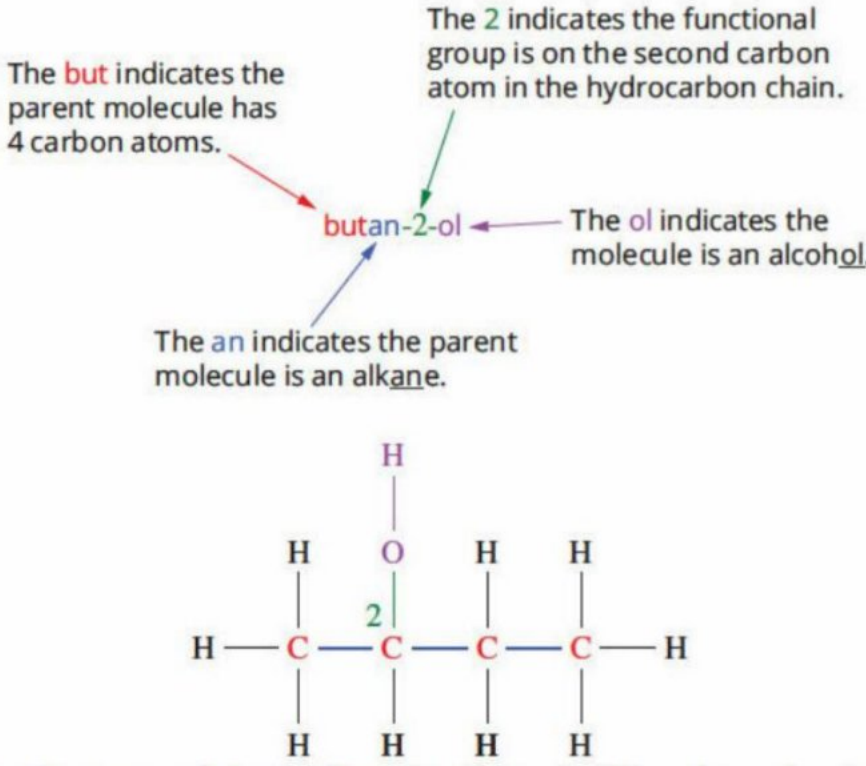
Example
Breaking Down a Name: butan-2-ol
Let's examine how each part of the name butan-2-ol describes the molecule's structure:
- but indicates four carbon atoms in the parent chain
- an indicates the parent molecule is an alkane
- 2 indicates the functional group is on the second carbon atom
- ol indicates the molecule is an alcohol (contains a hydroxyl group)
By reading this name, you can immediately visualize the complete structure of the molecule!
Summary of IUPAC naming rules
When naming organic molecules using IUPAC rules, follow these conventions:
- No spaces in the name (except for two-word names of esters and carboxylic acids)
- The longest carbon chain determines the parent name. For molecules containing alkenes, alcohols, amines, carboxylic acids, aldehydes, ketones and esters, this longest chain must include the functional group.
- Names and locations of branches and additional functional groups are added as prefixes to the parent name.
- Numbers (locants) identify which carbon atom groups are attached to.
- Numbers and letters are separated by dashes.
- Multiple numbers are separated by commas.
- Multiple functional groups or branches are listed in alphabetical order at the beginning of the name.
- For multiple identical functional groups, use prefixes di-, tri-, or tetra-. Each group still needs its position number.
When to omit locants
A locant is a number indicating the location of a functional group. According to IUPAC rules, a locant can only be omitted in specific situations:
Important
Rules for Omitting Locants:
- A locant can be omitted if it is '1' and the location is unambiguous
- If one locant is needed, then all locants should be specified for that molecule
Special case: Carboxyl and aldehyde functional groups are always on the end of a molecule (carbon 1), so locants are never needed for these groups.
For example:
- Locants omitted: butanoic acid, chloromethane, ethanol, pentanal, propene
- Locants required: 2-methylpropane, 2-methylprop-1-ene
Homologous series naming conventions
Different homologous series have characteristic functional groups that determine their naming conventions. A homologous series is a group of organic compounds with the same functional group.
Note
The table below summarises the naming conventions for the major homologous series you'll encounter. Notice how each series has a distinctive way of being represented in the IUPAC name - either as a suffix (ending) or prefix (beginning).
| Homologous series | Functional group name | Semi-structural formula | Naming convention |
|---|---|---|---|
| Alkane | not applicable | not applicable | suffix -ane |
| Alkene | carbon-carbon double bond | suffix -ene | |
| Haloalkane | halo | , , , | prefix fluoro-, chloro-, bromo- or iodo- |
| Alcohol | hydroxyl | suffix -ol; occasionally prefix hydroxy- | |
| Amine | amino | suffix -amine; occasionally prefix amino- | |
| Aldehyde | carbonyl (aldehyde) | suffix -al; occasionally prefix oxo- | |
| Ketone | carbonyl (ketone) | suffix -one; occasionally prefix oxo- | |
| Carboxylic acid | carboxyl | suffix -oic acid | |
| Ester | ester | two-word name with suffixes -yl and -oate |
Trivial versus systematic names
Before IUPAC standardisation, many organic compounds were given trivial names (common names) based on their source, properties, or the circumstances of their discovery. While IUPAC aims for every compound to have a systematic name, some trivial names remain in common use.
Historical context
In the 19th century, chemists named new compounds as they discovered them. For example:
Note
Butyric Acid: From Butter to Chemistry
Butyric acid (now butanoic acid) was named by French chemist Michel Eugène Chevreul in 1818 after isolating it from rancid butter. The name comes from the Latin word butyrum (butter). This compound has the distinctive smell found in vomit and Parmesan cheese - not the most pleasant discovery!
Note
Barbituric Acid: A Saint's Day Discovery
Barbituric acid was synthesised by German chemist Adolf von Baeyer in 1863 from malonic acid and urea on St Barbara's Day (4 December), hence the name. This shows how historical circumstances often influenced the naming of compounds before IUPAC standardisation.
Shape-based trivial names
Some trivial names are based on molecular shapes, providing memorable ways to refer to complex structures:
| Trivial name | Description | IUPAC systematic name | Skeletal structure |
|---|---|---|---|
| Cubane | A hydrocarbon in the shape of a cube | / pentacyclo[4.2.0.0².⁵.0³.⁸.0⁴.⁷]octane | cube shape |
| Housane | Cyclic alkane that looks like a house | / bicyclo[2.1.0]pentane | house shape |
| Olympicene | Five fused rings that resemble the Olympic flag | / 6H-benzo[cd]pyrene | Olympic rings |
While trivial names can be convenient for very complex molecules, IUPAC systematic names are preferred because they provide clear structural information.
Naming molecules with functional groups and alkyl side chains
Many organic molecules contain both functional groups and alkyl side chains (branches). When naming these molecules:
- Identify the longest carbon chain containing the functional group
- Number the chain from the end closest to the functional group
- Place alkyl group names in alphabetical order before the parent name
- Use numbers to indicate positions of both the functional group and branches
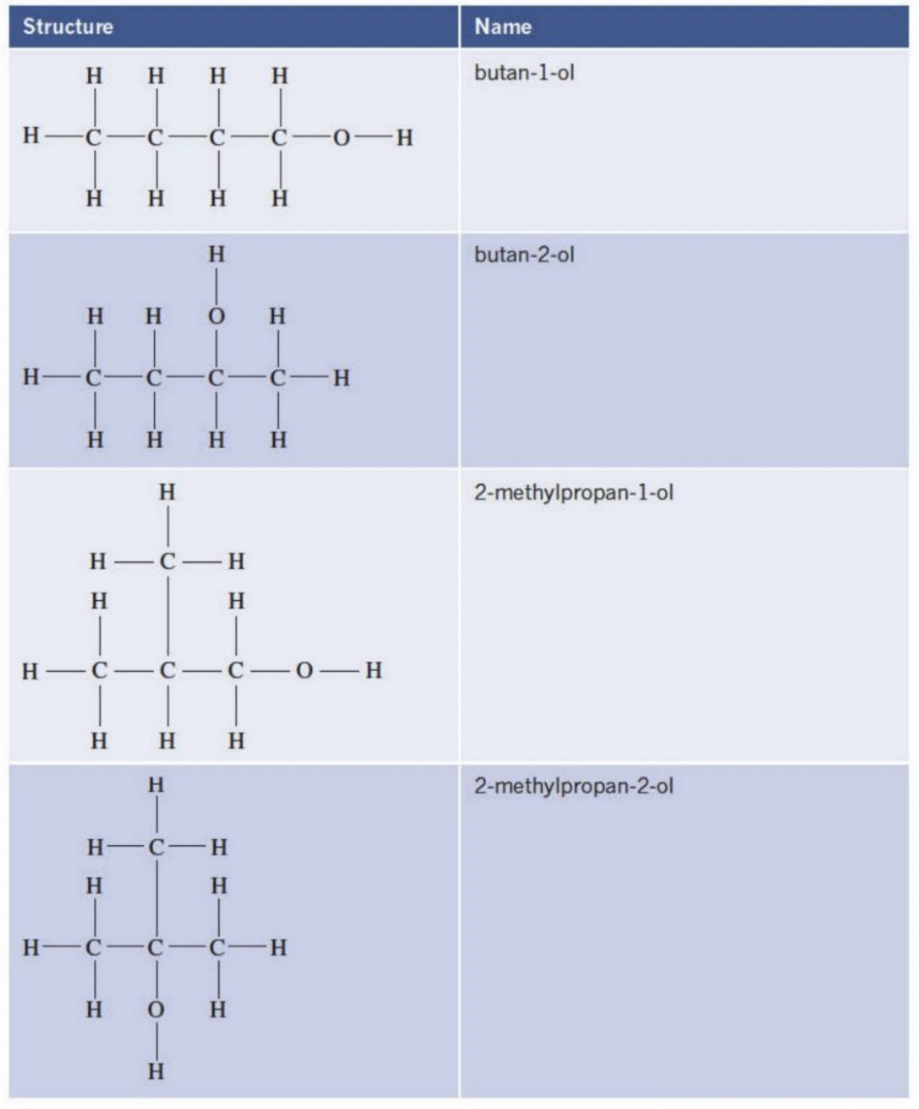
Example
Structural Isomers of
The table above shows structural isomers of an alcohol with molecular formula . Notice how the IUPAC name precisely describes each structure:
- Butan-1-ol: 4-carbon chain, hydroxyl on carbon 1
- Butan-2-ol: 4-carbon chain, hydroxyl on carbon 2
- 2-methylpropan-1-ol: 3-carbon chain with methyl branch on carbon 2, hydroxyl on carbon 1
- 2-methylpropan-2-ol: 3-carbon chain with methyl branch on carbon 2, hydroxyl on carbon 2
Each name uniquely identifies one specific isomer, demonstrating the precision of IUPAC nomenclature.
Naming molecules with two functional groups
When a molecule contains two different functional groups, you must know which functional group has higher priority to name it correctly.
Functional group priority order
IUPAC has established a priority system for functional groups:
| Priority | Functional group | Suffix | Alternative name (when lower priority) |
|---|---|---|---|
| Higher | Carboxyl | -oic acid | — |
| ↓ | Carbonyl on end carbon (aldehyde) | -al | oxo- |
| ↓ | Carbonyl not on end carbon (ketone) | -one | oxo- |
| ↓ | Hydroxyl | -ol | hydroxy- |
| ↓ | Amino | -amine | amino- |
| ↓ | Alkene | -ene | -an- becomes -en- |
| Lower | Halo | — | halo- |
Important
Memory Aid for Priority Order
The priority order from highest to lowest is:
Carboxyl > Aldehyde > Ketone > Hydroxyl > Amino > Alkene > Halo
Memorising this sequence is essential for correctly naming molecules with multiple functional groups. The highest priority group always gets the suffix!
Naming conventions for two functional groups
When naming a molecule with two different functional groups:
- The higher priority functional group receives the lowest possible carbon number
- Use the suffix for the higher priority functional group in the name
- The lower priority functional group is indicated by a prefix or alternative name
Examples of molecules with two functional groups
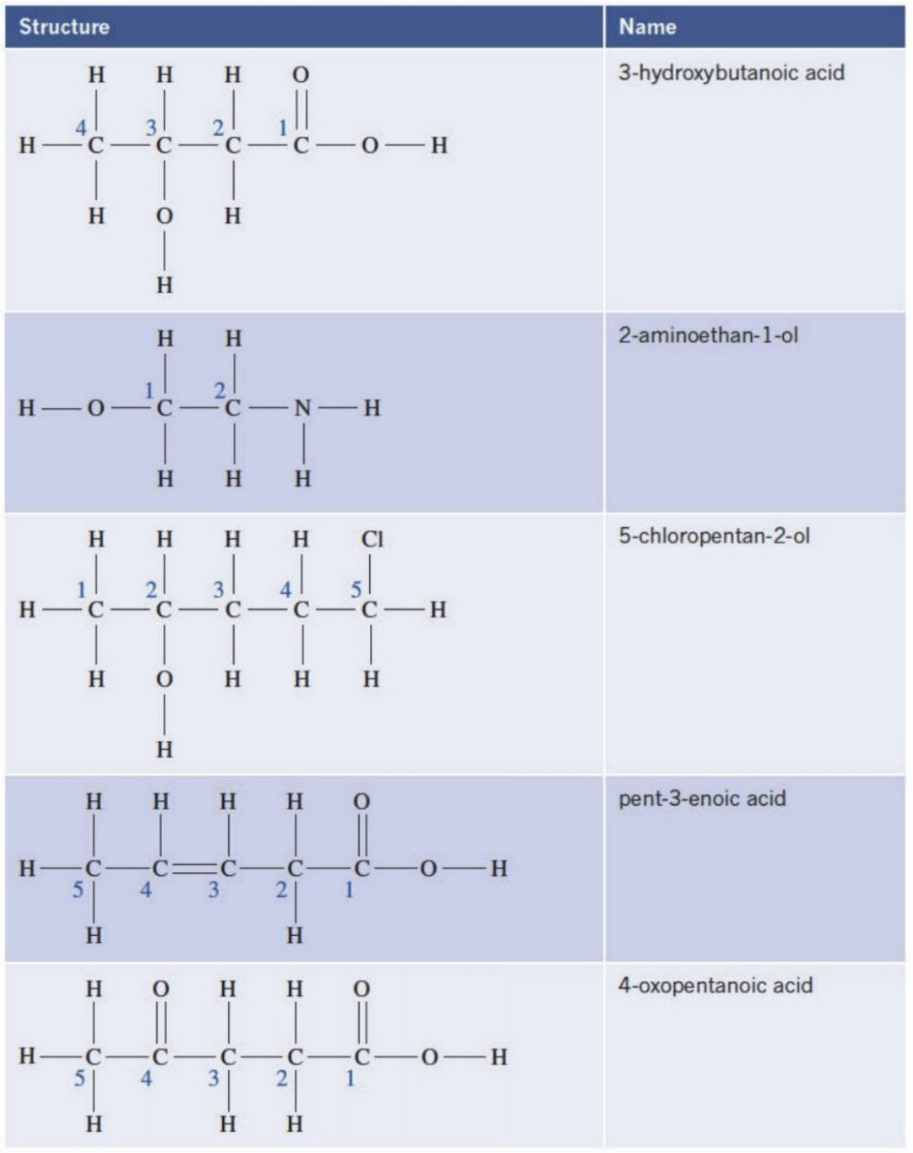
The figure above shows several examples demonstrating the priority system in action:
- 2-aminoethan-1-ol: Hydroxyl (higher priority) on carbon 1 gives suffix -ol; amino group (lower priority) on carbon 2 gives prefix amino-
- 5-chloropentan-2-ol: Hydroxyl (higher priority) on carbon 2 gives suffix -ol; chloro group (lower priority) on carbon 5 gives prefix chloro-
- Pent-3-enoic acid: Carboxyl (highest priority) on carbon 1 gives suffix -oic acid; alkene (lower priority) between carbons 3 and 4 is indicated by -en- in the name
- 4-oxopentanoic acid: Carboxyl (higher priority) on carbon 1 gives suffix -oic acid; ketone (lower priority) on carbon 4 gives prefix oxo-
Worked example: naming with two functional groups
Example
Worked Example: Naming a Molecule with Two Functional Groups
Let's work through naming a molecule with two functional groups systematically.
Question: Name this molecule according to IUPAC rules.
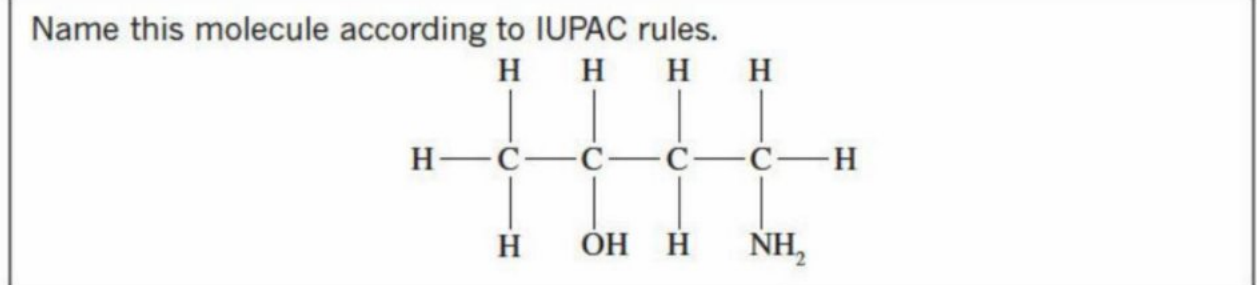
Step 1: Identify the parent name by counting the longest continuous carbon chain.
There are four carbon atoms in the longest chain, so the parent name is butane.
Step 2: Identify the functional groups present.
The two functional groups are hydroxyl () and amino ().
Step 3: Determine which functional group has higher priority.
Looking at the priority table, hydroxyl has higher priority than amino. Therefore:
- The molecule will end with the suffix -ol
- The amino group will be indicated by the prefix amino-
Step 4: Number the carbon chain, giving the higher priority group the lowest possible number.
Number from the left:
The hydroxyl group is on carbon 2, and the amino group is on carbon 4.
Step 5: Construct the full name.
The name is 4-aminobutan-2-ol.
This tells us:
- 4-amino: amino group on carbon 4
- butan: four-carbon parent chain
- 2-ol: hydroxyl group on carbon 2
Remember!
Summary
Key Points to Remember:
-
IUPAC nomenclature provides a standardised system for naming organic compounds that describes their structure uniquely.
-
The basic structure of an IUPAC name includes: parent chain name + position numbers + functional group suffixes/prefixes.
-
Key rules: no spaces (except for esters and acids), longest chain containing functional groups, alphabetical order for multiple groups, use of locants (numbers) to indicate positions.
-
Functional group priority (high to low): Carboxyl > Aldehyde > Ketone > Hydroxyl > Amino > Alkene > Halo. The highest priority group gets the suffix; lower priority groups get prefixes.
-
When naming molecules with two functional groups, number the carbon chain to give the higher priority functional group the lowest possible number, use its suffix in the name, and indicate the lower priority group with a prefix.