Diversity of Organic Compounds (VCE SSCE Chemistry): Revision Notes
📚Revision Notes
Diversity of Organic Compounds
What are organic compounds?
Carbon compounds form the foundation of all life on Earth. In fact, more than 90% of all known chemical compounds contain carbon. Because carbon compounds were first discovered in living organisms, the study of carbon-based substances became known as organic chemistry, and these substances are called organic molecules.
Note
Organic molecules are defined as molecules containing carbon atoms bonded to each other and to other non-metallic atoms through covalent bonds.
Most organic molecules have a hydrocarbon skeleton, meaning they contain carbon and hydrogen as their main components. Common additional elements found in organic molecules include oxygen, nitrogen, sulfur, and chlorine.
Why carbon is special
Electronic structure and bonding capacity
Carbon's unique properties stem from its electronic structure. A carbon atom has 6 electrons in total:
- 2 electrons in the first shell
- 4 electrons in the second (outer) shell
We can write this electronic configuration as 2,4 or as .
Important
This means carbon has four valence electrons (electrons in the outermost shell available for bonding). The valence electron number represents the number of valence electrons in an atom of an element. All four of carbon's valence electrons can participate in chemical bonding.
Carbon's bonding versatility
Carbon's four valence electrons give it remarkable versatility in forming compounds:
- Chain and ring formation: Each carbon atom can bond with up to four other carbon atoms, and each of those can bond with four more carbons. This allows carbon to form long chains, branched structures, and ring-shaped molecules.
- Multiple bond types: Carbon can form single, double, or triple bonds between carbon atoms:
- Saturated molecules contain only single carbon-carbon bonds
- Unsaturated molecules contain one or more double or triple carbon-carbon bonds
- Diverse bonding arrangements: Carbon's four bonds can be arranged in different ways:
- Four single bonds with four different atoms
- One double bond and two single bonds with three atoms
- Two double bonds with two atoms
- One triple bond and one single bond with two atoms
Bond strength and stability
The strength of chemical bonds is measured by bond energy, which is the amount of energy required to break 1 mole of covalent bonds in the gaseous state. Higher bond energy indicates a stronger, more stable bond.
Note
Molecules with strong chemical bonds are generally more stable and less likely to undergo chemical reactions. This is why substances in nature tend to react to form products with stronger bonds overall.
Carbon compared to silicon
Silicon and carbon are similar elements—both are in group 14 of the periodic table and have four valence electrons. However, their bonding characteristics differ significantly:
| Covalent bonds with carbon | Bond energy (kJ mol⁻¹) | Covalent bonds with silicon | Bond energy (kJ mol⁻¹) |
|---|---|---|---|
| 839 | do not form | ||
| 614 | do not form readily | ||
| 348 | 226 | ||
| 413 | 323 | ||
| 360 | 466 |
Key observations from this comparison:
- Silicon cannot readily form multiple bonds with itself
- Carbon-carbon single bonds (348 kJ mol⁻¹) are much stronger than silicon-silicon bonds (226 kJ mol⁻¹)
- The one exception is the bond (466 kJ mol⁻¹), which explains why silicon dioxide (quartz) is such a stable and abundant mineral
Strength of carbon-carbon bonds
The carbon-carbon single bond is exceptionally strong compared to bonds between other atoms of the same type:
| Covalent bonds between atoms of the same type | Bond energy (kJ mol⁻¹) |
|---|---|
| 348 | |
| 163 | |
| 146 | |
| 155 | |
| 226 |
Important
The strength of the bond (348 kJ mol⁻¹) is remarkably high. This exceptional bond strength explains why carbon forms stable chain and ring structures at Earth's temperatures and pressures, making it the fundamental building block of all living organisms.
Summary of carbon's diversity
Carbon forms such a wide variety of compounds because:
- It can form strong, stable bonds with many other elements
- It can form stable single, double, and triple bonds with itself
- The strength of carbon-carbon bonds enables the formation of chain-like and ring-like structures
- Its four valence electrons allow for diverse molecular architectures
Representing organic molecules
Chemists use several different notations to represent organic molecules, each with its own advantages. Understanding these different representations is essential for studying organic chemistry.
Molecular formulas
Molecular formulas show the number and type of each element present in a molecule. For example, and are molecular formulas.
Note
Limitation: Molecular formulas don't show how atoms are arranged or connected in the molecule.
Structural formulas
Structural formulas show the exact arrangement of atoms in a molecule, including the location and type of all covalent bonds.
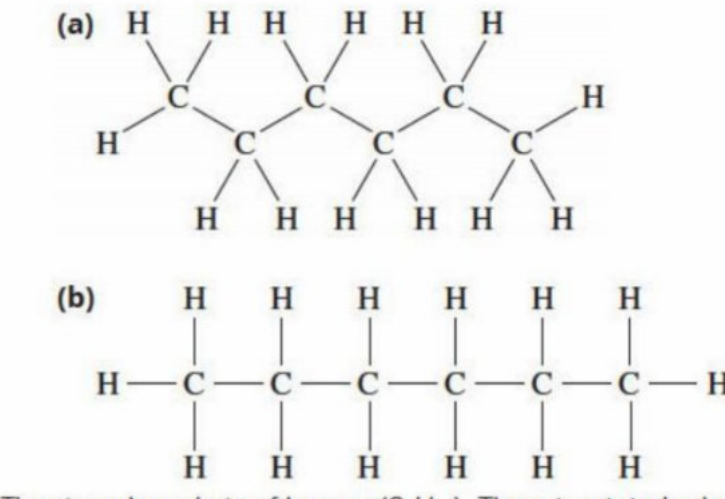
When carbon forms four single bonds, the electron pairs in each bond repel each other (according to VSEPR theory). This causes the bonds to arrange themselves in three dimensions at angles of approximately 109.5° to each other, creating a tetrahedral shape.
Note
Although carbon chains have a three-dimensional zigzag structure (as shown in part a of the diagram above), structural formulas are often drawn with bonds at right angles for simplicity (as shown in part b). This makes complex molecules easier to read and understand, even though it doesn't accurately represent the three-dimensional structure.
Semi-structural formulas
A semi-structural formula (also called a condensed formula) shows the connections between atoms without displaying the full three-dimensional arrangement. This notation is more compact than structural formulas.
In semi-structural formulas:
- The carbon chain is written on one line
- Single bonds are typically not shown
- Double and triple bonds are often shown
- Hydrogen atoms are written next to the carbon they're bonded to
- Branching groups are shown in brackets after the carbon they're attached to
- Repeated groups can be written as
Example
Examples of Semi-Structural Formulas:
- Butane: or
- But-1-ene:
Skeletal structures
Skeletal structures are a shorthand notation used for complex organic molecules. They show only the carbon-carbon bonds and functional groups, making the structure clearer and easier to draw.
What skeletal structures leave out:
- Carbon atoms (implied at each junction and end of lines)
- Hydrogen atoms bonded to carbon atoms
- Bonds between carbon and hydrogen
What skeletal structures show:
- Carbon-carbon single, double, and triple bonds
- Functional groups (groups of atoms that determine the molecule's properties)
- Bonds to and within functional groups
Note
A functional group is an atom or group of atoms that largely determines a molecule's chemical properties and behavior.
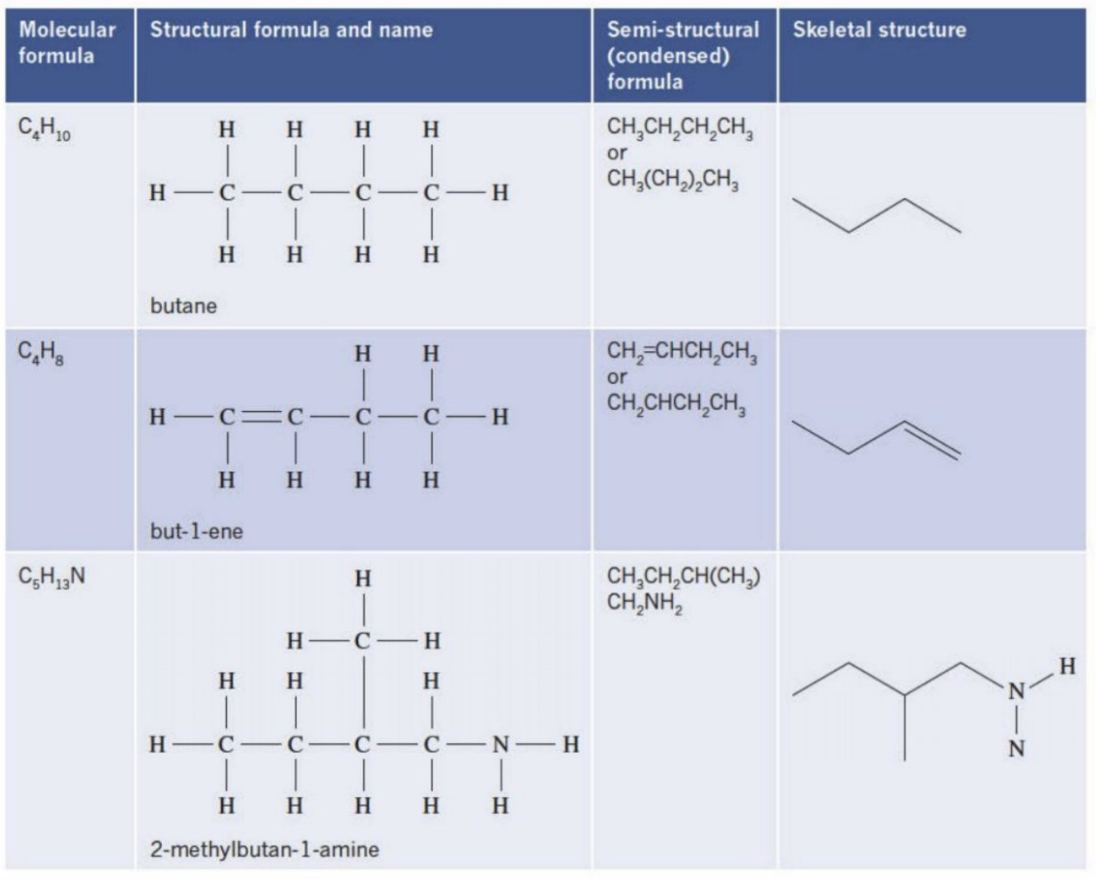
The table above compares all four representation methods for three different molecules, showing how each notation system presents the same chemical information in different ways.
Isomers: same formula, different structure
Isomers are molecules that contain the same number and type of atoms (same molecular formula) but have these atoms arranged in different ways. The existence of isomers is a major reason for the enormous diversity of carbon compounds.
Although isomers have the same molecular formula, they often have different physical and chemical properties because their atoms are connected differently.
Structural isomers
Structural isomers form when atoms with the same molecular formula bond together in different arrangements. You can create structural isomers by:
- Changing the length of the main carbon chain (creating branches)
- Changing the position of functional groups
- Combining both changes
Isomers formed by changing chain length
Carbon chains can branch, creating molecules with the same number of carbon and hydrogen atoms but different chain lengths and structures.
Example
Worked Example: Isomers of Hexane
Hexane () can exist in multiple forms:
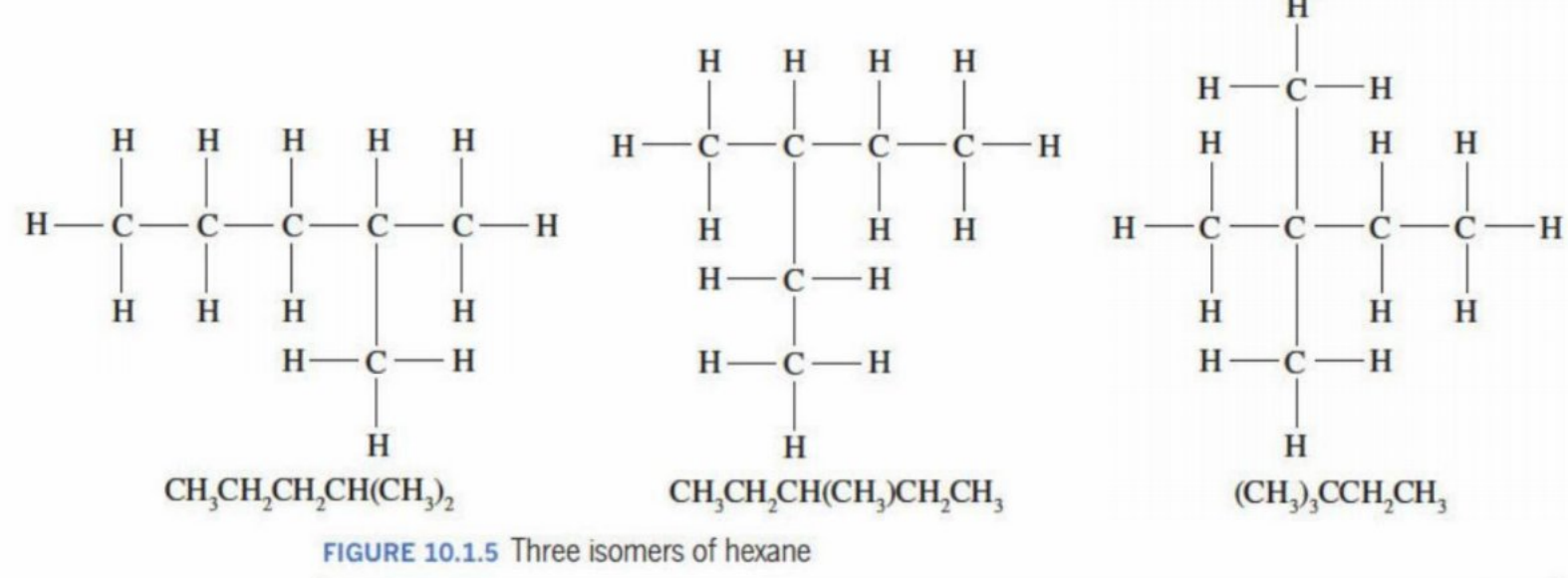
These three isomers of hexane all have the formula , but their carbon atoms are arranged differently:
- The first has a 5-carbon main chain with one branch
- The second has a 5-carbon main chain with the branch in a different position
- The third has a 4-carbon main chain with two branches
Each isomer has a unique name that indicates its specific structure, which you'll learn about in the nomenclature section.
Isomers formed by changing functional group position
When molecules contain functional groups, isomers can form by placing the functional group at different positions along the carbon chain.
Alcohols are organic molecules containing a hydroxyl functional group (). For the molecular formula , several alcohol isomers are possible:
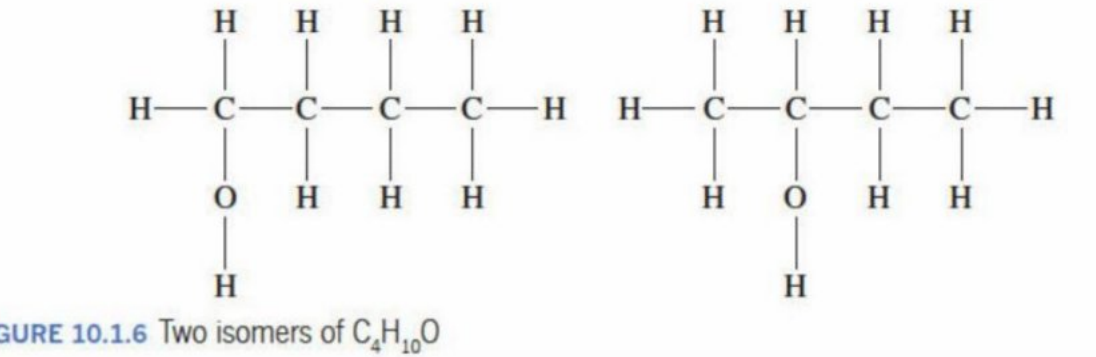
These two isomers show the hydroxyl group attached to different carbon atoms:
- Butan-1-ol: group on the first carbon
- Butan-2-ol: group on the second carbon
Alkenes contain a carbon-carbon double bond, which acts as a functional group. The position of this double bond can also create isomers:
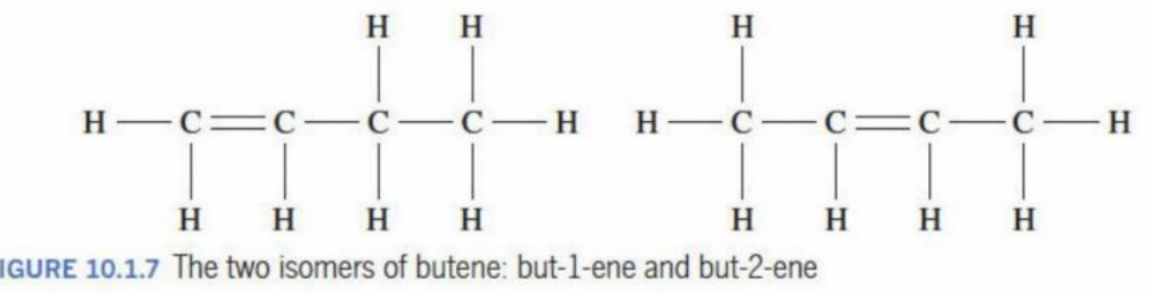
These two butene isomers () have the double bond in different locations:
- But-1-ene: double bond between the first and second carbons
- But-2-ene: double bond between the second and third carbons
Important considerations about isomers
When isomers are possible: Isomers can only exist when:
- The molecule contains a functional group, AND
- The carbon chain is long enough that the functional group can occupy different positions
Important
Avoiding false isomers:
Be careful not to draw the same molecule from different perspectives and call them isomers. For example:
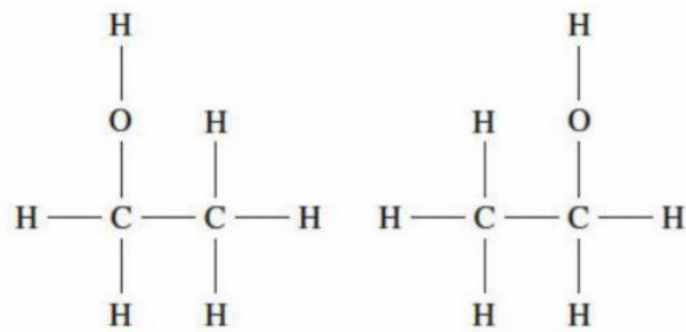
These two drawings of ethanol () are NOT isomers. If you flip the first structure over, it becomes identical to the second. They're simply different ways of drawing the same molecule.
Isomers with multiple changes
It's possible to create isomers by changing both the chain length and the functional group position. Here are two more alcohol isomers with the formula :
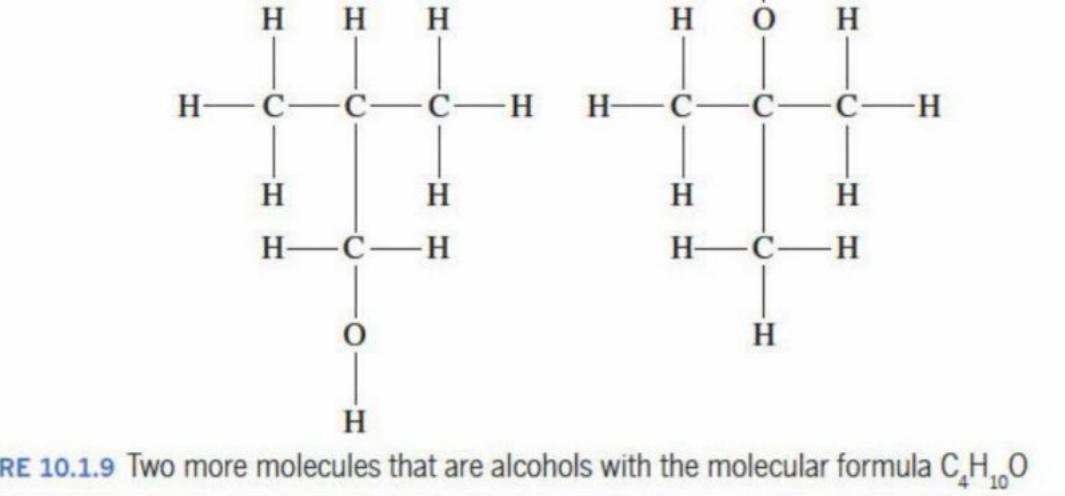
These structures differ from the earlier butanol isomers in both their carbon chain arrangement and the position of the hydroxyl group.
Summary
Key Points to Remember:
-
Organic molecules contain carbon atoms bonded to each other and to other non-metals through covalent bonds, forming the basis of all living systems.
-
Carbon's four valence electrons allow it to form four covalent bonds in multiple arrangements, creating enormous molecular diversity through chains, branches, rings, and single/double/triple bonds.
-
Bond energy measures bond strength. Carbon forms particularly strong C-C bonds (348 kJ mol⁻¹) compared to other elements bonding with themselves, explaining why carbon forms stable chains and rings.
-
Organic molecules can be represented using molecular formulas (showing atom types and numbers), structural formulas (showing all atoms and bonds), semi-structural formulas (condensed notation), or skeletal structures (showing only C-C bonds and functional groups).
-
Isomers have the same molecular formula but different structural arrangements. They can form by changing the carbon chain length (branching) or by changing the position of functional groups along the chain.