Haloalkanes, Alcohols, and Amines (VCE SSCE Chemistry): Revision Notes
📚Revision Notes
Haloalkanes, Alcohols, and Amines
Introduction to functional groups
Organic compounds can be thought of as modified hydrocarbons. In these molecules, one or more hydrogen atoms have been replaced by other atoms or groups of atoms. These replacement groups are called functional groups.
Note
A functional group is a specific atom or group of atoms that replaces hydrogen in a hydrocarbon and determines both the physical and chemical properties of the resulting compound.
The presence of a particular functional group determines the physical and chemical properties of a substance. This is why compounds with the same number of carbon atoms can have completely different characteristics.
Consider this comparison: vinegar and wine both contain organic molecules with two carbon atoms. However, their tastes and properties are completely different. This difference comes from the distinct functional groups present in each molecule. Vinegar contains ethanoic acid with a carboxyl functional group (-COOH), whilst wine contains ethanol with a hydroxyl functional group (-OH).
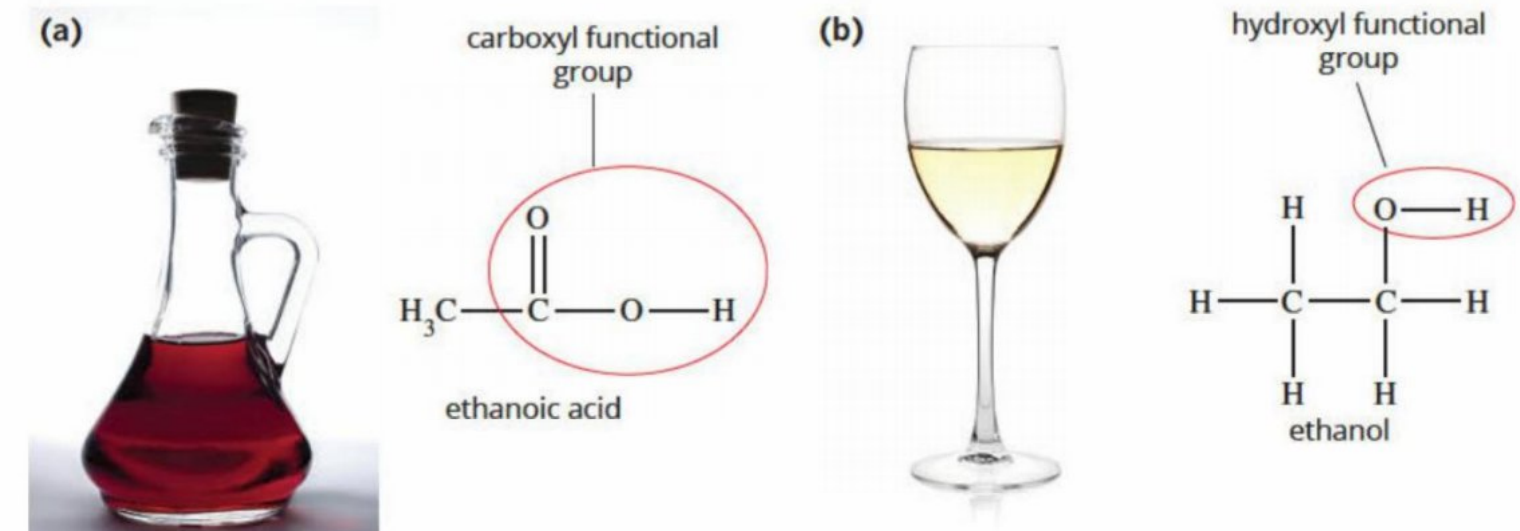
In this topic, we will examine three important homologous series:
- Haloalkanes
- Alcohols
- Primary amines
For each series, you will learn about the characteristic functional group, structural representations, and systematic naming conventions.
Haloalkanes
What are haloalkanes?
Haloalkanes are organic compounds formed when one hydrogen atom in an alkane is replaced by a halogen atom. The halogens that commonly form these compounds are fluorine (F), chlorine (Cl), bromine (Br), and iodine (I). These elements are found in Group 17 of the periodic table and have seven valence electrons, allowing them to form a single covalent bond with carbon atoms.
Note
All halogens are in Group 17 of the periodic table and have seven valence electrons, which allows them to form exactly one covalent bond with carbon atoms in haloalkanes.
Uses and environmental considerations
Haloalkanes have widespread industrial applications, including:
- Flame retardants
- Refrigerants
- Propellants
- Pesticides
- Solvents
- Pharmaceuticals
Important
Environmental Impact of Haloalkanes
Some haloalkanes pose serious environmental concerns. Chlorofluorocarbons (CFCs) and certain other haloalkanes are ozone-depleting substances. For example, bromomethane (CH₃Br) was historically used as a pesticide but has now been phased out due to its harmful effects on the ozone layer.
Naming haloalkanes
When naming haloalkanes, we use specific prefixes derived from the halogen element's name:
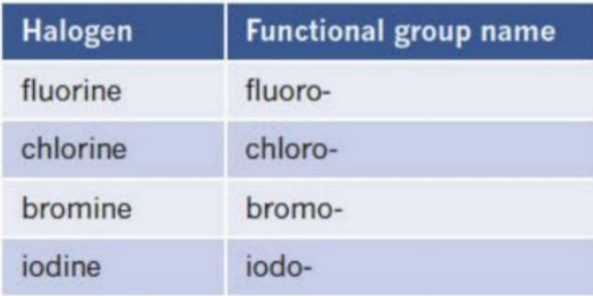
Naming rules for haloalkanes:
- Place the halogen prefix (fluoro-, chloro-, bromo-, or iodo-) at the start of the parent alkane's name.
- If structural isomers are possible, use numbers to indicate which carbon atom the halogen is attached to.
- Number the carbon chain starting from the end closest to the first halogen or alkyl group.
- When multiple identical halogen atoms are present, use the prefixes 'di-' (two), 'tri-' (three), or 'tetra-' (four).
- If different types of halogens or alkyl groups are present, list them in alphabetical order.
Example
Worked Example: Naming a Haloalkane
Consider a compound with the structure: CH₃-CHBr-CH₃
Step 1: Identify the parent chain The longest carbon chain has 3 carbons, so the parent is propane.
Step 2: Identify the halogen and its position Bromine is attached to carbon 2 (numbering from either end gives the same result).
Step 3: Apply the naming rules Replace the parent name with the halogen prefix: 2-bromopropane
Examples of haloalkanes
The following table shows several haloalkanes with their different structural representations:
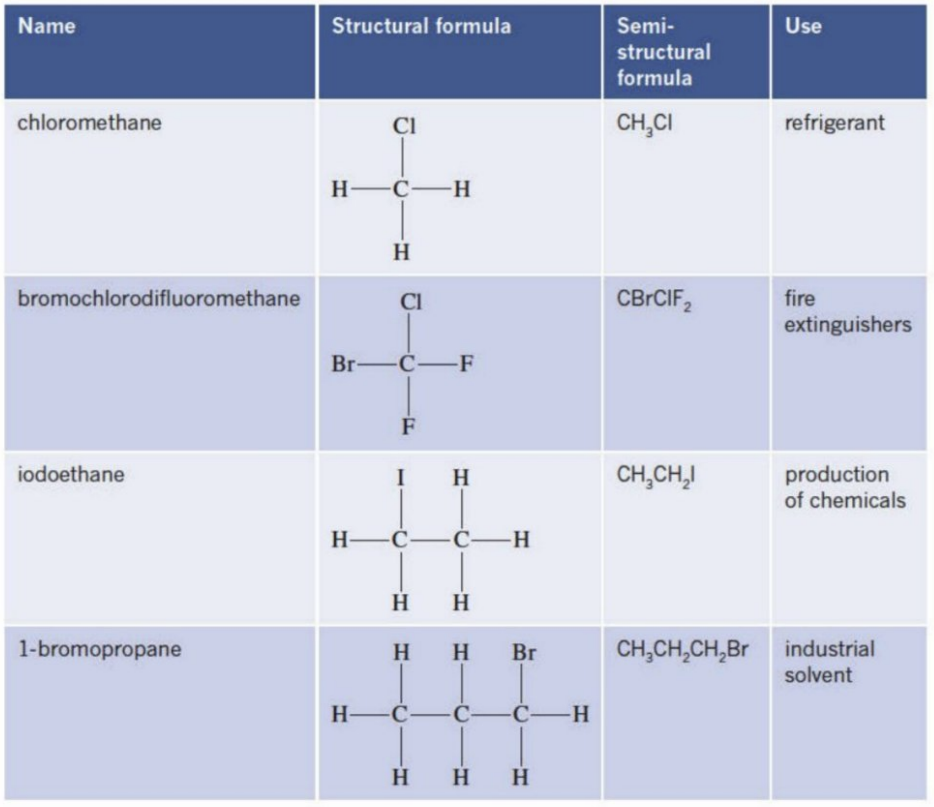
Note
Three Ways to Represent the Same Compound
Notice how the same compound can be represented in three ways:
- Semi-structural formula: Shows groups of atoms (e.g., CH₃CH₂CH₂Br)
- Structural formula: Shows all atoms and bonds explicitly
- Skeletal structure: Uses lines to represent carbon chains, with only heteroatoms (non-carbon, non-hydrogen) shown
All three representations convey the same molecular structure but with different levels of detail.
Alcohols
The hydroxyl functional group
Alcohols are organic compounds containing a hydroxyl functional group (-OH). This group replaces one hydrogen atom in a hydrocarbon chain. The hydroxyl group consists of an oxygen atom bonded to a hydrogen atom, with the oxygen also bonded to a carbon atom in the chain.
Note
The oxygen atom in the hydroxyl group has two pairs of non-bonding electrons, though these are usually not shown in structural formulas. These electron pairs are important for understanding the chemical reactivity of alcohols.
Examples of alcohols
Here are some examples of alcohol structures:
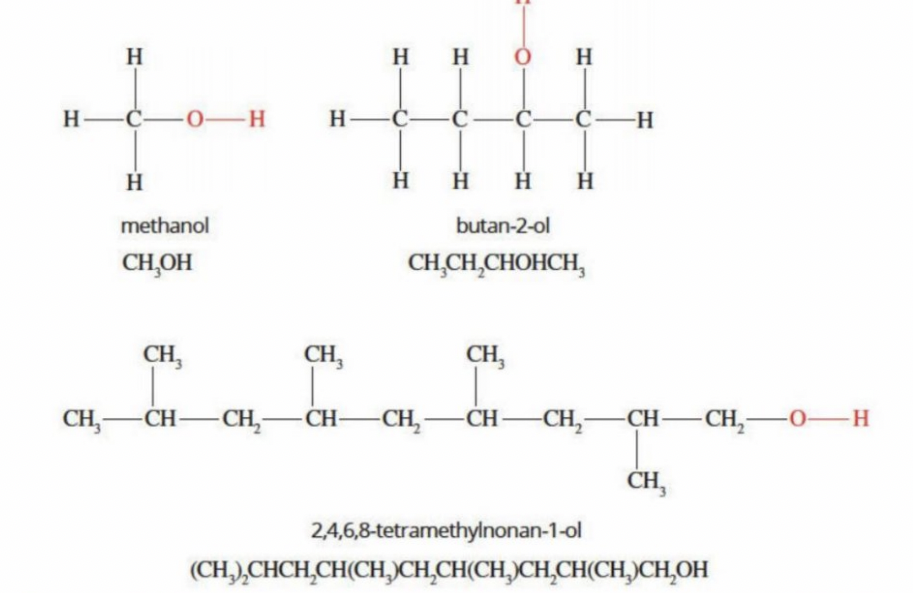
Types of alcohols
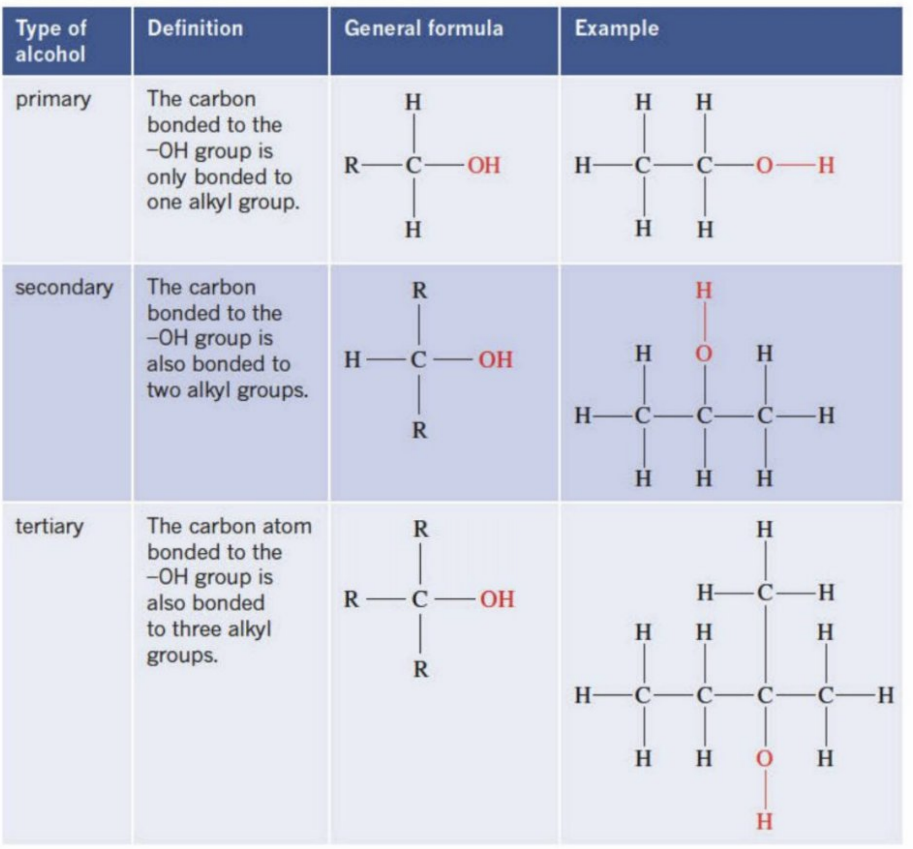
Alcohols are classified into three categories based on the number of alkyl groups attached to the carbon atom that bears the hydroxyl group:
Important
Classification of Alcohols
-
Primary alcohols: The carbon bonded to the -OH group is attached to only one other carbon atom (one alkyl group). This carbon has two hydrogen atoms attached to it.
-
Secondary alcohols: The carbon bonded to the -OH group is attached to two other carbon atoms (two alkyl groups). This carbon has one hydrogen atom attached to it.
-
Tertiary alcohols: The carbon bonded to the -OH group is attached to three other carbon atoms (three alkyl groups). This carbon has no hydrogen atoms attached to it.
In these classifications, R represents an alkyl group (a carbon chain).
Naming alcohols
The naming system for alcohols follows similar principles to alkane naming, with these specific rules:
- Replace the '-e' at the end of the parent alkane's name with the suffix '-ol'.
- Identify the parent chain as the longest carbon chain that contains the hydroxyl group.
- If isomers are possible, insert a number before '-ol' to indicate which carbon bears the hydroxyl group.
- Number the carbon chain starting from the end closest to the hydroxyl group.
Example
Worked Example: Naming an Alcohol
Consider a compound with the structure: CH₃-CH₂-CHOH-CH₃
Step 1: Identify the parent chain The longest carbon chain has 4 carbons, so the parent is butane.
Step 2: Identify the hydroxyl group position The -OH group is on carbon 2 (numbering from the right gives 2, from the left gives 3, so we choose the lower number).
Step 3: Apply the naming rules Replace '-e' with '-ol' and add the position number: butan-2-ol
Examples of alcohol nomenclature
| Name | Formula | Type |
|---|---|---|
| Butan-1-ol | CH₃CH₂CH₂CH₂OH | Primary alcohol |
| Butan-2-ol | CH₃CHOHCH₂CH₃ | Secondary alcohol |
| 2-methylpropan-2-ol | (CH₃)₃COH | Tertiary alcohol |
Note
All three examples above are isomers with the molecular formula C₄H₁₀O, but they have different structures and therefore different properties. This demonstrates how the position and arrangement of functional groups dramatically affects molecular characteristics.
Primary amines
The amino functional group
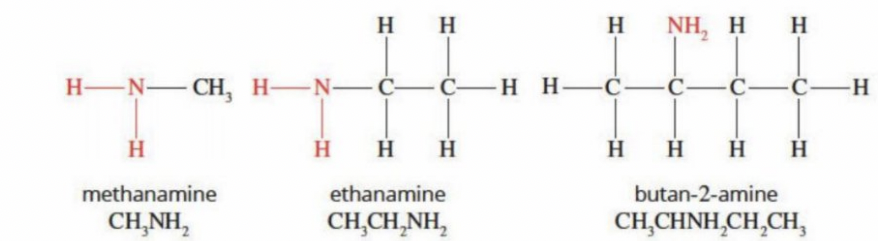
Primary amines are organic compounds containing an amino functional group (-NH₂). This group consists of a nitrogen atom covalently bonded to two hydrogen atoms. The nitrogen atom has one non-bonding pair of electrons.
Note
In primary amines, one carbon atom is bonded to the nitrogen atom. This distinguishes them from secondary and tertiary amines, which have two or three carbon atoms bonded to nitrogen respectively. Only primary amines are covered in this course.
Examples of primary amines
Naming primary amines
The naming system for amines is similar to that used for alcohols:
- Replace the '-e' at the end of the parent alkane's name with the suffix '-amine'.
- If the amino group can be attached to different carbon atoms (creating isomers), insert a number before '-amine' to specify which carbon bears the amino group.
Example
Worked Example: Naming a Primary Amine
Consider a compound with the structure: CH₃-CH₂-CH₂-NH₂
Step 1: Identify the parent chain The longest carbon chain has 3 carbons, so the parent is propane.
Step 2: Identify the amino group position The -NH₂ group is on carbon 1 (the end position).
Step 3: Apply the naming rules Replace '-e' with '-amine': propan-1-amine (or simply propylamine)
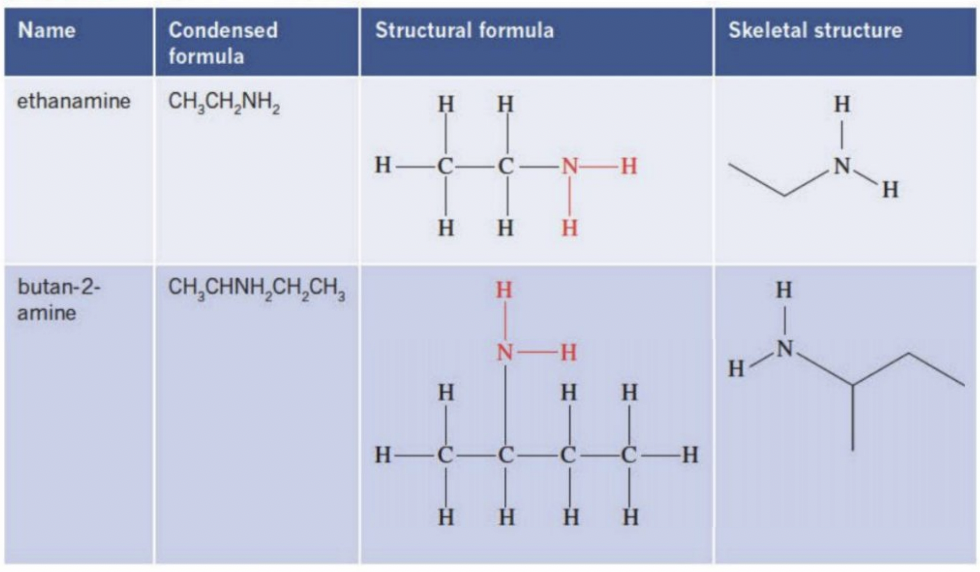
Examples of amine nomenclature
Real-world connection: amines in chocolate
Note
Amines in Everyday Life: The Chemistry of Chocolate
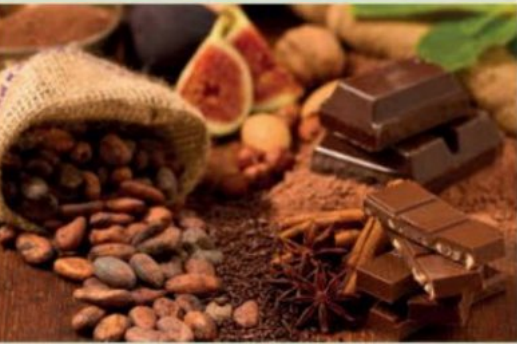
An interesting application of amine chemistry relates to chocolate consumption. Chocolate contains a primary amine called 2-phenylethanamine. This compound is also naturally produced in the pleasure centres of the brain, where it:
- Generates feelings of wellbeing and happiness
- Temporarily raises blood pressure
- Temporarily increases blood glucose levels
When you eat chocolate, you receive a boost of 2-phenylethanamine, which helps explain why chocolate can improve your mood. This is organic chemistry affecting your everyday experience!
Remember!
Summary
Key Points to Remember:
-
Functional groups are atoms or groups of atoms that replace hydrogen in hydrocarbons and determine the chemical and physical properties of organic compounds.
-
Haloalkanes contain halogen atoms (F, Cl, Br, I) in place of hydrogen. They are named using prefixes like fluoro-, chloro-, bromo-, and iodo-. Some haloalkanes damage the ozone layer and have been phased out.
-
Alcohols contain the hydroxyl functional group (-OH) and are classified as primary, secondary, or tertiary based on how many alkyl groups are attached to the carbon bearing the -OH group.
-
Primary amines contain the amino functional group (-NH₂) and are named by replacing the '-e' ending with '-amine'.
-
When naming all three compound types, number the carbon chain from the end closest to the functional group, and use numbers to indicate the position of the functional group when isomers are possible.