Trends in Physical Properties Within Homologous Series (VCE SSCE Chemistry): Revision Notes
📚Revision Notes
Trends in Physical Properties Within Homologous Series
Introduction
The functional groups present in organic compounds play a crucial role in determining their physical properties. For example, ethylene glycol contains two hydroxyl groups (), which give it a relatively high boiling point of . This property makes it useful as a coolant and antifreeze agent when mixed with water in car engines.
Note
This note explores how functional groups influence physical properties such as melting point, boiling point, and viscosity across different homologous series. Understanding these relationships helps explain why different organic compounds behave differently under various conditions.
Physical properties of alkanes, alkenes and haloalkanes
Melting and boiling points of alkanes
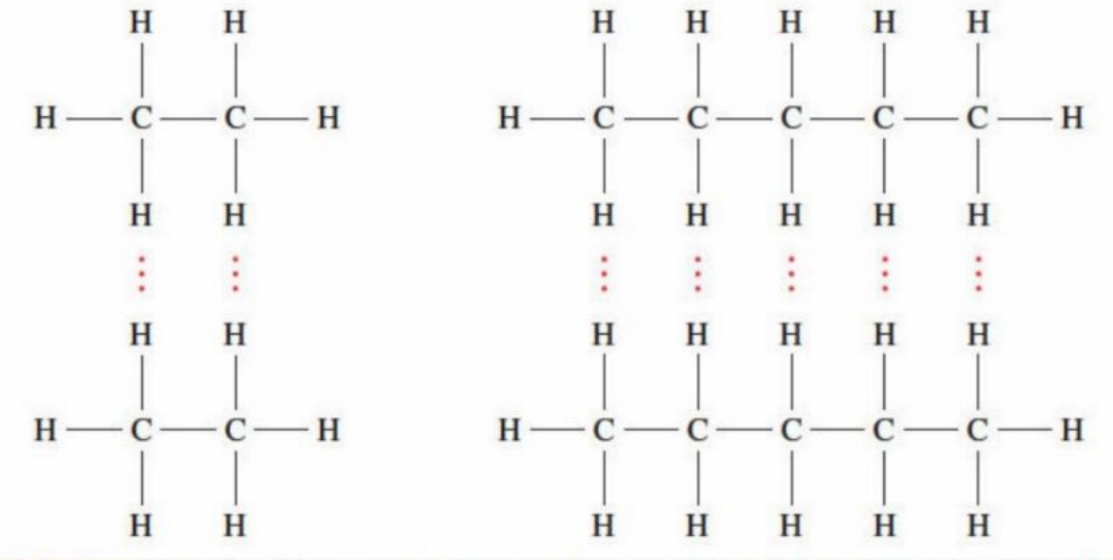
Alkanes and alkenes are hydrocarbons and are non-polar molecules. Because they lack polarity, the only intermolecular forces between them are weak dispersion forces (also called van der Waals forces). These weak forces significantly influence their melting and boiling points.
The table below shows the melting and boiling points of the first six alkanes:
| Alkane | Molecular formula | Melting point () | Boiling point () |
|---|---|---|---|
| Methane | |||
| Ethane | |||
| Propane | |||
| Butane | |||
| Pentane | |||
| Hexane |
Important
As the carbon chain length increases, both melting and boiling points increase. This fundamental trend occurs because:
- More points of contact exist between longer molecules
- Stronger dispersion forces develop due to increased temporary dipoles within larger molecules
- Greater energy is required to overcome these stronger intermolecular forces
The graph below illustrates how melting and boiling points increase with chain length:
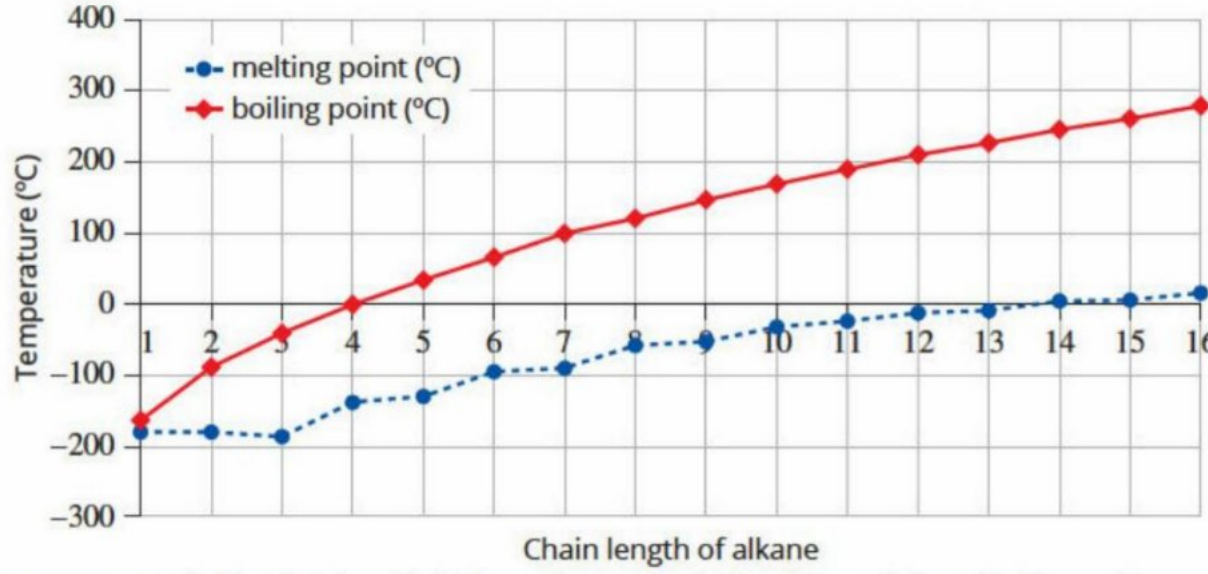
Note
Small irregularities appear in the melting point trend for methane to propane due to how these small molecules pack together in the solid state. Understanding these irregularities is not required at this level.
Effect of molecular shape on boiling points
Molecular shape significantly influences the strength of dispersion forces. Straight-chain alkanes can fit together more closely than branched-chain alkanes, leading to higher boiling points.
Example
Worked Example: Comparing Isomers
Consider butane and its branched isomer, methylpropane (both have the formula ):
- Butane (): boiling point =
- Methylpropane (): boiling point =
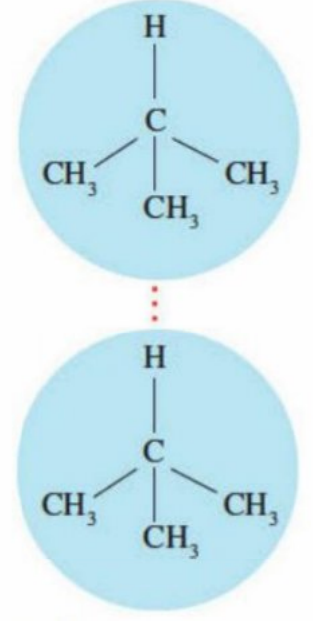
Explanation: Butane molecules are less compact and more linear, allowing them to come closer together. This creates stronger dispersion forces and a higher boiling point. Methylpropane molecules are more compact and cannot approach each other as closely, resulting in weaker dispersion forces and a lower boiling point.
Important
Key principle: The strength of dispersion forces between molecules depends on both the size and shape of the molecules.
Melting and boiling points of alkenes and haloalkanes
Alkenes, like alkanes, are hydrocarbons with non-polar molecules. They exhibit similar melting and boiling points to alkanes with the same number of carbon atoms, as shown in the table below:
| Compound | Melting point () | Boiling point () |
|---|---|---|
| Butane () | ||
| But-1-ene () | ||
| Chlorobutane () |
Haloalkanes, however, contain polar bonds. For example, chloromethane contains a polar carbon-chlorine bond:
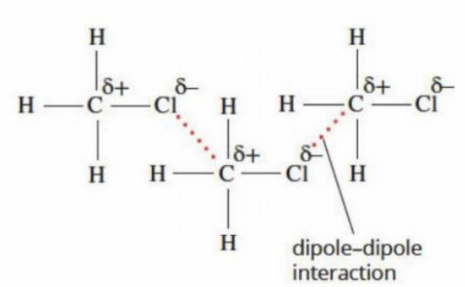
The chlorine atom is more electronegative than carbon, creating a permanent dipole. This allows dipole-dipole attractions to occur between molecules in addition to dispersion forces.
Note
Since dipole-dipole attractions are stronger than dispersion forces alone, haloalkanes generally have higher melting and boiling points than alkanes with a similar number of carbon atoms.
Important
Important trend: As the hydrocarbon chain length increases in any homologous series, melting and boiling points increase due to stronger dispersion forces.
Viscosity of alkanes, alkenes and haloalkanes
Viscosity is defined as a liquid's resistance to pouring or flowing. A liquid that pours slowly (like honey or tomato sauce) is described as viscous or having high viscosity. Petrol, by contrast, has low viscosity and pours quickly.
The viscosity of a liquid depends on the interactions between its molecules. Like boiling point, viscosity increases as the forces of attraction between molecules increase.
As the carbon chain length increases:
- More points of contact exist between molecules
- Dispersion forces become stronger
- Viscosity increases
The diagram below illustrates this concept:
Shorter hydrocarbon chains:
- Fewer contact points between molecules
- Weaker overall dispersion forces
- Lower viscosity
Longer hydrocarbon chains:
- More contact points between molecules
- Stronger overall dispersion forces
- Higher viscosity
Industrial application: petroleum fractions
Crude oil contains a mixture of hydrocarbons with different chain lengths. During fractional distillation, molecules of similar size are separated based on their boiling points. The table below shows different fractions and their uses:
| Fraction | Composition | Boiling range () | Uses |
|---|---|---|---|
| Gas | Heating fuel, LPG | ||
| Petrol | Motor fuel/petrol | ||
| Kerosene | Jet and diesel fuel | ||
| Heating fuel oils | Diesel fuel, heating fuel oil | ||
| Lubricating oils | Lubrication | ||
| Paraffin waxes | — | Candles, wax | |
| Bitumen | Above | — | Roofing tar, road surfaces |
Note
Molecules with carbon atoms form fractions suitable for use as lubricating oils. The high viscosity of these oils enables them to form a protective layer over metal parts, reducing friction and wear.
Effect of temperature on viscosity
As temperature increases, viscosity decreases. This occurs because:
- Molecules gain more kinetic energy
- Molecules move more quickly
- Contact time between molecular chains decreases
- Dispersion forces are disrupted
- Weaker forces of attraction result in decreased viscosity
Note
Engine oils must be specially formulated with a mixture of organic compounds and additives to maintain effective lubrication at both low and high temperatures.
Physical properties of alcohols, carboxylic acids, amines and amides
These four homologous series are considered together because their molecules contain functional groups capable of forming hydrogen bonds. This ability has a profound effect on their physical properties.
Understanding hydrogen bonding
Hydrogen bonds are the strongest type of intermolecular force. Molecules that can form hydrogen bonds generally exhibit much higher boiling points than those that cannot.
Compare the following compounds with similar molecular masses:
| Homologous series | Compound | Formula | Molar mass () | Melting point () | Boiling point () |
|---|---|---|---|---|---|
| Alkane | Butane | ||||
| Alcohol | Propan-1-ol | ||||
| Carboxylic acid | Ethanoic acid | ||||
| Amine | Propan-1-amine | ||||
| Amide | Ethanamide |
Important
Notice that compounds capable of hydrogen bonding (alcohols, carboxylic acids, amines, amides) have significantly higher boiling points than butane, despite having similar molecular masses. This demonstrates the powerful effect of hydrogen bonding on physical properties.
Melting and boiling points of alcohols
Alcohols contain the hydroxyl functional group (). The oxygen atom is more electronegative than hydrogen, making the bond polar. This creates a permanent dipole that enables hydrogen bonding between molecules.
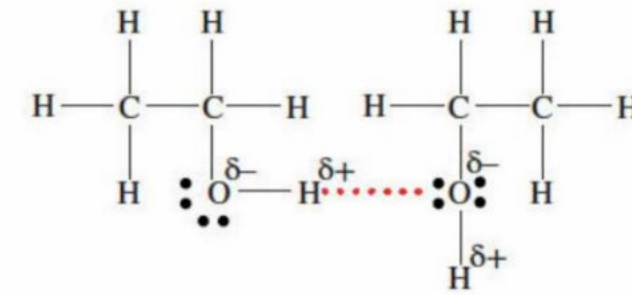
The diagram shows hydrogen bonding between ethanol molecules. The partially positive hydrogen atom () in one group is attracted to a lone pair of electrons on the oxygen atom () of a neighbouring molecule. These hydrogen bonds are much stronger than dispersion forces, resulting in higher melting and boiling points for alcohols.
Viscosity of alcohols
Alcohols are more viscous than alkanes with the same number of carbon atoms due to the strength of intermolecular hydrogen bonding.
Example
Real-World Example: Honey
Honey demonstrates the effect of hydrogen bonding on viscosity. Approximately of honey consists of glucose, fructose, and other sugars. These molecules contain many hydroxyl groups.
Explanation: The numerous hydroxyl groups form extensive hydrogen bonds between molecules, contributing significantly to honey's high viscosity.
Melting and boiling points of amines and amides
Both amines and amides contain polar nitrogen-hydrogen bonds, enabling hydrogen bond formation.
In amines: Hydrogen bonds form between the lone pair of electrons on the electronegative nitrogen atom and the partially positive hydrogen atom on another amine molecule.
In amides: Hydrogen bonds form between the lone pair of electrons on the oxygen atom of one molecule and the partially positive hydrogen atom on a neighbouring molecule.
Note
The strength of hydrogen bonding explains the relatively high boiling points and viscosities of amines and amides compared to hydrocarbon molecules of similar size.
Melting and boiling points of carboxylic acids
Carboxylic acids exhibit particularly high boiling points due to dimer formation. In the liquid state, two carboxylic acid molecules can form a stable unit called a dimer, held together by two hydrogen bonds:
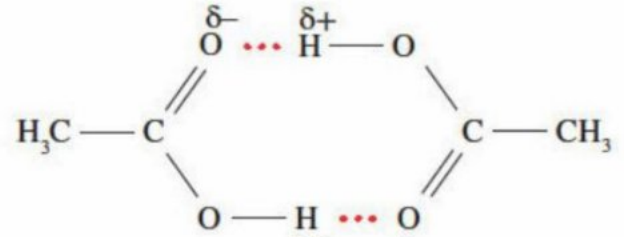
The dimer has double the molar mass of a single carboxylic acid molecule. This increased size leads to:
- Stronger dispersion forces between dimers
- Combined effect of hydrogen bonds and dispersion forces
- Higher boiling points and viscosity compared to other organic molecules of similar size
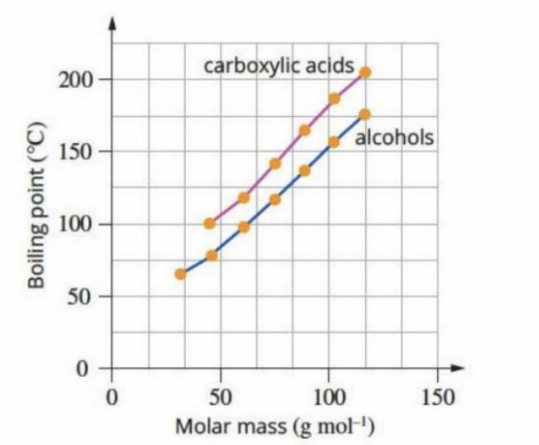
The graph below compares the boiling points of carboxylic acids and alcohols:
Important
Both series show increasing boiling points with increasing molar mass, but carboxylic acids consistently have higher boiling points due to dimer formation.
Effect of hydrocarbon chain branching on boiling points
The position and degree of branching in a molecule affects its boiling point. This is particularly noticeable in alcohols.
Example
Worked Example: Branching in Butanol Isomers
Consider three isomers of butanol ():
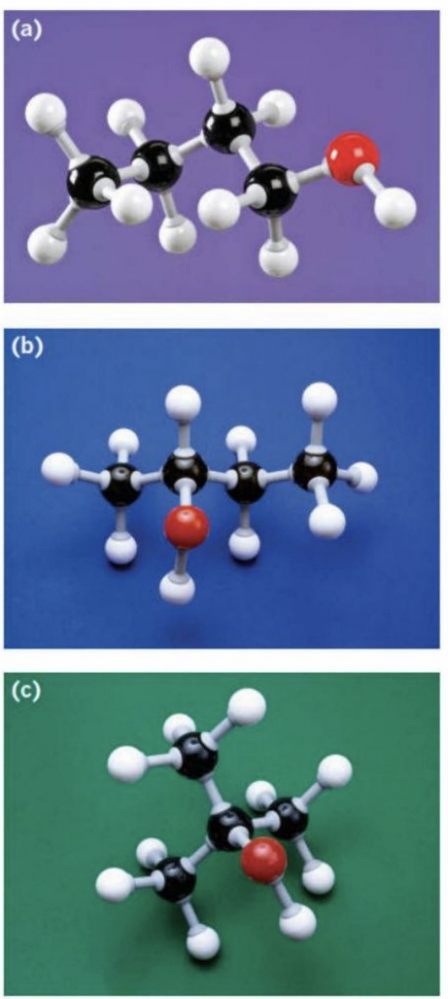
| Alcohol | Type of alcohol | Boiling point () |
|---|---|---|
| Butan-1-ol | Primary | |
| Butan-2-ol | Secondary | |
| 2-methylpropan-2-ol | Tertiary |
Explanation: As the hydroxyl group becomes increasingly "crowded" by alkyl groups (from primary to secondary to tertiary), its ability to form hydrogen bonds with other molecules is restricted. This explains why boiling points decrease in the sequence: primary > secondary > tertiary alcohols.
Additionally, branched isomers cannot fit as closely together as straight-chain molecules, resulting in weaker dispersion forces and lower boiling points.
Physical properties of aldehydes, ketones and esters
Aldehydes, ketones, and esters are considered together because their molecules are held together by dipole-dipole attractions. Unlike alcohols and carboxylic acids, these molecules cannot form hydrogen bonds with each other because they lack a hydrogen atom bonded directly to oxygen or nitrogen.
Melting and boiling points of aldehydes, ketones and esters
All three groups contain a carbon-oxygen double bond (), called a carbonyl group. Since oxygen is much more electronegative than carbon, this bond is polar, creating a permanent dipole in the molecule.
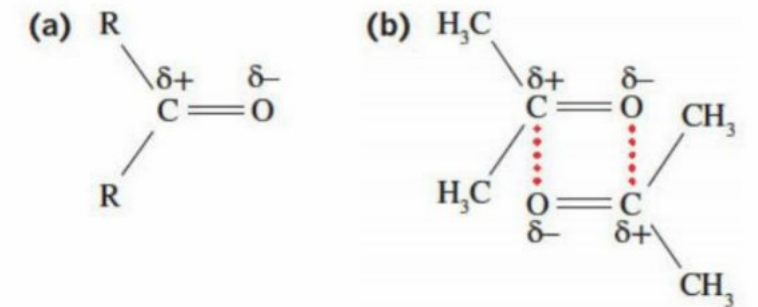
The diagram shows how dipole-dipole attractions occur between ketone molecules. The partially positive carbon atom () of one molecule is attracted to the partially negative oxygen atom () of another.
Note
These dipole-dipole attractions give aldehydes, ketones, and esters higher boiling points than similar-sized alkanes. However, their boiling points are not as high as similar-sized alcohols because dipole-dipole bonds are weaker than hydrogen bonds.
The table below compares boiling points across different functional groups:
| Homologous series | Semi-structural formula | Molar mass () | Boiling point () |
|---|---|---|---|
| Alkane | |||
| Alcohol | |||
| Aldehyde | |||
| Ketone | |||
| Ester |
Important
Ranking of boiling points: Alcohols > Aldehydes ≈ Ketones > Esters > Alkanes
This ranking reflects the relative strengths of the intermolecular forces present in each type of compound.
Effect of chain length on boiling point
As with other homologous series, increasing the hydrocarbon chain length in aldehydes, ketones, and esters leads to increased boiling points. This occurs because:
- More contact points exist between longer hydrocarbon chains
- Dispersion forces increase overall
- More energy is required to separate molecules
Note
This trend is consistent across all organic homologous series studied, demonstrating the universal importance of dispersion forces.
Remember!
Summary
Key Points to Remember:
Intermolecular force strength:
- Hydrogen bonding > Dipole-dipole attractions > Dispersion forces
Chain length effect:
- Within any homologous series, increasing carbon chain length leads to higher melting points, boiling points, and viscosity due to stronger dispersion forces
Molecular shape matters:
- Straight-chain molecules have higher boiling points than branched isomers because they can pack more closely together
- For alcohols: Primary > Secondary > Tertiary (boiling points)
Functional groups determine properties:
- The type of intermolecular forces present (dispersion, dipole-dipole, hydrogen bonding) depends on the functional group and greatly influences physical properties
Hydrogen bonding compounds:
- Alcohols, carboxylic acids, amines, and amides all form hydrogen bonds and have significantly higher boiling points than similar-sized alkanes
- Carboxylic acids form dimers, giving them the highest boiling points
Temperature and viscosity:
- As temperature increases, viscosity decreases due to increased molecular kinetic energy