Heat Capacity (VCE SSCE Chemistry): Revision Notes
📚Revision Notes
Heat Capacity
Introduction
Water has a remarkably high heat capacity, which is one of the key properties that makes it essential for life on Earth. Heat capacity refers to how much heat energy a substance can absorb before its temperature changes significantly. Water can soak up large amounts of heat energy whilst experiencing only small temperature increases.
You've probably noticed this property at the beach on a hot summer's day. The dry sand can be scorching hot under your feet, whilst the shallow water at the sea's edge remains pleasantly cool. Both the sand and water receive similar amounts of heat energy from the Sun, but they respond very differently because they have different heat capacities.
Note
This everyday observation at the beach perfectly demonstrates the concept of heat capacity. The sand heats up quickly and becomes uncomfortable to walk on, while the water remains cool despite receiving the same amount of solar energy. This difference in behavior is what we mean when we say substances have different heat capacities.

Comparing the heat capacity of different substances
Heat capacity measures a substance's ability to absorb and store heat energy. When you apply the same amount of heat energy to two different substances, they will undergo different temperature changes depending on their heat capacities.
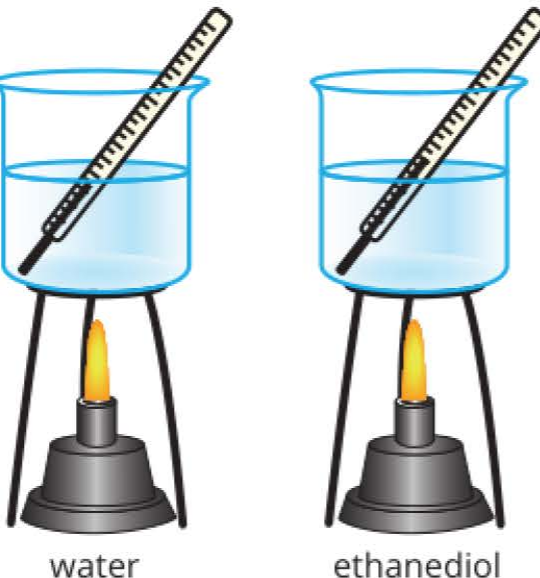
We can demonstrate this in the laboratory by comparing water with ethanediol (a liquid used as coolant in car radiators). Water has a higher heat capacity than ethanediol. When we heat of each liquid with identical amounts of energy, the water's temperature increases by a smaller amount than the ethanediol's temperature. This is shown in the experimental setup below.
Note
Experimental Observation:
The graph from this experiment clearly shows that when both liquids receive the same energy input, ethanediol's temperature rises much more steeply than water's temperature. This confirms that water has the higher heat capacity.
Specific heat capacity
Definition and units
Specific heat capacity is a more precise way of measuring how substances respond to heat energy. It tells us exactly how much energy (measured in joules) is needed to raise the temperature of of a substance by .
The units for specific heat capacity are joules per gram per degree Celsius:
Heat capacity values for common substances
Different materials have very different specific heat capacities, which reflects their internal structure and bonding. Here are some examples:
Metals:
- Iron:
- Copper:
- Aluminium:
Molecular substances:
- Water:
- Ethanediol (antifreeze):
- Chlorofluorocarbon (CCl₂F₂):
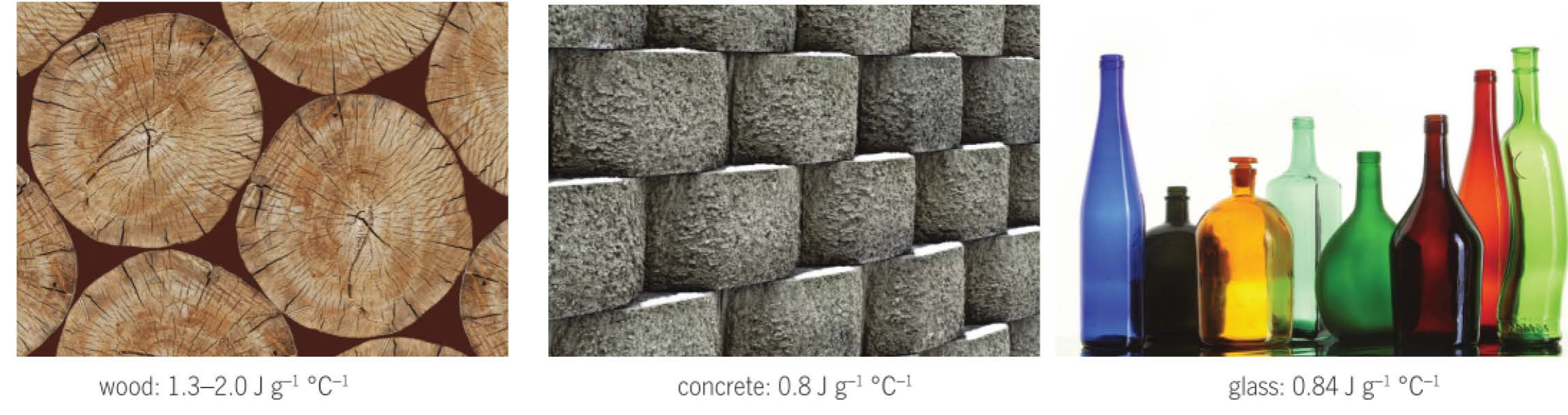
Composite materials:
- Wood:
- Concrete:
- Glass:
Important
Notice that water has one of the highest specific heat capacities of all common substances. This high value is directly related to water's molecular structure and is the reason water plays such a crucial role in regulating Earth's climate and supporting life.
Why does water have such a high heat capacity?
The specific heat capacity of a substance depends on the types of bonds holding its molecules, ions, or atoms together. For molecular substances like water, the heat capacity depends on the strength of the intermolecular forces between molecules.
Water's unusually high specific heat capacity is due to the extensive network of hydrogen bonds between water molecules. Hydrogen bonds are stronger than other types of intermolecular forces. When heat energy is added to water, much of that energy is used to stretch and vibrate these hydrogen bonds rather than increasing the kinetic energy of the molecules (which would raise the temperature).
Note
The Role of Hydrogen Bonds:
The hydrogen bonds in water can absorb and store large amounts of heat energy before they break, resulting in only small temperature changes. This is why water is so effective at moderating temperature changes in both biological systems and the environment.
Calculations using specific heat capacity
The heat capacity formula
Heat energy is represented by the symbol . We can calculate the heat energy needed to change the temperature of a substance using this formula:
Using symbols:
where:
- = amount of heat energy in joules (J)
- = mass in grams (g)
- = specific heat capacity ()
- = temperature change in degrees Celsius (°C)
Working with water volumes
Because water is a liquid, we often measure it by volume (in mL or L) rather than by mass. Fortunately, water has a convenient property that makes conversions easy:
This means:
Note
This 1:1 relationship between millilitres and grams is unique to water at room temperature and makes calculations much more straightforward. For other liquids, you would need to know the density to convert between volume and mass.
Worked example
Question: Calculate the heat energy, in kJ, needed to increase the temperature of of water by .
Example
Worked Example: Calculating Heat Energy for Water
Step 1: Identify the specific heat capacity of water
Step 2: Apply the formula
Step 3: Convert from joules to kilojoules
To convert from J to kJ, multiply by :
Answer:
Important
Exam tip: Always check your units carefully. If the question asks for kJ but you've calculated in J, remember to convert by dividing by 1000 (or multiplying by ). Many students lose marks by forgetting this crucial final step.
Practical applications
Water as a coolant in car engines
Water's high heat capacity makes it an excellent coolant for car engines. When fuel combusts in an engine, it releases enormous amounts of heat energy through a highly exothermic reaction. If this heat isn't removed, the engine will overheat and suffer permanent damage.
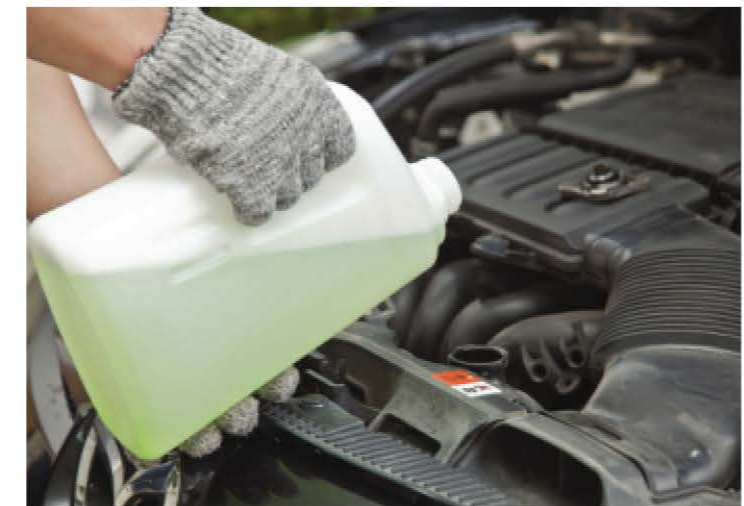
Water circulates through the engine via a system of pipes, absorbing excess heat energy. Because of its high heat capacity, water can absorb large amounts of this heat without its own temperature rising too much. The heated water then flows to the radiator, where the heat energy transfers from the water to the metal radiator and then to the air passing through the vehicle's grill.
Note
Practical Tip:
Interestingly, this is also why some drivers in the past would turn on the car heater during very hot weather when the engine was overheating. The heater diverts some of the heat energy away from the engine and into the passenger compartment, helping to cool the engine down. While uncomfortable for the passengers, this technique can prevent serious engine damage in an emergency!
Remember!
Summary
Key Points to Remember:
-
Heat capacity measures how much heat energy a substance can absorb before its temperature changes significantly.
-
Specific heat capacity is the energy needed to raise of a substance by , measured in .
-
Water has a very high specific heat capacity of due to its strong hydrogen bonding network.
-
The formula for calculating heat energy is:
-
Water's high heat capacity makes it essential for life on Earth and useful in practical applications like engine cooling systems.