Length of an Arc and Area of a Sector (VCE SSCE General Mathematics): Revision Notes
📚Revision Notes
Length of an Arc and Area of a Sector
Introduction
This topic explores two important measurements related to circles: the length of an arc and the area of a sector. Understanding these concepts allows you to calculate distances along curved portions of circles and find areas of wedge-shaped regions. These skills are essential for solving real-world problems involving circular shapes.
Note
Learning Intentions:
By the end of this topic, you will be able to:
- Find the length of an arc
- Find the area of a sector
Length of an arc
An arc is a curved section of a circle's circumference. When you cut out a portion of a circle's edge, that curved line is called an arc.
Understanding arc length
Remember that a circle's circumference equals , where is the radius. An arc represents only part of this total circumference. The fraction of the circumference represented by an arc depends on the central angle.
If an arc corresponds to an angle of at the centre of the circle, then the arc represents of the complete circumference.
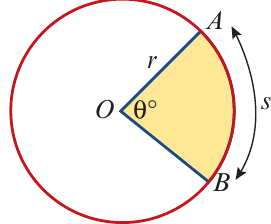
Note
The central angle determines what fraction of the circle's circumference your arc covers. A 90° angle gives you a quarter of the circumference, while a 180° angle gives you half.
Arc length formula
Important
Arc Length Formula
The length, , of an arc of a circle with radius , where the arc creates an angle of at the centre, is given by:
Where:
- represents the arc length
- is the radius of the circle
- is the central angle in degrees
- The formula gives you the distance along the curved arc
Worked example: Calculating arc length
Example
Worked Example: Finding Arc Length
Problem: A circle has its centre at point O and a radius of 10 cm. The arc ACB forms an angle of 120° at point O. Find the length of arc ACB to one decimal place.
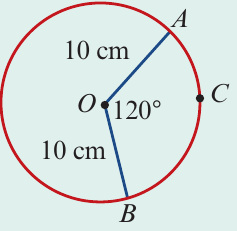
Solution:
Step 1: Write down the formula.
Step 2: Substitute the known values ( and ).
Answer: The arc length is approximately 20.9 cm.
Area of a sector
A sector is a wedge-shaped region of a circle, similar to a slice of pie or pizza. It consists of two radii and the arc connecting them.
Minor and major sectors
When a circle is divided by two radii, it creates two sectors:
- The minor sector is the smaller region
- The major sector is the larger region
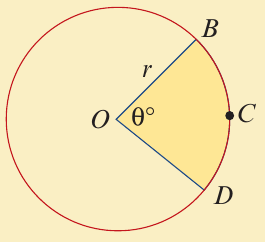
In the diagram above, the yellow shaded region shows a sector. The sector is bounded by two radii extending from the centre O to points on the circumference, and by the arc BCD connecting these points.
Note
Think of sectors as slices of a circular pie. The minor sector is the smaller slice, and the major sector is the larger slice when you cut the pie along two lines from the centre.
Sector area formula
The area of a sector is a fraction of the total circle's area. Remember that the area of a complete circle equals .
Important
Sector Area Formula
The area, , of a sector of a circle with radius , where the arc of the sector creates an angle of at the centre, is given by:
Where:
- represents the sector area
- is the radius of the circle
- is the central angle in degrees
- The formula gives you the area of the wedge-shaped region
- Always check your units - if the radius is in centimetres, the area will be in square centimetres
Worked example: Calculating sector area
Example
Worked Example: Finding Sector Areas (Minor and Major)
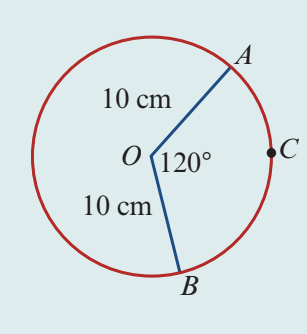
Problem: A circle has its centre at point O and a radius of 10 cm. The arc ACB forms an angle of 120° at point O. Find:
a) the area of the minor sector AOB
b) the area of the major sector AOB
Give your answers to two decimal places.
Solution:
Part a) Minor sector:
Step 1: Write down the formula.
Step 2: Substitute the known values ( and ).
Answer: The area of the minor sector is approximately 104.72 cm².
Part b) Major sector:
Step 1: Write down the formula.
Step 2: Calculate the angle for the major sector.
The major sector corresponds to the remaining angle after subtracting the minor sector's angle from a full circle:
Step 3: Substitute the values ( and ).
Answer: The area of the major sector is approximately 209.44 cm².
Exam tips
Important
Essential Exam Strategies
-
Units matter: Always include the correct units in your answer. Arc length uses the same units as the radius (e.g., cm), while sector area uses squared units (e.g., cm²).
-
Check your angle: For major sectors, remember to subtract the given angle from 360° to find the correct central angle.
-
Formula selection: Use the arc length formula when finding distance along the curve. Use the sector area formula when finding the size of the wedge-shaped region.
-
Show your working: In exam questions, write down the formula first, then substitute values, and finally calculate the answer. This helps you earn method marks even if your final answer is incorrect.
Remember!
Summary
Key Points to Remember:
-
An arc is a curved portion of a circle's circumference. Calculate its length using:
-
A sector is a wedge-shaped region of a circle. Calculate its area using:
-
The minor sector is the smaller wedge, while the major sector is the larger wedge when a circle is divided by two radii.
-
Arc length uses 180 in the denominator, sector area uses 360 in the denominator.
-
Always check your units: arc length has linear units (cm, m), sector area has squared units (cm², m²).