Pythagoras’ Theorem (VCE SSCE General Mathematics): Revision Notes
📚Revision Notes
Pythagoras' Theorem
Understanding right-angled triangles
Pythagoras' theorem shows how the three sides of a right-angled triangle are mathematically linked together. Before we explore this relationship, you need to understand two important terms.
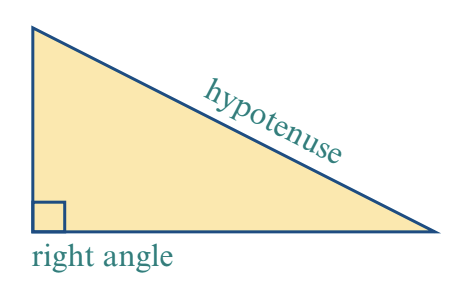
In any right-angled triangle, the longest side is called the hypotenuse. This side always sits directly opposite the right angle.
Note
The right angle itself is marked with a small square in the corner of the triangle. Being able to identify these features is essential for using Pythagoras' theorem correctly.
The theorem explained
Pythagoras' theorem states that in any right-angled triangle, if you square the lengths of the two shorter sides and add them together, you get the square of the hypotenuse.
We can write this as a formula:
where c represents the length of the hypotenuse, and a and b represent the lengths of the other two sides.
Important
The area of the square on the hypotenuse equals the combined areas of the squares on the other two sides. This visual relationship demonstrates why the theorem works.
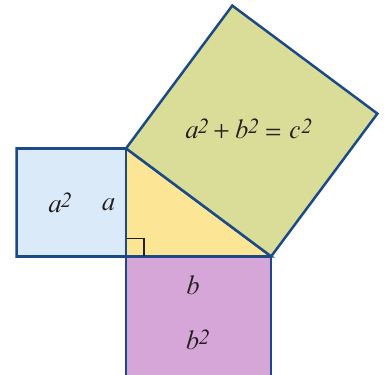
This theorem is incredibly useful because if you know the lengths of any two sides of a right-angled triangle, you can always calculate the length of the third side.
Calculating the hypotenuse
When you need to find the hypotenuse (the longest side), you can use Pythagoras' theorem directly. Here's a systematic approach:
Step 1: Write down the formula
Step 2: Substitute the known values for the two shorter sides
Step 3: Take the square root of both sides to find
Step 4: Calculate the answer and round to the required number of decimal places
Example
Worked Example: Finding the Hypotenuse
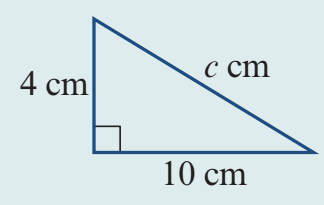
Calculate the length of the hypotenuse in the triangle below to two decimal places.
Solution:
We start with Pythagoras' theorem:
Substituting the known values ( cm and cm):
Rearranging to make the subject:
Therefore, the length of the hypotenuse is 10.77 cm (to two decimal places).
Note
Calculator Tip: Always ensure your calculator is in decimal mode when performing these calculations. This will give you the decimal answer directly rather than leaving it in surd form.
Calculating other sides
Pythagoras' theorem can be rearranged to find any side of a right-angled triangle, not just the hypotenuse. When the unknown side is one of the shorter sides, you need to rearrange the formula.
If the hypotenuse is known along with one other side, the formula becomes:
The key steps are:
Step 1: Write down Pythagoras' theorem
Step 2: Substitute the known values and the variable for the unknown side
Step 3: Rearrange to make the unknown the subject
Step 4: Calculate and round to the required accuracy
Example
Worked Example: Finding a Shorter Side
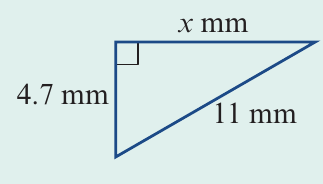
Calculate the length of the unknown side, , in the triangle below to one decimal place.
Solution:
Starting with Pythagoras' theorem:
Here, is one of the shorter sides, mm is the other shorter side, and mm is the hypotenuse. Substituting:
Rearranging to solve for :
Therefore, the length of is 9.9 mm to one decimal place.
Important
Key Difference: Notice that when finding a shorter side, we subtract the squares before taking the square root. When finding the hypotenuse, we add the squares.
Solving practical problems
Pythagoras' theorem is extremely useful for solving real-world problems involving distances, heights, and lengths. The key is to identify or draw a right-angled triangle that represents the situation.
Example
Worked Example: Helicopter Distance Problem
A helicopter hovers at a height of m above the ground and is a horizontal distance of m from a landing pad. Find the direct distance of the helicopter from the landing pad to two decimal places.
Solution:
First, we sketch a diagram showing the situation. The helicopter's height, the horizontal distance to the landing pad, and the direct distance form a right-angled triangle.
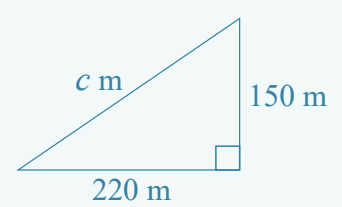
The vertical distance is m, the horizontal distance is m, and we need to find the direct distance, .
Using Pythagoras' theorem:
Therefore, the helicopter is 266.27 m from the landing pad (to two decimal places).
Note
Problem-Solving Strategy: Always draw a clear diagram for practical problems. This helps you identify which measurements correspond to which sides of the triangle.
Working in three dimensions
Pythagoras' theorem can also be applied to three-dimensional shapes like cubes, boxes, and prisms. The technique involves identifying right-angled triangles within the 3D shape and working with them one at a time.
When working with three-dimensional problems, remember that a plane is a flat surface. Right-angled triangles exist within these flat planes, even though the overall shape is three-dimensional.
Note
Strategy for 3D Problems:
- Carefully examine the 3D shape to identify the right-angled triangle containing the unknown side
- Draw this triangle separately as a flat, two-dimensional diagram
- Mark all known measurements on your triangle
- Apply Pythagoras' theorem
- If you need to find another distance, repeat the process with a different triangle
Example
Worked Example: Finding Diagonals in a Cube
The cube in the diagram has side lengths of cm. Find the length AC and AD, both to one decimal place.
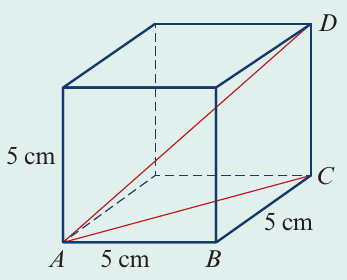
Part a) Finding AC:
First, we locate the right-angled triangle in the base of the cube that contains the diagonal AC. This is triangle ABC.
Drawing this triangle separately:
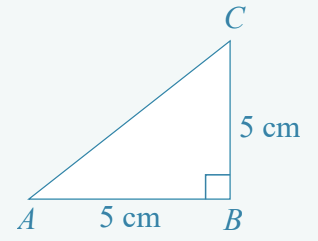
The triangle ABC has two sides of cm each (the edges of the cube). We can now apply Pythagoras' theorem:
Therefore, the length AC is 7.1 cm to one decimal place.
Part b) Finding AD:
Now we need to find the space diagonal AD. This requires us to use triangle ACD, which is vertical and contains the edge we just calculated.
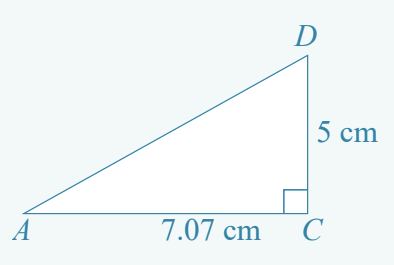
Drawing triangle ACD separately, we know:
- AC = cm (using one extra decimal place for accuracy)
- CD = cm (the vertical edge of the cube)
- AD is unknown
Applying Pythagoras' theorem:
Therefore, the length AD is 8.7 cm to one decimal place.
Note
Maintaining Accuracy in Multi-Step Problems: When solving multi-step 3D problems, keep extra decimal places in intermediate calculations to maintain accuracy. Only round your final answer to the required number of decimal places.
Quick Check Formula: For a rectangular box with dimensions , , and , the space diagonal (corner to opposite corner) is . This can be used to verify your answer.
Summary
Key Points to Remember:
- Pythagoras' theorem links the three sides of a right-angled triangle:
- The hypotenuse is always the longest side and sits opposite the right angle
- To find the hypotenuse: (add the squares, then take the square root)
- To find a shorter side: (subtract the squares, then take the square root)
- For 3D problems: identify the right-angled triangles within the shape, draw them separately, then apply Pythagoras' theorem to each triangle in turn
- Always draw clear diagrams to help identify the correct triangle and measurements