Similar Figures (VCE SSCE General Mathematics): Revision Notes
📚Revision Notes
Similar Figures
What are similar figures?
Similar shapes share the same overall form but differ in size. Think of them as enlargements or reductions of each other - like looking at the same image through different magnifications.

These three frogs are similar figures. They have identical shapes but are different sizes.
Conditions for similarity
For two polygons (closed shapes with straight sides) to be similar, they must satisfy two essential conditions:
Note
Two Conditions for Similarity:
- Corresponding angles must be equal - Each angle in one shape matches with an angle in the other shape
- Corresponding sides must be proportional - Matching sides are in the same ratio to each other
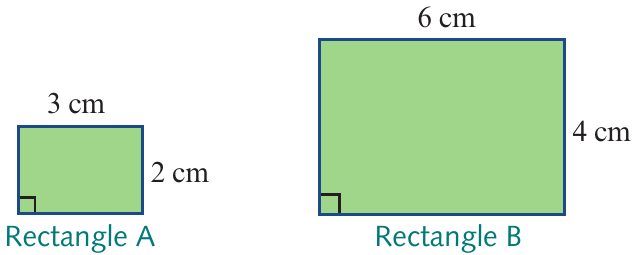
Let's examine these two rectangles. They are similar because:
- All their corresponding angles are equal (all are in both rectangles)
- Their corresponding sides are in the same ratio
For the side lengths:
- Ratio of longer sides = which simplifies to
- Ratio of shorter sides = which simplifies to
Both ratios simplify to the same value (), confirming the sides are proportional.
Important
You could also write these ratios as and (simplifying to ), as long as you maintain the same order when comparing both shapes. Ratios can also be expressed as fractions, such as for .
Scale factor for lengths
When shapes are enlarged or reduced, we use a scale factor to describe the relationship between them. This tells us how much bigger or smaller the new shape is compared to the original.
Calculating scale factor
The scale factor is calculated using this formula:
Important
Scale Factor Formula:
The numerator (top of the fraction) is always a measurement from the second shape, and the denominator (bottom) is the matching measurement from the first or original shape.
For the rectangles shown earlier:
This means Rectangle A has been scaled up by a factor of to create Rectangle B.
Scaling up and scaling down
Note
Understanding Scale Direction:
- Scaling up: Making a shape larger (scale factor greater than )
- Scaling down: Making a shape smaller (scale factor less than )
When scaling down from a larger to a smaller figure, the scale factor will always be less than one because you're dividing a smaller measurement (from the second shape) by a larger measurement (from the first shape).
Worked example: Finding scale factor of length
Example
Worked Example: Finding the Scale Factor
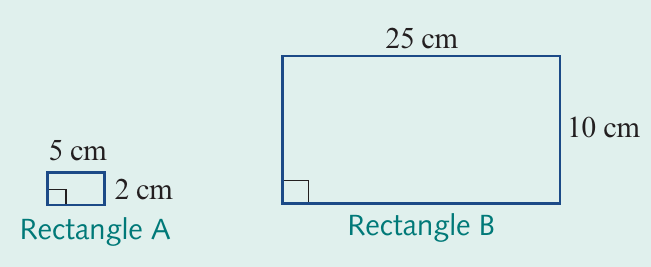
Question: The rectangles shown are similar. Find the scale factor of their side lengths.
Solution:
To find the scale factor, we divide a length from the second shape by the corresponding length from the first shape:
The scale factor of the side lengths is 5.
This tells us the small rectangle has been scaled up by a factor of to create the large rectangle.
Scale factor for areas
When you scale a shape's lengths by a factor of , something interesting happens to its area - it doesn't scale by , but by (k squared).
The relationship between length and area scale factors
Important
Critical Relationship:
When all lengths are multiplied by a scale factor of , the area is multiplied by a scale factor of .
Let's see why this works using our rectangles from earlier:
- Area of small rectangle (Rectangle A) =
- Area of large rectangle (Rectangle B) =
The length scale factor was .
For the area scale factor:
We can verify this:
So when the lengths doubled (), the area became four times larger ().
Another example with triangles
Consider two similar triangles where the length scale factor is :
- Small triangle area =
- Large triangle area =
The area scale factor should be .
Let's verify:
The area has indeed been multiplied by , confirming our rule.
Worked example: Finding scale factor of area
Continuing with the rectangles from the previous example:
Example
Worked Example: Finding the Area Scale Factor
Question: Find the scale factor of their areas.
Solution:
We already know the length scale factor is .
Therefore, the area scale factor is:
The scale factor of the areas is 25.
This means the area of the small rectangle has been scaled up by a factor of to give the area of the large rectangle.
Using similar triangles to find unknown values
One practical application of similar figures is finding unknown measurements. When two triangles are similar, we can use the proportional relationship between their sides to calculate missing lengths.
Setting up the proportion
Since corresponding sides are proportional in similar triangles, we can write:
Worked example: Finding an unknown side length
Example
Worked Example: Finding an Unknown Side Length
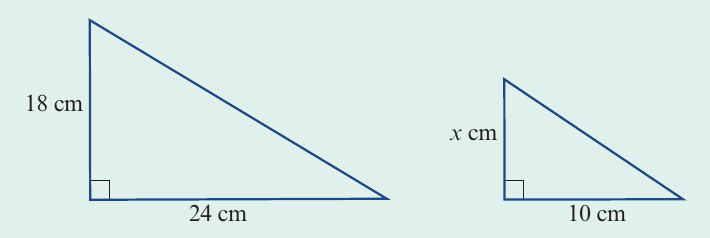
Question: The following two triangles are similar. Find the value of .
Solution:
Step 1: Since the triangles are similar, their corresponding side lengths are in the same ratio. We can write:
Step 2: Solve for by multiplying both sides by :
Step 3: Write the answer with correct units:
Key technique: When solving these problems, identify which sides correspond to each other, set up your proportion carefully, then solve the equation using algebraic methods.
Summary
Key Points to Remember:
- Similar figures have the same shape but different sizes
- Two conditions must be met for similarity:
- Corresponding angles are equal
- Corresponding sides are proportional (in the same ratio)
- Scale factor for length:
- Scale factor for area: When lengths scale by , areas scale by
- Use proportional relationships in similar triangles to find unknown measurements
- Scale factor greater than means scaling up; less than means scaling down