Similar Solids (VCE SSCE General Mathematics): Revision Notes
📚Revision Notes
Similar Solids
What are similar solids?
Two three-dimensional objects are called similar solids when they meet two important conditions. First, they must have the same shape. Second, the ratios of their corresponding linear dimensions must be equal. This means that if you compare matching measurements (like length to length, width to width, or height to height), these comparisons should all give you the same ratio.
Note
Definition: Two solids are similar if they have the same shape, and the ratios of their corresponding linear dimensions are equal.
Understanding similar solids is important because it helps us predict how changes in size affect volume. When you scale up or scale down a 3D object while keeping its shape the same, there are predictable mathematical relationships between the original and the new version.
Understanding scale factors
When working with similar solids, we use something called a scale factor, which we represent with the letter . This is the number by which we multiply all the linear dimensions of one solid to get the corresponding dimensions of the similar solid.
For example, if one cuboid has dimensions that are all three times larger than another similar cuboid, we say the scale factor .
Important
The Crucial Principle
When all linear dimensions are multiplied by a scale factor of , the volume is multiplied by a scale factor of .
This makes sense when you think about it - volume is three-dimensional, so the scaling effect is cubed. If you double all the dimensions of a solid (), the volume becomes times larger.
Cuboids
Let's look at a concrete example using cuboids (rectangular prisms). Consider two cuboids: Cuboid A has dimensions of cm length, cm width, and cm height. Cuboid B has dimensions of cm length, cm width, and cm height.
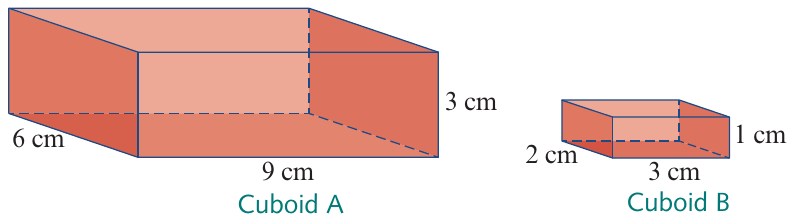
To determine if these cuboids are similar, we need to check both conditions. First, they are both cuboids, so they have the same shape. Second, we need to verify that the ratios of corresponding dimensions are equal.
Example
Worked Example: Verifying Similarity of Cuboids
Let's calculate each ratio:
Conclusion: All three ratios equal , which confirms that these cuboids are similar. The scale factor is .
Now let's examine the volumes. We can calculate the volume scale factor:
Notice that , which confirms our principle. When the linear dimensions are reduced by a scale factor of , the volume is reduced by a scale factor of .
Cylinders
The same principles apply to cylinders. Consider two cylinders: Cylinder A has a radius of cm and height of cm, while Cylinder B has a radius of cm and height of cm.
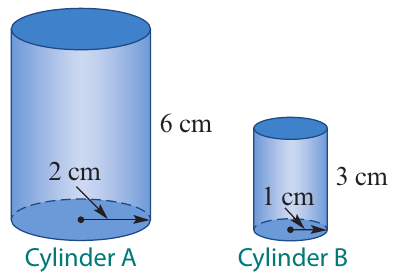
These cylinders are similar because they are both cylinders (same shape) and their corresponding dimensions have equal ratios:
The scale factor is .
For the volume comparison, we use the cylinder volume formula :
Again, we can verify: . The pattern holds true for cylinders just as it did for cuboids.
Cones
Let's examine one more example using cones. Cone A has a base radius of cm and height of cm. Cone B has a base radius of cm and height of cm.
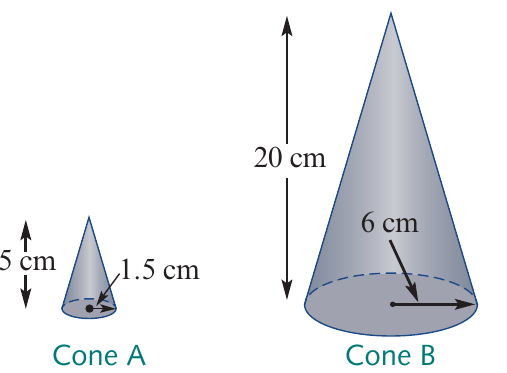
These cones are similar because they are both cones and their corresponding dimensions maintain equal ratios:
In this case, the scale factor is , meaning Cone B is an enlargement of Cone A.
For the volume comparison, we use the cone volume formula :
We can verify: . Once again, the volume scale factor is the cube of the linear scale factor.
Worked example: comparing volumes of similar solids
Let's apply what we've learned to solve a practical problem.
Example
Worked Example: Finding Volume Ratio
Problem: Two solids are similar such that the larger one has all of its dimensions three times that of the smaller solid. How many times larger is the larger solid's volume?
Solution:
When we know that all dimensions of the larger solid are three times those of the smaller solid, this means the linear scale factor .
To find how the volumes compare, we need to cube this scale factor:
Answer: The larger solid's volume is times the volume of the smaller solid.
This makes intuitive sense - when you triple all dimensions, you're increasing the volume in all three dimensions, which gives you times the original volume.
Practice question
Note
Now Try This
A solid has dimensions seven times those of a smaller similar solid. How many times is the volume of the larger solid greater than the volume of the smaller solid?
Hint: Remember that a scale factor of for lengths means a scale factor of for volumes.
Solution: times larger
Remember!
Summary
Key Points to Remember:
-
Similar solids have the same shape and equal ratios of corresponding dimensions. Both conditions must be met.
-
To verify similarity, check that all ratios of corresponding linear dimensions are equal (length to length, width to width, height to height, radius to radius, etc.).
-
The scale factor relates corresponding linear measurements between two similar solids. If you multiply all dimensions of one solid by , you get the other solid.
-
Volume relationships: When linear dimensions are multiplied by scale factor , the volume is multiplied by . This is the cubic relationship between linear scale and volume scale.
-
This principle applies to all 3D shapes - cuboids, cylinders, cones, spheres, and any other solid. The shape doesn't matter; the mathematical relationship always holds for similar solids.