Surface Area (VCE SSCE General Mathematics): Revision Notes
📚Revision Notes
Surface Area
What is surface area?
Surface area is the total area of all the outer surfaces of a three-dimensional object. To calculate it, you need to find the area of each individual surface and then add them all together.
The surface area is always measured in square units, such as , , or .
Solids with plane faces
Many solid objects, including prisms and pyramids, have flat surfaces called plane faces. When working with these shapes, it's helpful to use a net to ensure you've counted all the surfaces.
What is a net?
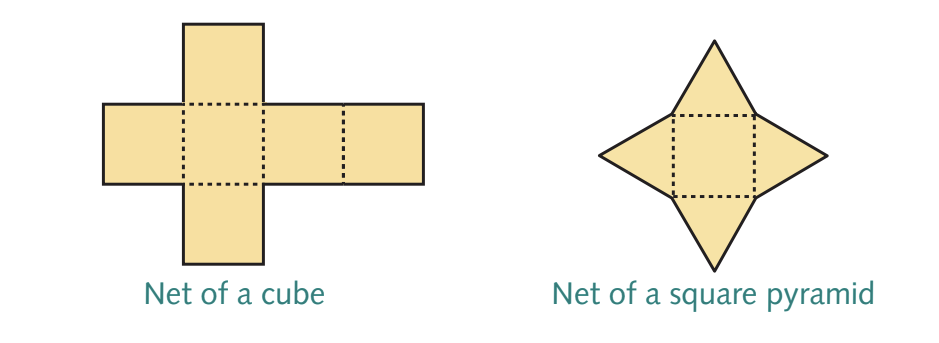
A net is a flat, two-dimensional pattern that shows all the faces of a solid shape. When you fold the net along its edges, it forms the complete three-dimensional object.
Note
Think of a net like unfolding a cardboard box to see all its sides laid flat. This visualization technique makes it much easier to identify and count all the surfaces you need to include in your surface area calculation.
For example, here are the nets of a cube and a square pyramid:
Finding the surface area of a pyramid
Let's work through an example to see how nets help us calculate surface area.
Example
Worked Example: Square-based pyramid
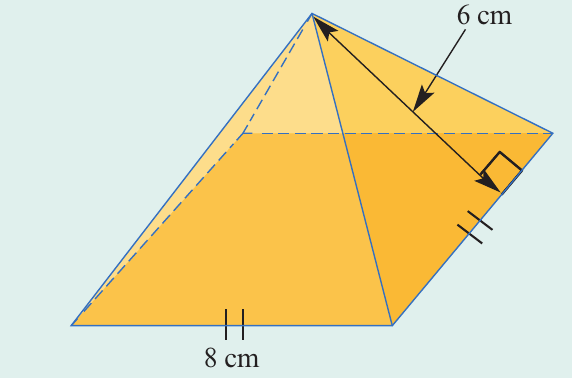
Find the surface area of this square-based pyramid:
Solution:
First, draw the net of the pyramid. This helps you visualize all the surfaces you need to include:
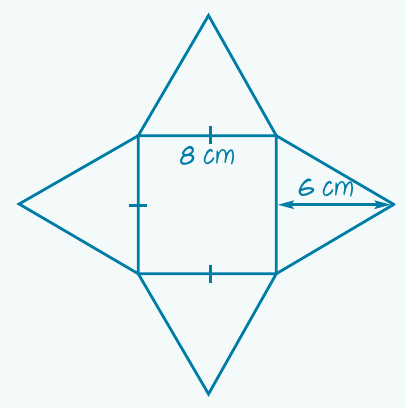
The net shows that the pyramid consists of:
- One square base (with side length cm)
- Four identical triangular faces (each with base cm and height cm)
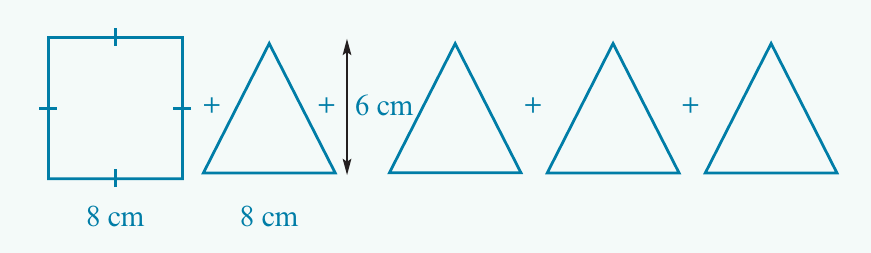
Now calculate the surface area by adding the areas of all these shapes:
Surface area = area of square + area of one triangle
The surface area of the square pyramid is 160 cm².
Note: To find the area of the square, multiply length by width (). To find the area of each triangle, use the formula , where and .
Solids with curved surfaces
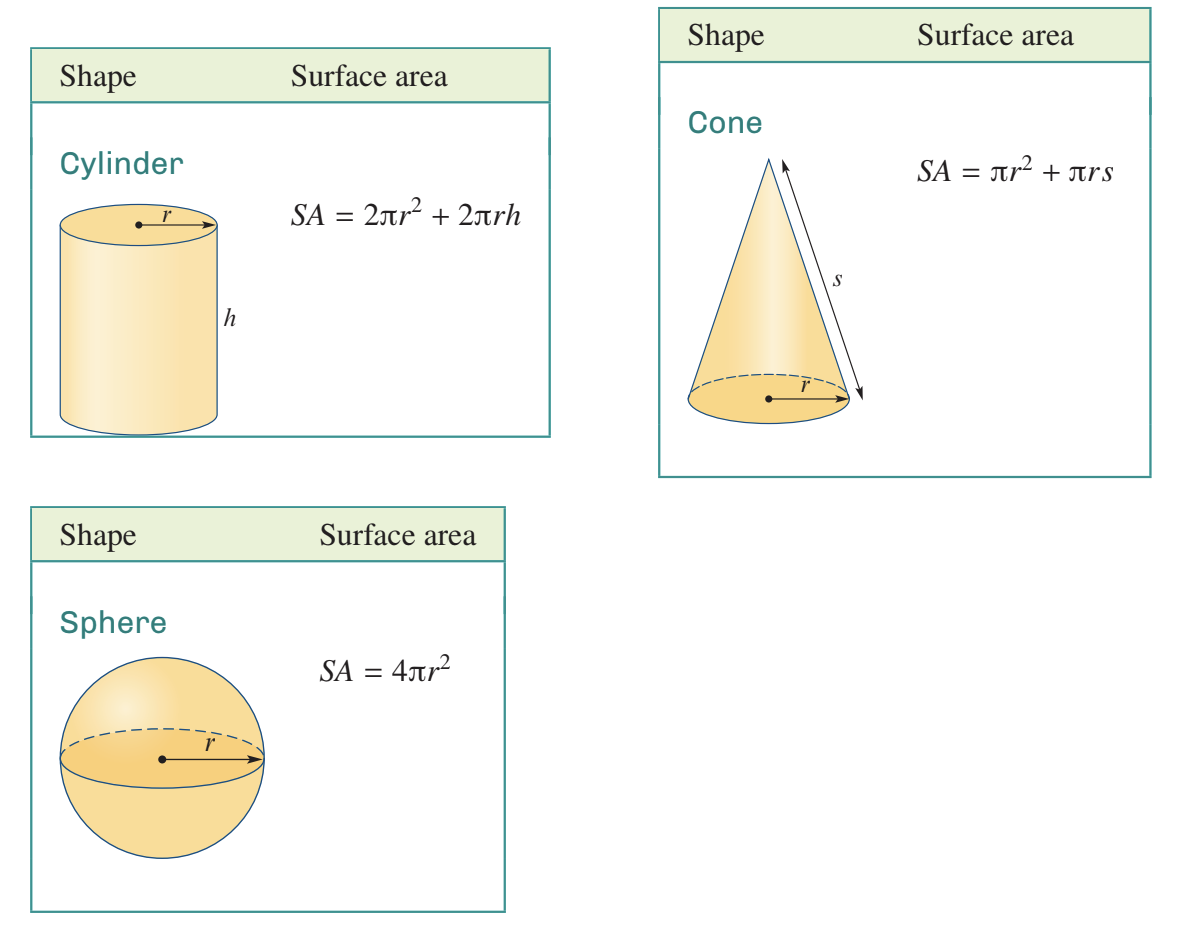
Some three-dimensional objects have curved surfaces rather than flat faces. The most common shapes with curved surfaces are cylinders, cones, and spheres. For these shapes, we use special formulas to calculate surface area.
Important
While cone surface area is sometimes studied, it is not required for the VCE exam. However, understanding cylinders and spheres is essential and will be tested.
Surface area formulas
Here are the key formulas you need to know:
Cylinder:
where is the radius and is the height.
Sphere:
where is the radius.
Cone (for reference only):
where is the radius and is the slant height.
Understanding the cylinder formula
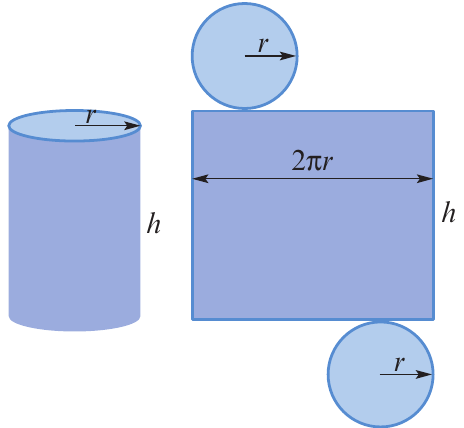
To understand where the cylinder formula comes from, we can draw its net:
Note
Breaking down the cylinder formula
When you unfold a cylinder, you get:
- Two circular ends (the top and bottom)
- One rectangle (the curved surface, when laid flat)
The rectangle's dimensions are:
- Width: (this is the circumference of the circular ends)
- Height: (the height of the cylinder)
Therefore, the total surface area is:
Cylinder example
Example
Worked Example: Find the surface area of a cylinder
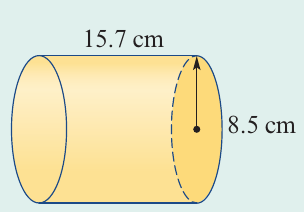
Find the surface area of this cylinder to one decimal place:
Solution:
Use the formula for the surface area of a cylinder:
Substitute and :
The surface area of the cylinder is 1292.5 cm² (to one decimal place).
Sphere example
Example
Worked Example: Find the surface area of a sphere
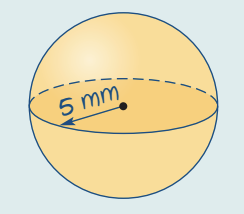
Find the surface area of a sphere with radius mm to two decimal places.
Solution:
Use the formula:
Substitute :
The surface area of the sphere is 314.16 mm² (to two decimal places).
Exam tips
Important
Essential tips for surface area calculations:
- Always draw a net when working with prisms and pyramids. This helps you identify all surfaces and avoid missing any.
- Remember to square the radius in the formulas for cylinders and spheres.
- Check that your final answer includes the correct square units.
- For cylinders, the formula has two parts: one for the circular ends () and one for the curved surface ().
- When using your calculator, use the button rather than approximations like for more accurate results.
Remember!
Summary
Key Points to Remember:
- Surface area is the total area of all outer surfaces of a 3D object, measured in square units.
- A net is a flat pattern showing all faces of a solid that can be folded to form the 3D shape.
- For pyramids, calculate the area of the base plus the areas of all triangular faces.
- For cylinders, use (two circles plus the curved surface).
- For spheres, use (simpler formula with just the radius).
- Always include appropriate square units in your final answer.