Volume (VCE SSCE General Mathematics): Revision Notes
📚Revision Notes
Volume
What is volume?
Volume measures how much three-dimensional space an object occupies. When you calculate volume, you're finding out how much room something takes up. Volume is always expressed in cubic units, such as mm³ (cubic millimetres), cm³ (cubic centimetres), or m³ (cubic metres).
Understanding cross-sections
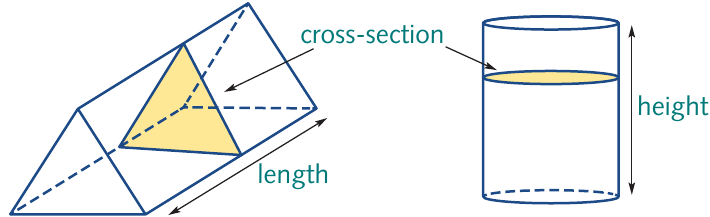
Many three-dimensional shapes, particularly prisms and cylinders, have a uniform cross-section along their entire length. A cross-section is the shape you would see if you sliced straight through the object.
Note
Think of a cross-section like slicing through a loaf of bread - the shape you see on each slice is the cross-section. For prisms and cylinders, this shape stays the same all the way through the object.
For any prism or cylinder, you can find the volume using this fundamental principle:
This means you first work out the area of the shape's cross-section, then multiply it by how long or tall the shape is.
Volume formulas for common shapes
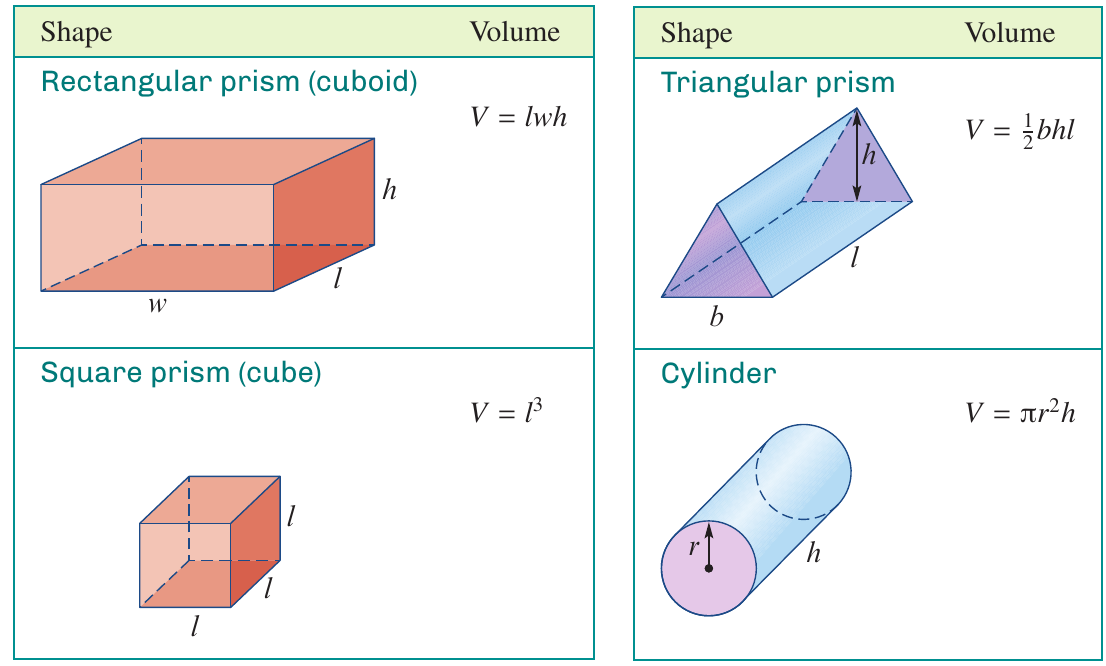
Different three-dimensional shapes require different formulas to calculate their volume. Let's look at the most common ones.
Rectangular prism (cuboid)
A rectangular prism, also called a cuboid, is a box-shaped object with rectangular faces. Think of a shoebox or a brick.
where:
- = length
- = width
- = height
Square prism (cube)
A cube is a special rectangular prism where all edges are the same length. Think of a dice or a Rubik's cube.
where:
- = length of one edge
This formula is simpler because you're just multiplying the same measurement three times.
Triangular prism
A triangular prism has a triangular cross-section. Think of a Toblerone chocolate bar or a camping tent.
where:
- = base of the triangle
- = height of the triangle
- = length of the prism
Cylinder
A cylinder is like a circular prism. Think of a tin can or a pipe.
where:
- = radius of the circular base
- = height of the cylinder
Important
Exam tip: Make sure you're using the radius, not the diameter. If you're given the diameter, divide it by 2 to get the radius. This is one of the most common mistakes students make!
Worked example: Finding the volume of a cuboid
Let's work through calculating the volume of a cuboid step by step.
Example
Worked Example: Volume of a Cuboid
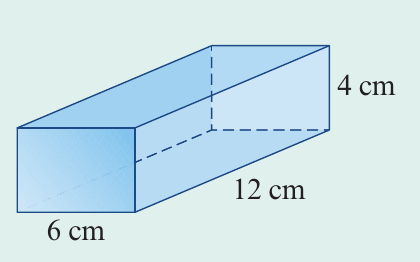
Question: Find the volume of a cuboid with length 12 cm, width 6 cm, and height 4 cm.
Solution:
We start with the formula for a rectangular prism:
Substitute the given values:
Calculate the result:
Answer: The volume of the cuboid is 288 cm³.
Note
Always include the correct units in your final answer. Since we measured in centimetres, our volume is in cubic centimetres (cm³).
Worked example: Finding the volume of a cylinder
Cylinders require the use of π in their volume formula.
Example
Worked Example: Volume of a Cylinder
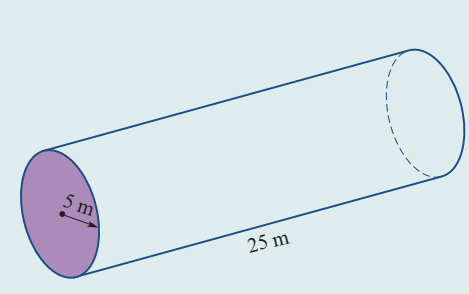
Question: Find the volume of a cylinder with radius 5 m and height 25 m. Give your answer to two decimal places.
Solution:
Start with the cylinder volume formula:
Substitute and :
Round to two decimal places:
Answer: The volume of the cylinder is 1963.50 m³ to two decimal places.
Finding the volume of composite shapes
Sometimes you'll encounter shapes made up of more than one basic form. For these composite shapes, you need to break the problem down into steps.
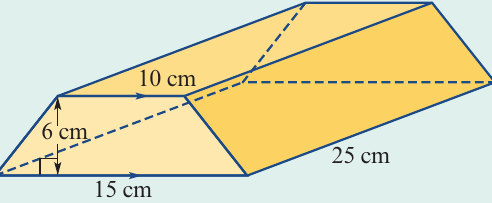
Example
Worked Example: Volume of a Composite Shape
Question: Find the volume of the three-dimensional object shown above.
Solution:
Strategy: Find the area of the cross-section (which is a trapezium), then multiply by the length.
First, calculate the area of the trapezoidal cross-section using:
Substitute , , and :
Now multiply the cross-sectional area by the length of the shape:
Answer: The volume of the shape is 1875 cm³.
Volume of a cone
A cone is a three-dimensional shape that tapers from a circular base to a point (called the apex or vertex).
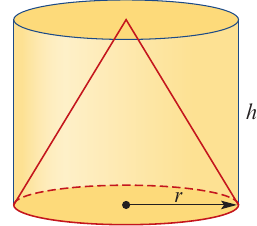
Note
An interesting property of cones is that they occupy exactly one-third of the volume of a cylinder with the same base and height. This is why the formula has in it!
This gives us the formula:
where:
- = radius of the circular base
- = perpendicular height from base to apex
A right circular cone is one where a line from the centre of the base to the apex is perpendicular to the base. This is the most common type of cone you'll work with.
Example
Worked Example: Volume of a Cone
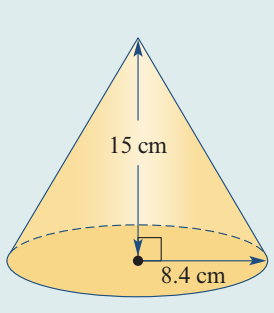
Question: Find the volume of a cone with radius 8.4 cm and height 15 cm. Give your answer to two decimal places.
Solution:
Use the cone volume formula:
Substitute and :
Round to two decimal places:
Answer: The volume of the cone is 1108.35 cm³ to two decimal places.
Volume of a sphere
A sphere is a perfectly round three-dimensional object, like a ball. Every point on its surface is the same distance from its centre.
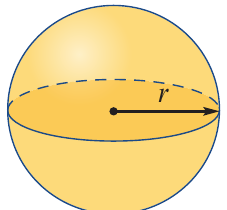
The volume of a sphere with radius is:
where:
- = radius of the sphere
Example
Worked Example: Volume of a Sphere
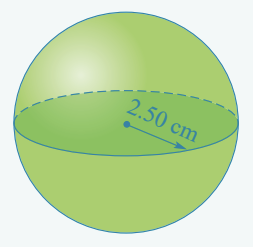
Question: Find the volume of a sphere with radius 2.50 cm. Give your answer to two decimal places.
Solution:
Use the sphere volume formula:
Substitute :
Round to two decimal places:
Answer: The volume of the sphere is 65.45 cm³.
Capacity
While volume measures the space an object occupies, capacity measures the amount of substance (usually liquid) that an object can hold.
Important
Understanding the Difference:
Volume tells you about the space itself, while capacity tells you how much you can put in that space. They're related but describe different things:
- A cube measuring 1 metre on each side has a volume of 1 cubic metre (m³) and can hold 1000 litres (L) of water - that's its capacity
- A bucket with a volume of 7000 cm³ has a capacity of 7000 mL (or 7 L)
Volume to capacity conversions
To convert between volume and capacity, use these key relationships:
Note
These conversions are essential when solving real-world problems involving containers and liquids. Memorize these relationships - they come up frequently in exams!
Example
Worked Example: Finding Capacity
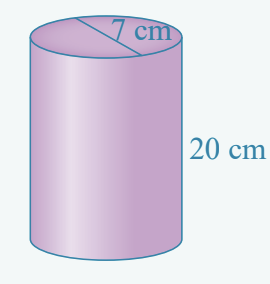
Question: A cylindrical drink container has a height of 20 cm and a diameter of 7 cm. How many litres of water can it hold? Give your answer to two decimal places.
Solution:
First, find the volume of the cylinder. Since we're given the diameter (7 cm), we need the radius:
Now use the cylinder volume formula:
The volume is approximately 769.69 cm³.
Now convert to litres. Since 1000 cm³ = 1 L:
Round to two decimal places:
Answer: The cylinder has a capacity of 0.77 litres to two decimal places.
Summary of volume formulas
Here's a quick reference table of all the volume formulas you need to know:
| Shape | Volume Formula | Where |
|---|---|---|
| Rectangular prism | = length, = width, = height | |
| Triangular prism | = base, = height, = length | |
| Cylinder | = radius, = height | |
| Cone | = radius of base, = height | |
| Sphere | = radius |
Summary
Key Points to Remember:
- Volume measures the three-dimensional space occupied by an object and is always expressed in cubic units (mm³, cm³, m³)
- For prisms and cylinders, volume equals the area of the cross-section multiplied by the height or length
- A cone's volume is exactly one-third the volume of a cylinder with the same base and height
- Capacity measures how much substance an object can hold, typically expressed in litres or millilitres
- Key conversions: 1 m³ = 1000 L, 1 cm³ = 1 mL, and 1000 cm³ = 1 L
- Always check whether you're given radius or diameter - remember to halve the diameter if you need the radius
- Include the correct units in your final answer and round to the specified number of decimal places